Friday, August 14, 2015

Russia, NATO Preparing For War? Think Tank Suggests Military Exercises Make Confrontation More Likely


By @KukilBora on
NATO-warship
The changed profile of combat exercises suggests that Russia and NATO are heading for a real military confrontation, according to a report. In the picture, NATO's Dynamic Mongoose anti-submarine exercise in the North Sea off the coast of Norway on May 4, 2015. Reuters
Deteriorating ties between Russia and the West over the last 18 months could lead to a potential military confrontation between the Kremlin and NATO, the European Leadership Network (ELN), a London-based think tank, said in a report Wednesday. Citing two major military exercises conducted this year, the think tank warned that recent developments by both sides make a real conflict more likely.
According to ELN, Russia conducted a massive “snap exercise” in March, involving as many as 80,000 military personnel. NATO also held its Allied Shield drills in June, involving 5,000 personnel from 19 member states and three partner states. ELN said that Russia and NATO have significantly increased scope and size of their military exercises in the Euro-Atlantic area since conflict in eastern Ukraine began.
“Both exercises show that each side is training with the other side’s capabilities and most likely war plans in mind,” ELN said in the report. “Russia is preparing for a conflict with NATO, and NATO is preparing for a possible confrontation with Russia.”
Russia-military-exercise Men wearing military uniforms ride atop an armored personnel carrier (APC) during exercises at the Kuzminsky military training ground near the Russian-Ukrainian border in Rostov region, Russia on May 25, 2015.  Reuters
The report stopped short of suggesting that the leadership of either side has made an explicit decision to go to war, or a military conflict between Russia and NATO is inevitable. However, it said that the "changed profile" of combat exercises is a “fact” that contributes to the growing geopolitical tensions in the region.
“These tensions are further aggravated and elevated into a sense of unpredictability when the exercises are not pre-notified or publicly announced beforehand, as is apparently the case with a number of Russian exercises,” ELN said in the report.
The think tank offered four recommendations to alleviate increasing tensions, including boosting Russia-NATO communication, utilizing channels under the Organization for Security and Co-operation in Europe, reassessing the benefits and dangers of intensified exercising in border areas and forming a new treaty to limit deployment of specific weapons.
Wednesday’s report comes only weeks after Russia revised its maritime doctrine to boost its navy’s strategic positions on the Black Sea. The amended doctrine was also expected to help the country’s military maintain a strong presence in the Atlantic Ocean and the Mediterranean Sea. Officials also said that the move was aimed at countering NATO’s “inadmissible expansion” near the country’s western borders.

Migrant problem, radical answer

Mail & Guardian

Teldah Mawarire
Creating a country for refugees may be a wild idea but solutions must be found for the desperate.
Homeless: The flood of refugees in many parts of the world reflect dire situations in their home countries. (AFP)
COMMENT
The world has a migrant and refugee crisis and there is no solution. The European Union, Greece and Italy in particular, is grappling with thousands of desperate arrivals on its shores from Africa and the Middle East.
As always happens when there is no solution, the blame game is quick to be played. Europe, it is argued, is the author of many of the crises that migrants are fleeing from, a case in point being the Nato bombing of Libya and the country’s descent into chaos. African countries stand accused of mismanaging their resources and allowing ethnic wars to drive millions out of their homes to seek refuge in distant lands.
ADVERTISING
Whatever the cause, tens of hundreds of lives continue to be lost in the unforgiving Mediterranean Sea. Migrants will continue to head out into the big blue in the hope of reaching the promised land. The possibility of drowning is not a deterrent. For many, the lives they are leaving mean certain death.
The allure of possibly crossing, of making it to London’s streets, that lawmakers there recently warned are not paved with gold, makes many take the risk. That strong warning from MPs will not stop migrants. They will keep coming. Stationing majestic ships on the sea will not stop the tide. They will come in droves. They will keep coming from Somalia, Sudan, Libya, Syria, Turkey and Eritrea and many other lands for as long as they are pushed.
Last week, a boat off the coast of Libya sent out distress signals. The rescue arrived too late. An estimated 200 people lost their lives. No one really knows the number. There is no record of those boarding the illegal boats that are sometimes just rafts. In April a boat, estimated to have had 800 migrants on board, went down. Only 28 survived the horror.
The International Organisation for Migration estimates that 2 000 have died at sea this year alone.
Migrants are also not deterred by the EU stopping its support for Operation Mare Nostrum, an Italian rescue programme that is credited with saving 100 000 lives last year. The EU argues that the rescue effort actually encouraged migrants to take a chance. That programme was stopped last October. Nothing will deter those in search of a better life.
The European plan to relocate 16 000 migrants over a two-year period is too little. So far this year alone, 124 000 migrants have arrived on Greece’s shores. Britain won’t participate and Hungary may roll out a 4m-high fence along its borders. The crisis is international, and it needs an international approach.
Refugee Nation Last week, property mogul Jason Buzi suggested that land be found and a state be created for migrants. “Refugee Nation” he called it.
It is a bizarre-sounding idea – and not a new one – but in the face of few solutions, perhaps the time has come for Africa to debate this from an African perspective.
Those advocating for such a state suggest that land that is not in use be pooled together perhaps by nations in a region sharing a common border and that refugees be allowed to be a start-up state.
It’s an outrageous and complex business to think about starting a state from nothing. It also borders dangerously on treating refugees as the “other”. Separating them from “normal” others would perhaps make them objects of unending pity and perhaps even targets of extreme forms of “othering” such as violence.
The first prize in dealing with the flood of refugees would be ending the crisis refugees are emanating from. This is easier said than done because most of the states at war have degenerated into failed states where finding resolutions and roads to recovery will be protracted and painful, taking decades and, in some cases, may not be possible at all.
The most basic problem about a new refugee state is that refugees are not stateless people. They belong somewhere. They left their homes, their support structures, their land, and they therefore cannot be treated as “new citizens” of nowhere and be given a new national identity because they already have an identity. Placing refugees in a new state could in effect strip them of their citizenship unless a framework is put up to prevent that loss. But a nation-state needs citizens.
How would refugees be moved? Refugees have rights and freedom of choice, just as anyone else has, and they should not be forced to move.
It is hard to conceive how nationhood will be built in the new state. In spite of attempts to put refugees in single camps, problems of integration arise because cultures are as diverse as the north is from the south.
Africa is not a country; African refugees cannot be lumped easily into a new state. Already many a war on the continent can be understood to come down to ethnic tensions. The ability to create a state with so many ethnic differences united only by displacement will be an enormous challenge – but an opportunity, too, to show ethnic integration is possible, just as it happens already in many African countries.
Although refugees and migrants around the world have shown resilience and often a willingness to work for below the minimum wage, this is generally because they are there illegally and this status keeps them away from trade union activities. A new state can be an opportunity to give migrants a space where they are free from unfair labour practices and abuse.
However, this will mean the new nation state has to be supported financially. Without economic stability and a financial attraction, refugees will simply keep pouring into Europe. These are bigger issues for regional unions such as the African Union and the EU to explore.
But perhaps a refugee state offers displaced African peoples a chance to stay on the continent. Many Africans are deeply rooted in Africa, the land of their ancestors. Those who leave only do so because there is often no other choice.
Many who make it to Europe feel alienated there and would rather be in another African state – even one that is not so rich but offers the opportunity for reasonable economic activities and is a peaceful place where they can raise their children.
On last week’s migrant boat on the Mediterranean that killed more than 200 people, a man and his wife risked drowning their 19-month-old baby. All they wanted was a peaceful place in which to raise their daughter.
Massive challengesA new state also brings massive challenges of how to stay stable in the long run in terms of its own policies for continuing migration. No state has a totally open-door policy as a result of rising security concerns around terrorism. But it would be hypocritical for a refugee nation to shut out other refugees. A middle-of-the-road approach needs to be explored.
People under threat in death zones will continue to move in search of better livelihoods. The creation of a refugee state is a radical idea that raises many questions on the treatment of refugees. Other countries have employed a policy of integration, such as in South Africa where there are no refugee camps but rather refugees fend for themselves and integrate into society.
But it must be confronted that in some places the policy of integration has not always worked, as shown recently by xenophobic attacks in South Africa. Refugees the world over complain that one major challenge is they are always treated as the “other” not just by citizens but also by state institutions. The failure of integration is evident in Europe, with a sizeable number of countries openly refusing to accommodate more migrants.
Integration should be continued and encouraged where it has worked. But its failure cannot not be ignored.
It is the duty of civil society to begin a new radical debate and canvass governments and regional bodies about a sustainable plan that is done in a human rights framework.
The growing numbers of those seeking refuge in other nations dictates that debate has never been more urgent.
Teldah Mawarire is the Mail & Guardian’s Africa Editor

Russian Navy Holds Exercise in Mediterranean Sea

Ships of the Black Sea Fleet

© Sputnik/ Vasiliy Batanov
Military & Intelligence
Get short URL
034950

During an exercise in the Mediterranean Sea, ships of the Russian Black Sea Fleet carried out a number of tasks, including protecting convoys and repelling simulated enemy attacks.

MOSCOW (Sputnik) — Russia's Black Sea Fleet has held an exercise in the Mediterranean Sea, a spokesman for the fleet said Friday. "During the exercise, Black Sea Fleet ships worked on protecting convoys, carried out tasks to repel simulated enemy air attacks from various heights, [practiced] combat operations against surface vessels," Capt. 1st Rank Vyacheslav Trukhachev told reporters.
Earlier this summer, Russian and Egyptian Navies carried out joint military exercises involving F-16 fighter jets in the Mediterranean Sea. Russia and China also carried out Mediterranean drills earlier this year.
According to the Russian Navy, up to 10 Russian warships and support vessels are permanently deployed in the Mediterranean Sea.

Wednesday, August 12, 2015

Greek President Pavlopoulos calls for an EU summit on migration


First entry: 12 August 2015 - 18:02 Athens, 15:02 GMT
Last update: 18:02 Athens, 15:02 GMTPolitics
Greek President Pavlopoulos calls for an EU summit on migration
Greek President Prokopis Pavlopoulos called for an extraordinary EU summit for the migration during his meeting with leader of Potami  Stavros Theodorakis.
"It is strange that Europe and the UN have not yet taken decisions on the condition in the Middle East and particularly in Syria" said Pavlopoulos noting that as long as the war continues the phenomenon will intensify.
"Foreign policy from Europe and from the international community and particularly from the UN is needed" he said.
According to Pavlopoulos there must be an EU Summit that will decide what Europe’s obligations are, adding that Greece can't handle the issue alone: "It is a European and international issue", he said.
On his part, Theodorakis said that migration is a major national issue noting that "even if we did everything right, we would not be able to face this huge migration and refugee flows".
Source: ANA-MPA

Albanian party threatens to organize fierce unrest


The Self-Determination Movement has threatened to organize the most fierce unrest so far and blockades of all institutions in Kosovo.
Source: Tanjug
(Beta, file)
(Beta, file)
This opposition party in the Kosovo assembly announced it would do so if Pristina "accepts to form a community of Serb municipalities."
The party's general secretary, Dardan Molicaj, told a KTV Interactive broadcast that these would be "the most radical protests ever seen" that will fall short only of war.

"All that will be missing will be war. Public and private institutions will be blocked. Nothing will function in Kosovo," Molicaj said, revealing the Self-Determination plan if Pristina agrees to set up the community, that is envisaged in the Brussels agreement.

He specified that this "most radical activity of Self-Determination that Kosovo has never seen" will mean the party is ready to "block everything that functions in Kosovo - not only public institutions, but citizens' lives as well."

"The Self-Determination will undertake the most radical actions you have ever seen. Not war - but everything else that is not war will be undertaken. We will block the lives of citizens and institutions," Pristina media quote Molicaj as saying.

Croatia can't confirm beheading of citizen; won't fight IS


Croatian PM Zoran Milanovic said on Wednesday afternoon he was unable to confirm that a Croatian citizen held by Islamic State in Egypt had been killed.
Source: B92
Zoran Milanovic addresses reporters in Zagreb on Wednesday (Tanjug/AP)
Earlier in the day, the extremist organization posted images on the internet purporting to show that Tomislav Salopek had been beheaded.
Milanovic called an extraordinary news conference in Zagreb today, and said:

"What we see looks terrible. We may not have confirmation even in the coming days."

He added that Croatia, along with officials and representatives of other states, "would not stop looking for Salopek for as long as there is a glimmer of hope left."

"I'm afraid that - although I can't say with complete certainty - that for the first time what has unfortunately been happening to others has happened to a Croatian citizen," Milanovic told reporters.

"Croatia will not participate in combat activities against the so-called Islamic State," the Croatian prime minister also said.

He confirmed that attempts have been made already today to confirm the authenticity of the image claiming to show the execution of the ho

Statement by NATO Deputy Spokesperson Carmen Romero on NATO military exercises


  • 12 Aug. 2015
NATO military exercises are intended to enhance security and stability in Europe. All NATO military activities are proportionate, defensive, and fully in line with our international commitments.
NATO flag flying at NATO Headquarters Brussels.
Today's report by the European Leadership Network misleadingly puts NATO and Russian exercises on par. In fact, the Russian Ministry of Defence has announced over 4000 exercises for this year, which is over 10 times more than what NATO and Allies have planned in the same timeframe.
Moreover, Russia has incorporated nuclear and nuclear capable forces in its recent exercises.
NATO has made repeatedly clear that we not seek confrontation with Russia. For over two decades, we have tried to build a cooperative relationship with Russia.  But Russia has changed borders by force, continues to support separatists in Ukraine and threatens to base nuclear missiles close to Alliance borders.
The scale and scope of Russia’s exercises are increasing tensions, rather than helping to de-escalate them. Russia is deliberately avoiding military transparency and predictability.  It has deliberately circumvented the requirements for notification and observation of exercises under the OSCE Vienna Document and has made routine use of the “exception” for large-scale, no-notice “snap” exercises. These exercises are part of a more aggressive Russian military doctrine, dangerous political rhetoric, increased military deployments and the illegal and illegitimate annexation of Crimea. 
In response, NATO has increased its presence in the eastern part of our Alliance, in order to enhance collective defence.  This is our core task as a defensive Alliance.
NATO has already taken new initiatives to keep political and military channels of communication with Russia open. NATO military exercises are open to observers, including from Russia.  In fact, all NATO exercises are announced months in advance and published on the NATO website. Russia has consistently refused all NATO offers for greater military transparency, dating back to well before the current crisis.
NATO fully supports arms control agreements which build trust and confidence. It is Russia which is obstructing key agreements like the Conventional Forces in Europe Treaty, the Open Skies Treaty, and the Vienna Document.
Russia’s unpredictable and surprise military maneuvers contribute to instability. We support calls for more transparency and predictability on military activities. NATO’s biggest exercise in more than a decade, Trident Juncture 2015, will take place in autumn in Spain, Italy and Portugal. It was announced one year in advance and all OSCE Participating States will be invited to send observers.

Tuesday, August 11, 2015

Tsipras seeks parliament approval of bailout by Thursday


First entry: 11 August 2015 - 19:18 Athens, 16:18 GMT
Last update: 11 August 2015 19:18 Athens, 16:18 GMTPolitics
Tsipras seeks parliament approval of bailout by Thursday
Greek leader Alexis Tsipras has called for an emergency session of parliament to vote on the new bailout deal Thursday.
In a letter sent to the parliament speaker, Tsipras said he wanted to have the draft law on the bailout submitted later on Tuesday so it can be distributed to lawmakers and then discussed in parliamentary committee on Wednesday before being voted on Thursday.
"The crucial nature of the situation requires the immediate convening of parliament to proceed with the deal's approval and allow the disbursement of the first installment," Tsipras said in the letter published by his government.
Greece is eager to get the deal ratified by parliament in time for euro zone finance ministers to give their approval by Friday, so that aid can be disbursed in time for a debt payment to the ECB on Aug.20.

Greece, German defence industry's best client - Handelsblatt


First entry: 10 August 2015 - 14:31 Athens, 11:31 GMT
Last update: 11 August 2015 23:45 Athens, 20:45 GMTPolitics
Greece, German defence industry's best client - Handelsblatt
Heavy tanks rolled past the parliament building in Athens. Fighter jets flew over the Acropolis and painted white vapor trails across the sky. It was March 25, a Greek national holiday, and the country’s military was putting on a big parade, meant to recall the uprising against the Ottomans in 1821.
Millions of euros’ worth of military equipment rumbled through the city, including the pride of the Greek military: German Leopard 2 tanks, known worldwide as the best of their kind – and the most expensive.
In recent decades, the Greek government has not skimped on its military, which has played an important, even dominant role in the country’s post-war history. Measured against GDP, no E.U. member country has spent more on new weapons over the past few years. And no country has kept a bigger army per head of the population.
The Bonn International Center for Conversion has listed Greece among the most militarized countries since 1990. It was ranked ninth in 2014, ahead of all other NATO members – despite Greece’s financial crisis.
“Athens’ high arms expenditures and extensive weapons purchases over the past years have contributed to the desolate budget situation,” according to BICC.
The figures show that Greece invested nearly €6 billion ($6.6 billion) in its military in 2000. Eight years later, the figure was €8.6 billion. In 2009, Europe’s NATO member countries spent an average of 1.7 percent of their GDPs on defense – Greece was at 3.1 percent. The country was among the world’s five biggest arms importers between 2005 and 2009, according to the Stockholm International Peace Research Institute.
In May 2010, Greece had to be saved from financial ruin, and eventually received a loan package of hundreds of billions of euros. The government used some of this money to buy more weapons.
Now, even more cash is on the table. The Greek government, led by Alexis Tsipras, has accepted a number of conditions connected to the deal. Greece must save money. The value-added tax has been increased, pension payments are to decrease, state-owned companies are to be privatized, and corruption weeded out. But only marginal consideration has been given to the country’s huge military expenditures. The army remains sacrosanct.
Politicians and others in Germany have often harshly criticized Mr. Tsipras. But the critics seem to forget that debt-ridden Greece until recently was ordering armaments worth billions of euros from Germany. Between 2001 and 2010, Greece was the most important customer for the German defense industry. During this period, Greece bought 15 percent of all of Germany’s exports, SIPRI estimates.
Greece’s armed forces have nearly 1,000 German-developed model Leopard 1 and 2 combat tanks. Including models from other countries, Greece has 1,622 tanks. The German military has 240 Leopard tanks in service. (That number is to increase by around 90 because of the crisis in Ukraine.) While the German armed forces have been shrinking and phasing out military equipment for years, Greece has gone the other way. No other E.U. country has more combat tanks today.
In 2003, Greece’s defense ministry ordered 170 Leopard tanks from Germany’s Krauss-Maffei Wegmann company. The Munich-based company is said to have made €1.7 billion from the deal.
Germany’s biggest defense company, Rheinmetall, has also had business results from Greece. The Düsseldorf-based company provided fire-command systems for the Leopards. The company sold tank ammunition worth €52 million to Greece last year. Previously, a Rheinmetall subsidiary sold an air defense system to the Greek military. The deal was riddled with bribe money, and the German firm recently had to cough up fines and skim excess profits to the order of €37 million.
German and Greek prosecutors are also investigating employees from companies such as Krauss-Maffei Wegmann and Atlas Elektronik. A top official in Athens has admitted to having pocketed millions from representatives of German firms. A former Greek defense minister had already been handed a long prison sentence for corruption.
Greece, which has been purchasing a good share of its armaments abroad since World War II, has a long history of importing weapons from Germany. The country’s own arms industry has been of no great significance.
At the beginning of the Cold War, the majority of Greece’s tanks and aircraft came from the United States. Greece joined NATO in 1952, and U.S. experts helped to build up the country’s armed forces. In the 1960s, friction flared between Greece and fellow NATO member Turkey. The government in Athens aimed to achieve “military balance” with its larger neighbor, in part by buying weapons from West Germany.
Conflict flamed up again and again between the two arch-enemies. Greece instigated a war over the island of Crete. In 1974, it was about Cyprus, which the Greek military dictatorship had wanted to annex. Instead, Turkey invaded the predominantly Turkish north of Cyprus, and war was just barely averted. The two countries had an arms race, and German weapons manufacturers supplied both sides.

Serbian and Albanian PMs to take part in TV debate


Serbian and Albanian prime ministers Aleksandar Vucic and Edi Rama will "confront their positions" during a TV debate later this month.
Source: B92, Tanjug
(Tanjug, file)
(Tanjug, file)
The 60-minute broadcast will be staged by the regional production network "Okruzenje", ran by the Thessaloniki-based NGO Center for Democracy and Reconciliation in Southeastern Europe (CDRSEE) and the European Fund for the Balkans (EFB).
The debate will be taped in Vienna, Austria, on August 27, where Vucic and Rama will travel for the Second Conference on the Western Balkans.

According to announcements, it will be broadcast "on national televisions of all regional countries: Slovenia, Croatia, Bosnia-Herzegovina and the Serb Republic, Serbia with Kosovo, Montenegro, Macedonia, and Albania."

Serbia's state broadcaster RTS will show the debate on August 31, while the Tanjug news agency will do the same "immediately after."

Goran Svilanovic, secretary-general of the Council for Regional Cooperation, will take part.

The Vienna summit is a part of the Berlin Initiative established last year by German Chancellor Angela Merkel.

The meeting in Vienna will be dedicated to energy, transport, science and education projects, and will also address last year's initiative to set up the Association of Western Balkans Youth.

Aleksandar Vucic has announced he will officially present his initiative to establish a joint remembrance day in the region at the summit.

Vucic and Rama met during the past year first in Belgrade and then in Tirana, "breaking the ice between the two countries" in this manner.

According to the announcement on Monday, the debate will be "a great opportunity to openly speak about joint interests and problems that prevent their realization."

Saturday, August 8, 2015

Kosovo: Jailed Serb politician starts hunger strike


Civic Initiative (GI) SDP leader Oliver Ivanovic, who is detained in a Kosovska Mitrovica prison, on Friday started a hunger strike.
Source: Tanjug
An August, 2014, file photo of Ivanovic being brough to the court (Beta)
The Serb politician from northern Kosovo, who is on trial accused of war crimes, is demanding to be released pending the outcome of the process.
He was arrested in late January 2014 and has been kept in jail since. The first time he decided to embark on a hunger strike was when he demanded to be transferred from Pristina to a prison in Kosovska Mitrovica.

Ivanovic decided to go on a hunger strike now after an EULEX panel of judges on Thursday extended his detention until October 6.

His wife, Milena Popovic-Ivanovic, told Tanjug that her husband made the decision after reflecting on it for a long time, and added that he "simply cannot understand the injustice that is happening to him."

"He decided to start a hunger strike because he thinks it's the only way to draw attention to himself. His health is now good, he expects the doctors that will examine him, and he will be under medical supervision," Popovic-Ivanovic said.

His party has also confirmed the news, saying that Ivanovic wants "to point out to the inhumane and unjust stance EULEX has toward him."

A statement issued by the GI SDP said that Ivanovic made the decision "because this politically rigged trial has, after hearing 47 witnesses, arrived to a point when legal arguments no longer exist, instead there are only political ones, that we have been pointing out to since the beginning."

The statement added that "aware of the risks for his health, but also of the scorn shown for his rights, his family, friends and political associates support his decision."

Ivanovic is accused of committing war crimes against civilians in April 1999 and February 2000 when he allegedly incited to murder of several ethnic Albanians in Kosovska Mitrovica.

Four other Serbs are accused in this case. All five have pleaded not guilty.

(PKK) has led to the death of a police officer and heavy injuries sustained by two others, local media reported Saturday.

Southeast Turkey Kurdish Militant Attack Kills Police Officer - Reports

© AFP 2015/ AHMAD AL-RUBAYE
Middle East
Get short URL
017100

An armed attack attributed to the Kurdistan Workers Party

MOSCOW (Sputnik) – The officer died in the hospital in the Midyat District, Mardin Province close to the northeast Syrian border, according to Today’s Zaman.
The region was previously rocked by a PKK attack last week, when a mine blast and a gunfire exchange killed a soldier and injured eight others. The soldiers had arrived in the district town of Gelinkaya to secure the area.
Turkey designates PKK a terrorist organization and is carrying out a military operation against it in northern Iraq, breaking a two-year truce with the group.
Ankara has also opened a simultaneous second front against the Islamic State extremist group in northern Syria following a series of attacks on Turkish soil.
According to the Turkish daily, a large-scale operation to find the gunmen is ongoing in the region.

Croatia sends protest note over Seselj and Nikolic


Croatia's Ministry of Foreign and European Affairs has asked Serbia to "sanction as soon as possible" those who on Thursday burned Croatian flags.
Source: B92
(Thinkstock)
(Thinkstock)
The incident happened in front of the Croatian embassy in Belgrade, when SRS leader Vojislav Seselj set the flags on fire.
The SRS protest took place on Wednesday as Croatia was celebrating, and Serbia observing a day of mourning on the 20th anniversary of Croatia's Operation Storm - a campaign that resulted in a mass expulsion of ethnic Serbs.

Croatian media are reporting that Zagreb delivered the protest note to Serbian embassy's charge d'affairs, Bosa Prodanovic.

Croatian Deputy FM Zeljko Kupresek reiterated it was "impermissible for accused war criminal Vojislav Seselj and a handful of his supporters to, unimpeded by the police, set Croatian flags on fire, and remind with his statements of the 1990's rhetoric."

"We condemn such statements and completely reject them. It is demonstrated once again that the statements of accused war criminals, beside damaging Serbia, also damage regional cooperation, relations between the countries in the region and the European path," he said.

The Croatian official added that the events that preceded the incident "did not contribute to the calming of the situation, to more rational and responsible actions," and that speeches given by top Serbian officials had "a counterproductive effect on the normalization of relations between the countries."

"In this context we consider the statement of Serbian President Tomislav Nikolic that Croatia was, with Storm, celebrating victory and a day when the state inherited from (Ante) Pavelic - recognized only by Hitler - was renewed, as completely inaccurate, offensive, impermissible, and irresponsible," a statement said.

Friday, August 7, 2015

Crisis, what crisis? say tourists flocking to Greece - Reuters


First entry: 7 August 2015 - 06:20 Athens, 03:20 GMT
Last update: 06:20 Athens, 03:20 GMTSociety
Crisis, what crisis? say tourists flocking to Greece - Reuters
At London's Heathrow Airport, a traveler to Greece is offered a deal by Aegean Airlines: the flight is booked solid, take a different flight and get 400 euros and a free round-trip ticket to anywhere in Europe.
Some hours later in Athens, a long queue moves slowly forward to passport control, while smiling but harried officials shout out "Santorini", "Mytilene" and the names of other sun-drenched Greek destinations as they try to herd tourists quickly toward connecting flights.
Greece, despite all its economic and political strife, is heaving with foreign tourists.
"On TV they said we can come, there was no problem," said Thibault Larhant, a tourist from Normandy, in France, who was resting at an open air cafe in Athens' Syntagma Square, cooled by a fan spraying water vapor.
"We came to go to the islands, for the countryside," he said, adding that he and his companion had had no problems.
Nearby, another French tourist sat on the "Athens Happy Train", a road vehicle with carriages that swings visitors around the main sights in Greece's capital, such as the Acropolis.
"My friend loves history and culture," said Christelle Fourdinier, from Perpignon, indicating her companion.
Greece's ancient sites and holiday playground islands have been little changed -- from a tourist standpoint -- by an economic crisis that led to the closure of banks and the country coming within a hair's-breadth of leaving the euro zone.
It is just as well, given that tourism accounts for around a fifth of Greek economic output -- perhaps more now that the economy is shrinking again.
"Tourism is ... our heavy industry, it is the main economic source of income today and also the main source of jobs for many Greeks," Minister of Tourism Elena Kountoura told parliament this week.
"Today it offers 750,000 direct jobs, numbers that rise to 1.5 million jobs including indirect tourism-related jobs."
 GIVING SUPPORT
Hard numbers for tourist arrivals are difficult to come by because it is only just high season, but there are signs.
Aegean Airlines, Greece's largest carrier, says passenger traffic was up 19 percent in July compared with the same month last year.
The economy ministry, meanwhile, estimates that arrivals this year will exceed last year's record of nearly 21 million. Some estimates put it at around 25 million.
"If the data we have so far is accurate and continues to show this positive trend, Greek tourism will have a positive season for 2015 in relation to previous years," Kountoura said.
From queues for ferries at Piraeus port to crowds milling at the changing of the pom-pommed, skirted guard at the Greek parliament in Athens, anecdotal evidence would also appear to suggest boom time.
This would be a much-needed boost for the economy, albeit one offset by an expected slump in domestic tourism as cash-strapped Greeks stay at home.
Some places less popular with visitors abroad are having a tough time of it. But there is little sign of hesitancy among foreigners, some of whom also benefit from a weaker euro.
The foreign visitors are not directly affected by Greece's debt crisis, the poverty provoked by austerity, a jobless rate of roughly 26 percent and the capital controls imposed on banks that limit Greeks to 60 euros of cash a day.
Some, though, are aware of the crisis and say they are happy their visiting is helping out.
Standing next to the 11th century Orthodox church of Kapnikarea, in Athens's Monastiraki district, Claire Murray from Lancashire, England, said she and her husband were coming to Greece twice on holiday this year, in part to give support.
"We like it. It is a lovely place," she said. "(We thought) why not spend our money here. We love the people."
Reuters

Thursday, August 6, 2015

Ekathimerini Greek newspaper on Albanian tourism


alban-thumb-large


This is not an original article of invest-in-albania.org.
You may read the original one by clicking here.

Greek newspaper Ekathimerini published the following article about the attractiveness of  Albanian Riviera.

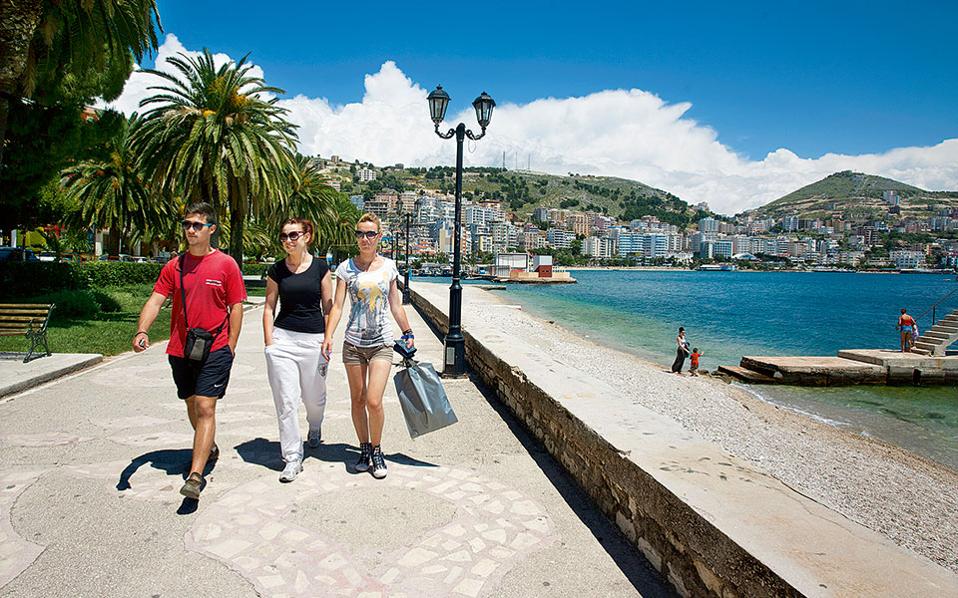
“On the outskirts of the archaeological site of Butrint, a few kilometers from Saranda, a group of tourists from Western Europe followed their guides. The Dutch Bregi Bimans and János Peter, along with their one year old daughter were coming down the hill. Peter has organized a ten-day trip in the Albanian Riviera, as it is called in the guides of Saranda, the coast which is opposite to the area of Corfu, northwest of Vlora.

Peter works as an engineer in Amsterdam. The costs of the family package was 1400 €, but for him this is a reasonable price (accommodation, breakfast and tickets). Six years before, he had visited the island of Crete: “What attracted me were the articles of the Dutch newspapers that advertise Albania as one of the last paradises unknown in Europe”- said Peter. The neighboring country (Albania), expects more than 3 million tourists this year.

Several months ago, the New York Times included Albania among the 52 major destinations for 2014. ‘You can swim near the abandoned castles and enjoy the fresh fish. This is Europe, where it is cool and … cheap.” Can this new trend of visiting Albania cause risk to Greek tourism? Could the tourist resorts of the Albanian Riviera “capture” the visitors from Greece and the Ionian Islands in particular? We traveled to confirm this ….

126821
126821Photo credits: Ekathimerini

From Corfu Airport to Saranda …

Off the port of Saranda there are two boats departing for Corfu, from which will disembark about 400 tourists. The bus will depart for day trips to nearby beaches. The same day trips from Corfu start in early May, but this year, for the first time, many tourists, especially Scandinavians, are using the Greek island as a passage for long vacations in Albania. “Thousands of tourists arrive at our airport, and their destination is the Albanian Riviera” says general secretary of the Union of Hoteliers Corfu George Zoupas.

Albania recently commissioned a Dutch company, for 540,000 euro, for its tourism promotion for this year and expects about 3 million arrivals. In a telephone conversation, the director of the Albanian Tourism Organization, Juliana Dhame told us that revenue is expected to reach to $1.2 billion, a substantial sum for a country with a weak economy and high unemployment.

On the Beach of Saranda, tourists sunbath and buy souvenirs. Mainly prefer mugs with the flag of Albania and small effigies, used as ashtrays and sold for 3 euros. Apart from the Scandinavians, there are many Polish tourists (800,000 will visit this year throughout Albania), while about one million Kosovars expected in August.

alban-thumb-large
Photo credits: Ekathimerini

Prices are low in focus. In a good restaurant we paid 15 euro for chef’s salad, pasta, grilled chicken, two beers and two sodas. The waiters-salary is about 200 euro- they speak basic English and some Italian. Traditional Albanian cuisine is not offered (excluding local mussels). Until dawn, all you can hear is Greek hits. You can feel a sense of security there, although you may rarely encounter police officials. The cost of accommodation is not particularly low. The price of a double room in 4 star hotel is around 50 euros including breakfast.

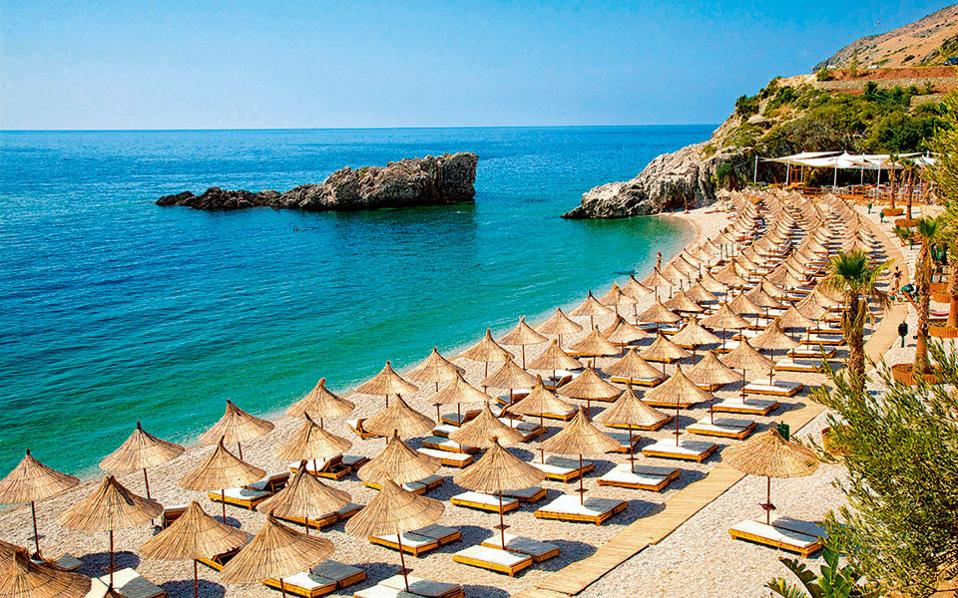
We pass the indented coastline untouched by development. We see a few beach bars and rudimentary camping. We encounter a group of ten cyclists. They are British and are doing a tour in Albania. “I visit the country for the first time,” says Bob Street, 48, a mechanical engineer from Bristol. “I like the absolute quietness on the roads and the food offered in local restaurants. The locals do not speak English, but are willing to help you.” He has visited Greece and Italy previously. Apart from lower costs, he notes that there are deficiencies in the Albanian tourism infrastructure. He paid for himself 1,250 eur for a seven days trip, including air tickets and stay in good hotels.

The region of Himara, a city with many Greek residents receives each year about 40,000 tourists, mainly Albanians and Kosovars. The Mayor Jorgo Goro has undertaken many  initiatives jointly with the mayors of Corfu and Ioannina to attract Japanese, Israeli and Scandinavian tourists. On the beach we meet the Norwegian Ouvangk Andrea and Veronica Gkoulmprantsen with backpacks on the back. “We search for unknown destinations,” they say, because “you know? In a few years Albania can become like Spain! “.

The signs of a sharp growth was apparent throughout the course of our trek. Our conclusion? To become truly competitive, Albanian Riviera must first overcome the “childhood diseases” of non-tourist project “explosion” – such as urban sprawl along the coastline. It must be given its own particular color, its culinary culture – an identity that will make it stand out.”
- See more at: http://invest-in-albania.org/ekathimerini-greek-newspaper-albanian-tourism/#sthash.pparmzdi.dpuf
alban-thumb-large

Ekathimerini Greek newspaper on Albanian tourism


This is not an original article of invest-in-albania.org. 

You may read the original one by clicking here.  
Greek newspaper Ekathimerini published the following article about the attractiveness of  Albanian Riviera.
“On the outskirts of the archaeological site of Butrint, a few kilometers from Saranda, a group of tourists from Western Europe followed their guides. The Dutch Bregi Bimans and János Peter, along with their one year old daughter were coming down the hill. Peter has organized a ten-day trip in the Albanian Riviera, as it is called in the guides of Saranda, the coast which is opposite to the area of Corfu, northwest of Vlora.  
Peter works as an engineer in Amsterdam. The costs of the family package was 1400 €, but for him this is a reasonable price (accommodation, breakfast and tickets). Six years before, he had visited the island of Crete: “What attracted me were the articles of the Dutch newspapers that advertise Albania as one of the last paradises unknown in Europe”- said Peter. The neighboring country (Albania), expects more than 3 million tourists this year.
Several months ago, the New York Times included Albania among the 52 major destinations for 2014. ‘You can swim near the abandoned castles and enjoy the fresh fish. This is Europe, where it is cool and … cheap.” Can this new trend of visiting Albania cause risk to Greek tourism? Could the tourist resorts of the Albanian Riviera “capture” the visitors from Greece and the Ionian Islands in particular? We traveled to confirm this ….

126821Photo credits: Ekathimerini
From Corfu Airport to Saranda …
Off the port of Saranda there are two boats departing for Corfu, from which will disembark about 400 tourists. The bus will depart for day trips to nearby beaches. The same day trips from Corfu start in early May, but this year, for the first time, many tourists, especially Scandinavians, are using the Greek island as a passage for long vacations in Albania. “Thousands of tourists arrive at our airport, and their destination is the Albanian Riviera” says general secretary of the Union of Hoteliers Corfu George Zoupas.
Albania recently commissioned a Dutch company, for 540,000 euro, for its tourism promotion for this year and expects about 3 million arrivals. In a telephone conversation, the director of the Albanian Tourism Organization, Juliana Dhame told us that revenue is expected to reach to $1.2 billion, a substantial sum for a country with a weak economy and high unemployment.
On the Beach of Saranda, tourists sunbath and buy souvenirs. Mainly prefer mugs with the flag of Albania and small effigies, used as ashtrays and sold for 3 euros. Apart from the Scandinavians, there are many Polish tourists (800,000 will visit this year throughout Albania), while about one million Kosovars expected in August.
alban-thumb-large
Photo credits: Ekathimerini
Prices are low in focus. In a good restaurant we paid 15 euro for chef’s salad, pasta, grilled chicken, two beers and two sodas. The waiters-salary is about 200 euro- they speak basic English and some Italian. Traditional Albanian cuisine is not offered (excluding local mussels). Until dawn, all you can hear is Greek hits. You can feel a sense of security there, although you may rarely encounter police officials. The cost of accommodation is not particularly low. The price of a double room in 4 star hotel is around 50 euros including breakfast.
We pass the indented coastline untouched by development. We see a few beach bars and rudimentary camping. We encounter a group of ten cyclists. They are British and are doing a tour in Albania. “I visit the country for the first time,” says Bob Street, 48, a mechanical engineer from Bristol. “I like the absolute quietness on the roads and the food offered in local restaurants. The locals do not speak English, but are willing to help you.” He has visited Greece and Italy previously. Apart from lower costs, he notes that there are deficiencies in the Albanian tourism infrastructure. He paid for himself 1,250 eur for a seven days trip, including air tickets and stay in good hotels.
The region of Himara, a city with many Greek residents receives each year about 40,000 tourists, mainly Albanians and Kosovars. The Mayor Jorgo Goro has undertaken many  initiatives jointly with the mayors of Corfu and Ioannina to attract Japanese, Israeli and Scandinavian tourists. On the beach we meet the Norwegian Ouvangk Andrea and Veronica Gkoulmprantsen with backpacks on the back. “We search for unknown destinations,” they say, because “you know? In a few years Albania can become like Spain! “.
The signs of a sharp growth was apparent throughout the course of our trek. Our conclusion? To become truly competitive, Albanian Riviera must first overcome the “childhood diseases” of non-tourist project “explosion” – such as urban sprawl along the coastline. It must be given its own particular color, its culinary culture – an identity that will make it stand out.”
- See more at: http://invest-in-albania.org/ekathimerini-greek-newspaper-albanian-tourism/#sthash.pparmzdi.dpuf

US Holds Secret Talks With Russia on Middle East Behind EU’s Back

High-ranking Russian and US military officials are holding “secret negotiations” to reduce tensions between Russia and NATO, Spanish news website Mil21.es reported, citing anonymous European intelligence sources.

© Sputnik/ Alyan Nazar
World
Get short URL
5140948

High-ranking Russian and US military officials are holding “secret negotiations” to reduce tensions between Russia and NATO, Spanish news website Mil21.es reported, citing anonymous European intelligence sources.

The secret talks are reportedly taking place with the approval of both the Kremlin and the White House in Northern Europe, Mil21.es said.
The negotiations began after Washington allegedly decided to change its strategy towards Moscow, making concessions on Ukraine in exchange for the Kremlin's support of new US geopolitical plans in the Middle East, anonymous sources said.
The United States needs Vladimir Putin's support to stop ISIL's expansion in the Middle East and to "make some changes" within the governments of some Persian Gulf states which distanced themselves from the White House following Washington's successful nuclear deal with Iran, Mil21.es said.
According to European intelligence sources, the United States initially supported the ISIL militants in their attempt to overthrow the Syrian government led by Bashar al-Assad. At the same time, ISIL received significant financial support from the Arab states of the Persian Gulf, especially Qatar and Saudi Arabia, as well as logistical support from the Turkish government on the Syrian-Turkish border. However, the situation soon backfired on Washington. The United States became seriously concerned with the events in the Middle East after ISIL announced the creation of the Islamic Caliphate on the territories it had conquered and began to recruit jihadists from all over the world, the Spanish news portal said.
US intelligence agencies actively cooperated with their Mossad counterparts in Israel, which allowed them to have a detailed picture of everything that was going on in the Middle East. However, the Iranian nuclear agreement made Israel unhappy, causing a reduction in the exchange of intelligence information between the two countries. Now Washington needs new allies and intelligence sources to keep the situation in the Middle East under control.
All of these factors have prompted Washington to reconsider its strategy towards Moscow. By finding a compromise with Putin and obtaining Russian support, the United States now wants to properly address the ongoing crisis in the Middle East, a region Washington considers a lot more important than Ukraine, the Spanish source said.

Wednesday, August 5, 2015

"We offer reconciliation, other side celebrates suffering"


Serbian President Tomislav Nikolic has said that his country was "praying the evil like the expulsion of Serbs during Operation Storm never repeats for anyone."
Source: Tanjug
(Tanjug)
(Tanjug)
He said that it took only 48 hours "to solve the Croatian problem called the Republic of Serb Krajina, a territory under UN protection" - and that this happened during a savage operation with elements of genocide, initiated "by a part of the world community."
At the same time, according to Nikolic, the rest remained "tragically silent and uninterested - because it was Serbs that were being murdered and driven out."

Tanjug reported that Nikolic, speaking during a memorial academy held in Belgrade to commemorate the 20th anniversary of Croatia's military campaign, added that Serbia was "praying that this kind of evil never repeats although it seems that only one, Serb side, cannot be constantly offering a hand of reconciliation and cooperation, while the other side is celebrating other people's misery and pain in full force."

He stressed that "Serbia was doing that even though a large majority of the expelled Serbs have not solved key issues related to property and residence rights, the unpaid pensions, the farming land that was taken away, the savings owed to them."

"Serbia has for its part showed a sincere dedication to peace and stability in the region and to overcoming of all open issues. The past is painful and burdensome, but the future must be built in cooperation and by overcoming our differences," Nikolic stressed.

Compromise and a sense of community rather than hatred and degrading was needed "in order to make the life of future generations possible" and in order for "minority communities to accept a state as their own."

"They should have a life worthy of humans, at least the right to their own language, alphabet, faith, history, culture," said the president.

While the Serbs in Croatia "do not even have the right to street signs in their own alphabet," minorities in Serbia have constitutionally guaranteed rights "greater than those of the Serb people," Nikolic said, adding that "Serbia does not expect implementation of absolute reciprocity" - but instead, "only a minimum of human dignity."

The president also said that "forgiving never means forgetting" but that Serbia has been prone throughout its history to "easily renounce and almost forget the Serb victims - in the name of some interests, that were everyone's but ours."

"It's never too late to correct historical errors and remember our own who suffered and are still suffering," Nikolic said, adding that the Serb people's victory is in surviving and living, building and persevering.

Parts of his speech were published earlier in the day, stating that Croatia's military parade held on Tuesday to celebrate Operation Storm sent a message to the expelled Serbs "not to return."

"They (Croatia) also organized a military parade. Of course, they did not mark victory over fascism and Nazism with a parade, Victory Day over concentration camps and genocide. They wouldn't go against themselves," Nikolic said.

The president also stated that "Croatians with the parade celebrated a day when they killed and expelled their own people with impunity."

"With the parade they are telling the living and the expelled Serbs: don't return, the same will be in store for you once again," Nikolic said.

Croatia celebrates Operation Storm with military parade


Croatia on Tuesday held a military parade to mark Victory Day - the 20th anniversary of Operation Storm when more than 2,000 Serbs were killed or went missing.
Source: B92
(Image made from HRT video)
200,000 more ethnic Serbs from Croatia were expelled from the country during the operation.
Half an hour before the start of the parade, Croatian President Kolinda Grabar-Kitarovic, who is the commander-in-chief, drove passed the parked armored vehicles and greeted the citizens, who responded with ovations. She then gave the order to start the parade.

Croatian Defense Minister Ante Kotromanic was in the vehicle with Grabar-Kitarovic.
(Beta/AP)
(Beta/AP)
Before this, the guests who gathered on the main stage in Vukovar Street in Zagreb were joined by former Hague war crimes indictee and former Croatian general Ante Gotovina, while another former general and indictee and one of the leaders of Croatia's army during the war, Mladen Markac, took photographs with soldiers participating in the parade.

3,000 members of Croatia's army with 300 vehicles and 30 aircraft took part in the first military parade held in 18 years.
(Beta/AP)
(Beta/AP)
Although Croatia invited all NATO members to take part in the parade, none did. Germany, the U.S., Slovenia, and Britain first announced their participation, but then canceled.

The parade was attended by 42 foreign delegations that included ambassadors, military envoy and high ranking military officials.

Due to disagreements among top Croatian officials on how to mark the day, Operation Storm is also celebrated in Knin this Wednesday.

Ontario: New FYROM Provocation with Map Including Greek Land

df1
By Philip Chrysopoulos -


df1The Parliament Vice President of Former Yugoslavian Republic of Macedonia Antonio Milososki made a provocative appearance at a national celebration having in the background a map that includes several Greek territories reaching to Mount Olympus in central Greece.

The event was held in Ontario, Canada, in collaboration with the nationalist group ‘United Macedonians’ for the anniversary of FYROM’s Day of the Republic/St. Elijah’s feast day (August 2).

The map of “Grand Macedonia” which contains a lot of Greek land, along with the flag with the Vergina Sun, and pictures of Alexander the Great and his father Philip II generated a lot of negative comments in Greece. Especially at a time when the dispute over the name of the neighboring country has not been resolved yet. Milososki, who has previously been foreign affairs minister, represents the nationalistic wing of the Skopje government.

In the past few months, Milososki has made other similar provocations, such as  holding the red flag in his hands, thereby violating the Interim Agreement Athens and Skopje signed in 1995. According to that, the neighbors were bound to stop the use of the symbol of the Sun of Vergina. Last September Milososki and his friends climbed Mount Olympus and were photographed with the spurious flag.

So far there has been no official complaint by the Greek Ministry of Foreign Affairs and Minister Nikos Kotzias.
- See more at: http://canada.greekreporter.com/2015/08/04/ontario-new-fyrom-provocation-with-map-including-greek-land/#sthash.yt8isNQ7.dpuf

Monday, August 3, 2015

Former CIA Officials Launch Smear Campaign Against Senate Torture Report

© REUTERS/ Larry Downing

In an attempt to unveil what was really behind the scenes of the Al Qaeda terrorist interrogations conducted by the CIA, eight former high-ranking CIA officials, including three former directors, are ready to publish a response to last year’s incendiary US Senate “torture report”, according to the Washington Examiner.

The beginning of September, 2015 will see the release of a report, “Rebuttal: The CIA Responds to the Senate Intelligence Committee's Study of Its Detention and Interrogation Program", which is expected to be published by the Naval Institute Press.
 According to the former Agency employees, the Democratic Senate’s intention was to undermine the CIA’s methods of dealing with terrorists, including waterboarding; the report was presented by the Vice Chairman of the Senate Select Committee on Intelligence, Dianne Feinstein, and was roundly cited as the main report on the CIA's enhanced interrogation programs.


After its release last December, current CIA Director John O. Brennan stated that the interrogations had set the stage for the 2011 Navy SEAL raid on Osama bin Laden's compound in Abbottabad, Pakistan.

Embedded image permalink
In the upcoming rebuttal, the former CIA officials will not only counter the Democratic report, but will unanimously give evidence about the Al Qaeda operation’s details for the first time in the history of the Intelligence Agency. It will contain the Republicans’ responses to the Senate Select Committee on Intelligence, who published the well-known report, officially called "The Senate Intelligence Committee Report on Torture: Committee Study of the Central Intelligence Agency's Detention and Interrogation Program."

What’s surprising to note is that the Democrats consulted none of the agents while preparing the December report.
Three former CIA directors, George Tenet, Porter Goss and retired Gen. Michael V. Hayden, two former deputy directors, John McLaughlin and Michael Morell, former clandestine service boss Jose A. Rodriguez, former CIA and FBI counterterrorism official J. Philip Mudd and former CIA Acting General Counsel John Rizzo have written the key points of the document which will be released next month.
All revenue earned from the publication of the 352-page "Rebuttal" will go to the CIA Officers’ Memorial Foundation.

Golden Dawn chief, wife, released from house arrest


Golden Dawn chief, wife, released from house arrest
Golden Dawn chief Nikos Michaloliakos and his wife Eleni Zaroulia, also an MP with the ultranationalist party, were granted release from house arrest on Wednesday.
The pair, who are awaiting trial on charges of running a criminal organization, will be allowed to leave their home on the condition that they report to their local police station three times a month.
A former lawmaker and one of their many co-defendants, Dimitris Koukoutsis, was also released from house arrest this week, following the adjournment of the trial until September 8.
ekathimerini.com

Greece planned German corruption probes in 'Grexit' scenario -report


First entry: 3 August 2015 - 02:00 Athens, 23:00 GMT
Last update: 3 August 2015 02:00 Athens, 23:00 GMTPolitics
Greece planned German corruption probes in 'Grexit' scenario -report
The Greek government produced a contingency plan that would "raise the cost of rupture" for Greece's creditors - the European Commission, European Central Bank (ECB) and the International Monteryary Fund - if the country was forced out of the eurozone, according to a report published by Greek daily "Efimerida Ton Syntakton" on Saturday.
Citing Greek government officials under condition of anonymity, Efimerida Ton Syntakton reported that the plan included opening corruption probes into prominent German companies, including Siemens, Lidl, Allians, MAN and Hochtief.
"In basketball terms, the government would apply 'pressure defense,'" the Greek periodical said.
According to "Efimerida Ton Syntakton," the plan also included nationalizing Greece's gaming monopoly OPAP, which was privatized in 2013.
The report comes on the heels of Greek Prime Minister Alexis Tsipras' statements to parliament on Friday, revealing that the young premier had instructed former Finance Minister Yanis Varoufakis to produce a "defense plan" in the event of a "Grexit" - a Greek exit from Europe's monetary union.
"I personally gave the order to prepare a team to prepare a defense plan in case of emergency," Tsipras said, adding that plans to leave the eurozone were "never prepared" by his administration.
"If our creditors were preparing a Grexit plan, should we not have prepared our defenses?" the prime minister asked, without going into further details of the plan.
Deutsche Welle

"Decision on KLA crimes court made under intl. pressure"


Kosovo Deputy Prime Minister Branimir Stojanovic says he is satisfied that amendments that will pave the way to establish a special court have been adopted.
Source: B92
(Beta, file)
(Beta, file)
"Of course we're satisfied, it was uncertain until the very end. Until the last moment we did not know whether we will have enough votes," he said.
Stojanovic told B92 late on Monday that he "hoped the law will also be adopted during the session this evening," and that "the decision (on the amendments) was significantly influenced by the international community."

"It is quite clear that this decision was made under pressure from the international community. Without implementing this obligation there could be no progress," said Stojanovic.

Stojanovic also commented on the threats received by Kosovo assembly members from the Serb (Srpska) List to say he was "not scared by the threats at all."

"Our obligation is to defend our people's interests, there is an investigation, I hope there will be results. I believe that a big and important thing has been done today. "

The assembly of Kosovo has adopted constitutional changes under strong pressure from the U.S. and the EU which pave the way for the formation of the special court that would deal with war crimes committed by the KLA.

After five hours of debate, 82 deputies voted in favor while five were against. 80 votes plus 14 from MPs from minority communities were needed to pass the proposal.

Sunday, August 2, 2015

Summer School for Serbian, Albanian youths in Tirana


Young people from Serbia and Albania completed on Thursday their five-day long Summer School on inter-cultural dialogue in the digital era, Tanjug reported.
Source: Tanjug
They "discussed and shared experiences and ideas on challenges facing the youth in their countries," the agency said.
A team comprised of trainers and experts from the ministries of youth from both countries assisted some 34 young people in their discussions on the topics of youth inclusion in the public and political life, youth policies, promotion of democratic values and fostering the cross-cultural dialogue and the role of the media in inter-cultural dialogue, as well as the issue of ways to challenge prejudice and stereotypes, a release by the Organization for Security and Cooperation in Europe (OSCE) states.

The Summer School is a result of the Memorandum of Understanding on Youth concluded by the Serbian and Albanian Prime Ministers with the idea to bring the youth of the two countries closer together.

This event was jointly organized by Serbia's Ministry of Sports and Youth and Albania's Social Welfare and Youth Ministry in co-operation with the National Youth Service of Serbia and supported by the OSCE Mission to Serbia and the OSCE Presence in Albania.

Kosovo: Draft resolution on genocide submitted to assembly


The head of the parliamentary group of the Alliance for the Future of Kosovo has submitted a resolution on "genocide during the war in Kosovo."
Source: B92
(Beta/AP, file)
(Beta/AP, file)
This has been reported on Friday by the Pristina-based Albanian language newspaper Koha Ditore.
The resolution, tabled by Donika Kada Bujupi, was proposed during a meeting of the Assembly Presidency and received the support of other parliamentary groups.

Kada Bujupi is demanding that this resolution be the first item on the agenda of the Kosovo Assembly.

The Alliance for the Future of Kosovo is led by Ramush Haradinaj, is the third strongest party in Kosovo and has nine deputies in the assembly.

The Kosovo government on Friday adopted changes to constitutional amendments that will allow a special court and a special prosecution to be formed to deal with war crimes committed by the former KLA.

It has been stressed that fulfilling this obligation would "contribute to shedding light on the accusations, and will be of exceptional importance for Kosovo's Euro-Atlantic integrations, and further strengthening of the strategic partnership with the U.S. and the EU."

The opposition believes that the amendments related to the court "should not be included in parliamentary procedure in any case" and said they would vote against.

It is expected that some deputies from the Democratic Party of Kosovo, who on June 29 voted against the formation of this court, will now vote in favor of the amendments.