Monday, September 29, 2014

Why Albania Was The First Stop On The Pope's European Tour

Guest post written by Edi Rama
Mr. Rama is the Albanian Prime Minister

The visit of Pope Francis to Albania last week was a highlight in my country’s history. But more than that, it was a powerful message for the world. First, because he chose one of Europe’s poorest countries to begin his European tour. Second, and more importantly, he chose a country where the Muslim majority co-exist peacefully with Christians. He came, a universal spiritual leader and the flag-bearer of the human endeavor against prejudice and divisions among people on grounds of faith, ethnic background or social provenance; and he was received by both Christians and Muslims with no distinction. That is a rare miracle in the increasingly turbulent and fearful world in which we are living. I was proud of the face Albania presented to him, and to the world, a remarkable example of inter-religious coexistence.
It was hugely significant to us that he began this series of events in Europe not in the heart of Europe, not in the EU, but in the Western Balkans. A region famed through history for conflict, not least the one which erupted from Sarajevo 100 years ago; a region which has endured a century of ideological wars, ethnic conflicts, religious divergences, bloody unrest border to border. But which today is a region of peace and cooperation. To think for a moment of that history is to understand why we felt so moved by his visit, and the sight of hundreds and thousands of Christians and Muslims swarming the martyrs’ boulevard from the early hours. In Communist Albania, clergy were killed, Churches burned to ashes. Today the leaders of our various faiths are a vital part of our civic society, working together for the good of the people.
The message that sends to the world is vital at this time. Because, as Pope Francis told the crowds, World War III has already begun.
Some might disagree. But as he spoke, the barbarous advance of the self-styled Islamic State of Iraq and the Levant continued, bringing with it mayhem, murder, instability that crosses borders and, if unchecked, will leave no country on earth untouched: all in the name of religion, a perverted view of a faith, Islam, which we know to be peaceful in its thinking and intent.
That it is war is clear from the way they are pursuing it. Our response must be just as clear. Because it affects us all. When the severed heads of murdered innocent men, there to help the vulnerable or tell the world what is happening, are used as message carriers to the US and its allies, we must surely see this is a war akin to a fight against a deadly pandemic that spreads with no distinction of borders, conventions or rules set by previous experience.
The fight against this abhorrent plague that is threatening our world, our liberty, our rights as human beings and our aspirations as societies of democratic countries can only be fought together. Part of that fight is military. But part of it is to show the power and the benefit of harmonious coexistence among religions, communities, ethnicities and countries.
We should not shy from the military part of this. Sometimes it is war that will deliver peace. Pope Francis landed in Albania in the very year where Albanians, both Muslims and Christians, joined with other neighbours in the region to seal an historic process started in 1999 with the bombing of Belgrade, and the courageous fight led by Bill Clinton and Tony Blair to halt the ethnic cleansing of Albanians by Slobodan Milosevic. Their acts of war ended the ethnic cleansing, brought about the fall of an evil dictator, which in turn led to the peace agreement sealed last year between Kosovo and Serbia, in the name of a common future in the European Union.
From that crossroads, the Holy Father came here to speak not only to Albanians or to the peoples of this region, but to all of Europe about the need to have faith and unity, and to overcome boundaries and limitations of the present in order to protect our common future. We look at the way the conflict now impacts on Turkey, and we see common cause. We hear of the plans of terror groups to launch attacks on Western targets, and we see common cause. We witness the spread of this evil message of hatred in the name of religious belief, and we must see common cause on halting that spread, large and small country alike, together. Western Europe and Western Balkans, together. Christian and true Muslim, together.
The Balkans needs Europe. But Europe needs the Balkans. That too, I believe, is a reason why The Pope came here, by his presence to deliver that message. At a time so many affluent European countries are turning in on themselves, they should be looking outwards, in the name of building a common shield that will defend us from an epidemics that kill the strong as well as the weak, the rich as well as the poor, unless we stand and fight together.
These murderers have shown there is no depth to their barbarism, which means there is no limit to the terror they would wreak upon our world. Democratic Europe, as their war comes ever closer, must fight back not only with weapons, but with the strength of unity against a fantasy gone rampant, against people who would return our to the dark abyss of past millennia. We are a poor country, but one that is willing to play our part in that; a part we can only play in co-operation with others in Europe and the wider world.
History has not been kind to Albania. But we have learned from it. That much was clear from the way our people came out to see, hear and celebrate with Pope Francis. He, a Catholic leader, understood that Albania deserves respect for our unanimously voiced affiliation to the democratic world as Europeans; we do not deserve the prejudice that sometimes goes the way of Muslim countries. Albanians should be respected for all the blood and suffering they consecrated to Christianity, giving forty martyrs to the Catholic Church only a few decades ago, and not be subjected to frivolous or unfair judgement because they pray to Allah in a country where Christmas and Bajram are also celebrated without boundary of fear.
The Pope is not alone in understanding the role the Balkans has to play in ensuring peace and prosperity for our times. His visit follows historic steps taken by Chancellor Merkel. She fought hard for Albania to secure EU candidate status. She also brought together, for the first time early in September, all the region’s leaders for a meeting in Berlin, to convey her insight that, beyond the impasse of the enlargement policy, the EU intends to bring the Balkans closer by building new bridges of support and cooperation.
Our world needs leadership in the face of so many current global challenges. Chancellor Merkel has shown it. So has the Pope. A Prime Minister of Albania will never have the power of a German Chancellor or the reach of a Pope. But we have a part to play. The Balkans has a big part to play. Our major challenge today to steer clear from this deadly epidemic of religious conflict which, in this region, would automatically spill over into an ethnic conflict and lead to renewed disputes about the current borders of peace. That is our challenge. But it is a challenge for the whole of Europe, and one we must face together, with courage. Angela Merkel and the Pope have led the way. Others now need to follow. This is a war that Europe must fight together.

Golden Dawn: Australian branch of far-right Greek party raises cash

Ultra-nationalist party raises funds and clothing in Australia using an unregistered charity and sends donations to Greece

theguardian.com,
golden dawn
A concert was held on September 19 to commemorate the one-year anniversary of the death of musician Pavlos Fyssas, allegedly by Golden Dawn members. Photograph: Louisa Gouliamaki/AFP/Getty Images
The Australian branch of Greece’s ultra-nationalist Golden Dawn party is raising funds locally using an unregistered charity.
A Melbourne-based charity named Voithame Tin Ellada (VTE) – which translates to “We are helping Greece” – has been raising cash and clothing from Australia’s Greek community since late last year.
The donations are ostensibly sent to Greece to help citizens afflicted by the country’s financial downturn. A shipping container of clothing collected from Australians was sent to Greece in March.
Photographs on the charity’s Facebook page show its members clad in matching T-shirts bearing the far-right party’s name and swastika-like logo.
A Christmas fundraising drive – asking donors to deposit their money into a Greek bank account – was announced on the page last week by Golden Dawn’s Australian representative, Ignatius Gavrilidis.
Gavrilidis confirmed to Guardian Australia that VTE was affiliated with the controversial Greek political party, whose leader, Nikolaos Michaloliakos, is in detention awaiting trial on charges of running a criminal organisation.
But Gavrilidis said the money raised by VTE’s fundraising efforts only went towards buying food for the needy. “We buy the food direct from the producers and Golden Dawn takes delivery of the goods … We use their labour, they hand out the food where it’s appropriate,” he said.
“They [the recipients] need to hold citizenship. As long as they hold citizenship, it gets distributed to them.”
The organisation is not registered with either federal or state charity regulators.
Golden Dawn’s anti-immigrant, antisemitic and homophobic rhetoric has found favour with some in a Greek population reeling from the country’s financial crisis, and the party has become the third-largest political force in Athens.
Its members have been accused by human rights groups of leading street attacks on dark-skinned immigrants, gays and Muslims. All 18 Golden Dawn members of the Greek parliament were arrested in police raids last year after an anti-fascist rapper, Pavlos Fyssas, was murdered, allegedly by thugs affiliated with the party.
Since the crackdown, the party has increasingly turned to its overseas branches to help deliver aid and build support among the Greek population, Gavrilidis said.
“The [Greek] government has virtually financially dried the party; they’ve stopped any funding, any entitlements they get as a party,” he said. “So to continue to help those in need they are reaching out to those beyond their borders.”
Gavrilidis said VTE was set up in November 2013 by members of the Greek community not associated with Golden Dawn. “But these individuals failed to attract support, and I offered my assistance, and they were more than happy to get it off the ground,” he said.
Within two months the organisation had been absorbed into Golden Dawn’s Australian branch, he said. “We decided to aid VTE and back them up, and we became VTE ourselves.”
Sotiris Hatzimanolis, the editor of the Greek community newspaper Neos Kosmos, said it was “not really common knowledge” within Australia’s Greek diaspora that VTE was a front for Golden Dawn.
Victorian Liberal MP Nicholas Kotsiras, who is of Greek heritage, said he was “disappointed” that Golden Dawn was fundraising in Australia.
“Our aim should be to take away the oxygen of the group so they disappear as quickly as they appeared,” he said.
Kotsiras said he would raise VTE with the Consumer Affairs Department: “I’d like the authorities to take a good look at it.”
Golden Dawn announced last month that two of its European MPs, the former army generals Eleftherios Synadinos and Georgios Epitideios, would visit Australia later this year to raise funds and awareness of the group.
The proposed visit, scheduled for November, has been condemned by ethnic community leaders, trade unions and senior members of the Greek community.

Putin intends to visit Serbia

NEW YORK -- Russian President Vladimir Putin intends to visit Serbia for the celebration of the 70th anniversary of Belgrade's liberation from German occupation.
Tanjug
Tanjug
Russian President Vladimir Putin intends to visit Serbia for the celebration of the 70th anniversary of Belgrade's liberation from German occupation, Russia's Foreign Minister Sergey Lavrov said at a news conference at the UN headquarters in New York on Friday.
Putin will attend the ceremony marking the anniversary, Russia Today has reported.

Moscow hopes the agreements Belgrade is going to make with the EU will not harm the relations between Serbia and Russia, the Russian TV station said on its website.

Sunday, September 28, 2014

Germany unable to fulfill 'some' NATO obligations – MoD

Published time: September 28, 2014 18:19
Eurofighter Typhoon.(Reuters / Michaela Rehle)

Berlin would not currently be able to keep its defense promises to its NATO allies, Germany’s defense minister Ursula von der Leyen told Bild am Sonntag.
“With our airborne systems we are currently below the target figures announced one year ago, defining what we would want to make available to NATO within 180 days in the case of an emergency,” von der Leyen stated.

On Saturday, German magazine “Der Spiegel” also reported that the fleet of 60 Eurofighters previously pledged could not currently be provided. On Friday, there had been an emergency meeting over the matter, reported Süddeutsche Zeitung.

At the moment, only 24 out of a total of 109 Eurofighters are ready for service, and 38 of 89 – less than half - of Tornado fighters could be utilized properly. In a war in the Baltic, the army would be overwhelmed.

Last Monday it also became known that the German navy only has three operational helicopters and on Saturday it emerged that a Tiger gunship helicopter had lost a weapons carrier during an exercise.

“From 2016 it will be necessary to increase the budget - by whatever amount of money is necessary to fulfill all our commitments,” Christian Democrat defense expert Henning Otte told the “Welt am Sonntag.”

The recent report prompted a heated debate in the Defense Committee as to the readiness of the German armed forces and its ability to provide international aid and respond to a crisis call.

On Friday the Defense Minister summoned all chiefs of forces.

After a discussion, they concluded that meetings were imperative and should take place more regularly in the future, with the next to be scheduled for 14 days’ time.

It comes as Foreign Minister Frank-Walter Steinmeier told the UN General Assembly on Saturday that Berlin was ready to take on a greater international role.

Fearing political crisis, Greece plots escape from bailout

Fearing political crisis, Greece plots escape from bailout
Greek Prime Minister Antonis Samaras and German Chancellor Angela Merkel address a joint news conference in Berlin on Sept. 23, 2014. (Photo: Reuters)
September 28, 2014, Sunday/ 03:05:58/ REUTERS / ATHENS

Four years after a messy descent into emergency funding to stave off bankruptcy, Greece's government is trying to pull the plug on a deeply unpopular bailout program to secure its own survival.
Under growing pressure from anti-bailout leftists, Greek Prime Minister Antonis Samaras desperately needs a new narrative to get the backing of lawmakers in a crucial presidential vote next year and rally Greeks fed up with four years of austerity.
It is a gamble with high stakes for the Greek economy and Athens' relations with its eurozone peers. Failure by Samaras to get his presidential nominee elected would trigger new polls that his anti-austerity rivals would almost certainly win.

In Berlin earlier this week, Samaras for the first time publicly acknowledged that Athens hoped to wean itself off a 240-billion-euro ($305-billion) EU/IMF aid package a year before its scheduled end in early 2016.

He offered no details, but Athens is calculating that declaring an end to the reviled bailout could be just the political game-changer it needs, with the end of bailout funding from the European Union in December offering a logical moment to seal the exit of the International Monetary Fund as well. "It makes political sense, completely 100 percent," a source familiar with the discussions said. "The IMF is not pushing to leave, the government is pushing for it."

Pulling this off, however, will almost certainly require Athens to notch up rapid-fire successes on several fronts -- a swift end to its current bailout review, securing debt relief and the backing of European partners for going it alone.

In addition, forgoing over 12 billion euros in IMF loans and finding its own financing, just two years after a sovereign debt restructuring, remains a risky bet. "If Greece completes this review with the blessing of the troika, who say 'Great, you've done a lot', maybe gets debt relief and a monetary agreement with the EU, then the markets may say 'That's good' and it can raise 10 billion over the next year," the source said. "It's a plausible financing scenario but there are risks for a country with emerging market access," the source added, referring to Greece's still low credit ratings.

Juggling risks

Athens is largely gambling that the political risk of not attempting an exit outweighs the financial risk of failing. Sentiment is finally turning in its favor: four years of austerity have produced a primary budget surplus, it has successfully tapped debt markets twice this year and its economy is set to grow in 2014 after a six-year recession.

European partners -- busy with a crisis in Ukraine, a widening Middle East conflict and a stagnant eurozone economy -- may well be willing to help Athens along to avoid upsetting the fragile pro-bailout political order in Greece.

In a sign of the change in mood, German Chancellor Angela Merkel on Tuesday praised Greece's efforts and promised Berlin would "do everything it can" to support Athens. She did not comment on Samaras's plan for an early bailout exit, which Greek officials say would avoid the anomaly of the IMF supervising a European nation alone.
Europe wants to ensure Athens does not slide back into the fiscal evasions that brought it to the brink of bankruptcy -- a risk Athens plans to address by presenting a plan for further reforms to strengthen the economy and government finances.

But if the IMF were to leave at the end of the year after disbursing 3.5 billion euros due at the end of the current review, Athens would forego over 12 billion euros. The IMF has also estimated an additional funding shortfall of 12.6 billion euros starting in mid-2015, though Athens disputes that, saying it does not need additional money beyond the current bailout.

Part of the shortfall could be met from leftover funds worth over 11 billion euros held by Greece's bank bailout fund -- assuming European bank stress tests do not reveal major capital needs for Greek banks and EU authorities approved such a move.

After ending a four-year exile from debt markets this year with two bond issues that showed keen appetite for its higher-yield bonds, Athens is increasingly confident.

Debt relief talks due to start later this year on a package of lower interest rates and longer maturities may also help the IMF to declare that Greece's debt -- set to peak at 177 percent of GDP this year -- is now sustainable. Indeed in Berlin this week Samaras took pains to say an exit by the IMF would not be a "divorce" but rather, "a success.”

Radical left ahead

For Samaras, all this will have to happen before February or March next year when he needs the support of 180 deputies in the 300-seat parliament to push through his nominee for president.

He has only the support of 154 deputies from his New Democracy party and Socialist PASOK coalition partner, but a bailout exit could help lure some of the 24 independent lawmakers and perhaps even a small anti-bailout party.

The radical leftist Syriza party, which has 71 seats in parliament and won the EU elections in May on an anti-austerity platform, has pledged to block the government's candidate.

Failure to elect a new president would require a general election, which Syriza would almost certainly win according to opinion polls that give it a 2 to 6 percentage point lead. "The government is now playing all its cards in an effort to get the 180 deputies it needs ... to stay in power," said political analyst John Loulis. "But there is a sense of political instability and a government that is wearing out."

Saturday, September 27, 2014

Italy plan Albania or Colombia game
Italy are reportedly planning a friendly on November 18 against either Albania or Colombia.
The Azzurri will be together for the Euro 2016 qualifier with Croatia on November 16, so this test would be a chance for Antonio Conte to see less-used players in action.
According to La Gazzetta dello Sport, negotiations are at an advanced stage to play against Albania on November 18.
They are fresh from a shock 1-0 victory away to Portugal and have an Italian Coach, Gianni De Biasi.
However, the Federation is also trying to organise an encounter with Colombia, which would bring more prestige and more fans to the stadium.
Think you know your Italian football? Share your knowledge, tips and comments to win cash prizes in OLBG's tipster competition - £11,000 to be won monthly!

British jets deployed on 1st Iraq anti-ISIS mission

Published time: September 27, 2014 
A British Eurofighter EF-2000 Typhoon. (Reuters/Giampiero Sposito)
Armed British RAF jets have been deployed on their first mission in Iraq since UK lawmakers voted to authorize military strikes against so-called Islamic State (IS) targets in the country.
A Ministry of Defense Spokesman (MOD) confirmed on Saturday that "Royal Air Force Tornados continue to fly over Iraq and are now ready to be used in an attack role as and when appropriate targets are identified."
UK MPs vote overwhelmingly for ISIS airstrikes in Iraq
The spokesman added that no running commentary on the jets' movements would be forthcoming, but they "are pleased with the response time achieved."
On Friday, MPs in Britain's House of Commons voted overwhelmingly to take part in military action against Islamic State (also known ISIS, or ISIL).
The motion proposed by Prime Minister David Cameron's government was passed overwhelmingly by 524 votes to 43 – a majority of 481.
Britain’s three biggest parties, coalition government partners the Conservatives and Liberal Democrats, plus the opposition Labour party, all officially backed the bombing campaign. The government insisted the intervention was legal under international law because it was requested by the Iraqi prime minister.
The measure did not propose any UK involvement in airstrikes in Syria, where a US-Arab coalition began bombing IS militants on Tuesday. A year ago, British MPs rejected airstrikes on Syria to oppose the government of President Bashar Assad.
Cameron told MPs early in Friday's debate the situation in Syria is “more complicated” than Iraq because of its "brutal dictator" President Assad, and the civil war that has been ongoing there for the past three years.
He noted, however, that there was a strong case for attacking IS in Syria, a proposition which both Foreign Secretary Philip Hammond and Defense Secretary Michael Fallon have cited as a distinct possibility.
Cameron added that there was no “legal barrier” to expanding operations into Syria, though MPs were far from united on such a move.

Catalonia president orders independence referendum on Nov. 9

Published time: September 27, 2014 08:58
Edited time: September 27, 2014 12:22
Catalonian separatist supporters wave estelada flags in front of Catalonia's Parliament before the approval of a regional consultation law in Barcelona September 19, 2014. (Reuters/Albert Gea)

The president of Catalonia, Artur Mas, has signed a decree calling an independence referendum for Nov. 9. The secessionist drive of the Spanish region has been rebuked by Madrid, which vowed to block the vote.
Spanish Prime Minister Mariano Rajoy has called a government meeting Monday that is expected to provide a legal response to Barcelona’s announcement. Madrid plans to challenge the vote in the constitutional court.

READ: Catalan parliament approves November independence vote
 
Last week the Catalan parliament voted to hold an independence referendum in November, with 106 MPs in favour and 28 against.

Support in Catalonia for seceding from Spain grew in the relatively prosperous northeast province over years of economic hardships and austerity measures. A recent opinion poll by the Omnibus Opinion Studies Center showed that almost 60 percent of Catalans would vote for independence.
Madrid insists that holding a referendum would be illegal and unconstitutional.
Following Mas’s statement, Spanish Deputy Prime Minister Soraya Saenz de Santamaria said the Madrid government will hold an emergency cabinet meeting within days and that the referendum will be challenged in the Constitutional Court.

"This referendum will not be held because it is unconstitutional,'' she said during a press conference on Saturday.


The West Gives Putin Too Much Credit

Barely a year has passed since Russia threw down the gauntlet to the West over Ukraine, when Moscow made plain its objections to the European integration sought by Kiev. With breakneck speed, the dispute turned into a full-out war imposed (though never declared) by the Kremlin against its smaller neighbor. Relations with the West, meanwhile, have returned to a confrontation reminiscent of the Cold War.
In this conflict, President Vladimir Putin has shown cunning, boldness and determination, while Western leaders have appeared disoriented, indecisive and ultimately weak. This, and Moscow's seemingly unstoppable march from one victory to the next, has fueled despair among those suffering from Russian aggression in Ukraine and elsewhere, while drawing admiration among Kremlin supporters in Russia and beyond. However, and admittedly against all appearances at this stage of the conflict, Putin has clearly overplayed his cards.
When Putin retook office in 2012, the new-old president vowed to restore Russia's standing in the world. In his view, a new multipolar world order was emerging, one that was no longer led by the West and in which Russia could play a key role.
To do so, Russia was to re-integrate the post-Soviet space and lead its own regional bloc, to limit Euro-Atlantic integration on its Western borders and to build new alliances in the East and elsewhere in the world. Two years into his presidency, and accelerated by the Ukraine crisis, it is becoming increasingly obvious that Putin is failing on all of these accounts.
First, the Russian president has proven unable to stem the centrifugal forces that are driving the former Soviet Union ever further apart. His grand design for a Eurasian Union isn't attractive to Russia's former satellites, whose populations have grown fond of independence and whose local rulers defend their mostly autocratic rule.
Coercion in turn, as applied to Ukraine, has irrevocably alienated Russia's most important neighbor. Those still willing to risk doing business with Russia, meanwhile, can ask for highly favorable terms. In doggedly pursuing this integrationist agenda, Moscow will see the Eurasian Union becoming an expensive drain on its resources, rather than a way to increase its regional and global sway.
Second, Putin has dramatically underestimated the unity and strength of the West. His plans to drive political, ideological and economic wedges between Europe and the U.S. have largely been frustrated. Instead, after long months of hesitation and faced with ever-greater tragedy in Ukraine, the European Union and NATO have regained their sense of purpose.
In lockstep, the U.S. and the EU have rolled out wave after wave of political and economic sanctions. The EU sped up the association process with Ukraine, as well as with Georgia and Moldova, and it is pressed ever harder to provide these neighbors with a clear European perspective. NATO has effectively returned to its original mission and has started to reinforce the defense of its Eastern-most members. In short, rather than preventing Western influence, Putin's approach has brought Euro-Atlantic structures closer to Russian borders than ever.
Third, Putin has grossly overestimated the global support that he might elicit with his challenge to the West over Ukraine. None of the emerging powers in the BRICS group has openly sided with the Kremlin. If anything, China took advantage of Russia's international isolation to wrestle Moscow into a bargain on long-term gas supplies.
Nor have Putin's closest partners — Presidents Alexander Lukashenko of Belarus and Nursultan Nazarbayev of Kazakhstan — expressly backed his actions in Ukraine, preferring instead to stick to cautious and pragmatic neutrality. Meanwhile, public opinion across Europe, which has traditionally viewed Russia favorably, has swung in the other direction, with majorities now opposed to Kremlin policies. In attempting to put Russia into the driver's seat against Western dominance, Putin has succeeded only in becoming an international pariah.
Fourth, Putin has misjudged the dynamics of nationalist sentiment inside Russia. After his contested re-election in 2012, it seemed that tapping into Russian patriotism would be an effective way to boost his legitimacy. With the annexation of Crimea, the Russian president rode these feelings to record heights.
But Putin will soon realize that nationalism is insatiable, and that his authority will be dangerously eroded if he sidesteps the nationalists' demands for "Novorossia." In short, Putin has made himself hostage to a sentiment that will push him from conflict to conflict with Russia's neighbors.
Finally, Putin demonstrates little grasp of his country's economy, its global exposure and vulnerability, and the heavy price it is now paying for his geo-political adventures. Already slowed by a falling oil price, the Ukraine crisis and Western sanctions have brought Russia's economy to the brink of recession.
Foreign direct investment has effectively stopped. Capital flight, already massive before the Ukraine crisis, has nearly doubled. Key companies and banks are cut off from global financial markets, and their refinancing needs are rapidly draining Moscow government coffers. Scores of companies have gone bust. The energy sector, Russia's life line, is forfeiting its future profits because it no longer has access to Western technologies.
Faced with this economic nightmare in the making, it is nothing short of delusional if Putin sees this situation as an opportunity for Russia to become self-sufficient.
These multiple failures expose Putin's fatal weakness, and his increasingly shrill threats against critics at home and abroad only testify to his growing anxiety. Indeed, his war against Ukraine may well be the first step toward his demise. Like many of his fellow autocrats the world over, he will cling to power at the expense of his own people and of others. The international community and Russians themselves must respond resolutely, and calling his bluff will go a long way in the right direction.

Friday, September 26, 2014

Omonoia: Disappointment for violation of human rights in Albania

The Greek Minority organization in Albania, declared that Tirana continues the violation of the human rights


Greek media wrote that the National Council of Omonia gathered a few days ago has handled very carefully the current political situation in Albania.

 
Greek minority organization has expressed its dissatisfaction to the Left Alliance which is in power.

Violation of minority rights related to administrative reform, ownership, unequal education and participation in public administration.  


Also, the General Council of Omonia said that the Party of Human Rights as soon undertake initiatives to remedy these issues open

Omar the Chechen heads jihadist most wanted list

US reveals jihadist most wanted list
Islamic State terrorist Tarkhan Tayumurazovich Batirashvili, known as Omar the Chechen.
INTRICATE details of the Islamic State’s sophisticated network have been revealed by the US, along with a wanted list of 14 key terrorist fighters and facilitators.
The dossier, compiled by the US Treasury and state departments, names people with crucial roles in moving foreign fighters into Syria, and training them, as well as financiers, arms brokers and the man in charge of hostage-taking operations.
It lays bare a network which is raising funds in Qatar, sourcing weapons in Libya and luring new recruits from Britain, Denmark and Albania.
By naming individuals as facilitators of terrorism, the US hopes to attack the efforts of IS, Nusra Front and al-Qa’ida “to raise, transport and access funds that facilitate foreign fighters”. The move to designate the individuals as foreign terrorist fighters means that they are now subject to sanctions, and Americans are legally barred from assisting them.
The dossier was published after President Obama led the Security Council in passing a resolution, co-sponsored by 104 nations, to take legal action against foreign fighters trying to join the extremists.
It identified Tarkhan Batirashvili, a Georgian national known as Omar the Chechen, as overseer of an Islamic State prison near Raqqa where foreign hostages were held. He is said to have led a force of 1,000 Islamic State fighters against the Assad regime forces.
Another of those named was Tariq al-Harzi, a Tunisian in his 30s who was one of the first terrorists to join the terror group. Now a leading fundraiser, he was in charge of receiving foreign fighters at the Turkish border and providing them with weapons training. He organised $2 million in donations from Qatar, and ordered an attack on UN staff in Lebanon.
Others included: Amru al-Absi, an IS leader in Aleppo “in charge of kidnappings”; Salim Benghalem, a Frenchman convicted of murder in 2007 who carried out “executions” in Syria; Lavdrim Muhaxheri, a Kosovan Albanian who posted online images of himself beheading a man; and Murad Margoshvili, a Chechen leader in Syria who built a terrorist training base near the Turkish border.

Fearing political crisis, Greece plots escape from bailout

ATHENS Fri Sep 26, 2014
Greek Prime Minister Antonis Samaras addresses a joint news conference with German Chancellor Angela Merkel in Berlin September 23, 2014. REUTERS/Fabrizio Bensch
Greek Prime Minister Antonis Samaras addresses a joint news conference with German Chancellor Angela Merkel in Berlin September 23, 2014.
Credit: Reuters/Fabrizio Bensch

Related Topics

(Reuters) - Four years after a messy descent into emergency funding to stave off bankruptcy, Greece's government is trying to pull the plug on a deeply unpopular bailout program to secure its own survival.
Under growing pressure from anti-bailout leftists, Greek Prime Minister Antonis Samaras desperately needs a new narrative to get the backing of lawmakers in a crucial presidential vote next year and rally Greeks fed up with four years of austerity.
It is a gamble with high stakes for the Greek economy and Athens' relations with its euro zone peers. Failure by Samaras to get his presidential nominee elected would trigger new polls that his anti-austerity rivals would almost certainly win.
In Berlin earlier this week, Samaras for the first time publicly acknowledged that Athens hoped to wean itself off a 240-billion-euro ($305-billion) EU/IMF aid package a year before its scheduled end in early 2016.
He offered no details, but Athens is calculating that declaring an end to the reviled bailout could be just the political game-changer it needs, with the end of bailout funding from the European Union in December offering a logical moment to seal the exit of the International Monetary Fund as well.
"It makes political sense, completely 100 percent," a source familiar with the discussions said. "The IMF is not pushing to leave, the government is pushing for it."
Pulling this off, however, will almost certainly require Athens to notch up rapid-fire successes on several fronts - a swift end to its current bailout review, securing debt relief and the backing of European partners for going it alone.
In addition, forgoing over 12 billion euros in IMF loans and finding its own financing, just two years after a sovereign debt restructuring, remains a risky bet.
"If Greece completes this review with the blessing of the troika, who say 'Great, you've done a lot', maybe gets debt relief and a monetary agreement with the EU, then the markets may say 'That's good' and it can raise 10 billion over the next year," the source said.
"It's a plausible financing scenario but there are risks for a country with emerging market access," the source added, referring to Greece's still low credit ratings.
JUGGLING RISKS
Athens is largely gambling that the political risk of not attempting an exit outweighs the financial risk of failing.
Sentiment is finally turning in its favor: four years of austerity have produced a primary budget surplus, it has successfully tapped debt markets twice this year and its economy is set to grow in 2014 after a six-year recession.
European partners -- busy with a crisis in Ukraine, a widening Middle East conflict and a stagnant euro zone economy -- may well be willing to help Athens along to avoid upsetting the fragile pro-bailout political order in Greece.
In a sign of the change in mood, German Chancellor Angela Merkel on Tuesday praised Greece's efforts and promised Berlin would "do everything it can" to support Athens.
She did not comment on Samaras's plan for an early bailout exit, which Greek officials say would avoid the anomaly of the IMF supervising a European nation alone.
Europe wants to ensure Athens does not slide back into the fiscal evasions that brought it to the brink of bankruptcy - a risk Athens plans to address by presenting a plan for further reforms to strengthen the economy and government finances.
But if the IMF were to leave at the end of the year after disbursing 3.5 billion euros due at the end of the current review, Athens would forego over 12 billion euros. The IMF has also estimated an additional funding shortfall of 12.6 billion euros starting in mid-2015, though Athens disputes that, saying it does not need additional money beyond the current bailout.
Part of the shortfall could be met from leftover funds worth over 11 billion euros held by Greece's bank bailout fund - assuming European bank stress tests do not reveal major capital needs for Greek banks and EU authorities approved such a move.
After ending a four-year exile from debt markets this year with two bond issues that showed keen appetite for its higher-yield bonds, Athens is increasingly confident.
Debt relief talks due to start later this year on a package of lower interest rates and longer maturities may also help the IMF to declare that Greece's debt - set to peak at 177 percent of GDP this year - is now sustainable.
Indeed in Berlin this week Samaras took pains to say an exit by the IMF would not be a "divorce" but rather, "a success".
RADICAL LEFT AHEAD
For Samaras, all this will have to happen before February or March next year when he needs the support of 180 deputies in the 300-seat parliament to push through his nominee for president.
He has only the support of 154 deputies from his New Democracy party and Socialist PASOK coalition partner, but a bailout exit could help lure some of the 24 independent lawmakers and perhaps even a small anti-bailout party.
The radical leftist Syriza party, which has 71 seats in parliament and won the EU elections in May on an anti-austerity platform, has pledged to block the government's candidate.
Failure to elect a new president would require a general election, which Syriza would almost certainly win according to opinion polls that give it a 2 to 6 percentage point lead.
"The government is now playing all its cards in an effort to get the 180 deputies it needs ... to stay in power," said political analyst John Loulis. "But there is a sense of political instability and a government that is wearing out."
(Additional reporting by Renee Maltezou and Deepa Babington, writing by Deepa Babington; Editing by Ruth Pitchford)

UK parliament set to support airstrikes against ISIS in Iraq

Published time: September 26, 2014 09:40
Edited time: September 26, 2014 10:48
Britain's Prime Minister David Cameron.(Reuters / UK Parliament)

MPs are set to back Britain joining US-led air strikes on Islamic State (formerly ISIS, or ISIL) in Iraq in a vote on Friday. A poll published ahead of the vote suggests a majority in the UK back military intervention against the jihadist group.

Britain’s three biggest parties, coalition government partners the Conservatives and Liberal Democrats, plus the opposition Labour party, all support the bombing campaign. The government says the intervention is legal under international law because it was requested by the Iraqi prime minister.
The government is not proposing any involvement in air strikes in Syria, where a US-Arab coalition began bombing IS militants on Tuesday. MPs last year rejected airstrikes on Syria to oppose the government of President Bashar Assad.
Cameron told MPs early in Friday's debate the situation in Syria is “more complicated” than Iraq because of its "brutal dictator" President Assad and the civil war that has been ongoing for the past three years.
The cause of the problem is the “poisonous narrative of Islamist extremism” said Cameron, adding that Muslims must “reclaim their religion from these extremists”.
Cameron called for political efforts to support an “inclusive” and “democratic” governments in Iraq and Syria. But he added that the British military has an indispensable role to play. There is “no realistic prospect” of defeating IS without it, the PM said. The Iraqi government “need our military help and it is in our interest and theirs to give it.”
He told MPs they must weight up the consequences of action and inaction. “If we allow Isil to grow and thrive there's no doubt in my mind that the level of threat to the country would increase.”
Referring to the UK’s intervention in Iraq in 2003, Cameron said: “This is not 2003 but we must not use past mistakes as an excuse for indifference or inaction.”
Labour leader of the Opposition, Ed Miliband, supported the PM's statement, but called for diplomatic efforts to go hand in hand with airstrikes.
“Those who advocate military action today have to persuade members of this House and the country not only that ISIL is an evil organisation but that it is we, Britain, who should take military action in Iraq,” said Miliband.
Intervention always has risks but a dismembered Iraq would be more dangerous for Britain,he added.
Miliband told MPs there is "already evidence" that the US-led air strikes are having the effect of holding back IS. He also believes that the action being proposed is proportionate.
The CIA estimates IS could have as many as 31,000 fighters in Iraq and Syria, where the group have seized large swathes of territory in recent months.
IS threatened to kill British hostage Alan Henning in a video showing the beheading of British aid worker David Haines earlier this month. Haines’s daughter backed proposed airstrikes on Wednesday and said that IS should be “eradicated”.
UK Defence Secretary Michael Fallon says Britain’s armed forces will be involved in Iraq for the “long haul” of at least three or four years to defeat IS. Speaking to House Magazine, he said Britain has a “very direct interest” in battling IS to stop terrorist attacks on British soil.

Fighters of the Islamic State.(Reuters)
Concerns have been raised over the UK's allies in action against IS. Conservative MP Zac Goldmsith has cautioned the UK needs to take a “much tougher line”toward its allies such as Saudi Arabia “who have been fuelling and funding terrorism for decades”.
Despite cross-party unity on intervention, some MPs have vowed to argue and vote against airstrikes.
Labour’s Diane Abbott, Jeremy Corbyn and John McDonnell all signed an open letter which said bombing Iraq would “only exacerbate the situation”.
“We urge the government to rule out any further military action in Iraq or Syria,” they said.
Anti-war activists staged an emergency protest outside Downing Street on Thursday evening against the possibility of military action in Iraq.
"Why are we going into yet another war, into a region full of natural resources that the West so covets, using arms that we've sold to every regime in the region, proposing more arms, more bombs, more war," Corbyn told the crowd.

Protester take part in a Stop the War demonstration opposite Downing Street in central London on September 25, 2014.(AFP Photo / Carl Court)
UKIP leader Nigel Farage, who is holding his party’s annual conference at Doncaster Racecourse, a stone’s throw from Labour leader Ed Miliband’s constituency, has also criticised the government’s plan for airstrikes.
“The trouble with bombing is you kill lots of civilians,” Farage told the BBC.
He argued that any successful operation would require “boots on the ground”, but said there was no appetite for that.
However, a poll conducted for The Sun newspaper, published on Friday, revealed that 57 percent of surveyed UK residents said they supported bombing ISIS in Iraq, compared to 24 percent who were against the move.
Support for a bombing campaign is up by one-fifth on a similar poll last month.
Asked whether they backed strikes on IS in Syria, 51 percent approved of spreading the intervention while 26 percent opposed it. Meanwhile, 43 percent backed sending ground troops to Iraq, or considering sending them there.

Tuesday, September 23, 2014

Boxing between MP of the Albanian Parliament


The Prosecutor General declared that they have started investigations
against three Albanian MPs, Arben Ndoka and Pjerin Ndreu from the
Socialist Party, who are accused of attacking the Democratic MP, Gent
Strazimiri from the Democratic Party. The third MP under investigation
is Astrit Veliaj, from the DP.
Venizelos denies jihadis are being trained in Greece


Foreign Minister Evangelos Venizelos has denied that Athens has been tipped of by American authorities about jihadis being trained in Greece or leaving the country to fight abroad.

“No we have had no such specific notification,” said Venizelos after being questioned about reports that the CIA told Athens seven people of Greek origin were fighting abroad as jihadists. “We are in very close cooperation with the American administration and with all of our allied countries.”

“Greece is participating in the international mobilization against the so-called Islamic State,” said Venizelos after a meeting with UN Secretary General Ban-Ki Moon in New York on Sunday. “So we are participating in the international cooperation on exchange of information in order to protect our countries, because this is now an issue of internal security. Greece does not have an immediate problem, but we are very interested in our neighbouring countries and the wider region.”

Venizelos said that the talks between the two men also focussed on reunification negotiations in Cyprus.

“We believe that the appointment of the Secretary General’s new Special Adviser, Mr [Espen Barthe] Eide, is a very good choice and can help things along, but we want a solution that is within the framework of the UN Security Council resolutions; a solution that is viable, just; a solution that is in accordance with the European acquis; and, primarily, a solution that can be accepted by the Cypriot people, the two communities, via a referendum,” said Venizelos.

The two men also discussed the ongoing UN-mediated talks between Greece and the Former Yugoslav Republic of Macedonia (FYROM).

“We are prepared to participate in the next meetings,” said Venizelos.” We support this process, but we have taken major steps, creative steps. Our stance is very clear. Our national stance is in favor of a compound name with a geographical qualifier, for use in relation to everyone, domestically and abroad, erga omnes.

“So we are waiting for the other side to take corresponding steps that are in good faith and productive.”
Three Albanian MPs under investigation

Three MPs under investigation
The Prosecutor General declared that they have started investigations against three Albanian MPs, Arben Ndoka and Pjerin Ndreu from the Socialist Party, who are accused of attacking the Democratic MP, Gent Strazimiri from the Democratic Party. The third MP under investigation is Astrit Veliaj, from the DP.

The Prosecution General started the investigations after the Democratic Party MP, Edi Paloka, filed a lawsuit against the two Socialist MPs. The Prosecution started the procedure by interviewing the witnesses and by seizing the security cameras at the Parliament. The Prosecution say that the footage show how Strazimiri was hit by Ndoka and then by Ndreu, due to the political declarations that he released on July 10th in Parliament.

The Prosecution has also taken under investigation the Democratic MP, Astrit Veliaj, accused of illegal construction and destruction of property, after a report made by a citizen in Fier. The Democratic Party MP is accused of illegal construction and of taking a building that belonged to the Ministry of Interior.

UFO Sh.P.K has destroyed these state buildings to build his own. For this reason, the Fier Police has made a report against MP Veliaj.

The Prosecution declared that their materials were sent to the Supreme Court, where all three MPs will be Prosecuted.

But before the Prosecution started the case, Prosecutor General Adriatik Llalla has met with the Minister of Interior, Saimir Tahiri.

Merkel and Samaras laud Greece's progress on reforms

Meeting in Berlin, Germany's Chancellor Merkel and Greek Prime Minister Samaras have said they see signs of progress resulting from structural reforms to Greece's economy. But sovereign debt is still growing.
Meeting in Berlin on Tuesday, German Chancellor Angela Merkel and Greek Prime Minister Antonis Samaras, both center-right politicians in their respective countries, painted a cautiously rosy picture of Greece's progress on the path of economic reform.
"I know what a difficult time the country is going through, but the first delicate green shoots of success are visible," Merkel said after the two leaders met. "Greece is now sending positive messages."
She urged Greece to stick with its structural reform program and continue with budgetary austerity.
Samaras said that Greece would achieve a primary surplus this year - i.e. he expects the government to take in more in tax revenues than it spends on program expenditures. A primary surplus is not an absolute surplus, because the former excludes interest payments on the country's enormous sovereign debt.
"Greece can now stand on its own two feet and … we believe we do not require a new support package," Samaras said. Greece has so far received 240 billion euros ($308.5 billion) in assistance from a 'troika' of bailout lenders - the IMF, EU and ECB - mostly in the form of cheap loans.
Samaras also said he expects the country to return to modest GDP growth in the third quarter of this year, after a record 24 consecutive quarters (six years) of GDP shrinkage.
Tourism in Greece Tourism revenues and employment have been picking up in Greece during the past two years
However, Greece's economy remains in dire condition. General unemployment stands at 27 percent, and youth unemployment double that, at 53 percent.
In a new report, the European Commission listed several reforms it said had had a positive effect. These included reforms to Greece's public administration and judicial system, and reforms aimed at removing barriers to competition in various economic sectors - building materials, food processing, retail trade, and tourism among others.

more see..  http://www.dw.de/merkel-and-samaras-laud-greeces-progress-on-reforms/a-17948976

Russia tests 100,000 troops in ‘Vostok 2014’, biggest-ever post-Soviet drills

Published time: September 23, 2014 

View image on Twitter

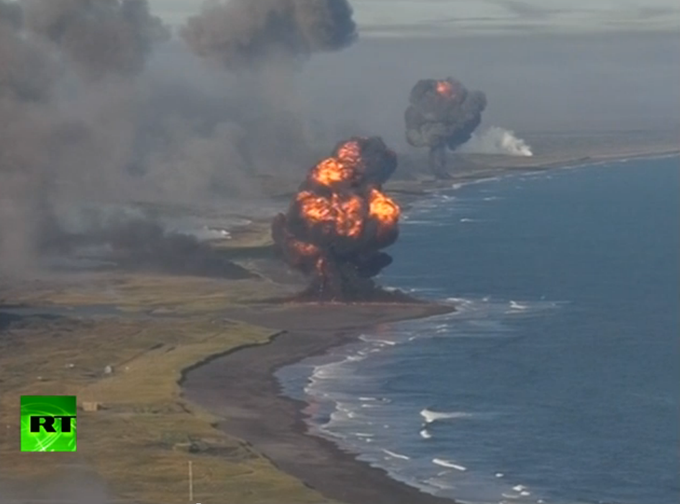
Russia has staged its biggest post-Soviet military drills in the Far East, involving 100,000 servicemen and a vast array of materiel.
During five days of exercises, troops were trained in repulsing a massive airstrike, combating an aircraft carrier, repelling a seaborne landing and many other military activities on a vast scale.
The drills, dubbed “Vostok-2014,” are the largest since the Soviet era. About 100,000 servicemen, up to 1,500 tanks, 120 aircraft, 5,000 pieces of weaponry, military and special hardware, and up to 70 ships took part in the exercises.
Military observers from up to 30 countries were closely monitoring the exercises. Military attachés from Angola, China, Malaysia, North Korea, Peru, Venezuela, Zimbabwe and various other countries attended the ultimate stage of the drills at Skalisty Cape in Kamchatka, with Russia’s Defense Minister Sergey Shoigu joining them. The supply units were to move 10,000 tons of munitions, fuel, food supplies and other materials over long distances, sometimes as far as thousands of kilometers.

Virtually the whole Russian Pacific Fleet was out at sea performing various tasks: protection of the coastline from seaborne assault, anti-submarine and anti-sabotage training, mine-laying operations and a landing on Vrangel Island in the Arctic – the first of its kind in the area. Marines and paratroopers have passed survival tests in the Arctic Circle.


Detachments operating S-300 missile defense systems conducted successful tests, hitting targets from the most difficult tail-chase guidance position. The time needed to carry out all preparations to eliminate the target is only 15 seconds.

In the meantime, supersonic MiG-31 interceptors successfully practiced the elimination of an attack by low-altitude cruise missiles. President of the Academy of Geopolitical Problems, Konstantin Sivkov, told the RIA Novosti news agency: “The US Air Force has not trained on such tasks, whereas other countries do not possess aircraft that could do anything similar.”
The Vostok-2014 maneuvers have proven that in an emergency situation, Russia is capable of putting together a force that would quickly suppress any aggression toward the country, Sivkov said.
However, the maneuvers were marred by the deaths of three soldiers who tried to rescue colleagues from a sinking vehicle.

A group of troops were conducting a landing on a wild shore, when a large wave swept an armored vehicle containing 10 servicemen off of a landing craft on Monday. Seven men inside managed to escape the sinking vehicle, but two servicemen reportedly tried to save the driver trapped inside and all three men died.
The incident is being investigated and the Defense Ministry has posthumously nominated the three soldiers for state awards.

Pentagon: F-22s used in combat for first time in Syria

Published time: September 23, 2014 
F-22 stealth fighter jets belonging to the U.S. Air Force move to take off at a U.S. air force base in Osan, south of Seoul April 3, 2013. (Reuters/Lee Jae-Won)

This week’s strike against Islamic State militants in Syria by the United States marked the first time that the Pentagon has deployed its F-22 Raptor jets into combat, the Defense Department acknowledged on Tuesday.
Lt. Gen. William Mayville, the director of ops for the Joint Chiefs of Staff, acknowledged during a Department of Defense briefing on Tuesday morning that the strikes launched by the US hours earlier were the first ever to involve F-22s — a fifth-generation aircraft that’s capable of dropping precisions bombs on targets from 15 miles away.
“What we were looking at were the effects we wanted to see on the target areas and what platforms in the region would be best suited to do that,” Mayville told reporters at the Pentagon. “We had a large menu of targets to strike from and we chose from there. Really it’s less the platform then the effects we seek.”

U.S. Army Lieutenant General William Mayville,September 18, 2014. (Reuters/Gary Cameron)
The fighter jets have previously been deployed to Asia and the Middle East, the Wall Street Journal acknowledged on Tuesday, but have until now not been relegated with combat duties. The Pentagon had invested roughly $77.4 billion on the fleet of Raptors as of 2012 but, as RT has reported in the past, a series of complications has repeatedly plagued the F-22 program.
Roughly an hour before Mayville’s remarks, US President Barack Obama said during a brief address from the White House in Washington, DC that American forces began strikes in Syria against the Islamic State — also known as ISIS, or ISIL — with the aid of five Arab nations: Saudi Arabia, the United Arab Emirates, Jordan, Bahrain and Qatar. “The proponent of the force” used against IS, Mayville said, was delivered by America’s military, both by air and by sea.

“America is proud to stand shoulder to shoulder with these nations on behalf of our common security,” Obama said early Thursday. “The strength of this coalition makes it clear to the world that this is not America's fight alone.”
Additionally, the president acknowledged, the US “also took strikes to disrupt plotting against the United States and our allies by seasoned Al-Qaeda operatives in Syria who are known as the Khorasan group.” Later, Mayville said the strike against this group was necessary to thwart an “imminent” attack.
"For some time now, we've been tracking plots to conduct attacks in the United States or Europe," Ben Rhodes, Obama's deputy national security adviser, told Reuters. "We believe that attack plotting was imminent and that they had plans to conduct attacks external to Syria," Rhodes told reporters on Tuesday while traveling with the president to the United Nations General Assembly meeting in New York.

US air strikes in Syria and the fight against the Islamic State


ECFR.EU

By - 23 Sep 14

The United States, together with a number of regional allies, has now launched military strikes against Islamic State (IS) positions in Syria, with the immediate stated aim of counter-terrorism rather than regime change. After more than three years of civil war, radical Islamists have finally drawn the US into direct intervention.

But with US action unlikely to be decisive right away, especially given the absence of ground troops, the prospects for success remain very uncertain. Both Syrian President Bashar al-Assad and non-IS rebels are actively trying to position themselves as the West’s natural partner in the fight against extremism.
However, they, as well as some of the regional players who now support air strikes, remain at cross-purposes with the US about the aims of the war as well as about the threat posed by IS.
Critically, Obama’s narrow counter-terrorism focus is by and large not shared by Syria’s non-IS affiliated warring parties, which view the group’s relevance through the prism of the ongoing civil war. Unlike Western powers, neither the regime nor non-IS rebels are primarily occupied with IS’s strength as a jihadi group – though of course it is a concern. Instead, both see IS as a means of leveraging international support to secure victory in the broader domestic conflict. This is an instinct partly shared by two of the key regional partners involved in air strikes, Saudi Arabia and Qatar. As such, the fallout from the attacks threatens new uncertainties and potentially even deeper disarray.

Europe, for its part, has remained silent.
Europe, for its part, has remained silent. Neither the United Kingdom nor France has joined the initial wave of strikes, a hesitation that can in part be viewed as a symptom of the lack of a clear strategy. The uncertainties inherent in the strikes mean that the UK government is wary of parliamentary opposition to action, while France fears that limited intervention will serve to empower the regime in Damascus.
For Assad, the creation of an international coalition targeting IS represents the hoped-for successful culmination of three years of deliberate strategy partly aimed at forcing the West to recognise him as a necessary partner. While claims of direct collaboration between Assad and IS appear largely unfounded, the regime has long focused its military campaign on non-IS rebels as a means of consolidating extremist trends.
Now, however, the regime has finally initiated a campaign of air strikes against IS – even if it is still channelling most of its resources against weaker non-IS rebels – and is calling for a common international front against IS. The West continues to state that Assad can have no partnership role in the campaign, but Assad believes the US and Europe will eventually reverse position. Already there are some reports of intelligence sharing, and the US government alerted Damascus ahead of initiating air strikes.
Nonetheless, Assad is playing a risky game. IS may represent an opportunity, but it also poses significant threats, not least its growing military strength. IS’s expansion together with a number of recent victories against regime forces is also provoking increased dissent among regime loyalists, who are angered by Assad’s apparent unwillingness or inability to wholly confront the group. This internal dissent is not game changing but it is noteworthy, particularly if it is tied to unease on the part of the regime’s key external backers, Iran and Hezbollah, over Assad’s still hesitant position towards a group that threatens their broader regional interests.
Of most concern to the regime, however, is that this now plays out as envisaged by non-IS rebels: through significant international arming of the opposition. Even if Obama has initially committed to narrow US ambitions in Syria, including the limited training and arming of some rebel fighters – aimed at containing IS, rather than bringing down the regime – the insistence that there can be no co-ordination with Assad offers rebels an opportunity to position themselves as the West’s only viable partner on the ground. With air strikes only likely to go so far in weakening an increasingly embedded and emboldened IS, this could eventually result in heavier direct arming.
The overthrow of the regime remains the rebels' central preoccupation.
What is clear is that many of these rebels see the fight against IS as of secondary importance. The overthrow of the regime remains the rebels' central preoccupation, and weapons channelled their way will primarily be focused on this struggle.
The respective positioning of non-IS rebels and Assad highlights an inconvenient truth: as long as Syria’s civil war rages, international attempts to defeat IS militarily will be significantly hampered, particularly if regional allies are also pulling in different directions. While tactical lines may shift as a result of air strikes, they are unlikely to provoke significant strategic realignments. Given their likely inconclusive nature, they risk drawing the West into deeper intervention. While Obama has clearly stated that US intervention in Syria will remain limited, those calling for wider action may see the proposed initial strikes and arming of rebels as the thin edge of the wedge, with further escalation inevitable.
Significantly, narrow air strikes that inflict collateral damage and leave the regime unscathed also risk further empowering IS, consolidating its self-declared position as the only legitimate defender of Syria’s Sunni population. IS’s apparent goading of the US to intervene in Syria and Iraq through the public beheading of a number of hostages may appear misguided given the power that the American military can bring to bear. But blunt military intervention may help entrench local support behind the group.