Tuesday, April 19, 2016

What is the Albania trade model?


FT


A girl plays with pinwheels on April 16, 2016 in Tirana's central square park, during an event entitled "which way does the wind blow" organized by Tedx Tirana . / AFP / GENT SHKULLAKU (Photo credit should read GENT SHKULLAKU/AFP/Getty Images)©AFP
Model economy: Albanian flag flying above centre of capital Tirana
Bosnia, Serbia, Albania and Ukraine are economically weak, desperate to integrate with the EU, and still carrying deep scars from recent war and revolution. So what makes their EU trade model so attractive for Brexit campaigners?
The praise for the Albania-Ukraine option voiced by Michael Gove, justice secretary, echoes the work of pro-leave analysts who see the countries charting “a way forward” that combines free trade with tailored political co-operation.

The hitch is that Brussels sees the pacts — known as “stabilisation and association agreements” in the western Balkans — as special support at the start of a long journey towards EU membership for relatively small, troubled economies, rather than a divorce settlement for a big, successful one.  
Karel De Gucht, the EU’s former trade commissioner, said any Brexit comparison was “ridiculous nonsense”. “Albania is a poor country, a small economy, under-developed,” he said. “It is like comparing a little nut with a big watermelon.”
Olli Rehn, who negotiated such pacts as EU enlargement commissioner, said he was “surprised” the Leave side would want an agreement that would put the UK “permanently on the substitute bench”.
“Besides, I doubt the UK could get the same asymmetric preferential treatment that the western Balkan countries have, as this is intended to support their economic development and European integration path."
The main attractions for Leave supporters are outlined in Business for Britain’s 1,000-page research document called “Change or Go”. 
This looked at Ukraine’s “deep and comprehensive trade agreement” as an “alternative model” to joining the European Economic Area. It allows for a close economic relationship with the EU, without the political and financial obligations of an EEA country like Norway, which semi-automatically applies EU law, accepts free movement and pays into the EU budget.
The report argues the Ukraine trade deal — hatched under the shadow of the Russian annexation of Crimea and war in eastern Ukraine — was an “under-examined way forward” that covers “all the key aspects as well as lightening the obstacles to trade, but without uniformly applying red tape across the home economy”. 
It goes on to say the format has similarities with the EU’s approach to former communist countries in the western Balkans — first called the “Central European Free Trade Agreement”. These attempted to clear trade barriers without cumbersome requirements to pool sovereignty or accept rules wholesale.
For a country like Albania, this has morphed into an association agreement that sets a framework for it to move closer EU law and business standards, in part to give EU investors confidence to work in the country.

What Brexit means for the UK economy
Frequently asked questions about the economics of Britain’s EU referendum
In theory the pact is broad, covering trade in goods and — crucially for the UK — potentially financial services, but only amounts to full single-market access if Albania adapts to apply the existing and future EU rule book.
In financial services it also relates to a tiny Albanian cottage industry, with barely any integration with the European market, whereas the City of London is the continent’s biggest financial hub, handling 40 per cent of wholesale euro-denominated trade.
While Leave campaigners may see the appeal of such a loose association to anchor Britain’s post-Brexit relations, the deal will still need unanimous support from all EU member states. 
Even if EU states are willing to cut a favourable deal with Britain, the political difficulties of implementing it were demonstrated this month when the Netherlands rejected the planned trade pact with Ukraine in a referendum. 
The consultative vote, which could ultimately scupper part of the Ukraine deal, was hailed by Nigel Farage, the UK Independence party leader, as “a victory for democracy” and “new politics”.

Monday, April 18, 2016

Europe’s Newest Micronation Prepares for a Hostile Takeover

Liberland
03:29 18.04.2016


Vit Jedlička, a self-proclaimed president of Liberland, is preparing to take over a no-man’s land between Serbia and Croatia.

The Free Republic of Liberland, a sovereign state created on no-man’s land between Croatia and Serbia, continues to grow with people from all over the world sending in their applications to become citizens, Vit Jedlicka, the president of Liberland, told Radio Sputnik.
If you thought South Sudan was the world's youngest country, you are behind the times. Because last week, a man walked out to an unclaimed little bit of land just seven kilometers square tucked along the Danube between Croatia and Serbia, ran up a flag, and made a country: Liberland.
The Free Republic of Liberland, a micronation proclaimed in 2015 by Czech politician and activist Vit Jedlička, is located on a 7 sq. km of no-man's land between Serbia and Croatia, one of territories disputed by both countries. However, Jedlička claims that neither side is willing to claim this territory.
As Croatian border police prevent people from coming to live at the territory, the micronation remains uninhabited, with only a sole hunting shack remaining its only building.

But in his interview for The Independent, "President" Jedlička revealed that plans are nearly in place for a group of Liberlanders to break through that police blockade in such numbers "there is nothing they can do to stop it".

This weekend Jedlička  and his three volunteer ministers held a conference to discuss Liberland's future at a Croatian hotel just 5 km from the border. During a conference, a plan was adopted to stage a "state celebration" in a field next to the disputed territory which, if all goes to plan, could snowball into a mass takeover action.

"It's going to be a big media event," Jedlička said. "We would like to invite 5,000 people, with the best artists who support Liberland [attending], and we already have two or three major festival organizers in the area helping us."

The self-proclaimed president revealed to The Guardian his plan to use the event for a spontaneous takeover of the land, going as far as threatening the Croatian government to "better give the festival-goers ‘a green light' for the move."

"There is no way you can stop 5,000 people taking over control of Liberland," he said.

Jedlička believes that Liberland will make a successful example of a tax haven — calling it a "tax heaven" — also naming Liberland's own sort of beer as the main source of export.

Having a legislation of only as much as five laws, Liberland is going to be a functioning anarchist state, with black color on its flag representing anarchy. The Serbian Ministry of Foreign Affairs has stated that Liberland, while ‘frivolous', does not infringe upon the border of Serbia, without any other comments. Croatia, however, stated that while the territory's status remains undetermined, after international arbitration, it will be awarded to Croatia or Serbia, not a third party.

Albania Starts Preparing for Diaspora Summit


Ahead of a major summit gathering Albanians from 50 countries around the world, debate still continues on the best ways that Albania can draw on its emigrants' talents.

Fatjona Mejdini
BIRN
Tirana

An Albanian diaspora gathering in the US | Photo: Facebook

Ahead of a major summit of Albanian diaspora communities from around the world, Albania is mulling the best ways of utilizing its large diaspora.

On November 2016, for the first time, the government plans to hold the first-ever diaspora summit, also marking 25 years of post-communist migration.

The Prime Minister, Edi Rama, told a meeting of Albanians in New York on Monday that the summit would open a new chapter for the nation.

"The summit in November is going to be the moment when we show who we are, what we are able to do and that we are experienced enough to do even more," Rama said.

The summit will gather Albanians from around 50 countries around the world, including pre- and post-communist emigrants.

Organisations of Albanian living outside the country have long sought the creation of a special Ministry for the Diaspora and their request is backed by the Albanian President, Bujar Nishani.

The Party for Justice and Integration, PDIU, which represents the Cham community and is part of the ruling coalition led by Rama, also considers the creation of a ministry important.

The Chams are ethnic Albanians expelled from northern Greece at the end of World War II.

Marselino Troshani, president of the Albanian Forum of Associations in Emilia Romagna, Italy, FARE, told BIRN that Albanians in Italy have submitted a formal request to Albania's parliament for the creation of a ministry.

"This ministry would help allow emigrants to vote in Albanian elections and... help the promotion of the country outside its borders," he said, citing the Kosovo Ministry of the Diaspora as a model.

But not all representatives of the Albanian diaspora back the idea of a ministry. The former director of the National Albanian-American Council, Avni Mustafaj, told BIRN that empowering the country's embassies would be the best way of drawing on the diaspora's talents.

He agrees that bringing together members of the Albanian diaspora from around the world is a terrific idea, as many of them have the right education, skills and experience to help the home country.

"I don't agree with a Ministry of Diaspora - but with empowering the various embassies to be more active with Albanian communities in their countries," he said.

"Coordination of this should be done by the Foreign Ministry. I fear parallel structures between ministries," Mustafaj said.

Further reform efforts needed in Albania and Bosnia & Herzegovina, say MEPs

Knut FLECKENSTEIN
  • Knut
    FLECKENSTEIN
  • Group of the Progressive Alliance of Socialists and Democrats in the European Parliament
  • Vice-Chair
  • Germany Sozialdemokratische Partei Deutschlands
Plenary Session Press release - Enlargement / External relations
 
Key political and administrative reforms needed in Albania are progressing, but have yet to reach a stage at which EU accession negotiations could start, say MEPs in Thursday's resolution. In a separate resolution, they welcomed Bosnia & Herzegovina’s EU membership application.

Albania

"Albania is on the right track towards EU membership. The country is currently preparing a very ambitious judiciary reform which will answer the most important concerns expressed by citizens and which will help to fight corruption in everyday life. Albania's citizens want to get ready for EU membership. Now, their political leaders must keep up the momentum and continue implementing the reforms", said rapporteur Knut Fleckenstein (S&D, DE).

The resolution on Albania  says that if it wants to start EU accession negotiations, it must intensify reforms in key priority areas, such as: rule of law, judicial reforms, the fight against corruption and organised crime, public administration reform and fundamental rights .

MEPs remain concerned about widespread corruption in education, healthcare, the judiciary and several other fields . "Widespread self-censorship among journalists, who are sometimes physically obstructed from covering specific events, assaulted, or threatened because of their work" is also a cause for concern, they add.

Bosnia & Herzegovina

"BiH submitted its application for EU membership on the same week where the European Council discussed the UK referendum issue. This proved that the EU model is still attractive", said rapporteur Cristian Dan Preda (EPP, RO). "The European Parliament is determined to support the country’s move closer to Europe, calling on the Council to examine its membership application at the earliest opportunity and encouraging it to stay on the reform path", he added.

MEPs reiterated their unequivocal commitment to Bosnia & Herzegovina's European perspective  and welcomed its application for EU membership, presented on 15 February 2016 . They call on authorities to continue constitutional, legal and political reforms and make steady progress towards EU integration.

The resolution condemns a proposed referendum in Republika Srpska on Bosnia & Herzegovina’s state-level judiciary, saying it challenges the country's cohesion, sovereignty and integrity . MEPs also deplored rampant corruption, and voiced concern about increased pressure on the judiciary by political players .

Both resolutions were passed by a show of hands.

Serbia: 49 arrested in anti-corruption operation


Interior Minister Nebojsa Stefanovic said on Friday that 49 persons had been arrested in raids carried out across Serbia.
Source: RTS, Tanjug
(Image made from MUP video)
They are suspected of corruption and abuse of office, and detained as part of police operation Skener ("scanner") 2.
Stefanovic said that the police filed criminal complaints against 25 persons in regular procedure.

"All these persons have committed numerous criminal acts since 2007, damaging the budgets of Serbia and the autonomous province (of Vojvodina), and several business and private entities to the amount of EUR 7.6 million," he said.

Stefanovic added that officials employed by the Ministry of Finance, the Tax Administration, the former Ministry of Protection of the Environment and Spatial Planning are among the suspects, as well as local officials, those from public companies, including Roads of Serbia, the power company EPS, Elektrokosmet, Posta Srbije, and 12 traffic policemen.

"This is yet another indicator that the police will not stop doing this job, together with prosecutors' offices, and we will show that Serbia can be a completely serious, honest and just country," said Stefanovic.

Μετά τον αρνητικό ρόλο του αλβανικού κράτους, ολιγάρχες και μαφίας,,,, Βορείου Ηπείρου, και Χιμάρα,,, απειλούνται από τους τρομοκράτες της ISIS και ΜΕΚ.


Ποιος είναι ο ρόλος της Ελλάδα, ενώ στη βόρεια σύνορά της με την Αλβανία, η ελληνική κοινότητα, την περιουσία τους και τα εδάφη τους απειλούνται από τρομοκρατικές των ΜΕΚ, σε συνεργασία με τους Αλβανόυς τρομοκράτες της ISIS.....

Ποιος εγγυάται την ασφάλεια στην Αλβανία?

ανάλυση μεγαλύτερη αξία για την γεωπολιτική και την περιοχή.

Clinton-Albania deal ensures MEK (Rajavi cult) members stay as terrorists


Help Us we don't want to be terrorists
When is a terrorist, who is not a terrorist, still a terrorist?
The answer to this complicated riddle can be surprisingly simple: When they are forced to remain in a terrorist group because there is no safe way for them to escape.
There is an ongoing debate in Europe and North America about how defectors from terrorism should be treated as they try to return to their homes in the West. Some say that on security grounds they should be either banned from re-entry or prosecuted and where possible imprisoned as an example to others. Others, usually practitioners who understand that deceptive recruitment is a huge factor in people’s involvement in terrorism, advocate for a more humanitarian and redemptive approach: allow these people home, albeit with severe restrictions imposed on their lives and activities, and get them to undergo re-programming.
What this debate does not address, however, is just how possible it is to actually escape a terrorist group in the first place. If you are in Raqqa, how do you step outside the group and remain safe?
In this context the fate of a handful of Iranians, stranded in Albania without any financial support or accommodation and unable to access refugee services, shines a spotlight on this aspect of the West’s approach to terrorism.
It would be easy to dismiss former MEK members Ehsan Bidi and Siavosh Rastar’s case as a local, individual problem. But when we look in more detail, it has everything to do with whether America and the West are complicit in forcing people to remain in terrorist groups because we do not see the need to help them leave at all. Certainly this is not a solution to terrorism – Plan B: get them all to leave - but a more facilitating approach toward genuine defectors could be a major factor in undermining the hold such groups have on their members.
Three years ago, Ehsan Bidi was brought to Albania along with other members of the Mojahedin Khalq (MEK). But Bidi was already a separated member when he arrived; it had just not been possible for him to escape them while in Iraq. As soon as he arrived he left them. Since then, he had been living on a small financial contribution from the UNHCR along with basic accommodation which they had provided. Suddenly at the end of March this year all this support ended. He and others like him were left destitute.
What Bidi and another handful of defectors didn’t know was that under the 2013 deal struck between former Secretary of State Hillary Clinton and the then Albanian Prime Minister Sali Berisha, the MEK members transferred to Tirana from Camp Liberty in Iraq would not be given official UN refugee status and would be dependent on Maryam Rajavi’s MEK for all their accommodation and costs while in Albania. Amazingly, neither the government of Albania nor the UNHCR has any obligation to treat them as refugees. All of these people are being transferred not as refugees but as the active members of a terrorist entity. In fact, part of the deal struck by Clinton was that the MEK would be removed from the US terrorism list specifically to allow this deal even though every active member remains radicalised to the core and capable of committing acts of terrorism.
This means that when people like Bidi and Rastar choose to reject membership of this terrorist group, they not only face the wrath of the MEK – which has promised to kill Bidi in particular because he is so vocal about this predicament – but they are also left destitute because the state doesn’t recognise them except as members of that terrorist group. After the UNHCR pulled the plug on its support, Bidi and the others were told ‘you must ask Rajavi to allow you back in the MEK or ask the Iranian embassy to send you back to Iran’. Clearly an impossible choice. It is a conundrum which was created by America and must be resolved by America.
A similar situation arose in Iraq after 2003 when the MEK were captured, disarmed and kept in Camp Ashraf. Within weeks the American army was being approached by defectors begging them for help to escape the clutches of the cult. After trying to send them back or ignore them, the army was eventually obliged, under the Fourth Geneva Convention, to establish a separate Temporary Internment and Protection Facility (TIPF) within their own compound to house the defectors. This allowed many others to escape and return to their families and to civilian life.
It is necessary now for the American administration to acknowledge that it has the same obligation toward the people it transferred to Albania under Clinton’s 2013 deal. It must give them the same opportunity to leave the MEK as was granted to people while in Iraq. Safe, alternative accommodation and social support must be given to those who, on principle, reject membership of a terrorist group. It’s almost unthinkable that this isn’t happening already.But while nobody imagines that in among the chaos of war in the Middle East and the massive refugee crisis that has engulfed Western countries, there can be a TIPF or something similar for ex-terrorists, we also know that Daesh kills defectors. They do this under the principle of ownership – we own our fighters and can dispose of them as we see fit.
In this case, if we stand by and allow Daesh, like the MEK, to dictate the conditions of how a defector is treated without making any effort to facilitate their safe exit, if we cannot offer a helping hand to those who wish to redeem themselves, then we are no better than the terrorists ourselves.

Sunday, April 17, 2016

George Friedman: NATO is an illusion


George Friedman, Mauldin Economics
Apr. 16, 2016,
NATO
NATOReuters/Francois Lenoir
NATO Secretary-General Jens Stoltenberg chairs a NATO defence ministers meeting at the Alliance headquarters in Brussels, Belgium.

Donald Trump’s statements that Europe isn’t paying its “fair share” and that it would be fine if NATO broke up are regarded with increasing concern in Europe.

Russia and the Middle East both present national security issues for all of Europe. Europe, however, has no integrated military capability except for NATO, and NATO is now in shambles. It is a military alliance, but Europe has allowed its military capability to weaken dramatically.

Many Europeans see NATO as the foundation of their national security. In other words, they depend on the United States… the only NATO member with a global military capability.

Now the Europeans worry that the US has lost confidence in NATO and the alliance is no longer the safety guarantor it used to be. And I think they are right.

Here’s why…

Europe Is Nothing but NATO’s Soft Power
From the start, the Europeans wanted NATO to serve as the mechanism for approving and overseeing military operations. They wanted a decisive voice in how NATO members, including the United States, applied their military power.

However, their forces were so small that in most cases, their participation was little more than symbolic. NATO became less and less a factor in US decision making, and the Europeans compensated by congratulating themselves for their sophistication compared to the American “cowboys.”

The Europeans celebrated a concept called soft power, which involves sanctions, the mobilization of public opinion, and other strategies that avoid military action. They wanted an option that cost less than becoming a global power.

Soft power, however, was simply a way to evade reality. As the Russians loomed larger and the Middle East spilled over into Europe, the Europeans discovered that soft power was… soft. And that they needed hard power, which the United States had (and to a far lesser extent Britain and France), but no one else did.

Suddenly, the world seemed out of control to the Europeans since they lacked the hard power to shape events.

In terms of soft power, NATO began to take on a function it was never designed for. As communism fell, post-communist European states sought membership in NATO—not so much to be defended, but to become integrated and Europeanized.

Membership in the EU and NATO, it was believed, would turn these former Soviet satellites into Western countries. But NATO is a military alliance. It’s about tanks and planes and war plans.

Integrating new countries into Western Europe was not the alliance’s purpose. Defending these countries and the rest of Europe was NATO’s function, but that function atrophied as war seemed increasingly irrelevant.

NATO No Longer Serves the Purpose for the US
The Europeans felt that the United States’ power should be available to them through NATO. They now hear the message that the United States is not prepared to spend a vast amount of money on its military and then allow the Europeans a voice in its use.

The issue is not NATO itself, but the defense relationship between Europe and the United States. NATO is simply the old framework for that relationship, which was established after World War II.

At the time, the United States towered over Europe economically and militarily. Europe had little that it could contribute to defense, while the United States had an overriding interest in preventing the Soviets from seizing Western Europe.

Comfortable with the asymmetrical arrangement, the US contributed the bulk of the military power to potentially fight a war on European territory, while Europe took the primary risk.

That was the foundation of NATO. That foundation crumbled long ago, mostly with the fall of the Soviet Union and the signing of the Maastricht Treaty that created the European Union.

nato trainingNATO
NATO military training at Ādaži Military Base.

Europe Is Too Complex to Defend Itself
The total population of the European Union is just over 508 million people. The population of the United States is about 320 million people. The GDP of the European Union is $18.45 trillion, while the GDP of the United States is about $18.3 trillion.

In other words, Europe and the United States are equal in wealth, while Europe has almost 200 million people more than the US does. There is, therefore, no reason why the Europeans should not have a military capability equal to or even greater than that of the US.

Though Europe was understandably the junior partner in the 1950s, neither demographics nor economics show the continent to be a junior partner now.
Today, policy decisions are what ensure the ongoing asymmetry between the United State’s commitment to NATO and Europe’s.

The structural problem is that the European Union lacks a defense dimension. European unification is a complex quilt of relationships, and defense rests in the hands of individual sovereign states.

The largest state, Germany, which should be devoting the most to a European defense force, devotes little even to its own force. Britain is cutting back its defense expenditures. And while France is raising the issue of increasing defense budgets, it still has a military force with limited capability.

There is an assumption in NATO that each country will devote 2% of its GDP to defense. A few do this, but most do not, and Europe as a whole does not come close. The American contribution to NATO is 2.7% of US GDP.

The extraordinary fact is not that Trump pointed out this disparity and made clear that it couldn’t continue, but that it took Trump to make this a major issue.
nato training
Nato military exerciseSgt. Sara Graham/USMC
Lance Cpl. Arturo Campos, assistant fire team leader for Delta Co., 4th Light Armored Reconnaissance Battalion, 4th Marine Division, run through dry fire drills during exercise Trident Juncture 2015 in Almeria, Spain, Oct. 27, 2015. These drills allow Reserve Marines to train in realistic environments and maintain a high state of readiness. More than 36,000 troops from more than 30 nations are participating in the exercise which is the largest NATO has conducted in the past 10 years.

Europe Must Take the Lead, but It Can’t
NATO’s mission was clear during the Cold War. It was to defend Western Europe from a Soviet attack. Military alliances function best with simple objectives. In this case, the military mission evaporated, but the alliance continued in place.

Lacking a clear and present military mission, Europeans became even more reluctant to invest in defense. The need for defense seemed distant from the reality Europe was living in.

Now, the Russians are reasserting their place in history, and the Islamic State is targeting European capitals. It is not clear how the threats they pose are to be countered, but the challenge will demand military force in some capacity.

The United States has been seen as vastly overreacting to 9/11 in Europe. A counterargument is that the Europeans simply didn’t believe they would become targets, but they have.

Today the fears fanned by terrorist acts in Europe have less to do with the number killed than with the disconcerting reality that a strike may come at any place and at any time. A state that does not act quickly and decisively to counter terrorism within its borders loses legitimacy and the trust of its public and its allies.

The Europeans must act, as the United States has determined that it will no longer act alone. In the case of Syria, the US is prepared to use air power but will not deploy the multidivisional force needed to bring peace to the country.

Instead, the US wants fellow NATO partners to shoulder a much larger part of the burden. And while the US is prepared to play a part, it does not intend to take the leading role.
Nato military exercise
Nato military exerciseTony Gentile/REUTERS
Military planes fly in formation during a NATO military exercise at the Birgi NATO Airbase in Trapani, Italy October 19, 2015. NATO and its allies opened their largest military exercise in more than a decade on Monday, choosing the central Mediterranean to showcase strengths that face threats from Russia's growing military presence from the Baltics to Syria.

Europe, however, is incapable of taking that role because it does not have the troops, hardware, or motivation to do so. Thus, the Europeans will continue to hope for soft power solutions so as to avoid the pain of hard power actions.

They will not be able to act decisively, even if they wish to do so, for many years. As for Russia and the situation in Ukraine, the US is taking steps in conjunction with Poland and Romania, but geography dictates that it cannot be the primary player there.

The foundations of NATO have dissolved. Europe’s financial commitment to NATO is not credible. The willingness of the US to operate within the constraints of NATO is long gone. A unified strategic outlook is missing.

NATO can be repaired, but it is hard to see that there is any unified vision or will to do so. Multinational institutions do not die. They continue to have annual meetings, such as NATO’s upcoming summit in Poland in July. But what is a military alliance without a military or a mission? It is just an anachronism.

The Europeans understand the problem, but want it to go away because dealing with it is much too hard. The problem will not go away, but the United States will as the partnership with Europe is largely an illusion.

The threats posed by Russian ambitions and terrorist plots will not go away, but will simply become increasingly difficult to manage. Good will and conferences cannot solve the problem. I think that the twentieth century exhausted Europe’s will to do difficult things, and for more than half a century, the things Europe had to do were relatively simple.

That is no longer the case. We will all agree that something needs to be done. We will also know that nothing will be.

Top Navy official: Russian sub activity expands to Cold War level


POSTED 1:56 PM, APRIL 16, 2016, BY CNN WIRE

Russia is deploying its ballistic missiles and attack submarines in numbers, range and aggression not seen in two decades, according to a top U.S. Navy official.
In an exclusive interview, the commander of U.S. Naval Forces in Europe told CNN that the buildup reflects an alarming strategic world view.

“NATO is viewed as an existential threat to Russia, and in the post-Cold War period, the expansion of NATO eastward closer to Russia and our military capability they view as a very visceral threat to Russia,” Adm. Mark Ferguson said.

Ferguson spoke from his base in Naples, Italy, home to U.S. Naval forces in Europe and the Navy’s 6th Fleet.

Adding to U.S. apprehension, Russia is deploying new submarines that are harder for U.S. naval forces to track and detect following years and billions of dollars in investment.

They are quieter, better armed and have a greater range of operation.

“The submarines that we’re seeing are much more stealthy,” Ferguson said. “We’re seeing (the Russians) have more advanced weapons systems, missile systems that can attack land at long ranges, and we also see their operating proficiency is getting better as they range farther from home waters.”

The U.S. currently has 53 submarines in its inventory, but because of decommissioning and budget decisions, Ferguson said that figure will drop to 41 by the late 2020s.

“We cannot maintain 100% awareness of Russian sub activity today,” retired Adm. James Stavridis, a former NATO supreme allied commander, told CNN. “Our attack subs are better, but not by much. Russian subs pose an existential threat to U.S. carrier groups.”

The increased Russian sub activity is backed by a much broader military expansion.

Russia is adding or upgrading some 12 naval bases across the Arctic Circle — expanding its capability to send subs in numbers through the crucial Greenland-Iceland-U.K. gap into the Atlantic — and closer to U.S. and NATO territorial waters.

They country also stationed six submarines in the Black Sea recently, giving them greater reach in the Mediterranean.

More worrying to the U.S., Moscow is also adding entirely new categories of submarines with greater capabilities to its arsenal.

“They have increased the readiness levels of the force,” Ferguson said. “They are operating it with more … out-of-area deployments, and what we are seeing is an improvement in the readiness of that force as well.”

The U.S. believes the new activity is designed to achieve multiple objectives, including denying NATO and the U.S. the ability to operate within Russia’s so-called “near abroad.”

Ferguson said that one important goal for Russia “is to build their own naval capability in the undersea domain to begin to deny NATO and the United States the ability to maneuver on the maritime flanks of NATO.”

Increasingly alarmed by Russia’s new sub developments, the U.S. and its NATO allies are launching new training exercises in anti-submarine warfare and deploying new systems, including the P8 Poseidon reconnaissance aircraft.

Russia’s growing military activity extends above the surface as well.

A Russian fighter jet’s fly-by of the USS Donald Cook this week — coming within 30 feet laterally and 100 feet vertically — is behavior U.S. naval commanders have not witnessed since the Cold War.

“We had radio calls in both English and Russian and the aircraft didn’t respond and proceeded on a course directly at the ship,” Ferguson said. “While we had seen these interactions before, this one was different because of the proximity to the ship, and the altitude and the flight path that it took.”

Putin Right on Role of Clinton-Bush Dynasties Dominating US Politics © AP Photo/ Charles Dharapak POLITICS

President Barack Obama stands with former presidents George W. Bush, Bill Clinton, George H.W. Bush, and Jimmy Carter.
07:24 16.04.2016
Russian President Vladimir Putin was accurate in his assessment of the durability of the political establishment in the United States, but sometimes the advantages of wealth and dynasty can backfire, former European Union adviser Paolo von Schirach told Sputnik.

WASHINGTON (Sputnik) — In his annual nationally televised question and answer broadcast with the Russian people on Thursday, Putin expressed his doubts about the possibility of removing power from established circles in the United States, citing the Bush and Clinton political dynasties as examples.


Putin Identifies Continuing Grip of Neocon-Liberal Militarists Running US Policy
"Yes, it is true that in America politics has become a ‘family business’, in at least some instances. Of course the Bush and Clinton ‘dynasties’ seem to prove Putin’s point," Schirach, president of the Global Policy Institute and a professor of international relations at BAU University, said on Friday.

However, Schirach noted that the current US presidential election campaign had also exposed unanticipated limits to the effectiveness of financial and dynastic influence in retaining or renewing political power.

"Notwithstanding formidable financial backing coming from old friends of his family, former Florida Governor Jeb Bush failed miserably in his attempt to gain the Republican nomination, mostly because Republican voters did not want to have ‘another Bush’ leading their party."

Jeb Bush had anticipated a possible popular reaction against his family and had thought he could overcome it by repackaging himself as an independent figure, but his effort failed completely, Schirach noted.

"The former governor tried to deflect this objection by presenting himself to the voters as ‘Jeb,’ and not as another Bush. But, it did not work. The family legacy proved to be a huge obstacle."

However, Schirach acknowledged that Bush’s failure had not ended the dynastic influence in US national politics.

Hillary Clinton, former two-term first lady and secretary of state, "most likely will be the Democratic Party nominee, with very good chances to be elected President," he admitted.

But even Clinton, who had anticipated a smooth "coronation" to the Democratic presidential nomination, still faced two uphill battles, first for the nomination against Senator Bernie Sanders, and then to win the national election in November, Schirach predicted.

"As several opinion polls show, a majority of Americans do not like her, in large part because she is seen as the latest manifestation of the ‘Clinton Machine,’" he acknowledged, referring to the entrenched connections and loyalists in the US establishment.

Sanders has routinely criticized Clinton for her connections to the large financial institutions on Wall Street and hefty payments and donations she received from them.

President Putin was also accurate in his observation because the very structure of the US political system was strongly weighted against change, renewal and reform by electing new people with different ideas to the two chambers of Congress, Schirach maintained.

"The real problem in American politics is that the system at the congressional level — mostly in the House of Representatives, but also in Senate elections — strongly favors incumbents," he stated. "This prevents the renewal of the national leadership. And this is a real issue."

This electoral dynamic had created an almost unmovable political establishment composed of perennially re-elected House and some Senate members, Schirach concluded.

Saudi Arabia Threatens United States: Will Dump US Treasury Holdings, If Congress Passes 9-11 Bill

undefined
written by robert wenzel
saturday april 16, 2016


Saudi Arabia has told the Obama administration and members of Congress that it will sell off hundreds of billions of dollars’ worth of American assets held by the kingdom if Congress passes a bill that would allow the Saudi government to be held responsible in American courts for any role in the Sept. 11, 2001, attacks, reports NYT.

According to NYT, Adel al-Jubeir, the Saudi foreign minister, delivered the kingdom’s message personally last month during a trip to Washington, telling lawmakers that Saudi Arabia would be forced to sell up to $750 billion in treasury securities and other assets in the United States before they could be in danger of being frozen by American courts.

The administration, which argues that the legislation would put Americans at legal risk overseas, has been lobbying so intently against the bill that some lawmakers and families of Sept. 11 victims are infuriated. In their view, the Obama administration has consistently sided with the kingdom and has thwarted their efforts to learn what they believe to be the truth about the role some Saudi officials played in the terrorist plot.

President Obama will arrive in Riyadh on Wednesday for meetings with King Salman and other Saudi officials. It is unclear whether the dispute over the Sept. 11 legislation will be on the agenda for the talks.

Reprinted with permission from Economic Policy Journal.

US, EU Back Albania’s Regional Center to Fight Radicalism

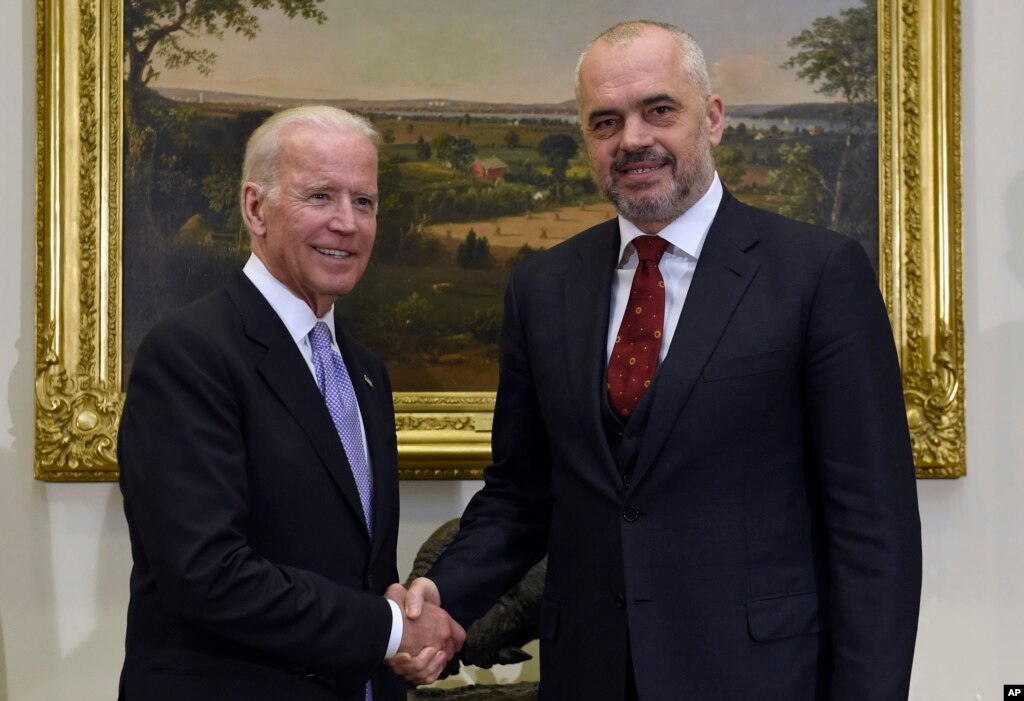
Vice President Joe Biden shakes hands with Albanian Prime Minister Edi Rama in the Roosevelt Room of the White House in Washington, April 14, 2016.
Ilir Ikonomi
Albanian Prime Minister Edi Rama said Thursday that preparations were underway in his country to set up a regional center for the fight against radicalism.
In comments made immediately following a meeting with President Barack Obama at the White House, Rama said his government had the backing of the United States and the European Union in this undertaking.
He said Albania was also striving to promote religious coexistence among youth. Young people, he said, should not take religious coexistence for granted; they need to invest in it.
Rama said he was also meeting with FBI officials to ask for technical support in improving Albania’s justice system. The changes include the creation of an anti-corruption court and a prosecutor's office as well as a national investigative body similar to the FBI. The United States has provided $20 million in assistance to support the reforms, and $5 million more is budgeted this year.
During his visit, Rama praised the United States for its strong support of Albania since the collapse of communism in the early 1990s.
Albania, a NATO member since 2009, enjoys a strategic partnership with the United States.
The Balkan nation has been helping relocate thousands of members of the exiled Iranian Mujahedeen-e-Khalq opposition group. Over the past year and a half, Albania has taken in about 1,000 members of the group and has committed to taking 2,000 more.
During his weeklong visit, the Albanian prime minister has drawn attention with comments strongly critical of Republican presidential candidate Donald Trump, saying Americans should not vote for him.

Πρόκληση της Αλβανίας: Αφαιρούνται τίτλοι ιδιοκτησίας από 123 ελληνικές οικογένειες

Στην περιοχή της Χειμάρρας

 
Proto Thema

Πρόκληση της Αλβανίας: Αφαιρούνται τίτλοι ιδιοκτησίας από 123 ελληνικές οικογένειες


dIn

Πρόκειται για τίτλους ιδιοκτησίας που εκδόθηκαν 22 χρόνια πριν, το 1994, σε ελληνικές οικογένειες των Δρυμάδων

Με μία προκλητική απόφαση τα Τίρανα ακυρώνουν τίτλους ιδιοκτησίας για τη γη που κατέχουν 123 ελληνικές οικογένειες στο χωριό Δρυμάδες της Χειμάρρας. Όπως έφερε στο φως η ενημερωτική πύλη himara.gr, μέσω γραπτής ανακοίνωσης που τοιχοκολλήθηκε σε καφενείο του χωριού, έγινε γνωστή η απόφαση της Επιτροπής Ελέγχου Τίτλων Ιδιοκτησίας που συστάθηκε από την Νομαρχία Αυλώνας με απόφαση του Αλβανού πρωθυπουργού Έντι Ράμα. Πρόκειται για τίτλους ιδιοκτησίας που εκδόθηκαν 22 χρόνια πριν, το 1994, σε ελληνικές οικογένειες των Δρυμάδων, με βάση το νόμο 7501. Η προκλητική απόφαση κάνει λόγο για «παρατυπίες» σε 123 τίτλους ιδιοκτησίας που εκδόθηκαν το 1994 και ζητείται από τον Δήμο Χειμάρρας να προχωρήσει στην ακύρωσή τους

Πρόσφατα , ο πρωθυπουργός Ράμα δήλωσε στο χωριό Βουνό της Χειμάρρας, πως έχουν εντοπιστεί 11.000 στρέμματα με «παράνομους» τίτλους ιδιοκτησίας. Ωστόσο η κίνηση αυτή εντάσσεται στις μεθοδεύσεις της αλβανικής κυβέρνησης να αφαιρέσει αυθαίρετα τίτλους ιδιοκτησίας από δεκάδες ομογενείς της περιοχής, Είναι χαρακτηριστικό, πως με την απόφαση αυτή αφαιρούνται ουσιαστικά η γη από τις μισές ελληνικές οικογένειες των Δρυμάδων.

Κάθε τίτλος ιδιοκτησίας συμπεριλαμβάνει όλα τα αγροτεμάχια που έχει στην κατοχή της μια οικογένεια, που κατά περίπτωση μπορεί να είναι από 1 έως 10 και περισσότερα με έκταση από 100 τ.μ. έως 10.000 τ.μ. το καθένα. Γίνεται λοιπόν αντιληπτό το τεράστιο μέγεθος της συνολικής ακίνητης περιουσίας που επιχειρείται να αφαιρεθεί από τις οικογένειες αυτές.

Όπως αναφέρει το himara.gr, μετά την ακύρωση των τίτλων ιδιοκτησίας τα κτήματα αυτά επιστρέφουν στο αλβανικό κράτος το οποίο μπορεί:
1) Να τα παραχωρήσει στο ταμείο ελεύθερων κτημάτων, τα οποία θα δοθούν σε Αλβανούς υπηκόους των οποίων οι περιουσίες (στα Τίρανα ή αλλού) είχαν κατασχεθεί από το κομουνιστικό καθεστώς.
2) Να τα παραχωρήσει σε Αλβανούς επενδυτές έναντι 1 ευρώ με βάση το νόμο για την ανάπτυξη του τουρισμού.

Τα τελευταία χρόνια τα Τίρανα έχουν στοχοποιήσει ιδιοκτησίες που ανήκουν σε Έλληνες κατοίκους της παραθαλάσσιας περιοχής, η οποία θεωρείται «τουριστικό φιλέτο». Η πολιτική των Τιράνων εντάσσεται στην συνεχή προσπάθεια αφελληνισμού της Χειμάρρας, όπως συνέβη με τον Ελληνισμό των Αγίων Σαράντα και του Αργυροκάστρου. Έως το 1945 η Χειμάρρα ήταν επισήμως αναγνωρισμένη από την Αλβανία, ως ελληνική μειονοτική ζώνη.

Σήμερα η περιοχή δεν ανήκει στη μειονοτική ζώνη που αναγνωρίζει η Αλβανία και επίσημα καλύπτει μόλις 99 χωριά της επαρχίας Αργυροκάστρου. Για τα επίσημα Τίρανα, οι κάτοικοι της Χειμάρρας είναι «δίγλωσσοι» Αλβανοί.

Saturday, April 16, 2016

Pope Francis Takes 12 Refugees Back to Vatican After Trip to Greece

Pope Francis arriving Saturday at the Moria detention center on the Greek island of Lesbos, where refugees are held as they await rulings on their asylum applications. Credit Aris Messinis/Agence France-Presse — Getty Images
MYTILENE, Greece — Pope Francis made an emotional visit into the heart of Europe’s migrant crisis on Saturday and took 12 Muslim refugees from Syria, including six children, with him back to Rome aboard the papal plane.
The action punctuated the pope’s pleas for sympathy to the crisis confronting the refugees just as European attitudes are hardening against them.
Those taken to Rome were three families — two from Damascus and one from Deir al-Zour — whose homes had been bombed in the Syrian war, the Vatican said in a statement as the pope departed the Greek island of Lesbos, where he had visited the Moria refugee camp. “The pope has desired to make a gesture of welcome regarding refugees,” the statement said.
The announcement capped a brief trip by the pope to Greece that again placed the plight of migrants at the center of his papacy.
“We have come to call the attention of the world to this grave humanitarian crisis and to plead for its resolution,” Francis said during a lunchtime visit to the Moria camp, where leaders of Eastern Orthodox Christian churches joined him.
“As people of faith, we wish to join our voices to speak out on your behalf,” Francis continued. “We hope that the world will heed these scenes of tragic and indeed desperate need, and respond in a way worthy of our common humanity.”
While the announcement had the appearance of a surprise, Francis told reporters on the plane ride home that the relocation of the refugees had involved planning and paperwork by the governments of the Vatican, Italy and Greece. In Rome, the Catholic charitable association Sant’Egidio will help care for the families and try to find them work.
Continue reading the main story
The pope did not explain how the families had been chosen, but said: “They are guests of the Vatican.”
Francis also showed reporters two drawings given to him by children in the Moria camp. One showed children drowning in the sea. The other showed the sun crying.
“The children have these things in their minds, and it will take time before these memories go away,” the pope said. “If the sun is able to cry, so can we. A tear will do us good.”
While papal visits to refugee camps are not new, religious scholars said Francis’ rescue of the 12 Syrians sent an important signal that reflected his long history of affinity with the world’s most vulnerable, dating to his roots as a Jesuit priest in Argentina.
“Welcoming the stranger is the heart of the Christian message,” said Charles Camosy, a professor of Christian ethics at Fordham University in New York. While Francis is often seen as a progressive pope, Mr. Camosy said, he also is “pushing a more traditional understanding of what Christianity is all about.”
Francis’ first papal trip in 2013 was to the Italian island of Lampedusa, to call attention to the refugees who were arriving there from Libya — or drowning before they reached shore. During his February visit to Mexico, Francis prayed beneath a large cross erected in Ciudad Juárez, just footsteps from the border with the United States, and then celebrated Mass nearby, where he spoke about immigrants.
Photo
A group of Syrian refugees preparing to board a plane Saturday with Pope Francis at the airport of Mytilene on the Greek island of Lesbos. Credit Pool photo by Filippo Monteforte
Upon landing in Lesbos on Saturday, Francis held a brief private meeting with Greece’s prime minister, Alexis Tsipras, before traveling across the island to the detention center in Moria, where people are held as they await rulings on their asylum applications — or as they wait to be deported under a recent agreement struck between the European Union and Turkey to curb migration.
Beginning last summer, hundreds of thousands of migrants, mostly from Syria, Iraq and Afghanistan, have poured into Lesbos after paying smugglers to make the short sea journey from Turkey. The procession through Greece and the Balkans toward Germany plunged the European Union into a political crisis and eventually led several countries to restrict or close their borders.
The deal with Turkey includes a provision under which migrants arriving in Greece can be swiftly deported back to Turkey. Since the deal took effect last month, the number of migrants arriving in Lesbos has dropped sharply (even as the numbers arriving in Italy are steadily rising). Critics say the agreement has trampled on the civil rights of refugees fleeing war and betrayed the ideals of the European Union.
At the migrants camp, Ecumenical Patriarch Bartholomew, the spiritual leader of the world’s Eastern Orthodox Christians, reminded Europeans and their leaders that Christians and others are judged on how they treat the powerless. “The world will be judged by the way it has treated you,” Bartholomew told the refugees. “And we will all be accountable for the way we respond to the crisis and conflict in the regions that you come from. The Mediterranean Sea should not be a tomb.”
Thousands of migrants have drowned in the Mediterranean, including a young child whose limp body washed ashore last year on the Turkish coast. A photograph of the child became a searing icon of the refugee crisis. “I hope that we never see children washing up on the shores of the Aegean Sea,” said Archbishop Ieronymos II, the leader of the Greek Orthodox Church, who called for a greater response by the United Nations. “I hope to soon see them there, untroubled, enjoying life.”
At the Moria center, Francis slowly walked down a line of migrants, many of them Muslims, greeting people as some waved handwritten signs with slogans like “Freedom of Movement.” Others propped their children above their shoulders or held out smartphones to photograph the pope.
Inside a large white tent, Francis greeted a woman in a head scarf as she cradled her baby, as well as other refugee families. A small boy stepped forward and handed him a picture drawn with crayons. An Iraqi mother asked Francis to help her find medical care for her child’s bone cancer. At one point, a man began wailing as Francis placed his hands on the man’s head. “Please, Father, bless me!” the man shouted. “Please, Father, bless me!”
Francis and the other religious leaders offered special praise on Saturday for ordinary Greeks who have welcomed refugees, taken some into their homes or provided food and clothing, even as they endure hardship amid the country’s long-running financial crisis. Mr. Tsipras and other Greek leaders have called on the European Union to provide more help to the country as it has borne the brunt of the migrant crisis.
Across Europe, the mood has soured in recent months, as many countries have closed or restricted their borders amid mounting public anxiety over the chaotic influx of more than a million refugees last year. The recent terrorist attacks in Paris and Brussels have also darkened public attitudes and stirred anti-migrant sentiment in some areas, even as many refugees say they are trying to escape extremist violence. Far-right, anti-immigrant parties have seized on the crisis to make gains, most recently in regional elections in Germany.
By appearing with the two Orthodox Christian leaders, Francis also took another small step in healing the breach between the Eastern and Western branches of Christianity. Francis has made ecumenical outreach a priority and in February became the first pope to meet with the patriarch of the Russian Orthodox Church.
Carlo Pioppi, a professor of church history at Santa Croce University in Rome, said the appearance by the three leaders showed they could put aside doctrinal and theological differences to highlight their shared concern about refugees. The three men described the refugee influx as one of Europe’s most serious crises since the end of World War II.
“Regular people will understand the sign these three religious leaders are sending,” Professor Pioppi said in an interview on Friday. “To see them have lunch with refugees, all together, is a strong message of humanity.”
The British charity Oxfam released a statement on Friday calling for a moratorium on deportations of refugees from Greece to Turkey until the authorities can guarantee that asylum processes are followed. The group also raised questions about new “fast track” processes to review asylum cases that the Greek Parliament recently approved under pressure from the European Union.
“Thousands are being held in squalid detention centers on the Greek Islands — this is the state of Europe in 2016,” Farah Karimi, the executive director of Oxfam Novib, the Dutch affiliate of Oxfam, said in the statement. “Shame on the E.U. for prioritizing detention and deportation over people’s rights to safety and dignity.”
Follow Jim Yardley on Twitter @JimBYardley.
Ney Work Times

NATO’s Freezing of Relations With Russia Not Paid Off

A general view of the table for a meeting of the NATO-Russia Council at the level of defense ministers at NATO headquarters in Brussels on Wednesday, Oct. 23, 2013

© AP Photo/ Yves Herman
Politics

NATO has unilaterally frozen cooperation with Russia in all areas, including in countering terrorism, according to a source in the Russia Foreign Ministry.

MOSCOW (Sputnik) — The decision of NATO to unilaterally cut all cooperation with Moscow has not paid off, which prompted the alliance's initiative to hold the upcoming NATO-Russia Council meeting, a source in the Russia Foreign Ministry told RIA Novosti on Saturday.
"The alliance has unilaterally frozen cooperation with Russia in all areas, including in countering terrorism… Events have shown that this policy of the alliance did not pay off and instead of solving problems it led to their worsening," the source said.
According to the source, NATO officials initiated the resumption of the NATO-Russia Council’s work, which was welcomed by Moscow under the condition of equality and being constructive. The meeting between NATO and Russian permanent representatives is scheduled to be held April 20 in Brussels.

Thursday, April 14, 2016

Τον αφανισμό του Ελληνικού στοιχείου επιδιώκει η Κυβέρνηση Ράμα – Τι κάνει η Ελλάδα?

DRYMADES

  Proinos-logos-logo
στην κατηγορία ΕΘΝΙΚΑ
 
Απτόητη και ανενόχλητη η κυβέρνηση Έντι Ράμα, συνεχίζει το έργο της για τον αφανισμό του Ελληνικού στοιχείου της Αλβανίας.

ΝΕΕΣ ΑΡΠΑΓΕΣ ΠΕΡΙΟΥΣΙΩΝ ΟΜΟΓΕΝΩΝ!

– Αφαίρεσαν τίτλους ιδιοκτησίας από 123 κατοίκους των Δρυμάδων Χιμάρας!
–  Αρνούνται την παραχώρηση ναών στην Αλβανική Ορθόδοξη Εκκλησία
– Συνεχίζεται η προφυλάκιση του πρώην Υπουργού Σπ. Ξέρρα
– Κράτος εν κράτει στη Ν. Αλβανία ο Κ. Κοκδήμα

Τα επεισόδια είναι διαδοχικά, οι προκλήσεις κατά της Ελλάδος συνεχείς, δίχως παρά ταύτα να αποτελούν εμπόδια στους υπουργούς της Αλβανικής Κυβέρνησης να έρχονται στην Ελλάδα και να ζητούν τη στήριξή της, τόσο σε επίπεδο διμερών σχέσεων, όσο και σε ζητήματα που αφορούν τις διαδικασίες ένταξης στην Ευρωπαϊκή Ένωση, αλλά και στο μεγάλο θέμα των ημερών, το προσφυγικό, όπως έπραξαν στις πρόσφατες επισκέψεις τους στην Αθήνα οι Υπουργοί Εξωτερικών και Εσωτερικών.
Το θέμα των θαλάσσιων συνόρων είναι ένα από εκείνα για τα οποία η Αλβανία και ειδικά η Κυβέρνηση Ράμα, στρέφεται ευθέως κατά των Ελληνικών συμφερόντων, «υπακούοντας» ουσιαστικά στις προτροπές της Τουρκίας, που δεν επιθυμεί με τίποτε να δημιουργηθεί προηγούμενο που θα επηρεάσει και τις αντίστοιχες διευθετήσεις στο Αιγαίο. Εξίσου όμως σοβαρά τα ζητήματα που ανοίγονται στην περιοχή της Χιμάρας, με επίκεντρο το ιδιοκτησιακό των Ομογενών, αλλά και μια σειρά άλλων πράξεων της Αλβανικής Κυβέρνησης που στοχοποιεί σε κάθε ευκαιρία Ελληνικής καταγωγής και συνείδησης Αλβανούς πολίτες.

Η περίπτωση Ξέρρα
 
Χαρακτηριστικό παράδειγμα είναι άλλωστε η σύλληψη και η προφυλάκιση κατά παράβαση ακόμη και αυτού του Αλβανικού νομικού πλαισίου, του Βορειοηπειρώτη πρώην Υπουργού Εργασίας Σπύρου Ξέρρα. Οι προσφυγές κατά της άδικης προφυλάκισής του απορρίφθηκαν και από τα τρία δικαστικά όργανα, με τελευταία την απόφαση του Ανώτατου Δικαστηρίου που έκρινε νόμιμη την απόφαση  κράτησής  του, η οποία στηρίχτηκε στην εκτίμηση ότι μπορεί να αλλοιώσει στοιχεία της προδικαστικής διαδικασίας, παρά τον γεγονός ότι πλέον δεν έχει καμία δυνατότητα εισόδου στο Υπουργείο Εργασίας.

123 οικογένειες χωρίς περιουσίες
 
Η υπόθεση Ξέρα, όπως πανταχόθεν ομολογείται, χρησιμοποιείται από το Αλβανικό κατεστημένο, ως παράδειγμα «υποταγής» και «σιωπής» στα σχέδια της Κυβέρνησης. Και είναι ιδιαίτερα χρήσιμη για τη νέα «επίθεση» κατά των Ομογενών της Χιμάρας και συγκεκριμένα των Δρυμάδων, όπου ξεκινά διαδικασία ακύρωσης των τίτλων ιδιοκτησίας 123 οικογενειών, που δόθηκαν πριν 22 χρόνια, όταν είχε δηλαδή αποκατασταθεί η Δημοκρατία (με τα όποια προβλήματά της). Η απόφαση φέρει μάλιστα ημερομηνία 1 Απριλίου 2016 και η ανάρτηση της λίστας σε καφενείο του χωριού, έγινε σχεδόν ταυτόχρονα με την επίσκεψη του Έλληνα Πρέσβη στα Τίρανα κ. Ροκανά, στη Χιμάρα όπου το βασικό θέμα των συναντήσεών του ήταν το περιουσιακό.

Ο ρόλος Κοκδήμα
 
Άλλωστε πριν τεθούν στο στόχαστρο οι κάτοικοι των Δρυμάδων, το Αλβανικό κατεστημένο είχε κάνει επίδειξη δύναμης μέσα στην πόλη της Χιμάρας, όπου εκτός της αφαίρεσης τίτλων ιδιοκτησίας από οικογένειες ομογενών,  κατεδαφίστηκε με συνοπτικές διαδικασίες παραλιακή ιδιοκτησία ομογενούς και στη θέση της κατασκευάζεται νέο κτίριο. Η συγκεκριμένη δεν είναι βέβαια η μόνη αυθαιρεσία στη Χιμάρα, στην οποία δρα ο στενός φίλος του Έντι Ράμα, βουλευτής και επιχειρηματίας Κότσο Κοκδήμα, τον οποίο ο πρώην πρωθυπουργός Σαλί Μπερίσα τον αποκαλεί «ληστή», ενώ άλλοι του έχουν αποδώσει τον τίτλο του «Αλή Πασά της Νότιας Αλβανίας», από τον οποίο περνάνε όλες οι αποφάσεις, ακόμη και οι διορισμοί καθαριστριών, όπως έχει δηλώσει πρόσφατα ο Πρόεδρος του ΚΕΑΔ (και πρώην   σύμμαχος του Ράμα) Βαγγέλης Ντούλες.

Στο στόχαστρο και οι εκκλησίες
 
Ένα άλλο επίσης μεγάλο ζήτημα, που αφορά το περιουσιακό, έχει να κάνει με τη μη απόδοση στην Ορθόδοξη Εκκλησία της Αλβανίας της περιουσίας της, ακόμη και των Ιερών Ναών. Με το πρόσχημα μάλιστα ότι ορισμένες από αυτές έχουν χαρακτηριστεί ως πολιτιστικά μνημεία, η κυβέρνηση Ράμα, επεμβαίνει και πραγματοποιεί εργασίες αποκατάστασης και συντήρησης χωρίς την άδεια, ούτε καν την ενημέρωση της Αρχιεπισκοπής.  Πριν λίγες ημέρες εγκαινίασε τις εργασίες αναστήλωσης στον Ιερό Ναό του Αγίου Σπυρίδωνα, στο Βούνο της Χιμάρας, που είναι το χωριό από το οποίο κατάγεται η μητέρα του Αλβανού Πρωθυπουργού. Όμως οι εργασίες συντήρησης και αναστήλωσης, που γίνονται σε ναούς,  δεν είναι και τόσο «αθώες», αφού πίσω από αυτές κρύβονται και πάλι σκοπιμότητες που σχετίζονται με ιδιοκτησιακά ζητήματα. Μάλιστα από εκμυστηρεύσεις που γίνονται από στελέχη της Αλβανικής Κυβέρνησης, υπάρχουν σκέψεις να ανακληθούν και ορισμένες παραχωρήσεις ναών που έγιναν στην Ορθόδοξη Εκκλησία της Αλβανίας.
Μία από αυτές είναι ο Ι. Ν. Υπαπαντής του Σωτήρα στους Δρυμάδες, που έχει μπει στο «μάτι» των Αλβανών, εξαιτίας της πολύ καλής θέσης του που έχει στην παραλία!
Τα χειρότερα έπονται
Ο προβληματισμός στους ομογενείς της Χιμάρας, αλλά και άλλων περιοχών της Νότιας Αλβανίας και ειδικά της παραθαλάσσιας προς Αγίους Σαράντα, είναι έντονος μετά τη διαδικασία που άρχισε από τις Δρυμάδες. Προάγγελος άλλωστε των εξελίξεων υπήρξε ο ίδιος ο Ράμα, που μιλώντας την περασμένη εβδομάδα στο Βούνο, είχε ανακοινώσει ότι εντοπίστηκαν «παράνομοι» τίτλοι ιδιοκτησίας στις Δρυμάδες, που είναι η αρχή για μαζική αφαίρεση σε όλη τη Χιμάρα. Πιθανολογείται μάλιστα ότι ανάλογη διαδικασία θα δρομολογηθεί τις επόμενες ημέρες και στα χωριά Γκιλεκάτες, Κοντράκια, Ηλία και Παλάσσα. Στη συγκεκριμένη περιοχή, τον κυβερνητικό σχεδιασμό εξυπηρετεί ο Δήμαρχος Χιμάρας Γ. Γκόρος που έχει εκλεγεί με τη στήριξη του Σοσιαλιστικού Κόμματος, έχει αποκτήσει την Ελληνική Υπηκοότητα, αλλά παρ’  όλο αυτό δρα ως ανθέλληνας.

Αλλοίωση πληθυσμού
 
Με την αφαίρεση των τίτλων ιδιοκτησίας, ανοίγει ο δρόμος για πλήρη πληθυσμιακή αλλοίωση αφού ο περιουσίες μπορούν να δοθούν σε Αλβανούς υπηκόους των οποίων έχουν κατασχεθεί περιουσίες από το κομμουνιστικό καθεστώς ακόμη και στα Τίρανα, ενώ όσες «κρύβουν» επιχειρηματικό ενδιαφέρον μπορούν να δοθούν έναντι 1 ευρώ σε επιχειρηματίες για την ανάπτυξη του τουρισμού.

Τι κάνει η Ελλάδα?
 
Το ερώτημα μετά από όλα αυτά, είναι για το τι κάνει η Ελλάδα για να σταματήσει τις αυθαιρεσίες και τις μεθοδεύσεις του Αλβανικού κατεστημένου. Από ότι δείχνουν τα αποτελέσματα σχεδόν τίποτε. Κι όταν δεν υπήρξαν ουσιαστικές παρεμβάσεις σε διακρατικό επίπεδο και σε διεθνείς οργανισμούς από τις προηγούμενες κυβερνήσεις, που όσο νάναι είχαν μια καλύτερη προσέγγιση στην προάσπιση των δικαιωμάτων των Βορειοηπειρωτών μας, είναι μάλλον ουτοπία να αναμένονται τέτοιες από τη σημερινή συγκυβέρνηση ΣΥΡΙΖΑ- ΑΝΕΛ, με τις γνωστές της ιδεοληψίες. Εκείνοι όμως που πρέπει να κινητοποιηθούν είναι οι κάτοικοι και οι καταγόμενοι από τη Χιμάρα, που πρέπει να προασπίσουν τα δικαιώματά τους, αλλά και την ιστορική διαδρομή της περιοχής, που άντεξε τις πιέσεις και τον ανθελληνισμό του καθεστώτος Χότζα – Αλία και κινδυνεύει να αφελληνιστεί επί εκλεγμένων κυβερνήσεων.

U.S. F-15s Fly Low Over Athens for a Photo Over the Acropolis

usf16
By Evgenia Choros -
Apr 13, 2016
GREEK REPORTER

Two U.S. fighter jets flew at low height over Athens on Wednesday morning, in order to be photographed flying over the Acropolis.

The two F-15s were flying along with three Greek F-16s, one of which was responsible for taking the photo of the two U.S. aircrafts passing over the Acropolis.

The citizens of Athens were deeply baffled and at unease by the noise caused by the low flight in addition to sight of the aircrafts.

The U.S. fighter jets were participating along with the Greek and Israeli air force in the Iniohos 2016 military exercise at Andravida air base. Twelve F-15E aircrafts and approximately 260 U.S. airmen are participating in the training event.

Vatican Calls Pope’s Trip to Greece a Humanitarian Visit


As political opinion on migrants has hardened in Europe, pontiff has pushed for a more welcoming approach

The Vatican on Thursday said the pope’s trip to the Greek landing point for hundreds of thousands of migrants would be a humanitarian and ecumenical visit, playing down differences with the European Union over a policy meant to stem the tide.
The five-hour visit to the island of Lesbos on Saturday is the pontiff’s strongest gesture to date in support of a more welcoming approach in Europe to the huge numbers of migrants, many of them Syrian refugees, attempting to reach the continent.
He is expected to reiterate his call for an open-door policy for those fleeing war, persecution and poverty, a position he has put at the center of his papacy.
It is a stance that sees the pope increasingly isolated, as political and public opinion in Europe hardens on migration. The Rev. Federico Lombardi, however, told reporters that the pope’s visit should not be considered “direct criticism” of a new policy of deporting migrants to Turkey.
However, Father Lombardi added it was “absolutely evident that solutions haven't been found for a situation in which so many are suffering.”
Greek Prime Minister Alexis Tsipras will welcome the pope at the airport in Lesbos’s capital of Mytilene on Saturday morning, along with Ecumenical Patriarch Bartholomew, the Istanbul-based spiritual leader of the world’s 300 million Orthodox Christians, and Greek Archbishop Hieronymus.

Turkey and Greece on brink of war?


Published on Feb 17, 2016
The Joint Staff of Greece reported that Turkish Air Force violated country's border 22 times during the day, in two cases there were 'virtual air fights' with the Greek fighters. Is a military conflict brewing inside the NATO? 

Azhdar Kurtov, chief editor of the RISS journal "National Strategy Issues":
'Although Greece and Turkey are members of the only military political block the North Atlantic Alliance, there exist a lot of contradictions between the two countries, and these contradictions are quite stubborn ones. One of them is dispute over Cyprus. The Turkish military used to occupy Cyprus and organized an unrecognized, except for Turkey, state there, that is the Turkish Republic of Northern Cyprus. There are also disputes over the extent of territorial waters. It is known that Greece is an island country, and there are places where it is impossible to fully apply international law on the extent of territorial waters. And there exist historical memories as well, as the Turks used to turn the Greeks out the peninsula of Asia Minor, which had been populated by Greece since the ancient times. Thus, such incidents occur from time to time. And they show that Turkey hangs on to possible force impacts on its neighbours, even those it is a member with of a single military political block.'


Greece prepares response to Turkey's aggression

Greece prepares response to Turkey's aggression. Greece
14.04.2016 | Source: Pravda

The Greek armed forces started large-scale military drills on Thursday. The operational readiness inspection is being carried out given frequent Turkish provocations in the border area.

The Turkish combat aircraft have violated Greek airspace several times this week and flew over the islands in the north-eastern part of the Aegean Sea.

Wednesday morning about five Turkish aircraft flew over the Oinousses islands. Before that, such facts of border violations had been registered only above sea. However, Greece is not going to tolerate flights of combat aviation above its territory.

According to the Greek Defence Ministry, the drills will be carried out across the whole territory of the country. Special attention will be paid to the Northern border. The ministry also believes that neighbouring Macedonia may claim part of the northern territories. As Pravda.Ru reported, Greece doesn't recognize Macedonia and calls it "The Republic of Scopje".

The PM Alexis Tsipras will hold a meeting of the government council on defence and inner politics Friday, where current situation with Turkey will be discussed.

Pravda.Ru