Who’s the real action hero? Putin meets Hollywood star Steven Seagal
as he claims to have secured deal with Syrian President Bashar al-Assad
to call snap elections
Hollywood actor is said to be one of Putin's favourite celebrity icons
Russian president said Bashar al-Assad is ready to hold snap elections
Vladimir Putin
shook hands with Hollywood actor Steven Seagal in bizarre scenes in
Russia today as he claimed Syrian President Bashar al-Assad is ready to
hold snap parliamentary elections and could share power with a 'healthy'
opposition.
Seagal
- said to be one of Putin's favourite celebrity icons - was
photographed with the president outside Russia's first ever Eastern
Economic Forum (EEF) in Vladivostok.
The
action hero is among the Western celebrities who have socialised with
Putin and praised him, as well as Russia, despite the deep chill in
diplomatic relations between Moscow and the West.
Scroll down for video
Russian President Vladimir Putin
shakes hands with movie actor Steven Seagal at the Russia's first ever
Eastern Economic Forum (EEF) in Vladivostok
Vladimir Putin speaks with Steven Seagal who is said to be one of the president's favourite celebrity icons
Russia, along with Iran, has been Assad's principle international ally in the war that has raged in Syria for four-and-a-half years and has claimed a quarter of a million lives.
Moscow
has made clear it does not want to see Assad toppled and has seized on
gains made by Islamic State in Syria and Iraq to urge his foreign foes,
including the United States and Saudi Arabia, to work with Damascus to
combat the common enemy.
'We
really want to create some kind of an international coalition to fight
terrorism and extremism,' Putin told journalists on the sidelines of the
Eastern Economic Forum, saying he had spoken to U.S. President Barack
Obama on the matter.
'We
are also working with our partners in Syria. In general, the
understanding is that this uniting of efforts in fighting terrorism
should go in parallel to some political process in Syria itself,' Putin
said.
'And
the Syrian president agrees with that, all the way down to holding
early elections, let's say, parliamentary ones, establishing contacts
with the so-called healthy opposition, bringing them into governing,' he
said.
Moscow
wants the U.S.-led coalition carrying out air strikes on Islamic State
positions to coordinate with the Syrian and Iraqi armies and moderate
anti-Assad rebel groups on the ground, as well as Kurdish forces.
SHARE PICTURE
Russian President Vladimir Putin delivers a speech at the Russia's first ever Eastern Economic Forum (EEF)
Assad's
enemies have refused to cooperate with Damascus, fearing that would
help legitimise his rule in Syria, where the West and Gulf states say he
is part of the problem, not the solution, and must go.
A
flurry of recent high-level diplomatic contacts have so far failed to
yield a breakthrough with the question over Assad being the main point
of contention.
'If
it's impossible today to organise joint work directly on the
battlefield between all those countries interested in fighting
terrorism, it's indispensable to at least establish some sort of
coordination between them,' Putin said.
He
noted that the chiefs of general staff of armed forces of countries
'sitting close' to the conflict visited Moscow recently on that. He gave
no details.
Earlier
this year, Seagal was spotted at Russia's biggest ever Victory Day
military parade on the Red Square, and last year he was
pictured pictured touring a Russian arms fair, days after playing a
controversial concert in the Crimea.
Migrants board a train to Munich at Vienna's Westbahnhof railway station in the early hours of Sept. 1.(JOE KLAMAR/AFP/Getty Images)
Forecast
Rising immigration and fragile economic recovery in Europe
will reduce political support for the Schengen Agreement, which
eliminates border controls among member states.
The Schengen Agreement will likely be reformed to make room for countries to tighten their border controls more frequently.
Friction between Schengen members and other countries will remain, as will tension within the bloc itself.
Analysis
When France, West Germany, Belgium, the Netherlands and Luxembourg signed the Schengen Agreement in
1985, they envisioned a system in which people and goods could move
from one country to another without barriers. This vision was largely
realized: Since its implementation in 1995, the Schengen Agreement
eliminated border controls between its signatories and created a common
visa policy for 26 countries.
The treaty was a key step in the creation of a federal Europe. By
eliminating border controls, member states gave up a basic element of
national sovereignty. The agreement also required a significant degree
of trust among its signatories, because it put the responsibility for
checking foreigners' identities and baggage on the country of first
entry into the Schengen area. Once people have entered a Schengen
country, they can move freely across most of Europe without facing any
additional controls.
The Schengen Agreement was implemented in the 1990s, when the end of
the Cold War and the prospect of permanent economic prosperity led EU
members to give up national sovereignty in many sensitive areas. The
creation of the eurozone is probably the most representative agreement
of the period. But several things have changed in Europe since then, and
member states are beginning to question many of the decisions that were
made during the preceding years of optimism.
The most important change of the past six years is probably Europe's economic crisis and its byproduct, the rise of nationalist political parties.
Not far behind, though, is the substantial increase in the number of
asylum seekers in Europe, which is putting countries on the European
Union's external borders (such as Greece and Italy) and countries in the
Continent's economic core (such as France and Germany) under significant stress.
This is not the first time the Schengen Agreement has been questioned,
but the combination of a rising number of asylum seekers, stronger
nationalist parties and fragile economic recovery are leading
governments and political groups across Europe to request the redesign,
and in some cases the abolishment, of the Schengen Agreement.
On the one hand, countries in northern Europe criticize countries on
the Mediterranean for their lack of effective border controls and for
their failure to fingerprint many of the asylum seekers that reach EU
shores. This means that the migrants can move elsewhere in the Continent
to apply for asylum. In recent months, French and Austrian authorities
accused Rome of allowing (and even encouraging) asylum seekers to leave
Italy and threatened to close their borders with Italy; indeed, France
followed through with its threat and briefly closed its border in late
June.
On the other hand, countries in southern Europe criticize their northern peers for their lack of solidarity.
Italy and Greece have repeatedly demanded more resources to patrol the
Mediterranean and rescue immigrants, more funds to shelter asylum
seekers and the introduction of immigration quotas in the European
Union. Central and Eastern European countries, which think asylum
seekers should be distributed on a voluntary basis, rejected the idea of
quotas.
The migration crisis has also led to greater friction between
Schengen members and their non-Schengen neighbors. The recent dispute
between France and the United Kingdom (which is not a member of the
Schengen zone) over immigrants trying to cross the English Channel at
the French port of Calais was perhaps the most visible example of the
growing tension, but the situation also led Hungary to build a fence at
its border with Serbia and issue threats to militarize the border.
Rising Migration and Schengen's Shortcomings
The European Union is dealing with two overlapping problems. The first is its struggle to come up with a new immigration policy.
Between September and December, EU members will hold a number of
meetings and summits to reform the bloc's immigration rules. Germany, a
country that only a few months ago was reluctant to change the Dublin
regulations (according to which asylum requests should be processed in
the country of a migrant's first entry) is now leading the push for a
change. Germany expects to receive some 800,000 asylum seekers this
year; meanwhile, attacks against immigrant shelters in Germany are
spiking.
Berlin's proposals include the creation of a common list of countries
considered safe, which means their nationals, in principle, should not
be allowed to request asylum in the European Union. This list would
largely include countries in the Western Balkans, such as Albania and
Macedonia, which are not experiencing a civil war or any particularly
serious humanitarian crisis that would justify a request for asylum.
Germany's second proposal is the allocation of more funds and staff to
centers in Greece and Italy to identify immigrants and process their
applications. Finally, Berlin will also push for a proportional
distribution of migrants across the European Union.
Each of these points is highly contentious. Asylum requests are a
case-by-case issue, and it often takes a long time for authorities to
determine who is truly seeking asylum and who is an economic migrant.
Deportation will also remain problematic, since most countries in
Mediterranean Europe lack the financial and human resources to expel
illegal immigrants. In addition, Mediterranean countries are unlikely to
simply accept the construction of larger immigration centers within
their territory without a clear system to redistribute immigrants across
the Continent. Several Central and Eastern European nations opposed a
recent plan by the European Commission to introduce mandatory quotas of
immigrants, and that opposition is not likely to end.
The European Union's second problem is what exactly to do with the
Schengen Agreement. The treaty makes it possible for illegal immigrants
to move freely among member states and raises some security questions.
Several member states have expressed concern that some of the thousands
of migrants arriving in Europe could be terrorists. Recent episodes,
such as the attempted attack on a French train in
which the attacker obtained weapons in Belgium before trying to kill
people on a train going from the Netherlands to France, illustrates the
problems linked to the lack of border controls. Although authorities do
not have the resources to place every single potential terrorist under
surveillance, the lack of border controls eliminates a layer of
potential threat detection.
The rise of nationalist parties is also a threat to the Schengen
Agreement. In Finland, a nationalist party is already a member of the
government coalition, and Euroskeptic and anti-immigration parties are
influential in countries such as Denmark, Sweden and Hungary. In France,
most opinion polls show that the Euroskeptic National Front will make
it to the second round of the presidential election in 2017. All of
these parties believe that national immigration laws should be toughened
and the Schengen Agreement should be revised, if not abolished.
The Future of Schengen
The European Union probably will not abandon the Schengen Agreement
anytime soon. Despite the criticisms, the treaty has reduced the time
and cost of moving goods across Europe because trucks no longer have to
wait for hours to cross an international border. It also benefits
tourists and people living in border towns, because passports and visas
are no longer needed. Finally, the agreement allows countries to save
money, because governments no longer need to patrol their land borders.
The Schengen Agreement will probably be reformed before the end of
the decade to make it easier for countries to reintroduce border
controls. The first step in this direction happened in 2013, when
signatory members agreed that border controls could be temporarily
reintroduced under extraordinary circumstances (such as a serious threat
to national security). But the reform is limited in its scope (border
controls can be reintroduced for a maximum of 10 days, and only after
consultation with the European Commission) and it explicitly says that a
spike in immigration should not, in itself, be considered a threat to
internal security.
In the coming years, member states will push to be given more power
and discretion when it comes to reintroducing border controls. EU
countries in northern Europe will also push for the suspension or even
the expulsion of countries along the European Union's external borders
that are seen as failing to effectively control their borders. New EU
member states will have a hard time entering the Schengen zone, and the
resistance from some countries to accept nations like Romania and
Bulgaria (which have been in the European Union for almost a decade but
are still waiting to join the Schengen area) will become the new normal.
Even without a proper reform of the Schengen Agreement, member states
will continue to enhance police controls at train and bus stations and
at airports. Several countries already employ sporadic police controls
on trains and buses, a practice that is likely to grow. Under pressure
from conservative forces, many EU countries (mostly in northern Europe)
will also toughen their migration laws to make it harder for immigrants
to access welfare benefits.
To a certain extent, the weakening of the Schengen Agreement is
linked to the weakening of the free movement of people — one of the key
liberties of the European Union. The treaty and the principle of free
movement are not the same thing; any EU citizen has the right to transit
and remain in any member state regardless of the existence of border
controls. But the Schengen Agreement was designed to strengthen the free
movement of people and create a Continent without borders. The likely
reforms to the Schengen Agreement will hurt this basic principle. Once a
basic principle is weakened, the door is open for other freedoms to be
similarly affected. The main threat to the European Union is that the
weakening of the free movement of people could precede the weakening of
the free movement of goods, which would end the European Union in its
current form.
The Panepirotic Federation of America vehemently condemns the
brutal destruction by Albanian authorities on August 26 of a Greek
Orthodox Church in the Chimara region of the former Communist nation
that once prohibited all forms of religious worship.
The Church of St. Athanasius in the town of Drymades, known in
Albanian as Dhermi, was completely destroyed by government agents acting
on the authority of Albania’s Interior Ministry. The action has raised
fears in Albania’s large community of ethnic Greeks of renewed
persecution of the country’s Orthodox Christians, who constitute a third
of the country’s 3.5 million people.
“The razing of St. Athanasius Church echoes the brutal actions of the
Stalinist regime that ruled Albania for half of the last century when
government forces executed priests, turned churches into stables and
imprisoned anyone wearing a cross or reading the Bible,” said Nicholas
Gage, president of the Federation. “It is a shameful act for a country
trying to shed its violent past and become a member of the European
Union.”
Mr. Gage said the only way Tirana can make amends for its brutal
actions is to offer an alternative site for the construction of a new
church and to provide the funds to build it.
St. Athanasius was first destroyed in 1972 by agents of Stalinist
dictator Enver Hohxa and its stones were used to build a water depot.
When communism fell in the country in 1992, residents built a new church
on the site of the old one. It served the Orthodox Christians in the
town as a place of worship for 23 years.
Last week as worshipers were observing religious services, local
government agents acting on an order from the Interior Ministry removed
icons and other religious objects and began to destroy parts of the
building. The next day the agents returned in cars without license
plates and continued the demolition despite the protests of the local
priest who was almost crushed by falling debris. By August 26 the whole
building was razed to the ground.
The Orthodox Church of Albania, leaders of the ethnic Greek minority,
human rights activists and foreign diplomats have all condemned the
destruction of the church by Albanian authorities as arbitrary, brutal
and in violation of the country’s own laws. A spokesman for the Orthodox
Church of Albania noted that Law 10057 passed in 2009 that ratified a
previous agreement between the Albanian nation and the Orthodox Church
guarantees the inviolability of places of worship and their protection
by the state.
Reports from Tirana say that U.S. Ambassador Donald Lu met with Prime
Minister Edi Rama to protest the destruction of the church as
insensitive to the rights of the Orthodox faith in Albania and the
ethnic Greek minority and to urge him to seek a solution to the problem
acceptable to both.
Omonia, the largest advocacy group representing the Greek minority,
and the Human Rights Party of Albania, the minority’s political
organization, both issued statements condemning the brutal destruction
of the church and warning that it will seriously harm relations between
the government of Prime Minister Rama and all minorities in the country.
Those warnings were echoed by the leaders of the Panepirotic
Federation of America both in the United States and in Albania, where
the organization’s vice president, Menelaos Tzelios, is traveling to
assess the treatment of minorities in the country. Mr Tzelios called on
the Albanian government to move quickly and decisively to repair
relations with its Orthodox Christians citizens if it wants to claim a
rightful place in the community of civilized nations.
TIRANA,
Albania (AP) — Albanian authorities say they have confiscated about half
a million cannabis plants this year, arresting 240 suspected growers
and drug traffickers.
Interior Ministry spokesman Ardi Bita said Friday that fighting drug production is a "top priority" for police.
Some
7 billion euros ($7.9 billion) worth of marijuana has been seized and
destroyed so far, Interior Minister Saimir Tahiri said.
On Wednesday, 100 police destroyed some 16,000 plants in Kurvelesh, south of Tirana.
Albania
was long a major marijuana producer in Europe. A crackdown started last
year, when police stormed the southern Lazarat village with armored
personnel carriers — despite coming under automatic weapon and rocket
fire by drug growers.
Prime Minister Edi Rama has set the fight against drugs as a main priority for his government, elected in 2013.
Maybe
it's time to build new big battleships, American scholar Robert Farley
suggests, adding that he expects the return of the era of big warships.
Although
big ships went out of style decades ago maybe it's time to bring back
legendary battleships, Professor Robert Farley of the Patterson School
of Diplomacy and International Commerce notes, calling attention to the
fact that Russia and China have kicked off separate projects aimed
at constructing large surface warships.
"For decades, naval architects have
concentrated on building ships that, by the standards of the World Wars,
are remarkably brittle. These ships can deal punishment at much greater
ranges than their early 20th century counterparts, but they can't take a
hit. Perhaps it is time to reconsider this strategy, and once again
build protected ships" Professor Farley wrote in his article for the
National Interest.
The professor elaborated that the modern battleship originated from the British Royal Sovereign class vessels of the 1890s.
These warships, equipped with two heavy guns each in turrets fore and
aft and protected by steel armor, displaced almost 15,000 tons.
Remarkably, the world's navies willingly adopted these design features,
which allowed a vessel to fight and absorb punishment effectively.
"[L]ethality and survivability increased dramatically with ship size,
and the navies of the world responded accordingly. By 1915 the first
line battleships of the Royal Navy would displace 27,000 tons; by 1920
the world's largest battleship (HMS Hood) displaced 45,000 tons. In
1921 international agreements would constrain warship size, although the
Germans and Japanese in particularly imagined battleships of staggering
proportions," the US scholar explained.
However,
the Second World War maritime battles indicated that huge warships
could not resist "concerted air and submarine attack," let alone
striking back at sufficient range at maneuverable airplanes or
underwater vessels. After the war big battleships had been
little-by-little slipping into oblivion.
The "battleship" had caught its second wind in the 1970s: the USSR
launched a project aimed at building Kirov class heavy missile cruisers.
In response, the United States refurbished its four Iowa class
warships, which nevertheless remained in service for only a few years.
"More recently, Russia, the United States, and China have all
considered the construction of large surface warships," the American
scholar underscored.
"One of the [US Navy] proposals for the CG(X) program involved a
nuclear powered warship approaching 25,000 tons," he pointed out.
Meanwhile,
China is testing its Type 055 surface warship, Asia's largest military
vessel. The Russian Navy, in its turn, announced that it plans to begin
construction of new Lider (Leader)-class destroyers in 2019.
According to designers, Russia's new battleships will displace
about 17,500 tons and carry 60 anti-ship cruise missiles, 128
anti-aircraft guided missiles and 16 anti-ship guided missiles. The
warship is expected to reach a speed of 30 knots and remain at sea up to
90 days without support.
Commenting on the issue, Professor Farley underscored that big ships still have lethality and survivability advantages.
"For example, bigger ships can carry larger magazines of missiles,
which they can use both for offensive and defensive purposes. Advances
in gun technology (such as the 155 mm Advanced Gun System to be mounted
on the Zumwalt class destroyer) mean that large naval artillery can
strike farther and more accurately than ever before," he noted.
"Larger ships can generate more power,
increasing not only their lethality (rail guns, sensors) but also their
survivability (anti-missile lasers, defensive sensor technologies,
close-defense systems)," Professor Farley emphasized, adding that modern
battleships will be most likely used to fight against shore-based
systems.
Speaking
at the European Forum Alpbach, the head of Croatia Kolinda
Grabar-Kitarović said that the EU should work with Russia to resolve the
Syrian crisis and other security issues.
Croatian
President Kolinda Grabar-Kitarović called on the EU to cooperate
with Russia on resolving the crisis in Syria, which has become one
of the causes of the "refugee crisis" in Europe.
"Today we confront Russia on the issue of the
Ukrainian crisis. But we have to cooperate with Russia to resolve the
Syrian crisis and a number of other crises," Grabar-Kitarovic said
on Sunday.
According
to the Croatian President, the current refugee crisis is just the
beginning. Millions of people from the Middle East and Africa can come
to Europe in search of a better life and Europe should be prepared
for it, Grabar-Kitarovic stated, adding that the refugee quotas should
not be imposed from Brussels, but indicated by countries themselves.
Grabar-Kitarovic stressed that the European Union is currently undergoing a series of crises.
"We have a crisis of vision, strategy, and
identity, and I fear, a crisis of leadership. These crises affect the
level of unity, the level of solidarity," Grabar-Kitarovic said, adding
that to respond to these crises, European leaders should coordinate
their actions, rather than isolate themselves from the others, she said.
The annual meeting of European politicians and representatives
of intellectual circles in the Austrian village of Alpbach has been
taking place since 1945. This year, it focuses on the issue of
"inequality" and the European refugee crisis caused by the inflow
of refugees from the Middle East and North Africa.
First entry: 29 August 2015 - 07:04 Athens, 04:04 GMT
Last update: 11:10 Athens, 08:10 GMTPolitics
A new poll published Saturday in financial weekly Agora gives Syriza a slender lead over main opposition New Democracy (ND).
According to the MRB poll Alexis Tsipras party gets 24.6% with ND following with 22.8%.
The poll suggests that the September 20 election will be a close call.
Up to 9 parties could be represented in the new parliament, the poll suggests.
At
least 8 of the parties are comfortably passing the 3% threshold
required by electoral law to have parliamentary representation.
Independent Greeks, junior government partners of Syriza, are below the threshold according to the MRB poll. Other polls
Other opinion polls also indicated that the election race will be a close one.
A poll conducted by the University of Macedonia
on behalf of Skai TV indicated that Syriza has experienced a dramatic
slump in support, falling by 9.5 percentage points to 25 percent. In
contrast, New Democracy has seen its backing increase from 16.5 percent
in June to 22 percent this month.
Syriza was supported by 23 percent of those polled by ProRata
for Friday’s Efimerida ton Syntakton newspaper, with New Democracy
second on 19.5 percent. The previous ProRata poll in early July showed a
wider gap in SYRIZA’s favor, putting the party on 26 percent compared
with 15 percent for New Democracy.
Syriza would get 29 percent and conservative ND 27.8 percent if elections were held now, a poll conducted by Metron Analysis for Parapolitika newspaper showed.
The Panepirotic Federation of America vehemently condemns the brutal destruction by Albanian authorities on August 26 of a Greek Orthodox Church in the Chimara region of the former Communist nation that once prohibited all forms of religious worship.
The Church of St. Athanasius in the town of Drymades, known in Albanian as Dhermi, was completely destroyed by government agents acting on the authority of Albania’s Interior Ministry.
The action has raised fears in Albania’s large community of ethnic Greeks of renewed persecution of the country’s Orthodox Christians, who constitute a third of the country’s 3.5 million people.
“The razing of St. Athanasius Church echoes the brutal actions of the Stalinist regime that ruled Albania for half of the last century when government forces executed priests, turned churches into stables and imprisoned anyone wearing a cross or reading the Bible,” said Nicholas Gage, president of the Federation.
“It is a shameful act for a country trying to shed its violent past and become a member of the European Union.”
Mr. Gage said the only way Tirana can make amends for its brutal actions is to offer an alternative site for the construction of a new church and to provide the funds to build it.
St. Athanasius was first destroyed in 1972 by agents of Stalinist dictator Enver Hohxa and its stones were used to build a water depot. When communism fell in the country in 1992, residents built a new church on the site of the old one. It served the Orthodox Christians in the town as a place of worship for 23 years.
Last week as worshipers were observing religious services, local government agents acting on an order from the Interior Ministry removed icons and other religious objects and began to destroy parts of the building.
The next day the agents returned in cars without license plates and continued the demolition despite the protests of the local priest who was almost crushed by falling debris. By August 26 the whole building was razed to the ground.
The Orthodox Church of Albania, leaders of the ethnic Greek minority, human rights activists and foreign diplomats have all condemned the destruction of the church by Albanian authorities as arbitrary, brutal and in violation of the country’s own laws. A spokesman for the Orthodox Church of Albania noted that Law 10057 passed in 2009 that ratified a previous agreement between the Albanian nation and the Orthodox Church guarantees the inviolability of places of worship and their protection by the state.
Reports from Tirana say that U.S. Ambassador Donald Lu met with Prime Minister Edi Rama to protest the destruction of the church as insensitive to the rights of the Orthodox faith in Albania and the ethnic Greek minority and to urge him to seek a solution to the problem acceptable to both.
Omonia, the largest advocacy group representing the Greek minority, and the Human Rights Party of Albania, the minority’s political organization, both issued statements condemning the brutal destruction of the church and warning that it will seriously harm relations between the government of Prime Minister Rama and all minorities in the country.
Those warnings were echoed by the leaders of the Panepirotic Federation of America both in the United States and in Albania, where the organization’s vice president, Menelaos Tzelios, is traveling to assess the treatment of minorities in the country. Mr Tzelios called on the Albanian government to move quickly and decisively to repair relations with its Orthodox Christians citizens if it wants to claim a rightful place in the community of civilized nations.
Albanian authorities say they have confiscated about half a million
cannabis plants this year, arresting 240 suspected growers and drug
traffickers.
Interior Ministry spokesman Ardi Bita said Friday that fighting drug production is a "top priority" for police.
Some 7 billion euros ($7.9 billion) worth of marijuana has been seized
and destroyed so far, Interior Minister Saimir Tahiri said.
On Wednesday, 100 police destroyed some 16,000 plants in Kurvelesh, south of Tirana.
Albania
was long a major marijuana producer in Europe. A crackdown started last
year, when police stormed the southern Lazarat village with armored
personnel carriers — despite coming under automatic weapon and rocket
fire by drug growers.
Prime Minister Edi Rama has set the fight against drugs as a main priority for his government, elected in 2013.
First entry: 28 August 2015 - 14:07 Athens, 11:07 GMT
Last update: 14:07 Athens, 11:07 GMTPolitics
Greece's
new prime minister, a top judge who is the country's first female
premier, named the members of her caretaker government Friday as the
country heads to early elections next month, the third time Greeks will
go to the polls this year.
The appointments come a day after
Supreme Court head Vassiliki Thanou was sworn into office. The
65-year-old was appointed after outgoing prime minister Alexis Tsipras
resigned last week, barely seven months into his four-year mandate,
following a rebellion by members of his radical-left Syriza party who
objected to his agreement with the conditions of Greece's third
international bailout.
The finance ministry post went to Giorgos
Houliarakis, an academic who had been on Greece's negotiating team
during talks with creditors. Popular Greek pop singer Alkistis
Protopsalti was named tourism minister. The new cabinet was to be sworn
in later Friday.
Elections are widely expected to be set for Sept.
20. Tsipras has said he needs a stronger mandate to implement the tough
austerity measures accompanying the three-year, 86 billion euro
bailout, but an opinion poll published in the left-leaning Efimerida ton
Syntakton newspaper Friday found small support for his move.
Sixty-four
percent said Tsipras' decision to call the snap poll was wrong,
compared to 24 percent who considered it correct. The remainder took no
position or did not reply.
Sixty-eight percent said they believe
the country should remain within the euro even if it means further
austerity measures and sacrifices. Asked whether the government got the
best deal it could for the third bailout, 48 percent said yes and 45
percent disagreed.
The poll showed Syriza supported by 23 percent,
compared to 26 percent in an early July survey by the same company. The
conservative New Democracy party stood at about 20 percent compared to
15 percent in July.
The small nationalist Independent Greeks,
Syriza's partner in the seven-month coalition government, were backed by
2 percent, below the 3 percent threshold for to enter Parliament.
Tsipras
has ruled out forming a coalition with any of the center-right or
center-left parties if he fails to win a majority to govern outright,
meaning he would be unable to form a government unless a party that
didn't make it into parliament last time manages to win above 3 percent.
The
poll was conducted by the ProRata company on Aug. 25-26 with a sample
of 1,000 people nationwide and had a margin of error of 3 percentage
points. Associated Press
A group of ethnic Albanians
in the town of Djakovica on Friday broke through a police cordon set up
to provide security for visiting Serb IDPs.
Source: B92, Beta, RTS, Tanjug
The Serbs in question, who had been driven out of their
homes in Djakovica and elsewhere in Metohija, today visited the town to
celebrate the Orthodox Christian holiday of the Dormition of the Mother
of God at the Serb Orthodox Church (SPC) monastery of Uspenje Presvete
Bogorodice (Holy Mother Assumption).
The Albanians who gathered to protest threw firecrackers and red paint at the police, RTS is reporting.
While three buses carrying the Serbs were leaving the monastery's yard,
a sizable group of people gathered at the end of the former Srpska
Street, shouting slogans against Serbs and throwing firecrackers. The
slogans included "Serbia cannot pass here," and, "No reconciliation
without justice."
The police used tear gas and prevented them
from approaching the IDPs as they were leaving the monastery. One person
was detained during the breaking through the police cordon.
After a short while, the Albanians dispersed while the IDPs left the
town safely with strong police escort, and headed toward the monastery
of Visoki Decani.
Beside the numerous Kosovo police members who
secured the monastery in Djakovica today, Italian soldiers from KFOR
had also been deployed. The entrance to the street was closed to
traffic.
Djakovica Mayor Mimoza Kusari Lila spoke with the
police before the buses arrived "to make sure everything is ready for
the visit."
"This municipality suffered a lot during the war
and that must be respected - but we of course know that is according to
the law, and we are ready for the believers to come in peace and we know
they come because of religion, and not for other reasons. When we take
into account there are many in our municipality still listed as missing
and all the sufferings and the situation here, it is not easy," said
she.
The liturgy held at the monastery today was also attended
by Kosovo Minister for Communities and Return Dalibor Jevtic who
stressed he "wished to send a message of peace and reconciliation from
this place."
"A message that nobody should ever be an obstacle
to anyone again, that life together is possible and that in line with
that only a small amount of tolerance and understanding is needed," said
he.
Vassiliki
Thanou, head of the Supreme Court in Greece, has been officially
sworn-in, as the first ever female prime minister to steer the Greek
government towards a new election amid the bailout crisis.
A
decree has been signed setting elections in Greece on September 20,
with parliament due reconvene in October. It's the first time the
country will be run by a female prime minister.
The country's economic future, in the short-term, relies on it
meeting all the demands set by the Troika in return for US$97 billion
dollars in a deal that left radical left wing Prime Minister Alexis
Tsipras with no choice but to resign following a rebellion in his Syriza
Party over his agreement with the Troika.
In January 2015, the Syriza party, with Alexis Tsipras at the helm,
won the election based on pledging to resist further austerity demands
from Brussels. Just seven months later and faced once again
with economic collapse and an exit from the Eurozone, Tsipras reneged
on his party promises and signed up to even stricter demands from the
creditors in return for another bailout. The deal was only approved
with the support of pro-European parties — and not his own.
Having been sworn-in to lead the interim government, Vassiliki
Thanou's task is to steer the ship until the country goes to the polls
during a time when Greece is facing an unprecedented immigration crisis,
which Thanou pointed out in her first public comment in office.
"<…> Given the circumstances… I believe that this government
will also have to handle crucial matters", Thanou said, suggesting that
the numbers of refugees arriving on Greek shores is a situation
as unstable and the country's economy. Greece has seen a 750 percent
rise in the number of refugees and migrants arriving on its shores this
year.
But the Syriza party is still topping election polls according to a
survey carried out by ProRata for Efimerida Ton Syntakton newspaper. The
same survey reveals that 68 percent of Greeks want to remain in the
eurozone — despite the increased austerity measures.
The same survey also suggests that despite everything, Tsipras still
remains in the wings as the most popular political leader with 41
percent of voters backing him — but his decision to call a snap poll
to seek a fresh mandate might just cost him the next election
on September 20.
Serbia's
ambassador to UNESCO told Sputnik Serbia that the country would win the
diplomatic battle against unrecognized Kosovo's membership in UNESCO,
as the opposite would mean putting Serbian cultural heritage in the
region in danger.
The
unrecognized state of Kosovo's admission to UNESCO, the United Nations'
cultural heritage body, is completely unacceptable, Serbia's ambassador
to the organization, Darko Tanaskovic, told Sputnik Serbia.
"If Kosovo joins UNESCO, from the
administrative point of view, Serbian heritage would belong to the
territory of the 'state of Kosovo' and it cannot be excluded that there
would be attempts to appropriate it," Tanaskovic told Sputnik Serbia.
According
to Tanaskovic, the ideology of "Greater Albania" advocates the
destruction of remnants of Serbian culture and attempts to create a
Kosovo culture which would appropriate everything on its territory. Over
100 Serbian Orthodox churches were destroyed in Kosovo between 1999 and
2004, when the breakaway territory was administered by the United
Nations.
"The law of Kosovo's cultural heritage, which still has not been
reviewed in the self-proclaimed republic's parliament, stipulated that
all heritage would be considered property of the 'state of Kosovo,'
which is absolutely unacceptable," Tanaskovic added.
Taskanovic also said that granting the unrecognized state of Kosovo
membership in UNESCO cannot happen, even despite partial international
recognition.
Athens has compared the demolition of the contested
church of St Athanas in a village in southern Albania to the actions of
Islamist jihadists in the Middle East.
Gjergj Erebara
BIRN
Tirana
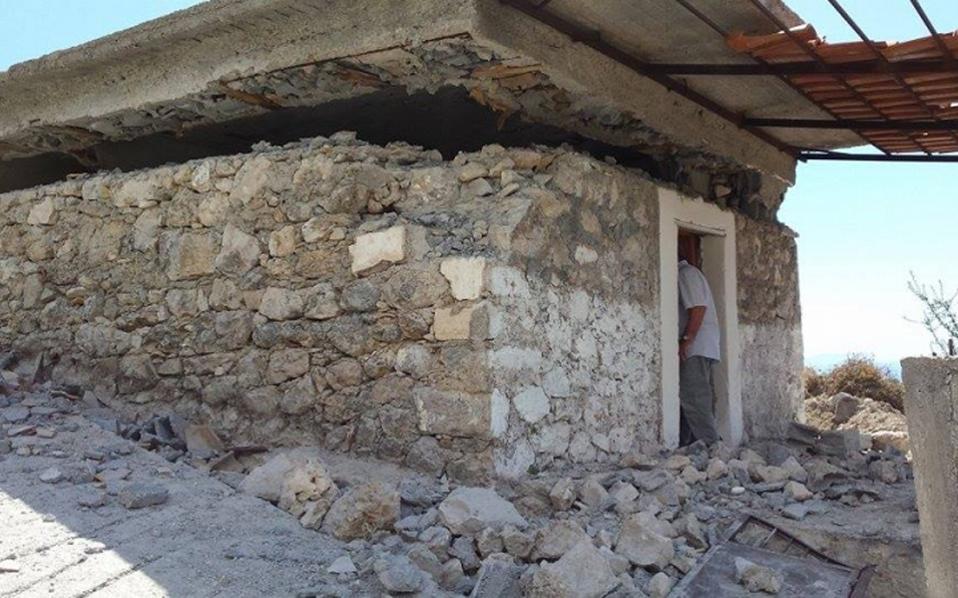
Demolished church photographed on 26 August 2015. Photo: Facebook
Albanian police have demolished a contested church dedicated to St
Athanas in the southern village of Dhermi, angering the Orthodox Church
and neighbouring Greece, which supports the Church's mission.
The Orthodox Church called it a vandalistic act of desecration and a
violation of church property. Greece said the Albanians were behaving
like Islamist extremists.
Police used heavy machinery to reduce to rubble the roof built in
1994 to cover the foundations of a much older church destroyed during
the communist era.
The renovated church was declared an “illegal construction” by the
local authorities in Himara municipality two weeks ago, pitting Albanian
nationalists against the Greek-supported Orthodox Church.
Since news about the demolition order broke out last Friday,
government officials, including the Prime Minister Edi Rama, described
the church as an important part of the national heritage of Albania and
pledged to restore it properly.
Albanians believe that in the 17th century, a well-known Catholic cleric served there and opened Albanian-language schools.
Speaking about the church, Prime Minister Rama said on Monday that
“the old church in Dhermi will be regenerated in the name of national
heritage [over] the 'parking lot' that is illegal, which they call a
church.”
Albanian nationalist historians and politicians have dismissed the Orthodox Church complaints as Greek nationalistic propaganda.
The southern Himara area has experienced several conflicts between
Albanian and Greek nationalists during recent years. Home to a
significant Greek minority, some Greek nationalists still dream of
uniting the area to the Greek state.
The Greek government urged the Albanian authorities to stop the
demolition and reacted angrily after the demolition went ahead,
comparing it to the acts of Islamic extremists.
“The destruction of holy sites and objects of worship took place at
least until recently in the wider region of the Middle East and North
Africa at the hands of jihadists. Today we also saw such an act carried
out in our neighbouring country, Albania,” a Greek Foreign Ministry
spokesperson Konstantinos Koutras said on Wednesday.
“You will be informed directly of Greece’s moves in this instance towards Albania and the international community,” he added.
Greece has condemned the demolition on
Wednesday of an orthodox church in the village of Dhermi, on the
southwest coast of Albania.
“The destruction of holy sites and objects of worship took place, at
least until recently, in the wider region of the Middle East and North
Africa, at the hands of jihadists. Today we also saw such an act carried
out in our neighboring country, Albania,” Foreign Ministry spokesman
Constantinos Koutras told journalists in Athens Wednesday.
“No one is more ungrateful than a beneficiary,” he said.
Athens was expected to lodge an official complaint with Albanian authorities and the international community.
On Monday, Greece’s Foreign Ministry called on Tirana to respect
religious freedoms after local authorities had partially destroyed the
interior of the Holy Church of Aghios Athanasios.
Albanian officials have said they intend to carry out excavations at the
site in an attempt to discover the grave of Nilo Catalano, a Catholic
missionary from the 17th Century.
Commander-in-Chief, Hellenic Fleet; Chief of Staff of the Hellenic National Defence General Staff
Awards
Knight's Gold Cross of the Order of Honour, Knight's Gold Cross of the Order of the Phoenix , Medal of Military Merit,
Commendation Medal of Merit and Honour, Navy Force Formation Command
Medal, Navy Force Meritorious Command Medal, Staff Officer Service
Commendation Medal
Admiral Panagiotis Chinofotis (Greek: Παναγιώτης Χηνοφώτης, also transliterated Panayiotis Khinofotis, born 12 August 1949) is a Member of Parliament with the New Democracy party, a former Vice-Minister of the Interior and a former Chief of the Hellenic National Defense General Staff.
Born in Athens, Chinofotis graduated from the Hellenic Naval Academy and was commissioned an Ensign in 1971. He served aboard several patrol boats, destroyers and frigates of the Hellenic Navy before being sent to the Hellenic Naval War College, from which he graduated in 1986. He was then sent to study at the United States Naval War College and Salve Regina University, from which he graduated with a master's degree in international relations.
After graduation, Chinofotis was promoted to Commander, and was made
commandant of the Hellenic Naval War College. In 1991, he was made
commander of the HS Lemnos, flagship of the Commander-in-Chief, Hellenic Fleet.
In 1993, Chinofotis began a two-year assignment as Hellenic Military Representative to NATO in Brussels. He next spent a year as Commander of the Fleet Command, followed by a tour as Deputy Military Representative of Greece to the European Union, serving as chairman of the Military Working Group during Greece's EU Presidency.
Chinofotis next progressed through several staff assignments until,
in 2004, by now a vice admiral, he became Chief of the Fleet Command. A
year later, he was promoted to Admiral and became Chief of the Hellenic National Defense General Staff.
On 21 August 2007, he resigned in order to participate in the September legislative elections, where he was elected MP on the statewide ticket for New Democracy. On 19 September he was sworn in the new cabinet as Vice-Minister of the Interior, a position he held until 2009.
Athens criticised Tirana after a police attempt to
remove an alleged illegal construction at a village church rekindled
rivalry between the Catholic and Greek-backed Orthodox churches in
Albania.
Gjergj Erebara
BIRN
Tirana
Archbishop Janullatos of the Orthodox Church of Albania. Archive photo: LSA/Gent Shkullaku
The Greek Foreign Ministry on Sunday condemned what it called a
“violent incident” at the church of Saint Athanas in the Albanian
village of Dhermi, describing what happened as “unacceptable and
contemptible”.
Construction police from the local Himara Municipality went to Dhermi
on Friday to remove the concrete roof of the church, claiming it was an
illegal build.
But the Orthodox Church of Albania, which has strong Greek support,
called it an attempt to destroy the church and said that those involved
“used violence against the priest and believers”.
It claimed that there had been officially-sanctioned attempts to
carry out excavations at the church in a bid to find the grave of a
Catholic missionary from the 17th Century.
The Albanian Foreign Ministry meanwhile described Greece’s statement as “interference in Albania’s internal affairs”.
Artan Shkreli, an advisor to Albanian Prime Minister Edi Rama, said
that local police had simply intervened to stop illegal construction at
the site, which he said had “deformed” the church.
Shkreli claimed that the Church of Saint Athanas is a cultural
monument in Albania and that the reactions against the intervention by
the police were organised by the Greek minority group Omonia, which is known for its nationalistic stance.
“The illegal and illogical reaction from Omonia against the
intervention of the Construction Police is linked to the fact that they
deny the history of this country,” Shkreli said.
“The [17th Century] Basilian missionary Nilo Catalano, who opened the
earliest Albanian schools, was buried in this church, amongst others,”
Shkreli told local TV station A1 Report.
Albanian Orthodox Church spokesperson Thoma Dhima responded by saying
that the church in Dhermi does not have cultural monument status and
that it was built by the villagers in 1992 on the foundation of the old
church. He described the police intervention as unlawful and said that
he had filed charges at the prosecutor’s office.
Responding to Shkreli’s claims about Catalano, Dhima said that the
missionary attempted to convince people in the area to become loyal to
the Pope, but was rejected.
He said that Catalano “poured in plenty of money to buy” the locals’ faith, but was driven out.
The rivalry between the Catholic and Orthodox churches in Albania is
centuries old and is often mixed up with Albanian-Greek rivalry.
But as the dispute over the church illustrates, it still has the
potential to cause serious disagreements between Albania and Greece.
In its statement on the row on Sunday, the Greek Foreign Ministry
suggested that Albania’s EU integration process could suffer as a
result.
“Greece will be at our neighbouring country’s side on its course
towards Europe, on the condition, of course, that Albania fully meets
all of its obligations provided for by international law and the
European acquis [the body of law that needs to be met to secure EU
accession],” the Greek Foreign Ministry statement said.
Serbian FM Ivica Dacic said
in New York on Friday that his country finds Pristina's demands "to join
the work of UNESCO and Interpol" unacceptable.
Source: Beta, Tanjug, Sputnik
"I was born in Kosovo and Metohija 49 years ago in a town
called Prizren, which was in the 14th century the capital of Serbia,
and today 21 or 22 Serbs live there," Dacic said, adding this was "a
historical reality, the fact that today the majority in Kosovo are
(ethnic) Albanians."
According to him, Kosovo Foreign Minister Hashim Thaci,
while explaining Pristina's request to join UNESCO, "in effect
acknowledged the ethnic cleansing" when said that the idea was not
endorsed "only by the Orthodox (Christian Serb) community, which makes
up four percent of the population in Kosovo."
"Serbia has
extended a hand of reconciliation and that hand is hanging in the air -
but we have not raised both our hands in surrender," Dacic told a UN
Security Council session dedicated to Kosovo.
We will see how
each country will vote in UNESCO, he said, adding that Serbia cannot
allow Kosovo's membership in UN organizations through the back door.
"Either abolish resolution 1244 or don't apply double standards toward
Serbia," was Dacic's message at the UN Security Council.
"It
must be that this world is governed by principles. It cannot be that
Serbia, as the OSCE chairman, is expected to defend the territorial
integrity of Ukraine - and not defend its own territorial integrity with
the same force. Serbia is in favor of dialogue, but we believe our own
eyes, not the claims that are often, in the case of Serbia, an example
of double standards," he added.
Dacic said that "a territory
administered by the United Nations under valid and mandatory Security
Council resolution 1244, Kosovo is not and cannot be considered a state
as a subject of international law and cannot, ipso facto, qualify for
admission to organizations like the ones referred to."
"We will
fight for our interests, politically and diplomatically. We'll see how
each state will vote on Pristina's request for membership in UNESCO. We
need to stop playing under the table and begin to play openly. Serbia
will not participate in the attempts to allow Kosovo to enter
specialized UN agencies through the back door," Dacic said.
According to him, "in that sense, each and every different attitude to
the consideration of the question of Kosovo’s membership in these
organizations would be tantamount to ignoring, i.e. violating, the legal
rules created under the auspices of the United Nations for the purpose
of maintaining international peace and security "If and when the time
comes, questions of this kind should be the subject of dialogue between
Pristina and Belgrade."
Stressing that Serbia "condemns any
desecration of religious sites of any religion," Dacic pointed out that
the destruction of cultural and religious heritage in the Middle East by
Islamic State (IS) is being met with strong condemnation across the
world as an act of terrorism - and added, in reference to Kosovo's
authorities, that "those who desecrate and destroy the Serbian cultural
heritage in Kosovo demand membership in UNESCO, "and a pat on the
shoulder as an act of reward."
Dacic also warned about "the
drastic discrepancy between the declarative commitment and the actual
conduct of Pristina" on the issue of the protection of the Serbian
cultural heritage:
"You will agree that someone who aspires to
membership in UNESCO must, not only with words but also with deeds,
confirm their commitment to the objectives and principles of the
Constitution of UNESCO - with which the deliberate, systematic, vandal
destruction of cultural and historical monuments of their fellow
citizens, in order to eliminate the traces of centuries of existence of a
people in an area, as well as the impunity got perpetrators of such
barbaric acts unworthy of the 21st century - are undoubtedly
irreconcilable."
The Serbian minister then told the UN Security
Council that "from June 1999 until today 236 churches, monasteries and
other buildings owned by the Serbian Orthodox Church (SPC, in Kosovo) as
well as cultural and historical monuments, have been the target of
attacks."
Of these, as many as 61 have the status of cultural monuments, "and 18 are of great importance for the state of Serbia."
"In the area of Kosovo and Metohija 174 religious sites and 33
cultural and historical monuments have been destroyed, more than 10,000
icons, religious, liturgical, and artistic items stolen. 5,261
headstones have been either destroyed or damaged in 256 Serbian Orthodox
cemeteries - and not a single whole tombstone stands on more than 50 of
the graveyards," said Dacic.
He pointed out that the attacks
on the Serb heritage in Kosovo in this regard represent attacks on the
Serb identity, have a direct impact on their sense of acceptance in the
local community and are a part of the process of "changing historical
facts in order to marginalize and eliminate Serbs and Serbia from the
history of Kosovo and Metohija."
The foreign minister went on to say that Belgrade "received information
that EULEX (EU mission in Kosovo) is preparing to transfer the cases
and the accompanying documentation processed by EULEX prosecutors and
judges to the PISG, i.e. the local judiciary."
"About 500 cases
are involved, about 300 of them related to war crimes, out of which 270
have been taken over from UNMIK (UN mission in Kosovo). The government
of the Republic of Serbia expresses its concern at the intention to
transfer the cases related to war crimes in the territory of Kosovo to
the local judiciary since all of them belong to the exclusive competence
of EULEX even after the amendment of the PISG regulations on the
mandate of the EU Mission relating to the rule of law in the province.
In point of fact, it is provided that EULEX prosecutors continue to
process the cases in respect of which they decided to launch an
investigation prior to April 15, 2014, as well as the cases allocated to
EULEX prosecutors before this date which include the cases of war
crimes that EULEX took over from the UNMIK judiciary," Dacic said, and
added:
"If EULEX does proceed and transfer the cases to the
institutions in Pristina, in particular the sensitive cases of the
investigation of the war crimes committed in the territory of Kosovo,
the consequences for processing the war crimes committed by the KLA
against the Serbs, non-Albanians and Albanians, marked ‘Serbian
collaborators’ during the armed conflicts of 1998 and 1999 would be
unforeseeable."
"Since it is expected that a Specialist Court
will be established soon to try the war crimes committed by the KLA in
the territory of Kosovo and Metohija, and it is being established
precisely for the incapacity of the local Kosovo judiciary to
investigate and try the perpetrators of war crimes from the ranks of the
KLA, let me point out that the transfer of the war crimes cases to the
local judiciary by EULEX runs counter to the activities of the
international community aimed at establishing the Specialist Court," the
foreign minister told the UN Security Council, and added:
"If
the said cases were to be transferred to the local judiciary, there is
reason to believe that much of material evidence and many witnesses
would be removed or intimidated, which would make the work of the future
Specialist Court for war crimes much more difficult. Politically
motivated arrests and long trials, as well as the different yardsticks
of the local judiciary should not be disregarded, either. One example of
which I already spoke at the previous meetings of the Security Council
is the case of Oliver Ivanovic, the leader of the Civil Initiative
'Serbia, Democracy, Justice', who was detained at the end of January
2014 and continues in detention regardless of the guarantees and calls
of the Government of Serbia that he be granted bail. In an effort to win
this right, Oliver Ivanovic has been on hunger strike for days now."
Dacic also told the UNSC that the Serbian government "attaches
particular importance to finding solutions for internally displaced
persons while the creation of conditions for their sustainable return is
one of the key segments of the reconciliation process."
"Out
of over 220,000 people who fled Kosovo since 1999, in the last 16 years
sustainable return has been achieved only by 1.9 percent, while around
204,000 persons sill remain displaced in Serbia. Accordingly, the
percentage of sustainable return in this case is below all international
standards and averages," said the minister.
Dacic also pointed
to the tendency of privatization of public companies in areas with a
majority Serb population, "leading us to the conclusion that the basic
motivation of these privatizations, the ethnic connotation of which is
very transparent indeed, is the destruction of economic resources
exactly in the Serbian communities which is incompatible with democratic
achievements and European standards."
"We are deeply concerned
over the Draft Law on the Kosovo Property Comparison and Verification
Agency which is under consideration in the Parliament of Kosovo and is
in outright contravention of the 2011 Technical Agreement on Cadastre.
It creates conditions for the legalization of the property expropriated
unlawfully from the Serbs, whereby enormous and irreparable damage would
be created to the Serbian community in the Province. It is exactly with
this in mind that we requested that the procedure of the adoption of
the said Law be stopped and that the Technical Agreement on Cadastre,
providing for the establishment of a body consisting of representatives
of Belgrade, Pristina and the European Union to carry out the comparison
of cadastral documentation, begin to be implemented," Dacic said.
The UN Security Council session was held on Friday in New York to
consider the UN secretary-general's regular report on the work of the UN
mission in Kosovo, UNMIK.
(Tanjug/Serbian MFA)
Addressing the session of the UNSC, Kosovo Foreign
Minister Hashim Thaci said that "Serbia's attempt to block Kosovo's
membership in UNESCO and Interpol" was "contrary to the Brussels
agreement."
"I heard harsh words from Dacic. I understand that
he is in an election campaign, but dialogue between Belgrade and
Pristina continues. Next week we will meet in Brussels and I hope we can
agree on important deals - on telecommunications, energy, the Community
of Serb Municipalities (SZO)," said Thaci.
Commenting on
Dacic's address to the Council, Thaci asserted that "Albanians have
always been the majority in Kosovo" and that Dacic "must realize that
the Serbian administration, the army and the police will never return."
"Your dream is over once and for all. If you start a war, you will lose," he said.
After 20 years, times when Greece has put Veto for the aids from EU to Albania, this is the first time that happens seriously
Foreign Ministry spokesperson’s response to
yesterday’s announcement from the Albanian Foreign Ministry’s
spokesperson regarding the episodes that took place at the Holy Church
of Saint Athanasios in Dhërmi, Himarë
Sunday, 23 August 2015
“Yesterday’s announcement from the
Albanian Foreign Ministry spokesperson regarding Albania’s commitment to
respect for and full protection of the individual, religious and
property rights of the minorities in Albania was very encouraging.
As
has been the case until now, Greece will be at our neighbouring
country’s side on its course towards Europe, on the condition, of
course, that Albania fully meets all of its obligations provided for by
international law and the European acquis.
This, moreover, is why
the Foreign Ministry is awaiting the response of and the taking of
immediate measures by the Albanian government regarding what occurred at
the Holy Church of Saint Athanasios in Dhërmi, Himarë.”