Thursday, July 16, 2015

4 Marines dead in shooting attack at Tennessee Navy facility

Now Playing Officials: 5 victims in Chattanooga shootings
BREAKING NEWS: Four Marines were killed Thursday at a Chattanooga, Tenn., Navy training center, in what authorities called a possible "act of domestic terrorism" that consisted of two attacks carried out by a lone gunman at military facilities just seven miles apart, officials said.
The unidentified gunman shot up a recruiting center before driving to the Navy Operational Support Center and Marine Corps Reserve Center and killing four Marines before he was shot, authorities said. Sources told Fox News police chased the gunman from the recruiting center to the Center, where the killings took place. The FBI and military police were investigating the attack, but authorities could not rule out the possibility of terrorism.
“We are treating this as an act of domestic terrorism,” said Bill Killian, U.S. Attorney for the Eastern District of Tennessee.
The names of the Marines who were reportedly shot were not immediately released pending notification of their families. The Navy Operational Support Center and Marine Corps Reserve Center lies along a bend in the Tennessee River, northeast of downtown Chattanooga.
Despite Killian's statement, an FBI Special Agent Ed Reinhold told reporters that it may have been a criminal act. The gunman was killed, but authorities did not comment on his identity, motivation or the circumstances of his death. Authorities said the gunman did not work at either military facility.
Reinhold said all the dead were killed at the Navy Operational Support Center and Marine Corps Reserve Center Chattanooga. It sits between Amnicola Highway and a pathway that runs through Tennessee RiverPark, a popular park at a bend in the Tennessee River northeast of downtown Chattanooga. It's in a light industrial area that includes a Coca-Cola bottling plant and Binswanger Glass.
The two entrances to the fenced facility have unmanned gates and concrete barriers that require approaching cars to slow down to drive around them.
Marilyn Hutcheson, who works at Binswanger Glass just across the street from the center on Amnicola Highway, said she heard a barrage of gunfire around 11 a.m.
"It was rapid fire, like pow pow pow pow pow, so quickly"
- Marilyn Hutcheson, a witness
"I couldn't even begin to tell you how many," she said. "It was rapid fire, like pow pow pow pow pow, so quickly. The next thing I knew, there were police cars coming from every direction."
President Obama was briefed by his national security team on the shooting involving two military sites, according to White House spokesman Eric Schultz.
In the first incident, the gunman, in a silver Mustang, drove up to the Armed Forces Career Center in a strip mall on Lee's Highway and sprayed the facade with gunfire before driving off, officials said. An unidentified police officer was shot in the ankle, but not seriously injured, according to reports.
A federal law enforcement official told Fox News that officers from FBI's Knoxville field office responded to the scene.
The Knoxville News Sentinel reported that there is a heavy police presence at the scene, along with five ambulances.
The Federal Aviation Administration said it was holding departing flights at their gates in Chattanooga, with delays projected to last 15 minutes or less.

Greek decision not to recognize Kosovo remains unchanged


Greek Ambassador to Serbia Constantine Economides has said that his country does not recognize the unilaterally declared independence of Kosovo.
Source: Danas
He made this statement for the Belgrade-based daily Danas.
Asked whether the Greek foreign minister's recent statements

in Pristina about Athens supporting Kosovo's membership in international organizations "meant a step in the direction of recognizing Kosovo," the diplomat said that his country's position on this issue "remains unchanged."

Economides added that Minister Nikolaos Kotzias' statements made in Pristina were "very clear."

Serbian Foreign Minister Ivica Dacic said on Thursday he was aware of the pressure Greece is under to recognize Kosovo, but that he believes it would not happen.

US Military Coup for Euro Meltdown?

A US soldier takes part in an exercise called Saber Junction at the military area in Hohenfels near Regensburg, southern Germany, Monday, Sept. 8, 2014

© AP Photo/ Matthias Schrader
Columnists
Get short URL
Finian Cunningham
1213038482
The capitulation of the Greek government to Berlin-led finance capital is a daunting watershed moment. It marks the “disciplining” of the wider European electorate under corporatist financier rule. What is happening in Greece is a forerunner for other European Union states.
In that event, widespread social unrest can be expected.
The rapid expansion of American military forces across Europe over the past year has invoked the pretext of “defending” NATO allies from alleged Russian aggression. But an altogether different contingency is that Washington is preparing for a military coup in Europe – in the wake of economic collapse stemming from the Greek debt crisis. Just last week, American army general Ray Odierno – a member of the US Joint Chiefs of staff – outlined plans for a new battalion of troops in Germany, along with heavy armour and other equipment. Odierno told the Wall Street Journal that the new military installations were to counter “the rising Russian threat”.
Germany is already under de facto US military occupation, since the end of the Second World War, with tens of thousands of American troops and a slew of garrisons. Why the need for more American military, and not in peripheral European states close to Russia, but right in the heart of Europe – Germany?
Similar increasing deployment of American troops, artillery, armour, warplanes and helicopters has taken place in other European NATO members over the past year under the guise of conducting war games.
The result is that US military presence across Europe has never been greater at any time since the Cold War ended with the Soviet Union 25 years ago.
General Odierno said the “prepositioning” of troops and equipment in Germany and neighbouring states, including Poland and the Baltic countries, would allow for the rapid scale-up of American military in Europe “in the event of a crisis”. By “crisis” he was apparently alluding to a possible war with Russia.
But Washington planners may have another crisis in mind – the economic and social meltdown of the European Union. In that event, the American military would be deployed to shore up fragile, discredited governments amid widespread social turmoil. These “care taker” governments may be similar in personnel to the parties already in power in European capitals. But their administrations will be increasingly autocratic and imposed without popular mandates, as is being evidenced in Greece. If a social crisis of full-blown poverty, soaring unemployment, public protests and industrial disruption were to culminate, then the American military forces in Europe will be in place to enforce the rule of these technocratic “governments”.
American political analyst Randy Martin, who writes at crookedbough.com, reckons that US rulers have anticipated the current turmoil in Europe over Greece.
“The Greek crisis has been going on for five years and more,” says Martin. “You can bet that Washington has already drawn up plans on how to administer Europe politically and financially if the situation demands that intervention. And that situation is becoming more and more apparent almost by the day.”
He added: “Don’t forget that the NATO military alliance of 28 members is really just American military power outsourced in various European disguises. NATO formations across Europe are therefore tantamount to US military occupation of Europe,” says Martin. “This is exactly what Russian government figures have perceptively been saying for a long time.”
Since the Ukraine crisis erupted due to the US-sponsored coup in that country in February 2014, the Western media has been saturated with American claims of Russian aggression toward Europe. But, as Randy Martin points out, the narrative of a Russian threat is becoming increasingly threadbare. There is no evidence of Russian infiltration in Ukraine, no evidence of Russian military aggression toward Europe, and, moreover, Moscow has consistently refuted the allegations as “fantasy”.
Which leads one to conjecture: is the American militarisation across Europe for another purpose – the containment of the European Union as it comes under increasing social pressure from within due to economic collapse?
What is called the “Greek debt crisis” is in reality a symptom of a systemic breakdown in Western capitalism. Many other countries across the European Union also find themselves in similar condition of chronic fiscal arrears and drowning indebtedness.
Italy, Spain and Portugal come to mind as having precarious debt loads that outstrip their respective economies. France, the second biggest economy in Europe, is also submerged with a total debt exceeding its national economic output.
The austerity measures that EU governments have been imposing on their populations are felt most acutely in Greece, manifested in the scenes of mass queues outside banks for a subsistence daily allowance, or desperate crowds at food stores and pharmacies searching for dwindling supplies of basic essential commodities. With the Greek government of Alexis Tsipras showing itself as a willing instrument of Europe’s banker-oligarchy to apply more austerity, the atmosphere among many ordinary Greeks is increasingly volatile and brooding.
But this scenario of economic collapse and social mayhem seen most vividly in Greece will likely be repeated in other EU countries because of the systemic nature of the crisis. The EU institutional creditors, led by Germany, want to teach the rest of Europe a lesson by disciplining Greece over its national finances.
However, austerity pushed to extreme will result in social revolt, not just in Greece, but across Europe.
Washington is alarmed by the potential meltdown in Europe. Last week, President Barack Obama urged Germany’s Chancellor Angela Merkel and Greek Premier Alexis Tsipras to come up with a solution to the debt crisis. Obama’s Treasury Secretary Jack Lew echoed the concerns and
warned: “There’s a lot of unknowns if this goes to a place that completely melts down in Greece.”
What we are witnessing in Europe is the emergence of autocratic centralised “government” serving the dictate of finance capital, which imposes austerity on the general population regardless of democratic mandate. The administrative, technocratic centre for this rule-by-banker-oligarchy in Europe is Berlin, which is, in turn, answerable to the technocratic administration in Washington under the control of Wall Street. What we have known up to now as sovereign national governments will henceforth be mere functionaries for the global banker elite. The control of government by private corporate interests, with no democratic accountability, attests to the definition of fascism. As analyst Randy Martin comments: “What is taking shape in Europe and more so in the United States is the complete subjugation of government by finance capital. It is not an exaggeration or empty jargon to say that we in the West are succumbing to the rule of financial fascism.”
Banker-led technocratic administrations across Europe will engender rising popular protest and civil unrest. When American politicians talk about “meltdown” and their army generals talk about “securing Europe” what they really mean is securing Europe from its own angry people. Russia is but the bogeyman to justify American military occupation of Europe and the imperative of finance capital administered from Berlin.
The irony is that 70 years after the defeat of fascism in Europe, Europe is coming full circle under the same phenomenon. This time instead of Nazi jackboots, we have American ones.
The views expressed in this article are solely those of the author and do not necessarily reflect the official position of Sputnik.

France encourages Albania to continue reforms


| TIRANA -
The French Secretary of State for European Affairs Harlem Desir visited Albania on Wednesday and praised the country's role in the region, encouraging it to continue strengthening peace, stability and prosperity in the Western Balkan.
Albanian President Bujar Nishani on Wednesday held a special meeting with Desir. Nishani expressed gratitude for the special friendship, assistance and partnership offered by France, emphasizing that "even during the most difficult periods of Communist dictatorship, France has been a symbol of encouragement for Albanians and has kept their dream of freedom alive."
Desir said he valued Albania's up-to-date progress and stressed the need to show progress in judiciary reform and fight against organized crime.
Desir also met with Albania's Parliament Speaker Ilir Meta and both underlined the close inter-parliamentary cooperation between Albania and France.
Meta said he considered France a very important partner for Albania's development and encouraged an increase in multilateral cooperation.
Moreover, Desir met with Albanian Minister of Foreign Affairs Ditmir Bushati and Minister of European Integration Klajda Gjosha.
Praising Albania's efforts to strengthen the rule of law, Desir underlined the importance of judicial reform and the fight against corruption and organized crime, which would have a positive impact on Albania's further advancement towards integration. (Cihan/Xinhua)

New Elections in Greece Possible in September or October

A general view of the Greek parliament

© REUTERS/ Alkis Konstantinidis
Politics
Get short URL
Greece's Gordian Knot: Syriza Tackles Austerity (314)
09410
Greeks might be again invited to cast their ballots in September or October, Greek Interior Minister Nikos Voutsis said Thursday.
MOSCOW (Sputnik) — The interior minister was quoted as saying by local media while speaking to radio station Kokkino:
"If it is not in September, it will be in October. It's very possible there will be elections, but this will be the result of the overall — not only from the government — insight as to the general developments."
On Wednesday night, the Greek parliament voted in support of a new package of bailout measures, paving the way for more financial aid from its international creditors. Of the 300 Greek lawmakers, 229 voted in support of the bill, 64 voted against it, including Parliamentary Speaker Zoe Konstantopoulou and the country’s former Finance Minister Yanis Varoufakis, while six abstained.
There is "a matter of political and institutional commitment in relation to the recovery of economic stability. The prime minister signed an agreement by which we disagree, and it should be put into practice in our presence," Voutis stressed.
On Monday, Eurozone leaders reached an agreement on a third bailout package for Greece, estimated at $95 billion over the next three years, which stipulated the Greek parliament to approve unpopular austerity measures – including pension reforms and VAT increases – by the end of Wednesday.
Greek Prime Minister Alexis Tsipras called on his fellow parliamentarians to adopt the new package of measures even if they lack belief in it. The left-wing Syriza party, led by Alexis Tsipras, came to power after winning the January parliamentary elections, promising to free the country of unpopular austerity measures.
On Tuesday, Greek Prime Minister Alexis Tsipras said he was forced to choose between the tough terms proposed by the international lenders and bankruptcy that would be followed by Greece's exit from the Eurozone.

NATO Members to Ditch Each Other in Case of War - Poll

Turns out, the majority of Europeans don’t really want to fulfill their NATO duties, according to which all members of the alliance should collectively defend each other in case one of them is attacked, the Philadelphia Trumpet reported, citing a Pew Research Center poll.

© Flickr/ US Army Europe Images
Europe
Get short URL
51208180
Turns out, the majority of Europeans don’t really want to fulfill their NATO duties, according to which all members of the alliance should collectively defend each other in case one of them is attacked, a Pew Research Center poll revealed.
NATO seems to be struggling with its existential raison d'etre, after the alliance lost its original enemy, the Soviet Union, and has yet to find a new role to fulfill.
Some say the United States wants to portray Russia as a new enemy to generate fear among Europeans, but according to the poll it looks like most Europeans aren't buying that nonsense, the Philadelphia Trumpet reported.
The survey asked: "If Russia got into a serious military conflict with one of its neighboring countries that is our NATO ally, do you think our country should or should not use military force to defend that country?"
Despite NATO's Article V, which establishes the idea of collective defense as the first and foremost concern of the alliance, only in two out of the eight surveyed countries the majority of citizens said their countries should use military force to defend their allies (only Americans and Canadians said they were ready to go to war if their NATO allies were attacked).
Western European countries, in particular, were against interfering on behalf of their allies. 53 percent of Frenchmen said "No" to defending an ally; in Italy, it was 51 percent against and 40 percent in favor, while 9 percent abstained; the Germans were the most decisive — 58 percent said they shouldn't defend an ally and only 38 percent said they should. The poll results were "devastating," according to Judy Dempsey, editor-in-chief of Strategic Europe at Carnegie Europe.
"The longer the Europeans refuse to even consider the use of military force to protect their allies, the more NATO's sense of collective defense and solidarity will weaken. The inexorable outcome is the demise of Article V. What the is NATO for?" — Dempsey said, as quoted by the Philadelphia Trumpet.
So there, the idea of United Europe quickly goes out of the window. At the end of the day, every nation stands only for itself and the Hobbessian concept of the state of nature prevails.
While Europeans are scratching their heads over whether they will defend each other if Russia got into a serious military conflict with one if their NATO allies, Russia repeatedly stated that it has never had any interest in attacking its neighbors.

Wednesday, July 15, 2015

"RS police told not to provide security for Vucic"


Bosnian Council of Ministers chair Denis Zvizdic "instructed members of the RS Interior Ministry (MUP) not to protect the Serbian prime minister in Potocari."
Source: Tanjug
The incident in Potocari (Beta/AP)
This is what Bosnian Interior Minister Dragan Mektic has said. He specified that the order to the police of the Serb entity in Bosnia, the Serb Republic (RS), came a day before the Srebrenica anniversary commemoration, during which Aleksandar Vucic was attacked.
Mektic "confirmed he has information that one day before the commemoration in Potocari, Zvizdic told the head of the Directorate for Coordination of Police Bodies, Mirsad Vilic, that it would not be good if members of the RS MUP were present inside the memorial center complex, and protecting Premier Aleksandar Vucic."

"I think Vilic told me that," Mektic has been quoted as saying by the Sarajevo-based daily Dnevni Avaz.

The decision was made based on this suggestion, while Zvizdic - although having no jurisdiction over police agencies - with his conversation with Vilic influenced Vucic's security to become "drastically weakened," said the paper on its website, adding that "the same applied to other guests and esteemed invitees."

The public broadcaster of the Muslim-Croat Federation (FBiH) entity, FTV, reported that the RS police said "the Directorate security left the entrance at he beginning of the commemoration, jeopardizing the entire system of protection."

FTV noted late on Tuesday in its main news program that Vucic and the Turkish prime minister were accompanied to the memorial center "by only two RS MUP policemen each."

Wednesday was the fifth day since the brutal attack and an attempt to lynch the Serbian prime minister in Potocari, where he traveled to bow to the Bosniak victims - but there has been no hint as to who may have ordered and carried out the attack.

The Council of Ministers tasked the Security Ministry, headed by Mektic, to urgently submit an analysis of the events in Potocari.

Although one person was said to be arrested on the day of the incident, no official has since confirmed this, nor is the identity of the person reportedly held by the police "which could be seen in one of the recordings" - known.

"Greece to help Kosovo join international organizations"


Greek Foreign Minister Nikolaos Kotzias has said that his country "will support Kosovo's membership in international bodies and security organizations."
Source: Beta, Tanjug
Close the entire text of the article here
According to the announcement, Mustafa with and the Greek minister spoke about "relations between the two countries" and the possibilities of deepening cooperation.

The statement said that Mustafa thanked Kotzias "for the support that Greece has given in the process of Kosovo's membership in international organizations and integration processes in the EU."

Mustafa was further quoted as saying that "the conditions are ripe for further promotion of relations between Greece and Kosovo."

After meeting with his Kosovo counterpart in Pristina, the Greek foreign minister said that that this "does not mean that Greece could recognize Kosovo, but represents an effort to establish better relations between Athens and Pristina."

Greece is one of five EU member-countries that have not recognized the ethnic Albanians' unilateral declaration of independence of Kosovo made in early 2008 - but reports said it was "the only one among the five that recognizes documents issued by Kosovo."

"I invited (Hashim) Thaci to come to Athens. We are waiting for him. We have decided to open an office of Kosovo. Our proposal is that the office can be located wherever you want, in Thessaloniki or in Athens. But I think that Thaci prefers Athens," said Kotzias.

In addition, he promised that within the existing framework of cooperation Greece will support "Kosovo's membership in the EU and NATO, as well as membership in other international organizations such as Interpol and UNESCO."

Asked by reporters "whether Greece will recognize Kosovo" he, according to the Pristina media, "remained vague" - saying that Greece will help Kosovo to join some international organizations and announcing that Greece will open a cooperation office in Kosovo.

In its statement, Kosovo's Minsitry of Foreign Affairs stressed this was "the first visit of a Greek chief of diplomacy to Kosovo."

According to the RTK2 broadcaster, Thaci said that the meeting covered many topics - including the establishment of a special court - that should deal with KLA crimes.

"This issue should not be delayed, but it will not be put up for a vote (in the assembly) before it's determined that there is a sufficient number of votes of MPs," said Thaci.

Thaci "thanked his Greek counterpart for his contribution to his country provides in maintaining peace and stability in the region, as well as the support that Kosovo receives from Greece in the Euro-Atlantic path."

"We expect investors from Greece to come to Kosovo, invest and feel good here. I take this opportunity to once again invite others to invest in Kosovo. We live in the same region and have the same values,"said Thaci.

Kotzias did not wish to comment on the economic crisis in Greece, saying that "MPs will decide on that."

Albania 1990 -- Embassy Storm

Become a fan
Special Advisor, Human Rights Watch


Posted: Updated:
Print
From the new book Modern Albania (NYU Press, 2015). A version of this oist first appeared in Spiegel Online.
2015-07-12-1436726270-9876813-Auf_der_Mauer1.jpg
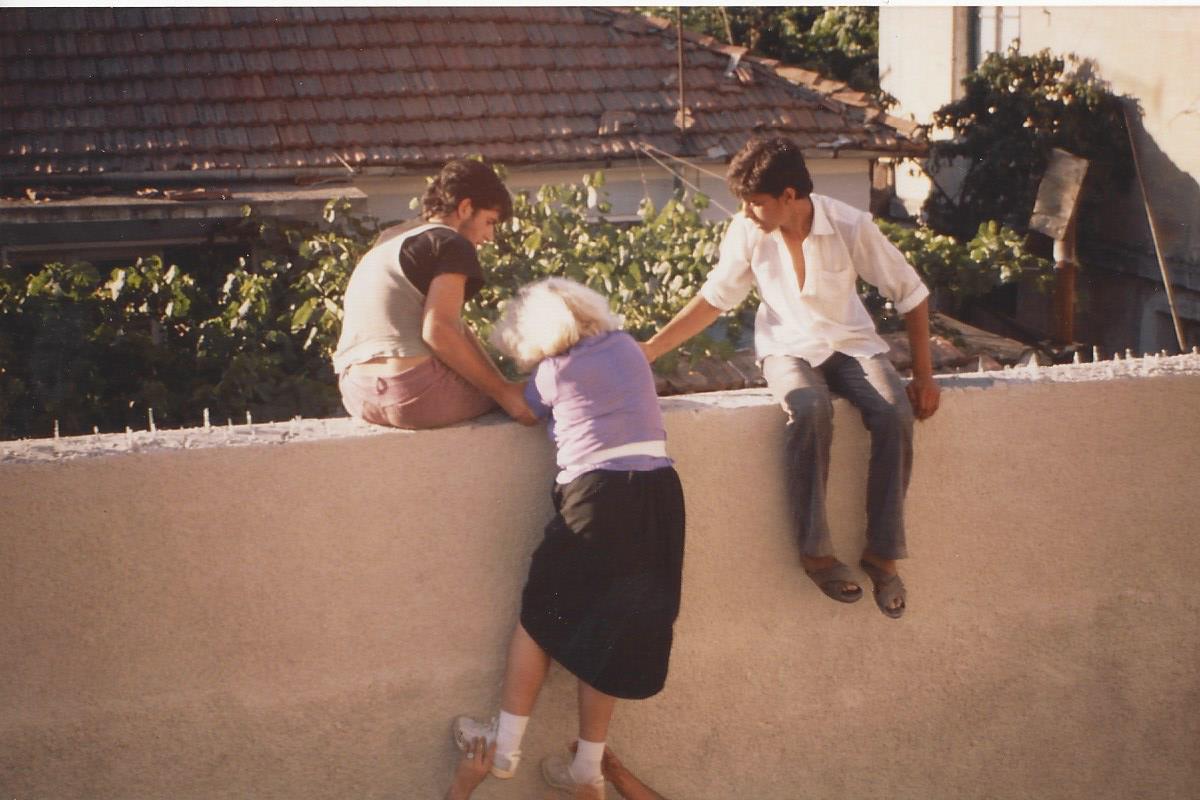
More than 5,000 Albanians stormed foreign embassies in Tirana in July 1990. Here a women enters the West German compound. © Lothar Parzeller
Ervis Gega was 16 years old in summer 1990 when hundreds of frustrated Albanians, craving to rejoin the world, began storming foreign embassies in their capital. Gega and her relatives watched the news on Italian television from their hometown and quickly made up their minds. A family of musicians, they had long suffered under Communist rule.
The Berlin Wall had fallen eight months before but Albania's Communist party was holding on. Statues of Stalin and the long-time dictator Enver Hoxha, who died in 1985, still stood in this closed and repressive Balkan state.
Gega grabbed her Chinese-made violin and boarded a train for Tirana with her parents, uncle and aunt. When they arrived, security forces had surrounded the diplomatic quarter but the family slipped the police some money and clambered over the wall into the West German embassy.
Within a few days, more than 3,000 Albanians had joined Gega and her family, especially after an asylum-seeker rammed the embassy's wall with a truck. Hundreds of other Albanians had occupied the embassies of the Greeks, Italians and French. Four people jumped into the Cuban embassy but the Cubans threw them back.
2015-07-12-1436726596-5578296-LKW_Mauerdurchbruch2.jpg
A man drove a truck through the wall of the West German embassy on July 3, 1990. Three people also entered the East German compound. © Lothar Parzeller
Police Want to Flee
For the most part, the police showed restraint. Even if ordered to shoot, low morale would have likely prevented security forces from opening fire. The police and soldiers also wanted to leave.
Some western diplomats encouraged Albanians to scale the embassy walls. "I did it because I knew a massive exodus would make the regime collapse," said Werner Daum, the senior West German diplomat in Albania at the time, who turned on the embassy lights and opened the gate.

Albanian Politburo members and intelligence agents from that time later said they had gathered information about foreign support for subversive plots to topple the government, pointing the finger at Germany, Italy, France, Yugoslavia, and Greece.
"This looked like something spontaneous," the communist president at the time, Ramiz Alia, told me. "But for sure there were hands behind it."
By July 7, the West German compound housed 3,199 people, who slept in the garden and relieved themselves in a hand-dug latrine. A woman gave birth to a baby girl she named Germana. Eight hundred and seventy people slept in the Italian embassy, and about five hundred stayed with the French.
"It was so full but the people were happy," Gega recalled 25 years later from her home in Bonn, Germany. "We watched the soccer World Cup every night and at that time Germany won - it was a party."
2015-07-12-1436726787-4236547-Wasserwagen2.jpg
Albanians atop a water tank in the West German embassy.
© Lothar Parzeller
The Albanian government denied the embassies' requests for food and tents. Either take them out of the country or give them to the police, the government said. Instead, the authorities cut the water supply and spies infiltrated the crowds to learn why people had left.
A Scooter and Jeans
"The reason was the lack of trust in the rules in force," one person told an agent who had slipped into the German embassy, according to an Albanian intelligence report.
"The reason is to be dressed like the people of my age abroad (blue jeans or other clothes like this) and to have a scooter," another person told a spy. "I have never thought to have these things without working, but I don't know how to buy a scooter in Albania or the clothes."
For Gega's family, it was the relentless persecution by Enver Hoxha and the party. Her relatives had been imprisoned and sentenced to death. The talented Ervis was forbidden to study music or join the choir.
On July 8, a United Nations envoy arrived for talks and the government announced it would allow the asylum-seekers to leave the country. Alia realized that they were not going to return home, even with a promise of immunity.
Two days later, the plane of the new Czechoslovak president Václav Havel picked up fifty-one Albanians who were in his country's embassy. "Long live Havel," they yelled upon landing in Prague.
Tossing Watches and Money

At 4:00 a.m. on July 12, the authorities herded the remaining people onto buses and drove them in a convoy to the port city of Durres, where ferries waited to take them across the Adriatic to Italy. Villagers lined the road to wave good-bye. The passengers threw their watches and money out the bus windows, as if they wanted to leave it all behind.
Trains took the asylum-seekers from Italy to Germany, France and beyond, escorted by the Red Cross. After they left, the end of Communist rule was a matter of time. That December, student protests pushed the Central Committee to legalize pluralism. Two months later, a crowd toppled Hoxha's bronze statue in Tirana's Skanderbeg Square. The Albanian Party of Labor won the first multi-party elections on March 31, 1991 and Alia remained president but he held the post for less than one year.
Today Gega is a professor at Johannes Guttenberg University in Mainz, plays for the Bonn Classical Orchestra and performs worldwide. "I'm an Albanian and Albania is my homeland," she said. "But Germany is my home."
2015-07-12-1436728345-8760102-ErvisGega1990.jpg
Ervis Gega in July 1990. © Ervis Gega
2015-07-12-1436728400-7831231-ErvisGega.jpg
Ervis Gega is now a master violinist at the
Bonn Classical Philharmonic. © Ervis Gega

Tuesday, July 14, 2015

An Empire Strikes Back: Germany and the Greek Crisis


By George Friedman
A desperate battle was fought last week. It pitted Germany and Greece against each other. Each country had everything at stake. Based on the deal that was agreed to, Germany forced a Greek capitulation. But it is far from clear that Greece can allow the agreement reached to be implemented, or that it has the national political will to do so. It is also not clear what its options are, especially given that the Greek people had backed Germany into a corner, where its only choice was to risk everything. It was not a good place for Greece to put the Germans. They struck back with vengeance.
The key event was the Greek referendum on the European Union's demand for further austerity in exchange for infusions of cash to save the Greek banking system. The Syriza party had called the vote to strengthen its hand in dealing with the European demands. The Greek government's view was that the European terms would save Greece from immediate disaster but at the cost of impoverishing the country in the long term. The austerity measures demanded would, in their view, make any sort of recovery impossible. Facing a choice between a short-term catastrophe in the banking system and long-term misery, the Greeks saw themselves in an impossible position.
In chess, when your position is hopeless, one solution is to knock over the chessboard. That is what the Greeks tried to do with the referendum. If the vote was lost, then the government could capitulate to German demands and claim it was the will of the people. But if the vote went the way it did, the Greek leaders could go to the European Union and argue that broad relaxation of austerity was not merely the position of the government, but also the sovereign will of the Greek people.
The European Union is founded on the dual principles of an irrevocable community of nations that have joined together but have retained their national sovereignty. The Greeks were demonstrating the national will, which the government thought would create a new chess game. Instead, the Germans chose to directly demand a cession of a significant portion of Greece's sovereignty by creating a cadre of European bureaucrats who would oversee the implementation of the agreement and take control of Greek national assets for sale to raise money. The specifics are less important than the fact that Greece invoked its sovereign right, and Germany responded by enforcing an agreement that compelled the Greeks to cede those rights.

Germany's Motivations

I've discussed the German fear extensively. Germany is a massive exporting power that depends on the European free trade zone to purchase a substantial part of its output. The Germans had a record positive balance of trade last month, of which its trade both in the eurozone as well as in the rest of the European Union was an indispensible part. For Germany, the unraveling of the European Union would directly threaten its national interest. The Greek position — particularly in the face of the Greek vote — could, in the not too distant future, result in that unraveling.
There were two sides of the Greek position that frightened the Germans. The first was that Athens was trying to use its national sovereignty to compel the European Union to allow Greece to avoid the pain of austerity. This would, in effect, shift the burden of the Greek debt from the Greeks to the European Union, which meant Germany. For the Germans, the bloc was an instrument of economic growth. If Germany accepted the principle that it had to assume responsibility for national financial problems, the European Union — which has more than a few countries with national financial problems — could drain German resources and undermine a core reason for the bloc, at least from the German point of view. If Greece demonstrated it could compel Germany to assume responsibility for the debt in the long term, it is not clear where it would have ended — and that is precisely what the Greek vote intended.
On the other hand, if the Greeks left the European Union, it would have created a precedent that would in the end shatter the bloc. If the European Union was an elective affinity, in Goethe's words, something you could enter and then leave, then the long-term viability of the bloc was in serious doubt. And there was no reason those doubts couldn't be extended to the free trade zone. If nations could withdraw from the European Union and create trade barriers, then Germany would be living in a world of tariffs, European and other. And that was the nightmare scenario for Germany.
The vote backed the Germans into a corner, as I said last week. Germany could not accept the Greek demand. It could not risk a Greek exit from the European Union. It could not appear to be frightened by an exit, and it could not be flexible. During the week, the Germans floated the idea of a temporary Greek exit from the euro. Greece owes a huge debt and needs to build its economy. What all this has to do with being in the euro or using the drachma is not clear. It is certainly not clear how it would have helped Europe or solved the immediate banking problem. The Greeks are broke, and don't have the euros to pay back loans or liquefy the banking system. The same would have been true if they left the European Union. Suggesting a temporary Grexit was a fairly meaningless act — a bravura performance by the Germans. When you desperately fear something in a negotiation, there is no better strategy than to demand that it happen.

The Resurrection of German Primacy

I have deliberately used Germany rather than the European Union as the negotiating partner with the Greeks. The Germans have long been visible as the controlling entity of the European Union. This time, they made no bones about it. Nor did they make any bones about their ferocity. In effect they raised the banner of German primacy, German national interest, and German willingness to crush the opposition. The French and the Italians, among others, questioned the German position publicly. In the end, it didn't matter. The Germans consulted with these other governments, but Berlin decided the negotiating position, because in the end it was Germany that would be most exposed by French or Italian moderation. This negotiation was in the context of the European Union, but it was a German negotiation.
And with this, the Germans did something they never wanted to do: resurrect fairly unambiguously the idea that Germany is the sovereign and dominant nation-state in Europe, and that it has the power and the will to unilaterally impose its will on another nation. Certainly the niceties of votes by finance ministers and prime ministers were adhered to, but it was the Germans who conducted the real negotiations and who imposed their will on Greece.
Germany's historical position was that it was one nation among many in the European Union. One of the prime purposes of European integration was to embed Germany in a multinational European entity so that it could develop economically but not play the role in Europe that it did between 1871 and 1945. The key to this was making certain that Germany and France were completely aligned. The fear was that German economic growth would create a unilateral German political power, and the assumption was that a multilateral organization in which France and Germany were intimately bound together would enable German growth without risking German unilateral power.
No one wanted this solution to work more than the Germans, and many of Germany's maneuvers were to save the multilateral entity. But in making these moves, Germany crossed two lines. The lesser line was that France and Germany were not linked on dealing with Greece, though they were not so far apart as to be even close to a breach. The second, and more serious, line was that the final negotiation was an exercise of unilateral German power. Several nations supported the German position from the beginning — particularly the Eastern European nations that, in addition to opposing Greece soaking up European money, do not trust Greece's relationship with Russia. Germany had allies. But it also had major powers as opponents, and these were brushed aside.
These powerful opponents were brushed aside particularly on two issues. One was any temporary infusion of cash into Greek banks. The other was the German demand, in a more extreme way than ever before, that the Greeks cede fundamental sovereignty over their national economy and, in effect, over Greece itself. Germany demanded that Greece place itself under the supervision of a foreign EU monitoring force that, as Germany demonstrated in these negotiations, ultimately would be under German control.
The Germans did not want to do this, but what a nation wants to do and what it will do are two different things. What Germany wanted was Greek submission to greater austerity in return for support for its banking system. It was not the government's position that troubled Germany the most, but the Greek referendum. If Germany forced the Greek government to capitulate, it was a conventional international negotiation.  If it forced the government to capitulate in the face of the electoral mandate of the Greek public, it was in many ways an attack on national sovereignty, forcing a settlement not in opposition to the government but a direct confrontation with the electorate. The Germans could not accommodate the vote. They had to respond by demanding concessions on Greek sovereignty.
This is not over, of course. It is now up to the Greek government to implement its agreements, and it does so in the face of the Greek referendum. The situation in Greece is desperate because of the condition of the banking system. It was the pressure point that the Germans used to force Greek capitulation. But Greece is now facing not only austerity, but also foreign governance. The Germans' position is they do not trust the Greeks. They do not mean the government now, but the Greek electorate. Therefore, they want monitoring and controls. This is reasonable from the German point of view, but it will be explosive to the Greeks.

The Potential for Continental Unease

In World War II, the Germans occupied Greece. As in much of the rest of Europe, the memory of that occupation is now in the country's DNA. This will be seen as the return of German occupation, and opponents of the deal will certainly use that argument. The manner in which the deal was made and extended by the Germans to provide outside control will resurrect historical memories of German occupation. It has already started. The aggressive inflexibility of the Germans can be understood as an attitude motivated by German fears, but then Germany has always been a frightened country responding with bravado and self-confidence.
The point of the matter is not going away, and not only because the Greek response is unpredictable; poverty versus sovereignty is a heady issue, especially when the Greeks will both remain poor and lose some sovereignty. The Germans made an example of Cyprus and now Greece. The leading power of Europe will not underwrite defaulting debtors. It will demand political submission for what help is given. This is not a message that will be lost in Europe, whatever the anti-Greek feeling is now.
This is as far from what Germany wanted as can be imagined. But Greece could not live with German demands, and Germany could not live with Greek demands. In the end, the banking crisis gave Germany an irresistible tool. Now the circumstances demand that the Greeks accept austerity and transfer key elements of sovereignty to institutions under the control or heavy influence of the Germans.
What else could Germany do? What else could Greece do? The tragedy of geopolitical reality is that what will happen has little to do with what statesmen wanted when they started out.

Visiting Schulz expects Albania to progress with rule of law

Schulz


TIRANA, July 13 (Xinhua) -- The president of the European parliament (EP) Martin Schulz said here on Monday he expects Albania to progress with the rule of law during his official visit to Albania.
Particular importance was given to the judiciary reform during the meeting between Schulz and Albanian speaker of parliament Ilir Meta, about which the EP President underlined must be stable and it constitutes a very important element for the increase of foreign investments in Albania.
Schulz and Meta shared the common confidence that the higher the quality of implementation of judiciary reform, the sooner Albania's advancement towards the opening of EU accession talks.
Asked by journalists if Albania will reach the goal to start negotiations with the EU this year, Schulz said that it is important that the reforms are effective and successful.
"The second half of 2015 is too soon. You have the full support of European Parliament, but as you know, it's not the only institution that decides on issuing a positive response for the start of talks with Albania. However, during the second half of this year, we will promote positive debate in order to have a positive response, while for the moment, I cannot give you a positive response," Schulz said.
In a joint press conference after the meeting, Meta said that "after the successful conclusion of the administrative-territorial reform and June 21 elections, our focus remains the reform to the judiciary, which is very important even for the success in the fight against corruption and organized crime," according to Albanian daily news.

Nuland: Macedonia, Bosnia to Toe US-EU Line or Face Decades in Isolation

US Assistant Secretary of State for European and Eurasian Affairs Victoria Nuland gestures as she speaks during her press conference in Tbilisi on February 17, 2015

© AFP 2015/ VANO SHLAMOV
Europe
Get short URL
143241037
The US government has told Macedonia and Bosnia-Herzegovina to sign up with the European Union (EU) on its terms, or be isolated in Europe for 20 years, Assistant Secretary of State for European and Eurasian Affairs Victoria Nuland said.
WASHINGTON (Sputnik) — Nuland acknowledged that Bosnia-Herzegovina is seriously seeking association status with the EU and in June “activated its SAA [Stabilization and Association Agreement]” with the 28-nation Union.
“The United States joins the EU, the IMF [International Monetary Fund] and the World Bank in urging Bosnia-Herzegovina’s leaders to make crucial reform decisions now, or risk being left behind for another twenty years,” Nuland said in prepared remarks delivered in Dubrovnik, Croatia on Friday.
“Our message to Macedonia is equally tough,” Nuland said. “[T]he major political forces must stop squabbling and get on the path to democratic reform sketched out by EU Commissioner Johannes Hahn with US support, and then move on to settle the name issue with Greece.”
However, Nuland continued, “politicians continue to put ethnic and party interests ahead of the basic social, economic and political reform needed to advance.”
For EU as well as NATO membership, Macedonia has already satisfied the conditions to begin membership negotiations. However, the main reason negotiations have not started is the demand by Greece for Macedonia to change its name — a unique condition that many in Macedonia say was put forth to negate the Macedonian national identity, which is why the Macedonians have almost universally rejected it over potential EU membership.
Nuland is a former chief of staff to Deputy Secretary of State Strobe Talbott under US President Bill Clinton. She also served as principal foreign policy advisor to Vice President Dick Cheney and then as US ambassador to NATO.

Sunday, July 12, 2015

Greek Crisis Poses Military, Political Fallout


15 30 7 LINKEDINCOMMENTMORE
ROME — As politicians and finance ministers work to keep crisis-hit Greece within the Euro-zone, analysts have warned of far-reaching consequences for security in the Mediterranean if the country is cut loose.
After months of wrangling with creditors, the debt-saddled country appeared close to tumbling out of the euro zone last week after Greeks voted to refuse a package of cuts and tax hikes proposed by the European Union.
In return for the cuts, the EU was offering a new bailout to keep Greece from defaulting on its debt.
But as the week wore on, and as European politicians refused to budge, Greek Prime Minister Alexis Tsipras appeared to buckle under pressure and come back to the negotiating table, offering to make cuts to public spending.
The deal, which was due to be discussed by European leaders July 12, involves a €100 million (US $110.5 million) cut in defense spending this year and a €200 million cut in 2016, less than the €400 million proposed by the EU.
Ahead of the announcement, European Commission President Jean-Claude Juncker said defense cuts were feasible.
"I proposed to them [Greece] to replace the VAT [value added tax] measures by other means, and by other instruments, one of these being a modest cut in the Greek defense budget. This could be easily done," he said.
New cuts will present a challenge to a military that has already seen spending drop by 46 percent since 2010. This year, Greece had planned to spend €3.25 billion on defense, including €700 million on procurement.
If the cuts go through, it could delay planned upgrades to Greece's P-3 aircraft.
"The P-3 midlife upgrade was approved some months ago, but the funds have not been released yet," said Periklis Zorzovilis, the president of the Institute for Security & Defence Analysis in Athens.
Thanos Dokos, head of the Hellenic Foundation for European and Foreign Policy, added that the cost of the program — around €500 million — had already been criticized by Greece's governing party.
The EU's current enthusiasm for Greek defense cuts seems to contrast with 2008, when Greece was first in line for bailouts.
Former European member of parliament Daniel Cohn-Bendit has said France and Germany pressured Greece at that time to maintain orders of German attack submarines and French helicopters.
Today, Zorzovilis said the military was not considering any new orders.
"The fuel situation is under control because the armed forces put in an annual order and there is enough at the moment," he said.
He was dubious that a planned upgrade for Greece's F-16s, including e-scan radar, would proceed, despite plans by rival Turkey to procure the F-35.
"The program is the top priority as these aircraft are the backbone of the Air Force fleet but the cost would run to €1.2 to €2 billion," he said. "Therefore it depends directly on the country's fiscal status."
Dokos pointed to Greece's frigate fleet, which is nearing retirement.
"There will have to be soon a decision about extensive modernization or replacement of some ships," he said.
But if defense cuts can keep Greece from slipping out of the euro-zone, analysts argued they may be worth it if it keeps Greece on board as a European team player, thus heading off a security headache in the Mediterranean.
The first danger of the EU expelling Greece would be closer Greek-Russian ties, said Paul Schwartz, a nonresident senior associate who focuses on Russia with the Center for Strategic and International Studies.
"I think [Russian President Vladimir] Putin would like to use this as an opportunity to improve relations with Greece," Schwartz said. "In his ideal world, he would like to split Greece further away from the EU and NATO. But I don't think he'll be that successful."
Schwartz argued Greece has shown no real desire to move away from NATO, and remains militarily integrated with the Western nations.
"Ultimately, even if Greece were to exit the Eurozone, they are so highly integrated with the West that it is unlikely to remove them from the West's orbit," he said.
Richard Aboulafia, an analyst with the Teal Group, agreed that while Putin may look to cause "mischief" with the Greek situation, it is unlikely to drive a wedge between that country and NATO.
"Greece has been for many, many years a highly valued and staunch ally within the NATO alliance," said NATO Secretary General Jens Stoltenberg.
"Greece is today meeting the guideline of spending 2 percent of GDP on defense. I support all efforts to reach an agreement between the European Union and Greece, but of course it's up to Greece and the European Union to find out how to do that. I support the efforts, and I hope that they will find an agreement. I think that's important for the EU, for Greece, and all of us."
But one Italian analyst was less confident in Greece's ties to Western Europe.
"If there is a break, it would weaken the EU and cause problems for NATO," said Stefano Silvestri, head of the Istituto Affari Internazionali, a Rome think tank.
"This comes at a time when we have problems with Turkey, and while Russia is carrying out naval maneuvers in the Mediterranean and China, which in turn is investing in the Greek port of Pireus. China is currently docking naval ships in Djibouti, but could move them," he said.
"Problems in Greece could also reopen the Pandora's box, which is the Balkans," he said. "Greece could try to accelerate the break-up of Macedonia, which would in turn restart Albanian ideas of a greater Albania, in turn setting off other disputes," he said.
Aaron Mehta, Pierre Tran and Martin Banks contributed to this report.

Why NATO Fears 'Grexit'

With Greece tottering on the brink of leaving the Eurozone, experts of all stripes have been debating Grexit's security implications, including Athens' relationship with NATO. While naysayers argue that the geopolitics behind Grexit are actually pretty boring, others warn that the implications for the bloc could be far more serious.

© Photo: NATO official website
Opinion
Get short URL
62644261
With Greece tottering on the brink of leaving the Eurozone, experts of all stripes have been debating Grexit's security implications, including Athens' relationship with NATO. While naysayers argue that the geopolitics behind Grexit "are actually pretty boring," others warn that the implications for the bloc could be far more serious.
Over the past couple of weeks, US and European media have been busy pondering the implications of the Grexit for European security, particularly as it relates to the NATO alliance. Following an initial outburst of panic and alarm about NATO standing to lose its Mediterranean outpost to Moscow before being flooded by immigrants, NATO Secretary General Jeans Stoltenberg urged for calm, noting that the Greeks "have not linked the problems within the European Union and the euro with their strong commitment to NATO," and adding that Athens will remain "a close partner."
Influential US news and geopolitical analysis publication Foreign Policy echoed Stoltenberg's tone, brushing off security fears with a recent headline reading "The Geopolitics of a Grexit Are Actually Pretty Boring." The piece, written by former European Council on Foreign Relations Senior Policy Fellow Dimitar Bechev, argues that "those fretting that a Greek departure from the Eurozone will unleash a flood of migrants and send Athens into the arms of a waiting Putin should calm down," noting that "none of this is going to happen." 
Bechev states out that the "alarmist" arguments over Greece have turned the country, a "peripheral member of the West that accounts for a mere 3 percent of the eurozone's GDP, into a pivotal country."
Moreover, dismissing arguments about the country's 'dangerous' "flirtation with Russia," Bechev posits that in actuality, the "Russian gambit," aimed at providing the Syriza-led coalition with "some space to maneuver" in relation to Brussels and Berlin, has "failed to pay off." As far as Greece's geopolitical importance is concerned, Bechev notes that geopolitical considerations have not really given the country "much mileage in the debt talks," adding that "even if Athens wanted to foment trouble –and there are few signs that it does –it has little power to actually do so."
Ultimately, according to the analyst, Greece is and will remain unlikely to rock the boat on any of Europe's major security and foreign affairs issues, from anti-Russian sanctions, to the US-EU trade pact, to immigration controls.
Trojan Horse, or Weakest Link?
But Bechev's calm and level-headed analysis is contradicted by other experts, no less dispassionate and rational than he is, including fellow FP contributor and former NATO commander James Stavridis, who noted in a piece preceding Bechev's that even if the "angry, disaffected and battered nation" remains a NATO member, it could nonetheless become an obstructive one. This, in Stavridis's view, would be a very serious problem for what is ostensibly a consensus-driven organization.  According to the former Navy commander, this obstructionism could come to a head when it comes time for the organization to make decisions against perceived threats, including Russia. It could also lead to thorny issues over the use of Greek bases in the Mediterranean, or Athens' participation in NATO military missions.
Politico Europe echoes Stavridis's analysis, noting in a recent article that with NATO "rely[ing] on unanimous approval from all 28 members for all major decisions, Greece, especially one shored up with economic reprieve from Russia, could prove to be a major headache for future Alliance maneuvers" to counter Moscow. Furthermore, the publication notes that "NATO's unanimity clause applies not only to deploying military forces, but also to essential day-to-day functions of the Alliance such as arms sales and major political decisions such as invoking Article 4 or 5 of the Washington Treaty to consult and defend fellow allies."
Challenging Bechev's argument that Greece could not put a crimp in NATO's plans 'even if it wanted to', numerous analysts have cited Athens' history of obstructing NATO decisions when necessary, from the country's outright withdrawal from the organization's military command structure in the 1970s, following Turkey's invasion of Cyprus, to its condemnation of NATO's 1999 bombing campaign of Yugoslavia, to recent efforts to block NATO-EU cooperation over the Turkey-Cyprus dispute.
Moreover, even if Stoltenberg is correct, and an Athens left to its economic fate continues to be NATO's "close partner," its impoverished status would likely leave it NATO's weakest link. As recently noted by The Guardian's John Hooper, while Greece is presently one of the few NATO members which abides by the requirement to spend at least 2 percent of its GDP on defense, the country's economic collapse would not only cripple the country's participation in NATO missions; it would also signal the weakening of the organization's south-eastern flank, while sparking fears of a Russia looking to take military advantage of the situation. Economic Ripple Effects
Even if the naysayers are correct, and Moscow shows that it does not have the political will or the financial wherewithal to attempt to pry Greece from NATO's warm embrace, analysts note that the Greek crisis has had, and is likely to continue to have, a knock-on economic effect on European economies.
In a recent op-ed for Indian Express, University of Cambridge lecturer and Greek Public Policy Forum member Nikitas Konstantinidis argued that "the chain set off by Grexit" could be "even more painful than events following the Lehman Brothers bankruptcy" in 2008. As a result, Politico Europe notes that if the recession-treading members of the EU were to face further economic shocks resulting from Grexit, this will not "augur well for NATO militaries," shifting "NATO members' focus further away from defense spending."
Security Issues Surrounding the Migrant Crisis
With Greece turning into one of the main points of entry for tens of thousands of African and Middle Eastern refugees fleeing war and instability across the Mediterranean, analysts warn that Grexit is likely to have a negative impact on this pressing issue as well. And While Bechev's argument that Greece is unlikely to "use migration controls as a weapon in a guerilla war against Europe" stands to reason, this does not mean that economic collapse and the ensuing political and social fallout will have a positive impact on the country's ability to control the flood of immigrants.
As Politico Europe points out, the worsened economic situation following Grexit will severely "undercut badly needed funding for Greece's ability to track refugees and retain border security" which in turn "poses a very real danger to NATO members' security, especially as reports begin to filter in of Islamic State fighters slipping into Europe in the wave of refugees.
300 Spartans
Ultimately, while some analysts now attempt to downplay Greece's importance in the political, economic and security geography of Europe, others, including Konstantinidis, maintain that the country remains "a core member of some of the world's largest regional blocs." Therefore, "the ramifications of a potential Grexit" are likely to be highly "disproportionate to the country's economic size and geopolitical clout." As far as transatlantic security is concerned, the danger posed by the Grexit is not confined to the questions it raises over Greece's NATO membership, or the security ripple effects caused by the Greek economy's collapse. Grexit's danger lies in the fact that it serves as a symbol of the reversal of transatlantic institutions' fortunes in their attempts to build and maintain a hegemonic political, economic and military order in Europe.