Friday, June 26, 2015

Tsipras told Saturday’s Eurogroup meeting is 'decisive' - PHOTOS


First entry: 26 June 2015 - 13:31 Athens, 10:31 GMT
Last update: 13:31 Athens, 10:31 GMTPolitics
Tsipras told Saturday’s Eurogroup meeting is 'decisive' - PHOTOS
Reuters reports on the Tsipras, Merkel and Hollande meeting this morning, which lasted 45 minutes. A French source told the news agency:
On the substance, the gap is not so wide. They discussed what has to be done today and tomorrow to conclude on issues still to be settled relating to reforms, the extension of the programme and the question of financing.
Both Merkel and Hollande stressed that Saturday’s Eurogroup meeting was the decisive moment in the negotiations and saw no need for another eurozone leaders’ summit.
According to Athens News Agency, Tsipras briefed the two leaders on the Greek proposal and underlined that the Greek side does not understand the institutions' insistence on so harsh measures.
If necessary, they will hold further talks with Tsipras before the finance ministers’ meeting.
ANA, Reuters via Guardian

Over 34,000 migrants now seeking asylum in Serbia


The number of migrants passing through Serbia has increased significantly since the beginning of the year, Interior Minister Nebojsa Stefanovic has said.
Source: Tanjug
(Tanjug)
(Tanjug)
Over 34,000 people have expressed the intent to request asylum in Serbia, he revealed on Friday during a meeting in Belgrade of Serbian, German, Austrian, Hungarian and Bulgarian police officials dedicated to the problem of irregular migration.
Stefanovic noted that most of those people have not requested asylum because, to them, Serbia is a transit country on their way to Germany, France, as well as Sweden and other Scandinavian countries, the Ministry of Foreign Affairs said in a statement.

"For the problems of illegal migrants, a practical solution and specific methods must be found that will help us to protect the state borders and, at the same time, act lawfully and provide the right to asylum to people who come from war-affected regions and meet the requirements," Stefanovic said.

He asked his German, Austrian, Hungarian and Bulgarian colleagues for help and support in the form of technical equipment - thermal vision cameras, vehicles and sensors - as well as staff capable of providing assistance in registration and control of irregular migrants.

Thursday, June 25, 2015

Hollande: still time for a deal


First entry: 25 June 2015
Hollande: still time for a deal
French President Francois Hollande held out the prospect of a deal for Greece even as German Chancellor Angela Merkel said negotiations looked to be going backward.
The contrast in tone from the heads of Europe’s two biggest economies reflected the frustration among leaders and finance ministers after days of talks in Brussels failed to yield a breakthrough. Finance chiefs will reconvene on Saturday for their fifth session on Greece in just over a week.
“We don’t yet have the necessary progress,” Merkel told reporters as she arrived for a two-day summit of European Union leaders on Thursday. “One even has the impression that we’ve regressed a bit.”
Differences over pensions, sales-tax rates, debt relief and corporate taxes have left Prime Minister Alexis Tsipras’s government and his country’s creditors grappling for common ground before the June 30 expiry of Greece’s euro-area bailout. With no follow-on financing in place, Greece may struggle to make a payment due that day to the International Monetary Fund.
Tsipras Confidence
“European history is full of disagreements, negotiations and then compromises,” Tsipras said in Brussels. “So after the comprehensive Greek proposals, I’m confident that we will reach a compromise that will help the euro zone and Greece to overcome the crisis.”
The Athens Stock Exchange Index closed little changed, gaining 0.1 percent after whipsawing through most of the day. The index is still nearly 14 percent up this week, having rallied on hopes of a deal earlier. Prices in the government bond market, where liquidity is thin, were mixed: the yield on the two-year bond fell 88 basis points to 21.5 percent from more than 30 percent a week ago as some investors remain hopeful an accord will be reached.
Merkel said that EU leaders won’t “interfere” in the negotiations, leaving it to finance ministers and Greece’s three creditor institutions -- the European Central Bank, the IMF and the European Commission -- to resolve the impasse.
Heading into Saturday’s meeting, the two sides are “worlds apart,” Maltese Finance Minister Edward Scicluna said in an interview. “We either have an agreed document or we haven’t, in which case we will start looking at what’s next,” he said. “In other words, Plan B.”
A separate EU official said that without a deal by Saturday, ministers would turn their attention to managing the potential consequences of a default for Greece and the wider euro region.
Hollande, speaking as he arrived in Brussels, said an agreement was “possible and is necessary,” and urged Greece and creditors to work for a conclusion.
“Let me say this: the earlier the better,” Hollande said. “Not just because it’s useful, but because there is nothing to gain in taking much more time. Greece doesn’t have any left.”

"Kosovo to get calling code, Telekom to get license"


Belgrade insists in the dialogue with Pristina that as Kosovo is given a calling code Telekom should get a fixed and mobile telephony license in Kosovo.
Source: Tanjug
(Beta, file)
(Beta, file)
This was stated by Serbian Minister of Trade, Tourism and Telecommunication Minister Rasim Ljajic.
"The license is important, because otherwise Telekom would operate illegally. We want to ensure that Telekom operates legally on the territory of Kosovo," Ljajic said.

He said that the proposal of Serbia is to, until Kosovo gets the calling code,, the license for Telekom is deposited in the EU, which would be activated when Kosovo gets the calling code and that Serbia does not want to cheat anyone.

"We want Telekom to get the license to operate mobile and fixed telephony on the territory of Kosovo and that calling codes from Kosovo and Metohija to central Serbia are treated as a local, not international. For this there is a solution and I do not think there can be big problems," Ljajic told RTV.

What is disputed, he added, is the procedure of obtaining the calling code, as Pristina wants Austria applied for that number, "something we even agree to, but along with Serbia giving its consent."

"It is important how that number will be registered. We asked that it be 'Kosovo, Serbia' or 'Kosovo' without Serbia, but with a footnote that says it is a geographical code, and that the telephone number is practically given with the consent of Serbia. Therefore, Serbia must be mentioned in the document," said Ljajic and reminded that Kosovo without Serbia's consent cannot get a calling code, because it is not a UN member.

He said that Pristina was criticized by the EU for statements that do not correspond with reality.

"Pristina is constantly coming up with new demands, and each subsequent text always has some changes, and the goal is to create an allusion to Kosovo being independent, while we want an agreement which is status-neutral," said Ljajic.

When it comes to negotiations on energy and Serbia's property in Kosovo, Ljajic said that the Albanian side is pursuing a policy of double standards.

"We asked that Telekom and Posta assets be a topic when we talk about telecommunications, but the EU and Pristina believe that this is a separate problem, and then over energy they introduce by the back door the issue of property in order to get hold of EPS' valuable assets," Ljajic said.

Commenting on the criticism of the Albanian side that they were not compensated for the social and state property in Serbia, Ljajic said it was not a problem to put everything on the table, but pointed out that there was a huge disparity with regard to what Serbia invested in Kosovo, and what Kosovo claims to have the right to in other parts of Serbia.

Regarding the progress in negotiations concerning a future community of Serb municipalities, Ljajic said he "knows nothing about that" - but that the state does not agree to the community to be reduced to a non-governmental organization, wanting it instead to be "an institution that would protect the rights of people living in Kosovo."

Greek PM Tsipras invited to visit Belgrade


Serbian Prime Minister Aleksandar Vucic on Thursday invited his Greek counterpart Alexis Tsipras to visit Serbia.
Source: Tanjug
(Beta)
(Beta)
Vucic, who received Greek Foreign Minister Nikos Kotzias in Belgrade, also thanked the Greek government for its unchanged position on Kosovo. Greece does not recognize ethnic Albanians' unilateral proclamation of independence of the province.
Vucic stressed during the conversation that Serbia sees Greece as a sincere friend, "and follows with great attention the goings on" in the economy sphere.

The two officials discussed cooperation in the fields of energy and trade, the government's media relations office said.

Kotzias said he arrived to Serbia as a friend, and that his country wants to help Serbia become an EU member state, and offers full support for the first negotiation chapters to be opened as soon as possible.

"Our experience in negotiations with the EU is good and we will be glad to share it. If we work together, we can help Europe be better in negotiations with Serbia," Kotzias said, adding that Tsipras could visit Serbia in July or September this year.

During the meeting, the officials concluded that the two countries will step up the cooperation in all fields, and agreed to form a joint technical group that will deal with economic issues.

It was also announced that Greece would support the holding of a Balkans conference on migration that should give the region an opportunity to find a common solution to the problem.

Earlier in the day, Kotzias met with his Serbian counterpart Ivica Dacic.

Turkey Accused of 'Supporting ISIL' as Jihadists Launch Kobane 'Massacre'


Smoke billow from the Syrian town of Kobane, as seen from the Turkish side of the border in Suruc in Sanliurfa province on June 25, 2015. Turkey denied baseless claims that Islamic State (IS) militants reentered the Syrian town of Kobane through the Turkish border crossing to detonate a suicide bomb,

© AFP 2015
Middle East
Get short URL
11008120
A leader of one of Turkey's pro-Kurdish parties has accused the Turkish state of aiding and supporting ISIL following a fresh attack on the Syrian city of Kobane, which has been described as a "massacre".
Figen Yuksekdag, co-leader of the pro-Kurdish Peoples' Democratic Party (HDP), reacted angrily to the news that ISIL fighters had entered Kobane and started attacking civilians, saying that there was a "high probability" that the attackers had traveled to the city from Turkey, as it lies just a couple of kilometers from the Turkish border.
"The Turkish government has supported ISIL for years. Today's massacre is a part of this support," she said.
The accusations that Turkish border officials may have let the attackers into Syria is set to stir more animosity among Turkey's large Kurdish minority, who have had longstanding criticisms of their treatment by Ankara.
The Turkish government strongly rejected the claims, with the country's foreign ministry spokesperson labeling the allegations as "lies."
The attack also comes at a crucial time for incumbent Turkish President Recep Tayyip Erdogan, after his AK Party failed to secure enough seats in Turkey's recent elections to form government, with negotiations continuing to try and create a coalition agreement with minor parties.
Turkey 'Must Prove' it Doesn't Support ISIL

Yuksekdag stepped up the attack on Erdogan, saying that the Turkish establishment was suffering from a lack of credibility over the manner in which the ISIL saga has been managed.
"The remarks of Turkish politicians are null and void for us. It is up to the Turkish government to prove it does not support ISIL."
Although Turkey is part of the US-led coalition against ISIL, the country has come under fierce criticism for its perceived lack of involvement in trying to stop the threat of ISIL in Syria and Iraq, drawing the ire of US officials in the process.

Wednesday, June 24, 2015

Albanian police again take on marijuana-growing village, after gunmen shoot officers

Albania Cannabis Village-1.jpg

LAZARAT, Albania — About 400 Albanian police officers, backed up by two army helicopters, started to move late Wednesday into a major illegal marijuana-growing village after gunmen there fatally shot one policeman and wounded two others.
Local media said gunfire was heard coming from the southern village of Lazarat throughout the day, but an Associated Press photographer heard no shooting in the evening.
Police spokesman Gentian Mullai said officers had identified 21 suspects and called on them to surrender, also asking residents and authorities to cooperate.
"If the armed group responds by shooting, police will eliminate them," a police statement said.
Police "are keeping under control an isolated armed group in the village," said Enerjeta Camani, police spokeswoman in nearby Gjirokastra.
Police officers said they were targeting a couple of houses near the place where their colleagues were shot early Wednesday, believing the suspects were there.
Lazarat, which is 200 kilometers (125 miles) south of the capital, Tirana, has been cordoned off, with checkpoints set up for everyone going in or out, while journalists have been kept outside the village.
Police spokesman Ardi Bita said the shots were fired by a suspected criminal gang from a house in Lazarat, which has about 5,000 residents.
Lazarat came to prominence in 2014 after a five-day police siege in which special police forces with armored personnel carriers came under intense fire with automatic weapons and rocket launchers from local homes. The raid destroyed 102 tons of marijuana and 530,000 marijuana plants with an estimated market value at the time of 6.4 billion euros ($8.2 billion) — more than 60 percent of the country's annual gross domestic product.
Wednesday's shootout came after police stationed in the village stopped a car transporting weapons, seizing two rifles and one automatic rifle and arresting the driver. Police had launched an operation in the morning to arrest suspects who had shot at but did not injure policemen stationed in the village overnight.
Seven people have been questioned.
Prime Minister Edi Rama, along with his interior and health ministers, visited the injured police officers in a hospital in Tirana, where they had been airlifted by helicopter. Both had non-life threatening injuries.
Police identified the dead policeman as Ibrahim Basha.
"We are in mourning ... and I believe every Albanian who values the honesty, courage and service of the state police is in mourning too," Rama told journalists.
The U.S. Embassy in Tirana also condemned the violence against police and expressed condolences over the death of Basha, who had been deployed with NATO forces in Afghanistan.
The Delegation of the European Union to Albania also saluted "the courage of the Albanian police officers who are serving their country by taking forward the fight against drug trafficking."

NATO Response Force, reinforce collective defence


24 Jun. 2015

Defence Ministers on Wednesday (24 June 2015) took key decisions on strengthening the Alliance’s collective defence, including by increasing the strength and capability of the NATO Response Force. “We have just taken another step forward in adapting NATO to our changed and more challenging security environment,” said Secretary General Jens Stoltenberg, adding “we are clearly making a lot of progress”.
General view
NATO Defence Ministers decided on air, maritime, and special forces components of the enhanced NATO Response Force (NRF). The NRF will now consist of up to 40,000 personnel – a major increase from the previous level of 13,000. Ministers further took measures to speed up political and military decision-making, including authority for NATO’s Supreme Allied Commander Europe to prepare troops for action as soon as a political decision is made. Allies also approved a new concept of advance planning.

Allies finalized details on the six small headquarters being set up in Bulgaria, Estonia, Latvia, Lithuania, Poland, and Romania. “They will each consist of around 40 people, and will play a key role in planning, exercises, and assisting potential reinforcement,” the Secretary General explained. In addition, ministers decided to establish a new Joint Logistics Headquarters, to facilitate the rapid movement of forces when necessary.
“We are carefully assessing the implications of what Russia is doing, including its nuclear activities,” the Secretary General said. He added that NATO is working on how to deal with hybrid threats, including through close cooperation with the European Union. “We do not seek confrontation, and we do not want a new arms race,” Mr. Stoltenberg said. He stressed, “we want to keep our countries safe... this is our job.”
The Secretary General welcomed that NATO’s very high readiness force “is now operational”, and that next year, it “will available to respond rapidly to any contingency.” He further welcomed the announcement by US Secretary of Defense Ash Carter on the pre-positioning of equipment and enablers in Europe, calling it proof of “a truly transatlantic effort to reinforce our collective defence.”
Ministers reviewed defence spending figures, in light of the commitment made by Allied leaders last September to increase defence spending over the coming decade. “The picture is mixed,” the Secretary General said, adding that “while some progress has been made, we need to see more.” 
The defence ministers also endorsed a defence capacity building package for Moldova. The Secretary General noted that Allies look forward to finalizing a defence capacity building package for Iraq “as soon as possible.”

Tuesday, June 23, 2015

EU and Greece: Tyranny of Strong States Over Weak Ones

Greece's Finance Minister Yanis Varoufakis attends an emergency Parliament session in Athens, on Friday, June 5, 2015

© AP Photo/ Petros Giannakouris
Columnists
As Greece squares off with its creditors one episode more than any other explains the nature of the crisis.
According to what might be an apocryphal story, just after the election that brought Syriza to power, the finance ministers of Greece and Germany, Yanis Varoufakis and Wolfgang Schauble, had a meeting.
“I am elected,” Varoufakis told Schauble, as he demanded that Schauble accept his demands. “So am I,” Schauble fired back.
The EU presents itself as a democratic union of equal democracies, underpinned by solidarity between its members. 
The preamble of the Treaty of the European Union speaks of the EU states “confirming their attachment to the principles of liberty, democracy and respect for human rights and fundamental freedoms and of the rule of law.”
Article 4 (2) of the Treaty says:
“The Union shall respect the equality of Member States before the Treaties as well as their national identities, inherent in their fundamental structures, political and constitutional, inclusive of regional and local self-government… Pursuant to the principle of sincere cooperation, the Union and the Member States shall, in full mutual respect, assist each other in carrying out tasks which flow from the Treaties.”
The reality, as the exchange between Varoufakis and Schauble shows, is that the EU is no such thing.
Far from being a democratic union of equal democracies in which each helps the other, the EU is in reality a layered cake, with some democracies above the others.
The Greek crisis is a case in point. German political imperatives have prevailed over economic rationality and the interests of Greece and the eurozone.
When the Greek crisis began back in 2010 the representatives of the non-Western states on the IMF’s board spoke out strongly against what the EU led by Germany proposed — an imposition of austerity coupled with more debt. They all said that this would cause an economic crisis in Greece whilst saddling the country with debts it could never repay.
The problem was that what made economic sense did not make political sense in Germany. 
The Germans were not prepared to write-off Greece’s debts. That would have set a bad example that might have led to more debt write-offs in other EU states.  
That could have hit Germany’s banks — with politically unacceptable consequences in Germany. However since Greece had to be bailed out to save Germany’s banks, austerity had to be imposed to win political support for the bailout from the German public.
Though this formula made no sense since it has locked Greece into perpetual recession, because Germany’s democracy is “more equal” than that of Greece, its view prevailed.
What is not sustainable economically is not sustainable politically. So it has proved. However despite the failure of the policy, the political imperatives that led to it in Germany are unchanged. That is why Germany insists on continuing with it.
The same has been true on other issues. 
Many EU states are known to disagree with the EU’s sanctions policy against Russia. Other EU states are known to have supported Russia’s South Stream project. The more powerful EU states support the one and opposed the other. Predictably their view has prevailed.
So far from being a democratic union of equal democracies the EU looks increasingly like the tyranny of the stronger over the weaker. 
One is reminded of the words of Thucydides, the great ancient Greek historian:
“Right, as the world goes, is only in question between equals in power, while the strong do what they can and the weak suffer what they must”.
(Thucydides, The Peloponnesian War, 5:89).
The views expressed in this article are solely those of the author and do not necessarily reflect the official position of Sputnik.

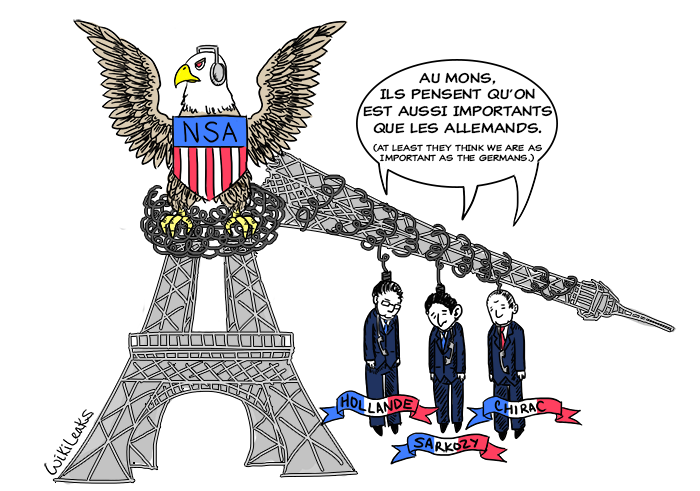
WikiLeaks Release: NSA Spied on Three French Presidents

Embedded image permalink

The US National Security Agency spied on three French presidents, according to top-secret documents released Tuesday by whisteblower group WikiLeaks.
The US spy agency targeted the communications of French presidents Francois Hollande (2012–present), Nicolas Sarkozy (2007–2012), and Jacques Chirac (1995–2007), as well as French cabinet ministers and the French Ambassador to the United States, WikiLeaks said in a release announcing the documents.
"The revelation of the extent of US spying against French leaders and diplomats echoes a previous disclosure in the German press concerning US spying on the communications of German Chancellor Angela Merkel and other German officials," the release states. "That disclosure provoked a political scandal in Germany, eventuating in an official inquiry into German intelligence co-operation with the United States, which is still ongoing."
According to WikiLeaks, the documents include a communication showing that French President Francois Hollande approved a secret meeting with German opposition figures – without the knowledge of Merkel – to discuss the euro-zone crisis, and that former French President Nicolas Sarkozy wanted to resume peace talks between Israel and Palestine without US involvement.
WikiLeaks founder Julian Assange said: "The French people have a right to know that their elected government is subject to hostile surveillance from a supposed ally. We are proud of our work with leading French publishers Liberation and Mediapart to bring this story to light. French readers can expect more timely and important revelations in the near future."

What Borders Mean to Europe?

Geopolitical Weekly

Europe today is a continent of borders. The second-smallest continent in the world has more than 50 distinct, sovereign nation-states. Many of these are part of the European Union. At the core of the EU project is an effort to reduce the power and significance of these borders without actually abolishing them — in theory, an achievable goal. But history is not kind to theoretical solutions.Today, Europe faces three converging crises that are ultimately about national borders, what they mean and who controls them. These crises appear distinct: Immigration from the Islamic world, the Greek economic predicament, and the conflict in Ukraine would seem to have little to do with each other. But in fact they all derive, in different ways, from the question of what borders mean.
Europe's borders have been the foundation of both its political morality and its historical catastrophes. The European Enlightenment argued against multinational monarchies and for sovereign nation-states, which were understood to be the territories in which nations existed. Nations came to be defined as groupings of humans who shared a common history, language, set of values and religion — in short, a common culture into which they were born. These groups had the right of national self-determination, the authority to determine their style of government and the people who governed. Above all, these nations lived in a place, and that place had clear boundaries.
[Read: Accounting for Inertia in Geopolitical Forecasting]
The right of national self-determination has created many distinct nations in Europe. And, as nations do, they sometimes distrust and fear one other, which occasionally leads to wars. They also have memories of betrayals and victimizations that stretch back for centuries before the nations became states. Some viewed the borders as unjust, because they placed their compatriots under foreign rule, or as insufficient to national need. The right of self-determination led inevitably to borders, and the question of borders inevitably led to disputes among states. Between 1914 and 1945, Europeans waged a series of wars about national boundaries and about who has the right to live where. This led to one of the greatest slaughters of human history.
The memory of that carnage led to the creation of the European Union. Its founding principle was that this kind of massacre should never happen again. But the union lacked the power to abolish the nation-state — it was too fundamental to the Europeans' sense of identity. And if the nation-state survived, so did the idea of place and borders.
If the nation-state could not be abolished, however, then at least the borders could lose their significance. Thus two principles emerged after World War II: The first, predating the European Union, was that the existing borders of Europe could not be changed. The hope was that by freezing Europe's borders, Europe could abolish war. The second principle, which came with the mature European Union, was that the bloc's internal borders both existed and did not exist. Borders were to define the boundaries of nation-states and preserved the doctrine of national self-determination, but they were not to exist insofar as the movement of goods, of labor and of capital were concerned. This was not absolute — some states were limited in some of these areas — but it was a general principle and goal. This principle is now under attack in three different ways.

The Movement of Muslims in Europe

The chaos in the Middle East has generated a flow of refugees toward Europe. This is adding to the problem that European nations have had with prior Muslim migrations that were encouraged by Europeans. As Europe recovered from World War II, it needed additional labor at low cost. Like other advanced industrial countries have done, a number of European states sought migrants, many from the Islamic world, to fill that need. At first, the Europeans thought of the migrants as temporary residents. Over time, the Europeans conceded citizenship but created a doctrine of multiculturalism, which appeared to be a gesture of tolerance and was implicitly by mutual consent, given that some Muslims resisted assimilation. But this doctrine essentially served to exclude Muslims from full participation in the host culture even as they gained legal citizenship. But as I have said, the European idea of the nation was challenged by the notion of integrating different cultures into European societies.
Partly because of a failure to fully integrate migrants and partly because of terrorist attacks, a growing portion of European society began perceiving the Muslims already in Europe as threatening. Some countries had already discussed resurrecting internal European borders to prevent the movement not only of Muslims, but also of other Europeans seeking jobs in difficult economic times. The recent wave of refugees has raised the matter to a new level.
[Recommended: A Net Assessment of the Middle East]
The refugee crisis has forced the Europeans to face a core issue. The humanitarian principles of the European Union demand that refugees be given sanctuary. And yet, another wave of refugees into Europe has threatened to exacerbate existing social and cultural imbalances in some countries; some anticipate the arrival of more Muslims with dread. Moreover, once migrants are allowed to enter Europe by any one country, the rest of the nations are incapable of preventing the refugees' movement.
Who controls Europe's external borders? Does Spain decide who enters Spain, or does the European Union decide? Whoever decides, does the idea of the free movement of labor include the principle of the free movement of refugees? If so, then EU countries have lost the ability to determine who may enter their societies and who may be excluded. For Europe, given its definition of the nation, this question is not an odd, legal one. It goes to the very heart of what a nation is, and whether the nation-state, under the principle of the right of national self-determination, is empowered to both make that decision and enforce it.
This question does not merely concern Muslims. In the 19th and 20th centuries, the Ostjuden — the Jews coming into Western Europe as they fled czarist edicts — raised the same challenge, even though they sought more vigorously to assimilate. But at that point, the notion of borders was unambiguous even if the specific decision on how to integrate the Jews was unclear. In many countries, the status of minorities from neighboring nations was a nagging question, but there were tools for handling it. The Muslim issue is unique in Europe only to the extent that the European Union has made it unique. The bloc has tried to preserve borders while sapping them of significance, and now there is an upsurge of opposition not only to Muslim immigration, but also to the European Union's understanding of borders and free movement.

The Greek Crisis

The question of borders is also at the heart of the Greek crisis. We see two issues: one small, the other vast. The small one involves capital controls. The European Union is committed to a single European financial market within which capital flows freely. Greeks, fearing the outcome of the current crisis, have been moving large amounts of money out of Greece into foreign banks. They remember what happened during the Cyprus crisis, when the government, capitulating to German demands in particular, froze and seized money deposited in Cypriot banks. Under EU rules, the transfer of deposits in one country of the bloc, or even outside the bloc, is generally considered legitimate. However, in the case of Cyprus, the free movement of capital across borders was halted. The same could conceivably happen in Greece.
In any event, which is the prior principle: the free movement of capital or the European Union's overarching authority to control that flow? Are Greek citizens personally liable for their government's debt — not merely through austerity policies, but also through controls imposed by the Greek government under European pressure to inhibit the movement of their money? If the answer is the latter, then borders on capital can be created temporarily.
The larger issue is the movement of goods. A significant dimension of this crisis involves free trade. Germany exports more than 50 percent of its gross domestic product. Its prosperity depends on these exports. I have argued that the inability to control the flow of German goods into Southern Europe drove the region into economic decline. Germany's ability to control the flow of American goods into the country in the 1950s helped drive its economic recovery. The European Union permits limits on the movement of some products, particularly agricultural ones, through subsidies and quotas. In theory, free trade is beneficial to all. In practice, one country's short-term gain can vastly outweigh others' long-term gains. The ability to control the flow of goods is a tool that might slow growth but decrease pain.
The essential principle of the European Union is that of free trade, in the sense that the border cannot become a checkpoint to determine what goods may or may not enter a country and under what tariff rule. The theory is superb, save for its failure to address the synchronization of benefits. And it means that the right to self-determination no longer includes the right to control borders.

Ukraine and the 'Inviolability' of Borders

Finally, there is the Ukraine issue — which is not really about Ukraine, but about a prior principle of Europe: Borders cannot be allowed to change. The core of this rule is that altering borders leads to instability. This rule governed between 1945 and 1992. Then, the fall of the Soviet Union transformed the internal borders of Europe dramatically, moving the Russian border eastward and northward. The Soviet collapse also created eight newly free nations that were Soviet satellites in Central and Eastern Europe and 15 new independent states — including Russia — from the constituent parts of the Soviet Union. It could be argued that the fall of the Soviet Union did not change the rule on borders, but that claim would be far-fetched. Everything changed. Then came the "velvet divorce" of Slovakia and the Czech Republic, and now there are potential divorces in the United Kingdom, Spain and Belgium.
Perhaps most importantly, the rule broke down in Yugoslavia, where a single entity split into numerous independent nations, and, among other consequences, a war over borders ensued. The conflict concluded with the separation of Kosovo from Serbia and its elevation to the status of an independent nation. Russia has used this last border change to justify redrawing the borders of Georgia and as a precedent supporting its current demand for the autonomy and control of eastern Ukraine. Similarly, the border between Azerbaijan and Armenia shifted dramatically as the result of war. (On a related note, Cyprus, divided between a Turkish-run north and a Greek-run south, was allowed into the European Union in 2004 with its deep border dispute still unsettled.)
Since the end of the Cold War, the principle of the inviolability of borders has been violated repeatedly — through the creation of new borders, through the creation of newly freed nation-states, through peaceful divisions and through violent war. The principle of stable borders held for the most part until 1991 before undergoing a series of radical shifts that sometimes settled the issue and sometimes left it unresolved. The Europeans welcomed most of these border adjustments, and in one case — Kosovo — Europeans themselves engineered the change.
[See also: Private Sector Debt in EMEs Poses Risk as US Dollar Appreciates]
It is in this context that the Ukrainian war must be considered. Europe's contention, supported by America, is that Russia is attempting to change inviolable borders. There are many good arguments to be made against the Russians in Ukraine, which I have laid out in the past. However, the idea that the Russians are doing something unprecedented in trying to redraw Ukraine's borders is difficult to support. Europe's borders have been in flux for some time. That is indeed a matter of concern; historically, unsettled borders in Europe are precursors to war, as we have seen in Yugoslavia, the Caucasus and now Ukraine. But it is difficult to argue that this particular action by Russia is in itself a dramatically unprecedented event in Europe. The principle of national self-determination depends on a clear understanding of a nation and the unchallenged agreement on its boundaries. The Europeans themselves have in multiple ways established the precedent that borders are not unchallengeable.
There are two principles competing. The first is the European Union's desire that borders be utterly permeable without the nation-state losing its right to self-determination. It is difficult to see how a lack of control over borders is compatible with national self-determination. The other principle is that existing borders not be challenged. On the one hand, the union wants to diminish the importance of borders. On the other hand, it wants to make them incontestable.
Neither principle is succeeding. Within Europe, more forces are emerging that want to return control over borders to nation-states. In different ways, the Muslim immigrant crisis and the Greek crisis intersect at the question of who controls the borders. Meanwhile, the inviolability of borders has been a dead letter since the fall of the Soviet Union.
The idea of borders being archaic is meaningful only if the nation-state is archaic. There is no evidence that this is true in Europe. On the contrary, all of the pressures we see culturally and economically point to not only the persistence of the idea of nationality, but also to its dramatic increase in Europe. At the same time, there is no evidence that the challenge to borders is abating. In fact, during the past quarter of a century, the number of shifts and changes, freely or under pressure, has only increased. And each challenge of a national border, such as the one occurring in Ukraine, is a challenge to a nation's reality and sense of self.
The European Union has promised peace and prosperity. The prosperity is beyond tattered now. And peace has been intermittently disrupted — not in the European Union, but around it — since the Maastricht Treaty was signed in 1992 to create a common economic and monetary union. All of this is linked to the question of what a border represents and how seriously we take it. A border means that this is my country and not yours. This idea has been a source of anguish in Europe and elsewhere. Nevertheless, it is a reality embedded in the human condition. Borders matter, and they matter in many different ways. The European crisis, taken as a whole, is rooted in borders. Attempting to abolish them is attractive in theory. But theory faces reality across its own border.
What Borders Mean to Europe is republished with permission of Stratfor.

Britain to boost its military presence in E. Europe to ‘strengthen NATO’


Published time: June 21, 2015 16:03
British Ghurkas attend the multinational NATO exercise Saber Strike in Adazi, Latvia, June 11, 2015. (Reuters / Ints Kalnins)
British soldiers and fighter jets are going to do longer reassurance missions in Eastern Europe to send signals to President Putin on NATO member states’ commitment to collective defense, Britain's Defense Secretary Michael Fallon said Sunday.
“We have to continue to strengthen NATO,” Fallon said, speaking on the BBC's Andrew Marr Show on Sunday.
The reason for strengthening the alliance presence in new NATO member states was cited as “saber rattling” by Russian President Vladimir Putin.
“It is very important we keep sending Putin this message that we are determined in our commitment to the collective defense of NATO,” Fallon said.
READ MORE: NATO conducting biggest beef up of defenses since Cold War – alliance chief
Britain is going to contribute to the rapid reaction force “spearhead” being created that is set to be stationed in in Eastern Europe and be ready for deployment in a matter of two days after receiving an order.
Starting from 2016, Britain will provide 1,000 troops to this force, 3,000 the year after and will now contribute a battle group of around 1,000 soldiers every year until 2021, Fallon said. British Typhoon fighter jets will continue to patrol the skies of the Baltic States next year, he added.
Last week NATO Secretary-General Jens Stoltenberg acknowledged that NATO is implementing “the biggest reinforcement” of defense since Cold War times.
“NATO is facing a new security environment both caused by violence, turmoil, instability in the south, ISIL in Iraq, Syria, North Africa, but also caused by the behavior of a more assertive Russia, which has used force to change borders to annex Crimea and to destabilize eastern Ukraine,” Stoltenberg said.
Britain's Defence Secretary Michael Fallon (Reuters / Stefan Wermuth)
Poland and the three Baltic States Estonia, Latvia and Lithuania have been demanding a greater NATO presence on their territory after the political crisis in Ukraine evolved into a full-fledged civil war in spring 2014.
Warsaw and Vilnius are in talks with Washington about the permanent stationing of US army equipment warehouses on their territories.

This all provoked a harsh reaction in Moscow, with President Vladimir Putin NATO’s activities may prompt a response.
“If someone threatens our territories, it means that we will have to aim our armed forces accordingly at the territories from where the threat is coming. How else could it be? It is NATO that approaching our borders, it’s not like we are moving anywhere,” Putin said Tuesday

US to send military equipment to NATO allies in Europe


Pentagon to also contribute weapons, aircraft and forces to NATO's new rapid reaction force to help Europe defend itself

The US equipment would go to Bulgaria, Estonia, Latvia, Lithuania, Poland and Romania [File: EPA]
US has announced that it will spread about 250 tanks, armoured vehicles and other military equipment across six European nations, including the Baltic states, to help reassure NATO allies facing threats from Russia and armed groups.
Ash Carter, the US defence secretary, said on Tuesday that the equipment would go at least on a temporary basis to Bulgaria, Estonia, Latvia, Lithuania, Poland and Romania.
"We intend to move those equipment sets around as exercises move around," Carter said. "They are not static. Their purpose is to enable richer training and more mobility to forces in Europe."
He said the US presence would be "persistent" but "agile".

RELATED: Putin says Russia is beefing up its nuclear arsenal

A day earlier, Carter also announced that US would be contributing weapons, aircraft and forces, including commandos, to NATO's new rapid reaction force to help Europe defend against potential Russian aggression from the east, and the Islamic State of Iraq and the Levant (ISIL) and other armed groups from the south.
The US  is also going to work with NATO's cyber centre, located in Estonia, to help allies develop cyber defence strategies and other protections against computer-based attacks, said Carter.
He also expressed the readiness of the US to provide intelligence and surveillance capabilities, special operations forces, logistics, transport aircraft and a range of weapons support that could include bombers, fighters and ship-based missiles if requested and approved by the European countries.
It woud not provide a large ground force, he said.

RELATED: Vladimir Putin says Russia not a threat to the West

Russia's annexation of Crimea from Ukraine last year has jangled nerves in Europe, with Baltic and Nordic countries reporting an uptick in Russian military activity over the past year.
However, Russian President Vladimir Putin said earlier in June  that his country was "not a threat to the West", ruling out a major conflict between Russia and NATO member countries.
But he said Moscow would develop "systems to overpower anti-missile defences" to ensure a stategic balance in case NATO and US beefed up their presence at Russia's borders.
Several days later, Putin announced that his country would add more than 40 new intercontinental ballistic missiles to its nuclear arsenal this year.
Putin also noted that the military was to start testing its new long-range early warning radar intented to monitor the western direction.

Russian Customs Seize MiG-21 Contrabanded Parts on Moscow-Odessa Train

MiG-21

Parts of a MiG-21 fighter jet have been seized by Russian customs on a train traveling from Moscow to Odessa.
MOSCOW (Sputnik) — Russian customs officers have seized parts of a MiG-21 fighter jet on board a train traveling from Moscow to Odessa in Ukraine, the Central Customs Directorate said on Tuesday. "A coach attendant filled in a customs declaration describing the declared goods as parts of a tractor," the directorate said in a statement.
"The attendant said he did it on request of a person who asked him to deliver the cargo to Ukraine," the statement said.

Socialist-led coalition wins three-fourths of mayoral elections in Albania, helping EU hopes


The Associated Press
Officials at a polling station in capital Tirana count the ballots of the local municipal elections considered a key step toward convincing the European Union to launch membership negotiations with Albania, after the country was granted candidate status last year Monday, June 22, 2015. Preliminary results show the leftist majority is ahead in most of the country’s municipalities, including the capital Tirana and the main cities.(AP Photo/Hektor Pustina)
Associated Press + More
TIRANA, Albania (AP) — A coalition led by the governing Socialist Party has won three-fourths of mayoral elections in Albania, seen as a possible step toward improving its bid to launch membership negotiations with the European Union.
Erion Veliaj, a 35-year-old former social affairs minister, declared victory Tuesday in the race in the capital, Tirana. He defeated a candidate backed by incumbent Lulzim Basha of the opposition Democratic Party, who was not running again.
With 97 percent of votes counted from Sunday's mayoral elections, the Socialist-led coalition won 46 out of 61 races. The victories could help Albania overcome political squabbling that has hindered reforms needed to seek EU membership.
Reforms shrank the number of municipal elections from 373 to cut costs and boost local decision-making, putting Albania more in line with EU standards.

Putin saved my life, Ukraine’s ex-president says


First entry: 23 June 2015
Putin saved my life, Ukraine’s ex-president says
Ukraine’s former president Viktor Yanukovych has praised Russian president Vladimir Putin and thanked him for saving his life.
The former leader of Ukraine told BBC's Newsnight he was grateful that Putin ordered security officials to help Yanukovych get out of Ukraine.
Yanukovych fled to Russia on February 23, 2014, with the help of Moscow troops.
"Vladimir Putin took that decision, on the recommendation of his own special forces, that was his right and his business. He did not consult me. I am of course grateful to him for giving the order and… helped my security to get me out, and save my life."
In what the BBC said was his first interview with a Western journalist, Yanukovych refused to answer directly questions about whether Crimea belongs to Russia or Ukraine.
"Today what happened is already a fact. Now there is war. They talk about getting Crimea back. How? By war? We need another war?" he said.
He took responsibility for the killings in Maidan in February 2014. "I don't deny my responsibility," he said. But the former president denied he gave the order for government troops to fire on protestors.
"I did not give any orders, that was not my authority... I said publically I was against the use of force, let alone the use of firearms, I was against bloodshed."
Yanukovych's most colourful response was to questioning over the private zoo that he kept in the grounds of his 343-acre estate Mezhygirya, outside Kiev.
The zoo was home to thousands of animals, including deer, pigs, peacocks, ostriches and even kangaroos.
Asked about the animals that lived on the property Yanukovych was defiant.
"That I supported the ostriches, what’s wrong with that?" he asked.
Initially he said the zoo was a "totally separate entitiy" that just happened to be situated within palace grounds, saying "Yes, what am I supposed to do, go around with my eyes closed?"
But he later conceded: "Ok it was one territory."
However, he denied that he visited the zoo often.
"If I ever went there I went there roughly twice a year, when I had time. I didn’t have much time. I worked. Even though I love animals. When I had time, I went there."
Source: The Telegraph

Monday, June 22, 2015

The Death of Omonia and the Challenges inside of the Greeks of Albania


THE GREEK EPIROTES OF ALBANIA IN DEEP POLITICAL CRISIS. THE DEATH OF OMONIA FROM THE ALBANIAN POLITIC SYSTEM . ADMINISTRATIVE ELECTIONS RESULTS, A TRAGIC FALIMENT FOR HRUP.

SManalysis
 
Output from the Albanian political scene of Omonia, should be reflected in particular to The Greek Epiriotes Community of Albania and the diaspora, to receive soon, the lost time, being organized into a single front, facing a geopolitical development, now with new challenges underway to "The Greater Albania" 

It is unconscionable that anti democratic laws, dictated by oligarchs from the Albanian Parliament and the decisions of the government, specially built for the robbed land of ethnic Greeks, especially in Himara Region, to show complete indifference from Omonia, and especially by the Greek government

Finally the Organisation of Greeks of Albania, Omonia, emerged from the political scene. Since 1991 when it was created, it was represented by 5 MPs in the first pluralistic Parliament of Albania, and with 12 municipalities.

After 24 years, Omonia went dropping toward a bankruptcy, unable to organize the requirements for the internationalization of human rights and freedoms, losing political territories that historically held by ethnic Greeks.

The main responsibility, of remains, political leadership, Vangjel Dule and Vassilis Bolanos, who led Omonia and PBDNJ since 2000, a direction as authoritarian and Confrontations as within the ranks of the Greek organization as well as in relationship with Tirana.

But in the same responsibility should have the Greek government, which left only without broad political support and helped democratize the Albanian Greek relationship, taking advantage of its geopolitical credibility, particularly in European history, of Albanian relationship.

Issues such as economic investments, the agreement of border marine waters, or further, had the foreign policy priorities of the Greek government, and left in limbo democratization and support of hundreds of thousands of ethnic Greeks in Northern Epirus, as far as today's situation, is dramatic , losing territories inhabited for thousands of years by the Greeks, without any support for violation of human rights and freedoms.


Not only that but the Greek government, built an authoritarian system within the Greek organization Omonia, so as tens of thousands of political supporters were forced to indifference or to join the Albanian political parties, for survival.


It is unconscionable that anti democratic laws, dictated by oligarchs from the Albanian Parliament and the decisions of the government, specially to built for the robbed land of ethnic Greeks, especially in Himara Region, to show complete indifference from Omonia, and especially by the Greek government.
 
Omonia, as an important partner in the geopolitical developments in Albania, failed policy initiatives for democratic self-determination of autonomous system (Refering the Protocol of Corfu) , for a series of issues that relate to International Agreements and Freedoms for Human Rights, and did not develop ever mass protests against Albanian authorities.

Output from the Albanian political scene of Omonia, should be reflected in particular to The Greek Epiriotes Community of Albania and the diaspora, to receive soon, the lost time, being organized into a single front, facing a geopolitical development, now with new challenges underway to "The Greater Albania"

Clashes in central Athens square


First entry: 22 June 2015
Clashes in central Athens square
About 40 or 50 anarchists suddenly surged in the middle of the pro-European rally, started burning EU flags and threw pepper spray at those of the pro-EU crowd who tried to move against them. Riot police separated the two groups.

EU launches Mediterranean migrant military mission

EU ministers formally approve launch of first phase of a military operation against people smugglers, official says.

| Humanitarian crises, Human Rights, Europe
The first ships and aircraft to conduct intelligence gathering missions should be available within a week, an official said [Reuters]

EU foreign ministers have formally approved the launch of the first phase of a military operation against people smugglers in the Mediterranean, officials said.
The first ships and aircraft to conduct intelligence gathering missions should be available within a week, officials said on Monday.
EU foreign affairs head Federica Mogherini said the 28-nation bloc had responded quickly to the crisis
Talk to Al Jazeera in the field - African migrants: What really drives them to Europe?
washing up on its southern shores.
"I am impressed by the unanimity and speed with which we have put this together," Mogherini said as she arrived to chair the foreign ministers meeting.
There have been serious differences among member states over how to handle the thousands of migrants crossing the Mediterranean.
Italy, Greece, and Malta have endured the burden until the loss of up to 800 people in April when their rickety boat sank and forced a rethink.
Phases of the plan
EU leaders agreed at an emergency summit that month to formulate a comprehensive plan to tackle the problem at the source, including a military option to go after the people traffickers working out of Libya.
The first phase of intelligence gathering is meant to be followed by active intervention to board and disable smuggler vessels and arrest the traffickers.
A third phase would extend these actions into Libyan territorial waters and possibly inside the country itself.
The April summit agreed that advancing to the next two phases would however require a UN Security Council Resolution and agreement from Libya before the EU would go ahead.
 
Source: AFP

Belgrade and Pristina teams meet, won't make statements


Monday morning saw the start of what the public supposes to be the most important round of talks between Belgrade and Pristina.
Source: B92
However - the public will be deprived of the participants' statements.
B92's reporter in Brussels said this afternoon that teams of Belgrade and Pristina are discussing four topics: the future community of Serb municipalities, telecommunications, energy, and Peace Park on the bridge that separates the northern and southern part of Kosovska Mitrovica.

Participants in the talks will not make any statements - in fact, they are prohibited from addressing the public. This is the case because of recent statements made by Kosovo Minister for Dialogue with Belgrade Edita Tahiri, who after the previous round of negotiations said that "Kosovo will be given an international dialing code through a request submitted by Austria."

Serbian Government's Office for Kosovo and Metohija Director Marko Djuric reacted to this by saying that the southern Serbian province cannot be given this code "without the approval of Serbia."

That is why EU officials barred dialogue participants from giving any statements until prime ministers Aleksandar Vucic and Isa Mustafa arrive in Brussels.

They will join the talks on Tuesday, and, according to some media, "the European Union will ask them to sign documents which will provide for further implementation of the Brussels agreement."

Greek Baitout


Cartoons
More and more people in Greece think that country's exit from the eurozone, compared to the social pain of maintaining austerity policies, is a better option.
Greek Baitout
For example, the country's ruling Syriza party lawmaker and Chairman of Committee on Economic Affairs, Stefanos Samoilis told Sputnik Turkey that a potential Greek exit from the eurozone would be much more painful for the European monetary union than for Athens.
Addressing the assertion that a Grexit would be suicidal for the country, Samoilis said, "I don't agree with this view. I don’t think anything other than the continuation of austerity policies is suicidal for Greece."
If Greece's creditors insist on unsustainable policies bringing more people to the brink of poverty, the government will explore other options and "democratically decide which way to go forward," Samoilis added.
There has been broad media speculation regarding Greece’s potential exit from the eurozone in recent weeks. Several Greek officials, including Finance Minister Yanis Varoufakis, have spoken out against Athens leaving the single currency.