Monday, June 22, 2015

Greece's Russian Card: Russo-Greek Gas Deal Likely to Infuriate Brussels

Vladimir Putin meets with Greek Prime Minister Alexis Tsipras

© Sputnik/ Sergey Guneev
Ahead of a crucial Eurozone emergency summit in Brussels, which many regard as a potential turning point for Greece, Athens has inked a $2.3 billion deal with Moscow on extending the Turkish Stream pipeline through the Greek territory.
While experts are expressing their doubts regarding Greece's ability to settle its debts anytime soon, Athens is seeking ways to bring the country back from the brink of economic collapse; the recent move of the Tsipras government aimed at creating the EU gas hub on its territory may provide the country with an unbeatable advantage in the future.
"It's crunch time for Greece. An emergency summit of Eurozone leaders in Brussels Monday will decide whether the heavily-indebted country, run by a left-wing government that refuses to make concessions that cut deeper into living standards, will be granted another financial reprieve or is headed for default and possible exit from the Eurozone," Moscow-based Christian Science Monitor correspondent Fred Weir noted.
Alex Tsipras' recent visit to Russia sparked a heated debate among Western experts which suggested that the meeting between the Greek Prime Minister and Russian President Vladimir Putin would be focused on a potential financial aid package to Athens. However, "Mr. Putin emerged from the meeting saying the issue of Russian cash assistance was never even raised," the journalist underscored. Nevertheless, Moscow and Athens have concluded a significant and mutually beneficial agreement, Mr. Weir stressed, referring to a memorandum on extending Russia's Turkish Stream gas pipeline through the territory of Greece inked by Greek Energy Minister Panagiotis Lafazanis and his Russian counterpart Alexander Novak in St. Petersburg.
The deal is evidently playing into the hands of Moscow, which needs "an EU member to become the new "gas hub" for distribution to Europe." Russia's previous South Stream project, which was considered an opportunity to provide gas to Europe avoiding troublesome Ukraine, was suspended last year under the EU pressure. Remarkably, some Western media outlets emphasize that the Russo-Greek agreement is likely to infuriate those EU countries which are calling to toughen the European sanctions policy against Moscow.
However, when the system is completed in 2019, it will "bring hundreds of millions of dollars in gas transit fees to Greek government coffers," the journalist underscored. Furthermore, Athens will own its part of the gas network stretching through its territory. According to Gazprom's plan, the Turkish Stream will be divided into four lines, and one of them will supply Turkey. The Turkish Stream's total capacity is expected to amount to 63 billion cubic meters per year.
Although the deal is unable to solve Greece's current debt crisis, the creation of the EU gas hub on the Greek territory will provide the country with a competitive advantage and a new source of income.
Whatever the result of the Eurozone emergency summit will be, "the Kremlin is playing a long game with Greece, which doesn't depend on whether the struggling country remains in the Eurozone or not," Mr. Weir stressed. Indeed, Greece has long been considered a Russian ally, since the countries share deep cultural and religious ties. At the same time Athens needs Russia as a trade and business partner.
"Russia couldn't help Greece in its financial negotiations with the Eurozone even if it wanted to. Greece can obtain advantages for itself in energy and other spheres by courting Russia. So why shouldn't it play this card?" said Sergei Zabelin, an expert with the official Institute of European Studies in Moscow, as cited by the journalist.

U.S. Explains How NATO Could Respond To Russia

If NATO decides to interfere in the Ukrainian-Russian conflict, the fastest way of stationing its forces would be through aircraft.
In case of Russia's large-scale invasion into Ukraine, the West will respond through both military means using NATO’s aircraft and, which is more probable, strict sanctions, the U.S. intelligence-analytical company Stratfor says in its report, as reported by Russian media, which has gotten a hold of the report.

Heavy Military Equipment Baltics NATO Europe Russia
Although the U.S. and NATO have enough ground forces, which could be stationed in Eastern Europe and deployed to Ukraine in case of Russia’s large-scale invasion, the transportation of these forces would take too much time. Besides, this kind of operation requires aerial military assistance, according to Stratfor.
The report notes that military aerial forces of the European states are stationed relatively close to Ukraine. However, even their capabilities would be limited due to the required fuel refills.
As for the U.S. air force, they are in a tougher situation as they first have to deploy its forces into Eastern Europe. They would have several aerial squadrons stationed in Europe, but it would be not enough for a large-scale military operation against Russian air defense systems and its fighter aircraft. Therefore, the U.S. would have to wait for a backup from Washington. However, the fastest scenario of deploying 22 fighter squadrons would take at least 11 days.

Russia's forces to reach its targets by the time U.S. deploys its forces

The U.S. would also get 30 airports in Poland, Slovakia, Hungary, Romania and Bulgaria at its disposal. Besides, there is a high possibility of deploying the U.S. forces to Italy and Germany. Furthermore, stationing of U.S. fighter aircraft on Ukraine’s territory is also possible, according to the Stratfor’s report.
However, in such a case the U.S. aircraft would become reachable to be targeted by Russian forces. Among many other things, such a scenario does not rule out the involvement of the U.S. aircraft carrier, which would most likely be sent to the Aegean Sea. Therefore, by the time the U.S. deploys its forces, Russia’s offensive operation would have already reached its main targets.
The report also notes that the main advantage of Russia’s air forces would be the fact that it would operate close to its military bases and under the protection of its own anti-aircraft defense systems. NATO, for its part, has more warplanes that are more modern compared to the Russian ones, and some of them are too advanced for Russian radars.
Having gotten an advantage in the air, the Alliance would be able to carry out its ground operation, which would neutralize all Russia’s previous gains.

U.S.-Russia tensions are expected to outlive Putin

Meanwhile, the U.S. and its allies in NATO are preparing for the differences between the West and Russia to outlive Vladimir Putin’s reign.
The United States Secretary of Defense Ashton Carter made such an announcement on Sunday, completing his official mission around Europe.
Pentagon chief also noted that Washington hopes that Moscow would one day get back to a forward-looking course, and pointed out a few areas of diplomatic cooperation with Russia, including the nuclear talks on Iran’s nuclear program.
However, according to Carter, there is a much stronger tension expected in the relations between Russia and the U.S. He also noted that the revisions in the military strategy of NATO are aimed at the deterrence of Russian interference.
Carter also shared his concerns that Russia might not change after Putin. When asked whether Putin would be able to change his political course, Carter said that he hopes so, but he cannot be sure.

Russian-Ukrainian war over the ownership of Vladimir the Great

On the 1,000th anniversary of the death of Vladimir of Kiev, who decided to abandon pagan gods and take Christian Orthodoxy, Russia and Ukraine entered a heavy fight over his legacy.
Vladimir the Great, who later became Saint Vladimir, made the states of Russia, Ukraine and Belarus spiritually closer to the rest of Eastern Europe a millennium ago. Vladimir’s decision united the people of Kievan Rus, which stretched along the waterways between the Baltic and Black seas.
And now that the two of Kievan Rus’ successor nations, Russia and Ukraine, are not that united over Russian President Vladimir Putin’s annexation of Crimea from Ukraine and Russia’s ongoing involvement in the conflict in eastern Ukraine and the support of local pro-Russia rebels, there is a stinging battle over the ownership of Saint Vladimir the Great.
Ukrainian President Poroshenko called Vladimir the founder of the “European state of Rus-Ukraine,” while announcing a national plan of festivities as part of the 15 July anniversary.
Russia, which also has great plans to celebrate the anniversary, could not leave Poroshenko’s comments unnoticed. “It’s hard to call that an opinion. It’s easy to call it a fantasy,” said Andrei Nazarov, director of the state-backed Russian Military-Historical Society.
Most Russian politicians – and people in general, for that matter – consider Vladimir to be a symbol of Russia. “Thanks to him, Russia became what she is – a mighty state with a strong, Orthodox Christian base,” Mr Nazarov said.
Furthermore, the Russians claim that Moscow is “the mother of Russian cities.” That is something that Kiev has been called for pretty much a millennium. And that is completely understandable given the fact that it was Kiev where Vladimir drove his people into the Dnieper river for a mass baptism.
According to histories, Kievan Rus controlled the territory around Moscow during Vladimir’s times, but the city had not yet appeared.
Although there have always been numerous political differences between the Russians and Ukrainians, the countries were always close in terms of culture and religion. Up until Vladimir Putin decided to play a king and make his own Kievan Rus.

Sunday, June 21, 2015

BALTOPS 2015: A Show of Force in the Baltic Sea

Ships, planes, and hundreds of Marines attacked a beachfront off the Baltic Sea this week. This impressive show of force is part of BALTOPS 2015 - an annual US-led NATO exercise designed to enhance flexibility and interoperability, and demonstrate the resolve of allied and partner forces to defend the Baltic region.

Thousands of military personnel take part in this multinational exercise involving 49 ships, 61 aircraft, 1 submarine, and a combined landing force of 700 troops. 17 NATO Allies and partner nations participated in BALTOPS 2015, which took place in Poland, Sweden, Germany, and throughout the Baltic Sea.

Albania Holds Local Polls, Key to Launch EU Membership Talks

Albanians have started voting in local municipal elections, a key step in their efforts to launch membership negotiations with the European Union.
About 3.4 million eligible voters cast their ballots in the country's seventh local elections since the fall of communism in 1990 to elect 61 mayors and 1,595 municipal counsellors.
Voting started Sunday at 7 a.m. (0500 GMT) and ends at 7 p.m. (1700 GMT).
The focus is in the capital where a 37-party coalition led by Prime Minister Edi Rama's Socialists have nominated former social affairs minister Erion Veliaj, while the 15-party opposition led by Tirana Mayor Lulzim Basha's Democrats tapped parliamentarian Halim Kosova.
Around 200 international observers are monitoring the polls.
The law says results must be revealed no later than three days after the vote.

Russia Reveals Two Different Warships to Replace Mistrals

The Mistral-class helicopter carrier Vladivostok is seen at the STX Les Chantiers de l'Atlantique shipyard site in Saint-Nazaire

© REUTERS/ Stephane Mahe
Military & Intelligence
Russian-made Priboy and Lavina, two amphibious helicopter carriers, will replace the Mistral-class warships that France failed to deliver to Russia.
The Russian Defense Ministry revealed the layout of a new amphibious assault ship during the "Army-2015" military show at a shooting range in Alabino near Moscow earlier this week, Lenta.ru reported.
With its new amphibious warship, known as Priboy ("Surf"), the Defense Ministry plans to replace the Mistral-class helicopter carriers that France failed to deliver to Russia.
For now, the ship is available in the layout form on the stand. Priboy will be a relatively smaller-size (a 14,000-ton, 165 meters in length and 25 meters in width) helicopter carrier capable of transporting 8 helicopters, up to 600 marines and between 40-60 armored vehicles.
St. Petersburg-based Nevsky Design Bureau announced that it plans to start the construction of Priboy next year, RT said.
Furthermore, later on the Krylov State Research Centre revealed another amphibious helicopter-carrier, codenamed Lavina ("Avalanche"). Lavina will apparently be bigger and faster than French Mistrals. The Russian helicopter carrier will have a full load displacement of 24,000 tons, compared to Mistral's 21,300 tons. Lavina's maximum speed will be 22 knots, as opposed to Mistral's 19 knots. Similar to Mistrals, Lavina will be capable of carrying 16 helicopters, around 50 armored vehicles and possibly six smaller boats, versus Mistral's four, RT reported.
Russia and France signed a $1.3 billion deal for the delivery of two Mistral-class ships in 2011.
The deliveries were put on hold in late 2014 over Moscow's alleged involvement in the Ukrainian civil war. The Kremlin has repeatedly denied these groundless claims and pushed for peace in the war-torn nation.

US Navy Plans to Equip Next-Generation Aircraft Carriers With Laser Weapons

The laser weapon system (LaWS) is tested aboard the USS Ponce amphibious transport dock during an operational demonstration while deployed in the Gulf

© REUTERS/ John Williams/U.S. Navy/Handout via Reuters
Military & Intelligence
US Navy officials are pinning their hopes on laser and directed-energy weapons, claiming that lasers would even replace some existing missile systems, providing a much higher rate of annihilation.
The US Navy is considering the possibility to equip America's next-generation aircraft carriers with powerful laser weapons, according to US journalist Zachary Keck, who has interned at the Center for a New American Security and the US Congress, where he worked on defense issues. Citing Rear Admiral Michael Manazir, Director of Air Warfare, the journalist pointed out that the aircraft carrier is a perfect platform for the installation of laser weaponry. Currently this weapon can be used only for defensive purposes, but Rear Adm. Manazir believes that as technology gets more sophisticated, the US carriers will be able to boast new laser offensive technology.
"The USS Gerald Ford is able to generate 13,800 volts of electrical power, over three times as much as Nimitz-class carriers, which can generate 4,160 volts of electricity," Keck elaborated, adding that while some of this energy will be needed to power the carrier's Electro-Magnetic Aircraft Launch System (EMALS), the rest of it can be used by laser weaponry systems.
By placing direct energy weapons on aircraft carriers, the US Navy plans to solve a number of problems traditional missile defense systems still suffer from. First and foremost, offensive missiles are far cheaper to manufacture and operate than the interceptors which are used for defensive purposes. On the other hand, aircraft carriers have limited space on board for interceptors, since they should also carry offensive weapons. However, it is expected that laser arms will solve both of these problems.
"The US Navy already operates a directed energy weapon system; namely, the Laser Weapons System (LaWS), which is onboard the USS Ponce. It is primarily intended to engage threats posed by Iranian unmanned aerial vehicles (UAVs) and small boats that could be used to overwhelm US Navy ships in the Persian Gulf," Mr. Keck noted.
However, directed-energy weapons still need further refinement, the journalist stressed, quoting the Center for a New American Security report, which stated that "few weapons have held as much promise — and have consistently failed to live up to that promise — as directed-energy weapons." Megawatt-class anti-missile weapons remain a distant prospect for the US Navy, which currently uses tactical lasers to shoot small boats and low-cost drones. Still US military officials do not give up hope for obtaining powerful directed-energy arms in the future. Believing that at some points lasers will one day replace some existing missile systems, they insist that lasers will be able to provide a much higher rate of annihilation than traditional missile interceptors.

Tsipras assembles cabinet on eve of crucial EU Summit


First entry: 21 June 2015
Tsipras assembles cabinet on eve of crucial EU Summit
Greece’s cabinet will huddle with the prime minister on Sunday to map out its strategy for a meeting the next day that will decide the nation’s future in Europe’s currency bloc.
On the agenda at the meeting in Prime Minister Alexis Tsipras’ residence is whether to compromise on election promises in order to avoid a default on its debt.
“Austerity must end,” government spokesman Gabriel Sakellaridis said after Greek negotiators ended a meeting on Saturday. “A different Europe is necessary, a different Europe is possible.”
With markets closed, the weekend gives negotiators some room to lay out a roadmap for what will be a high-stakes week with an emergency summit of EU chiefs on Monday in Brussels. The clock is running down on a June 30 deadline to make payments and work out a new deal amid disagreements on pensions, sales tax and spending targets.
In a sign that Greece may not bend to creditor demands, Minister of State Nikos Pappas said red-lines include no cuts to pension plans and wages, and a comprehensive review of the country’s onerous debt load.
The Frankfurter Allgemeine Sonntagszeitung newspaper said Greece may gain an extension of the current aid program to at least September as well as some funds, provided that Greece agrees to EU Commission proposals. It didn’t cite anyone.
Bloomberg

Friday, June 19, 2015

Eurostat: Over quarter of asylum seekers come from Kosovo


Over one quarter of the 185,000 people who applied for asylum in the EU in the first quarter of the year are citizens of Kosovo, according to Eurostat.
Source: Tanjug
This makes them the most numerous category among asylum-seekers, the EU's statistical office said on Thursday.
With almost 49,000 asylum requests, ethnic Albanians rank above citizens of Syria who have a 16 percent stake in the total number of asylum applications, followed by people from Afghanistan who occupy the third place on the list with seven percent of all asylum requests.

The greatest number of asylum requests (40 percent) was filed to Germany and Hungary (18 percent), while all other EU members received a considerably fewer number of asylum requests, Eurostat said.

Compared to the first quarter of 2014, the total number of asylum seekers in 2015 increased by 85 percent, but the growth does not apply when viewed relative to the last three months of 2014, when EU countries received around 185,000 asylum seekers.

Greek Economic Crisis Reflects EU Problems - Tsipras

Greek Prime Minister Alexis Tsipras during the plenary meeting of the 19th St. Petersburg International Economic Forum 2015.

© Sputnik/ Sergey Guneev
The economic crisis in Greece is a reflection of European Union problems, Greek Prime Minister Alexis Tsipras said Friday.
ST. PETERSBURG (Sputnik) — The European Union needs to return to its initial declarations and principles of solidarity and justice as the path of austerity is counterproductive, Tsipras noted. "The so-called Greek problem is not a Greek problem, it is a European problem," Tsipras said, adding that the problem is the Eurozone itself and its structure.
"The question is, whether the European Union will be able to become a region of development again," Tsipras said.
Athens is currently attempting to negotiate a $270-billion debt relief terms with its international creditors. Its current bailout program expires on June 30.
Greece's overall debt stands at about $350 billion, of which $270 billion is owed to the European Commission, the European Central Bank and the International Monetary Fund.
On Thursday, EU Commissioner on Economic and Financial Affairs Pierre Moscovici said that the failure to reach an agreement in talks between Greece and international creditors before the deadline could lead to catastrophic consequences.

Thursday, June 18, 2015

Tsipras message to the Germans: You are told lies about Greece


Tsipras message to the Germans: You are told lies about Greece
The "blind insistence" on cutting Greek pensions will only worsen the country's already dire financial crisis, Greek Prime Minister Alexis Tsipras wrote in a German newspaper commentary on Thursday.
In a guest column for Der Tagesspiegel newspaper in Berlin, Tsipras also rejected the "myth" that German taxpayers are paying Greek pensions and wages. He said Greeks, contrary to the widespread belief in Germany, work longer than Germans.
"The blind insistence of cuts (in pensions) in a country with a 25 percent unemployment rate and where half of all the young people are unemployed will only cause a further worsening of the already dramatic social situation," Tsipras wrote.
He said that pensions are the only source of income for countless families in Greece. In Athens on Wednesday he also rejected pension cuts that creditors are seeking to unlock aid.
Tsipras also wrote that the state's expenditures for pensions and social spending were cut by 50 percent between 2010 and 2014. "That makes further cutbacks in this sensitive area impossible."
Tsipras also challenged perceptions among Germans, a majority of whom now want Greece to leave the eurozone, about who is paying for Greek wages and pensions:
"Anyone who claims that German taxpayers are coming up for the wages and pensions for Greeks is lying," he wrote. "I'm not denying there are problems...But I'm speaking out here to show why the 'cuts offensive' of the past years has led nowhere."
Tsipras's leftist government has faced dire warnings that it risks being forced out of the eurozone and left without support if it fails to strike a aid-for-reforms deal with creditors.
Hopes of a breakthrough on Thursday at a meeting of European finance ministers, once seen as a final chance for an agreement, are looking increasingly dim.Athens must find a way out of the impasse by the end of June, when it faces a 1.6 billion euro repayment due to the International Monetary Fund, potentially leaving it bankrupt and on the verge of exiting the eurozone.
Finance Minister Wolfgang Schaeuble maintained his hard line against Greece, telling Bild newspaper the question was whether "Greece fulfils its commitments from the existing program."
Schaeuble stressed the IMF must continue to take part in the rescue program: "Without its important contribution, it (the program) doesn't work."
Reuters

Hungarian Air Force is in a 'Catastrophic' State – Ex-Defense Minister

Commenting on several incidents involving Hungarian Airforce Saab JAS-39 Gripens over the past few months, Hungarian Defense Minister Imre Szekeres stated that the Hungarian air force is in a catastrophic state, Slovakian newspaper Sme reported.
Last week, a Hungarian Air Force single-seater Saab JAS-39C Gripen crashed at Hungary's Kecskemet Airbase during exercises. After suffering a landing gear failure, the pilot attempted to land the aircraft on its belly, but lost control after touching the runway, and was forced to eject. The pilot was injured after his ejection seat failed to separate from his chute.
Commenting on the incident, and those that had preceded it in March and May, Szekeres stated that the Hungarian government "has wasted the money necessary for the purchase of fuel for combat aircraft, spending it on all kinds of festivities and celebrations."
Video of the crash of the Gripen JAS 39C at Kecskemet Airbase.
The former defense minister argued that the lack of fuel is the main cause of the Air Force's catastrophic state, noting that pilots are not able to be in the air long enough to receive sufficient flight training. As a result of the shortages, Szekeres estimated that pilots receive 1,000 hours less flight time than necessary. He noted that the pilot that crashed another Saab Jas 39 at an incident in May had flown only 8 hours this year.
On May 19, a two-seater Saab Jas 39D crashed upon landing at the Caslav air base in the Czech Republic during exercises. Both pilots were able to escape uninjured. That crash was itself preceded by another incident involving a Saab JAS 39 in March, when a pilot was forced to make an emergency landing at the airport in the Slovak city of Kosice. Commenting on the underfunded state of the country's air force, Hungarian newspaper Magyar Nemzet complained that "although the Hungarian Air Force has been leasing Swedish JAS 39 Gripen fighter aircraft for nine years, it hasn't been able to buy bombs and other weapons for it due to lack of funding."
The JAS-39 multirole fighter serves as Hungary's main fighter aircraft, with 12 presently. The Air Force had agreed to lease purchase 14 JAS 39 Gripens from Sweden, including 2 dual-seaters and 12 single-seaters, in 2006, at a cost of 13.8 billion forints ($50 million) apiece. The country also has up to two dozen MiG-29 fighters in reserve, which it had previously attempted to auction off.

Greece's Tsipras heads to Russia for some love


With Greece's relations with its European counterparts at a low ebb, Greek Prime Minister Alexis Tsipras will head to Russia on Thursday and meet President Vladimir Putin at the St. Petersburg International Economic Forum (SPIEF).
Tsipras' visit comes at a crisis point for Greece, with reforms-for-rescue talks between the country and its international lenders in deadlock.
He is due to meet with Russian President Vladimir Putin on Friday afternoon, the Greek government said in a statement Thursday, and ahead of that meeting will make a keynote speech at the forum.
Tsipras' government has already warned it will not have the money to pay a debt of 1.5 billion euros to the International Monetary Fund (IMF) without an agreement, prompting increasing concern that Greece will default and eventually leave the euro zone.
However on Thursday, Russian Deputy Finance Minister, Sergei Storchak, said Greece had not asked the Russian Finance Ministry for financial assistance, Dow Jones reported. The ministry would not comment on the remarks when contacted by CNBC.
The head of the IMF, Christine Lagarde, said that Greece would be in default at the start of July if it fails to make a repayment on June 30 because there is no grace period or possibility to delay, Reuters reported.
"It will be in default, it will be in arrears vis-a-vis the IMF on July 1, but I hope it is not the case, I really do," Lagarde told reporters following a meeting with the Luxembourg finance minister.
Dmitry Azarov | Kommersant Photo | Getty Images
Russia's Central Bank Governor Elvira Nabiullina told CNBC Russia had considered the implications of such a scenario – for example, its impact on money flow in Europe – and was worried.
"We do consider that scenario as one of possible risks which would increase turbulence in the financial markets in the European market, bearing in mind the fact the European Union is one of major trading partners, and we are definitely worried by it," she told CNBC this week.
Voicing the fears of European politicians who are keen to avoid contagion spreading throughout the euro zone, Nabiullina said a "Grexit" was a possibility – and Russia too could be affected.
Read MoreA key project for Putin

"There is a possibility of this kind of sentiment becoming stronger, which could reduce the rate of the development of the recovery of the European economy, and bring down the demand for our products," she said
There is speculation that talks between the leaders will focus on the proposed construction of a gas pipeline through Greece and the country's potential participation in a new BRICS development bank, set up by Brazil, Russia, India, China and South Africa with a reserve fund for emergency situations.
Tsipras is travelling to Russia with the Greek economy minister and alternate finance minister, among others, plus some business leaders, the Greek government said.
<p>Aiming for 4% inflation: Central Bank of Russia Governor</p> <p>Elvira Nabiullina, governor of the Central Bank of Russia, tells CNBC they are targeting the rate of inflation, rather than a specific level for the ruble. </p>
Russia invited cash-strapped Greece to participate in the new bank in May.
The Greek and Russian governments' warming relations have not come as a surprise to some Europe-watchers.
"Ever since he became premier, Mr Tsipras has gone to great lengths to accentuate Greece's cultural and historical ties to Russia as part of his efforts to reorient Greece's economic and foreign policies away from conventional euro zone-centric ones," Nicholas Spiro, managing director of Spiro Sovereign Strategy, told CNBC Thursday.
Read MoreRussia: Time to invest despite sanctions threat?

"He's playing the nationalist card and cosying up to Russia is part of his brinkmanship with Greece's creditors. This is music to the ears of Mr Putin who already has good relations with a number of EU leaders, notably Hungary's, and wants to showcase Russian influence in Europe," he said.
"All this adds to fears that if Greece exits the euro zone, Russia is waiting in the wings."

For the Sake of Europe: Entire Eurozone Hinges on Greek Debt Deal

Protesters gather in front of the parliament during a pro-government rally calling on Greece's European and International Monetary creditors to soften their stance in the cash-for-reforms talks in Athens, June 17, 2015.

Athens and its three main creditors - the European Commission, the European Central Bank and the International Monetary Fund are attempting to reach a new agreement on Greece's debt before the expiry of its current bailout program on June 30.
LUXEMBOURG (Sputnik) — A deal between Greece and its international lenders is vital to maintaining the most important political project — the eurozone, EU Economic Affairs Commissioner Pierre Moscovici said Thursday. "A solution is badly needed. First, for Greece, for the Greek people, but also for the sake of this important project, this major political project that is the euro," Moscovici said ahead of the Eurogroup meeting.
The commissioner added that the sides need to reach an agreement on a comprehensive set of reforms that would be "ambitious, realistic and financially sustainable," adding that the solution is not only possible, but absolutely necessary.
Greece is undergoing a deep economic crisis. Its overall state debt stands at $350 billion, of which $270 billion is owed to three of its major international creditors.
The terms of Athens' debt relief is on the agenda of Thursday's Eurogroup meeting in Luxembourg, where Greece is being represented by its finance minister, Yanis Varoufakis.


Leader of the Alliance for the Future of Kosovo Ramush Haradinaj was on Wednesday arrested in Slovenia on a Serbian warrant.
Source: B92, Tanjug
(Beta/AP, file)
(Beta/AP, file)
He was brought before a court in Kranje in the evening, and released, but his passport has been taken and he will not be able to leave Slovenia "until it is clarified whether the warrant is valid," his party announced.
According to the same sources, quoted by the media in Pristina, he will appear before a judge on Thursday.

Slovenian State Prosecutor Marinka Jeraj explained that despite the fact he was released, Haradinaj will have to stay in the country "until it is clarified whether the warrant is still valid." She could not say how long the procedure might last.

Earlier in the day, Slovenian police spokesman Bojan Kos confirmed that "a citizen of Kosovo" was arrested on a Serbian warrant, without giving the name, and that he would be brought before the District Court in Kranj. According to him, this person "will be able to leave Slovenia only in the evening hours."

Haradinaj earlier in the day spoke for the Pristina-based Albanian language media outlet Gazeta to say he was "not arrested," and add that Slovenia's authorities "reacted on an arrest warrant issued by Serbia in 2006."

However, speaking for another Pristina-based media, Kosova Press, Haradinaj said he was detained at the airport in Ljubljana.

"I have not been arrested, it's just that time is needed for things to be regulated with the Slovenian system," he said, "laughing and adding that he missed his flight to Pristina because of the whole situation."

He also revealed his disappointment with the Slovenian authorities, "and compared them with those in Serbia."

"This warrant has been removed from all airports, except this one in Ljubljana. During my trip I went through several airports and never had any problems, but Slovenians are the same as Serbs, they are their brothers," said Haradinaj, noting he would "stay at the airport for a couple more hours until the complete procedure has been finished."

The Pristina-based daily Koha Ditore cited sources from Haradinaj's party who said he was arrested on a 2006 Serbian warrant "while returning from an official visit to Germany."

Haradinaj was twice tried for war crimes before the Hague Tribunal and both times - in 2008 and 2012 - acquitted of all charges.

Serbia has filed 108 criminal complaints against him.

Haradinaj arrested, released, kept in Slovenia


Leader of the Alliance for the Future of Kosovo Ramush Haradinaj was on Wednesday arrested in Slovenia on a Serbian warrant.
Source: B92, Tanjug
(Beta/AP, file)
(Beta/AP, file)
He was brought before a court in Kranje in the evening, and released, but his passport has been taken and he will not be able to leave Slovenia "until it is clarified whether the warrant is valid," his party announced.
According to the same sources, quoted by the media in Pristina, he will appear before a judge on Thursday.

Slovenian State Prosecutor Marinka Jeraj explained that despite the fact he was released, Haradinaj will have to stay in the country "until it is clarified whether the warrant is still valid." She could not say how long the procedure might last.

Earlier in the day, Slovenian police spokesman Bojan Kos confirmed that "a citizen of Kosovo" was arrested on a Serbian warrant, without giving the name, and that he would be brought before the District Court in Kranj. According to him, this person "will be able to leave Slovenia only in the evening hours."

Haradinaj earlier in the day spoke for the Pristina-based Albanian language media outlet Gazeta to say he was "not arrested," and add that Slovenia's authorities "reacted on an arrest warrant issued by Serbia in 2006."

However, speaking for another Pristina-based media, Kosova Press, Haradinaj said he was detained at the airport in Ljubljana.

"I have not been arrested, it's just that time is needed for things to be regulated with the Slovenian system," he said, "laughing and adding that he missed his flight to Pristina because of the whole situation."

He also revealed his disappointment with the Slovenian authorities, "and compared them with those in Serbia."

"This warrant has been removed from all airports, except this one in Ljubljana. During my trip I went through several airports and never had any problems, but Slovenians are the same as Serbs, they are their brothers," said Haradinaj, noting he would "stay at the airport for a couple more hours until the complete procedure has been finished."

The Pristina-based daily Koha Ditore cited sources from Haradinaj's party who said he was arrested on a 2006 Serbian warrant "while returning from an official visit to Germany."

Haradinaj was twice tried for war crimes before the Hague Tribunal and both times - in 2008 and 2012 - acquitted of all charges.

Serbia has filed 108 criminal complaints against him.

The US Ambassador in Tirana, Donald Lu, met in Tirana today the Himarioton Community Represent in USA, Father Kosmas Karavella and Peter Gikuria

Photo of the Day


New NATO Force Trains in Poland to Assure Eastern Flank


Poland NATO Exercise
Warships. Tanks. Helicopters. Rapid reaction forces.
Thousands of NATO troops are on the move this month in Poland and the Baltic states, practicing sea landings, air lifts and assaults. The massive maneuvers on NATO's eastern flank that began in early June include the first-ever training by the new, rapid reaction "spearhead" force, and are NATO's biggest defense boost since the Cold War.
Polish and Baltic state leaders have made it clear that they want to host large numbers of U.S. and NATO forces as a deterrent in the face of a resurgent Russia, and are welcoming the thousands of allied troops to their land and sea test ranges. Polish and Romanian leaders are even seeking more of a permanent allied military presence ahead of next year's NATO summit in Warsaw.
"We must know how to defend ourselves. It is our goal to assure a stable order," Polish Foreign Minister Grzegorz Schetyna said.
"In the face of new, real threats, the biggest enhancement since the Cold War of the alliance's collective defense is taking place," NATO Secretary General Jens Stoltenberg told the Polish PAP news agency.
He added that the spearhead exercise means to show that NATO is "ready and capable of facing every challenge and every threat."
East European countries that took pains to shed Moscow's dominance almost three decades ago have been jittery ever since Russia annexed the Crimean Peninsula last year and began backing separatists in the deadly conflict in eastern Ukraine. They have urged NATO to show force as a deterrent.
In response, all kinds of NATO troops are testing their readiness this month to react and cooperate in the face of a potential crisis in the Allied Shield exercise in Poland, the Baltic states and in Romania. Those nations had significantly downscaled their armies and defense spending since the Cold War, but now they want to be sure that NATO will defend them in time of need — especially Poland, with its memories of failed defense alliances at the start of World War II.
Over 2,000 of the troops taking part in the Noble Jump maneuvers in southwestern Poland are from the Very High Readiness Joint Task Force that President Barack Obama and NATO leaders agreed upon at a NATO summit last fall.
Multi-national drills are also being held at Poland's northwestern range in Drawsko Pomorskie, along with greatly scaled-up annual BALTOPS exercises on the Baltic Sea.
BALTOPS this year includes a spectacular amphibious landing of 700 allied troops on a beach in Ustka in northern Poland. Its maneuvers involve some 60 ships from 17 NATO and partner nations and about 5,000 troops. But for the first time they are taking place without Russia, whose Kaliningrad military port is on the Baltic.
On Wednesday at BALTOPS, a Polish army amphibian sank while returning to its ship following the drill. Both crew members were rescued unscathed.
A multi-nation corps in Poland's Baltic port of Szczecin was doubling its staff to 400 this year to host the spearhead's command.
Underscoring the maneuvers' significance, the Noble Jump exercises are being visited Wednesday and Thursday by Stoltenberg and NATO's commander for Europe, Gen. Philip M. Breedlove, as well as Polish Defense Minister Tomasz Siemoniak and defense ministers from some other NATO nations.

Wednesday, June 17, 2015

Albania prepares to vote in crucial election


Albanian Prime Minister Edi Rama (AFP PHOTO)
“More than the results, the real importance of these elections are the values of the democracy that should win," parliamentary speaker Ilir Meta told AFP.
Over 3.3 million people in the southeast Europe republic will go to the polls on Sunday.
According to the latest opinion polls, the ruling Socialist-led coalition would emerge the undisputable winner of the vote.
Prime Minister Edi Rama has promised that the elections' outcome will give added momentum to “economic development” in the country.
However, since the demise of Communism in the country about twenty years ago, there have never been smooth elections in the country.
Opposition leader Luzlim Basha, who is also the mayor of the capital Tirana, has warned supporters to be on look for what he called "fake and rigged” votes.
Nevertheless, Basha forecast the elections to be a vote "against the ruling majority".
Albania is one of the poorest countries in Europe. One in seven people in the country live below the poverty line. Albanians living in Greece, Italy and other countries are said to have a definitive role in the outcome of the elections.


Some 400 foreign and 5,000 local observers will be monitoring the vote. The EU, in particular, will be closely watching the vote.
Albania obtained EU candidate status one year ago.

US Deploys in Mediterranean as NATO Brings in 25,000 Troops

Soldiers from NATO countries attend a opening ceremony of military exercise 'Saber Strike 2015'

Hundreds of US Marines are set to become part of a 25,000 troop NATO military campaign in the Mediterranean in an unusual move that will see them deployed on British and other European ships as tensions in Eastern Europe rise.

NATO is testing its ability to quickly deploy a Response Force, its highly ready and technologically advanced multinational force made up of land, air, maritime and Special Operations Forces, in the face of what it perceives as Russian aggression. It has already deployed extra forces in and around the Baltic area, but is now moving to upgrade its presence in the Mediterranean.
US Marines would normally serve on US ships, however, with its forces currently heavily committed in the Middle East, it has been forced to rely on its NATO allies. The marines will initially test the use of their vertical take-off and landing aircraft, the MV22 Ospreys, on the Italian aircraft carrier Cavour, as it requires strong flight decks.
The Osprey is used by the US Marines as it can take off, land and hover like a helicopter. Once airborne, it can convert to a turboprop airplane capable of high-speed, high-altitude flight.
US Marines will also operate from British, Spanish, French and Dutch ships. "They all have ships that could potentially carry an alert force with Osprey," Brigadier-General Norman Cooling, deputy commander of Marine Forces Europe and Africa, told The Times.
The UK will be offering its biggest warship, the helicopter carrier and assault ship HMS Ocean, the Flagship of the Royal Navy. As Britain's older aircraft carriers have been taken out of service, HMS Ocean is the only platform the 150 US Marines can use.
NATO Rapid Reaction

The decision to deploy troops on European navy ships in the Mediterranean comes just three months after NATO announced it would set up six new command posts on its eastern borders and create a 5,000-strong rapid reaction force in an effort to show resolve and solidarity in the face of what the alliance brands Russian aggression in Ukraine.
NATO Secretary General, Jens Stoltenberg, said it was "the biggest reinforcement of our collective defense since the end of the Cold War."
The first operation in the Mediterranean will be Exercise Trident Juncture 2015, which will take place from 28 September to 06 November 2015, in multiple locations across the Alliance — including Italy, Portugal and Spain. Over 25,000 troops are expected to train together and test the NATO Response Force.
Following the NATO summit in Wales, where the allies decided to put more pressure on Russia, they decided to enhance the NRF in 2014 by creating a "spearhead force" within it, known as the Very High Readiness Joint Task Force. 

Greece Eyes ‘Involvement’ in BRICS Bank

BRICS summit

Greece’s Minister of Economy, Infrastructure, Shipping and Tourism said that Greek government is considering whether it could get involved in the BRICS New Development Bank.
ST. PETERSBURG (Sputnik) – The Greek government is considering whether it could get involved in the BRICS New Development Bank, Greece’s Minister of Economy, Infrastructure, Shipping and Tourism Giorgos Stathakis told Sputnik Wednesday. “We are fully supporting the BRICS initiative, and we are investigating ways for Greece to get involved in this initiative that could be beneficial for both sides,” the minister said.
A source in the Greek government told Sputnik in May that Greek Prime Minister Alexis Tsipras was likely to discuss his country’s membership of the NDB, with BRICS leaders in St. Petersburg during a June 18-20 economic forum.
The five major developing economies – Brazil, Russia, India, China and South Africa – bill their venture as an alternative to the International Monetary Fund (IMF), one of Greece’s three main creditors, to which Athens owes a $1.7-billion repayment by the end of June.

Haradinaj arrested at airport in Slovenia on Serbian warrant


Leader of the Alliance for the Future of Kosovo Ramush Haradinaj will be brought before a Slovenian court at 18:00 hours CET on Wednesday.
Source: B92
(Beta/AP, file)
(Beta/AP, file)
The Pristina-based website koha.net is reporting that the former KLA commander was arrested earlier in the day on a 2004 Serbian warrant.
Slovenian police spokesman Bojan Kos confirmed that "a citizen of Kosovo" was arrested on a Serbian warrant, without giving the name, and that he would be brought before the District Court in Kralj. According to him, this person "will be able to leave Slovenia only in the evening hours."

Haradinaj earlier in the day spoke for the Pristina-based Albanian language media outlet Gazeta to say he was "not arrested," and add that Slovenia's authorities "reacted on an arrest warrant issued by Serbia in 2006."

However, speaking for another Pristina-based media, Kosova Press, Haradinaj said he was detained at the airport in Ljubljana.

"I have not been arrested, it's just that time is needed for things to be regulated with the Slovenian system," he said, "laughing and adding that he missed his flight to Pristina because of the whole situation."

He also revealed his disappointment with the Slovenian authorities, "and compared them with those in Serbia."

"This warrant has been removed from all airports, except this one in Ljubljana. During my trip I went through several airports and never had any problems, but Slovenians are the same as Serbs, they are their brothers," said Haradinaj, noting he would "stay at the airport for a couple more hours until the complete procedure has been finished."

The Pristina-based daily Koha Ditore cited sources from Haradinaj's party who said he was arrested on a 2006 Serbian warrant "while returning from an official visit to Germany."

Haradinaj was twice tried for war crimes before the Hague Tribunal and both times - in 2008 and 2012 - acquitted of all charges.

Serbia has filed 108 criminal complaints against him.

Tuesday, June 16, 2015

Edi Rama, opposes Greece from Spilea of Himara, a photo, many meanings

Photo of The Day


Sitting close to the sea in Himara, but his eyes, going in depth of Ionian Sea, there at front of Corfu and the Greek islands nearby. And sure, that in the near future, of the Greek - Albanian relationship , will break the traditionally the "bridge of cooperation and friendship". Prime Minister of Albania, Edi Rama, will be the protagonist of a battle, as diplomatic, geopolitical as well as with Greece. Albania does not recognize the border with Greece, while Greece fears games for the "Greater Albania", probably, after 100 years, opened the "Pandora's Box" Between Greece and Albania, for territorial annexation (Greater Albania or Northern Epirus Autonomus Republic)

Sunday, June 14, 2015

Americans Ready to Go to War With Russia

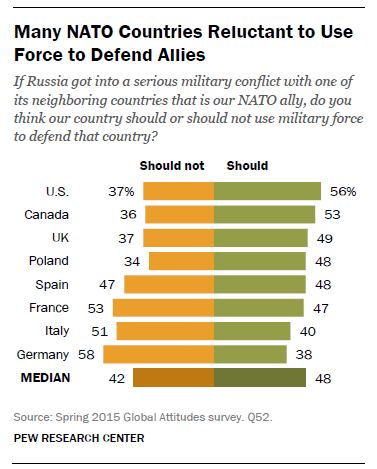
Many NATO countries reluctant to use force to defend allies against Russia

The US foreign policy drags the country into a vicious cycle of interventionism, Ron Paul underscored, referring to the recent Pew Research poll that indicated that more than over 50 percent of Americans would not oppose going to war with Russia.
According to the latest poll conducted by the Pew Research Center, a US independent fact tank, many NATO countries are reluctant to defend their allies against Russia with the exception of the United States and Canada: over 50 percent of Americans and Canadians would not oppose going to war with Russia. This trend is really worrisome, according to Dr. Ron Paul, a former Republican congressman and two-time US presidential candidate, and Daniel McAdams, Executive Director of the Ron Paul Institute for Peace and Prosperity.
Americans' readiness to get involved in a direct military confrontation with Russia could be regarded as a relic of the Cold War, suggested the experts, warning that the US foreign policy course may drag the country into a vicious cycle of interventionism that in its turn would further undermine America's economy and the well-being of its citizens.
"It really does not solve the problem of what the countries are to do with NATO. I am afraid NATO is going to be with us for a long time. I see it as only a tool for our propaganda," Dr. Paul noted.
At the same time, however, the US' opinion of NATO has gone down since 2011, Mr. McAdams remarked, referring to the same Pew Research survey.  Only 49 percent of Americans expressed a favorable opinion of NATO, down from 54 percent in 2010 and 2011. On the other hand, the number of those Americans who expressed disapproval of NATO has increased from 21 percent in 2010 to 31 percent in 2015. Attitudes are changing gradually, and a lot more Americans do not believe the government either, despite all the propaganda from Washington, Ron Paul stated, adding that the Internet is helping people to question more what the US government is doing.
It is remarkable though that lots of NATO-member countries expressed their unwillingness to unleash a war against Russia. Particularly, the population that is the least enthusiastic to go to war with Russia is that of Germany. While Angela Merkel is regarded by many as a lap dog of Washington, the German people are not with her, Mr. McAdams stressed. While the West is threatening itself with Russia's phantom menace, there is another figure that shows how "militant" the Russians really are, the experts noted.
"We [the United States] are spending [on defense] more than twice as much as the next four countries put together. And Russia is the fourth. There is a country called Saudi Arabia that spends [on defense] more money than Russia," Dr. Paul stressed.

Albanians march in Skopje demanding equal rights


Albanians march in Skopje demanding equal rights
About 2,000 people have marched in Skopje, demanding equal rights for the Albanian minority.
They also called for the resignation of Prime Minister Nikola Gruevski and his party's junior coalition partner, the ethnic Albanian DUI.
The country's leaders agreed last week to hold early elections by next April, in an attempt to end months of turmoil.
Former Yugoslav Republic of Macedonia saw months of civil conflict in 2001 between the security forces and ethnic Albanian rebels.
Mr Gruevski faces wire-tapping and corruption allegations, which he denies.
In turn, he has accused opposition leader Zoran Zaev of prolonging the crisis by "rejecting all proposals" in the latest round of EU-mediated talks between the country's main political leaders.
BBC

US, Russian Navies Meet to Discuss How to Avoid 'Accidental Clashes'

A U.S. military fighter jet participates in a NATO Baltic Air Policing Mission practice mission near Estonia.

© AP Photo/ Mindaugas Kulbis
US
Get short URL
82683212
For the first time since the Ukraine crisis drove a wedge between the two countries, officials from the Russian and American navies have met to discuss how to avoid accidental clashes, incidents which could lead - unintentionally - to war.
The crisis in Ukraine has led to the worst rift in US-Russia relations since the end of the Cold War. As Washington continues to both accuse Moscow of its involvement in the conflict and reject the Crimean peninsula’s decision to rejoin the Russian Federation, it has increased NATO’s presence in border territories.
Russia has repeatedly denied any involvement in fueling the crisis, and has urged the West to recognize the referendum in which 96% of Crimea’s voters expressed a desire to rejoin Russia.
Of course, as NATO increases its number of military drills across Eastern Europe in response to an alleged Russian threat, it also increases the chances of an unintentional collision, either by aircraft or at sea. Last November, the think tank European Leadership Network counted nearly 40 potential flashpoints between Russian and Western militaries since the conflict began.
Most recently, a collision over the Black Sea between a Russian fighter jet and a US Air Force reconnaissance aircraft was narrowly avoided last month. According to US officials, the two aircraft came within 10 feet of each other.
On Wednesday, both nations took steps to ensure that such accidental clashes do not occur. A Russian Navy delegation led by Vice-Admiral Oleg Burtsev met with US counterparts in Naples, Italy on Wednesday. The US team was led by Rear Admiral John Nowell.
"There was an open, frank and direct discussion…about how we can better operate in the same bodies of water and avoid miscues, mistakes or miscalculations," Vice-Admiral James Foggo, deputy commander of US naval forces in Europe, told reporters. “I think that dialogue was productive.”
Foggo is currently leading an international exercise in the Baltic Sea, near the Russian border. Involving 17 NATO allies or partner nations, the drills will involve 49 ships, 61 aircraft, and 5,600 military personnel.
While this exercise is held annually, this year’s is the largest ever. NATO says this is in response to an alleged Russian threat against the Baltic nations. Estonia, Latvia, and Lithuania have all become increasingly paranoid over recent months, fearful of the "little green men" reportedly seen in Crimea.
"We are here with 49 ships right now and we are operating in areas all over the Baltic Sea," Foggo said, according to Reuters.
While the talks may be a positive step toward avoiding unnecessary conflict, Western nations could even more accurately ensure peace by not holding unnecessary and provocative drills along the Russian border.