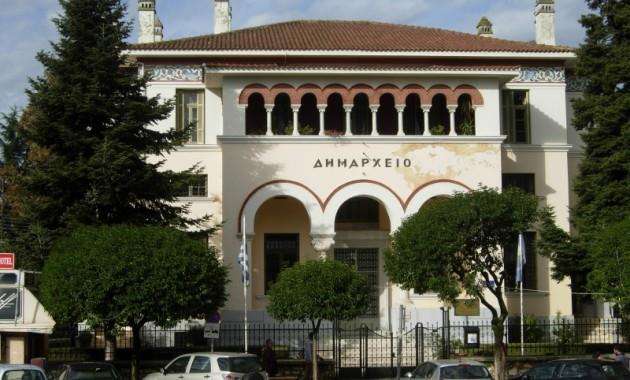
The position of the City Council of Ioannina on the note verbale of the Albanian Government for the marine program and land surveys of our country for hydrocarbons and growing nationalist surges in our neighborhood, was transmitted by the Chairman of the Counsil, George Papadioti,to the State Department, the parties of the parliament and Members of the Government.
The Municipality Council notes that:
"The neighbor country policy recently by the unacceptable and legally invalid sovereign rights dispute and other actions, is clearly hostile and provocative for our country even more dynamites already tense of the Greek-Albanian relations.
At the same timing, the resurgence of ethnic Albanians and Slav conflict in our neighborhood in FYROM, and the extremity of history "expansionism" various circles, threaten to plunge once again the Balkans into chaos.
Faced with escalating tension in the region, governments have an obligation to cultivate and strengthen consistently, friendship, cooperation and good neighborly relations between countries.
Finally, the light is always the above, the Greek authorities should assess calmly and in depth the events and to take all necessary measures to respect the international order and legality. "
Kamenos: "We will be strengthened further reopening outposts, commando units will do
exercises in the region, and helicopters operating in the area to give
residents a sense of security" Security News on The Region
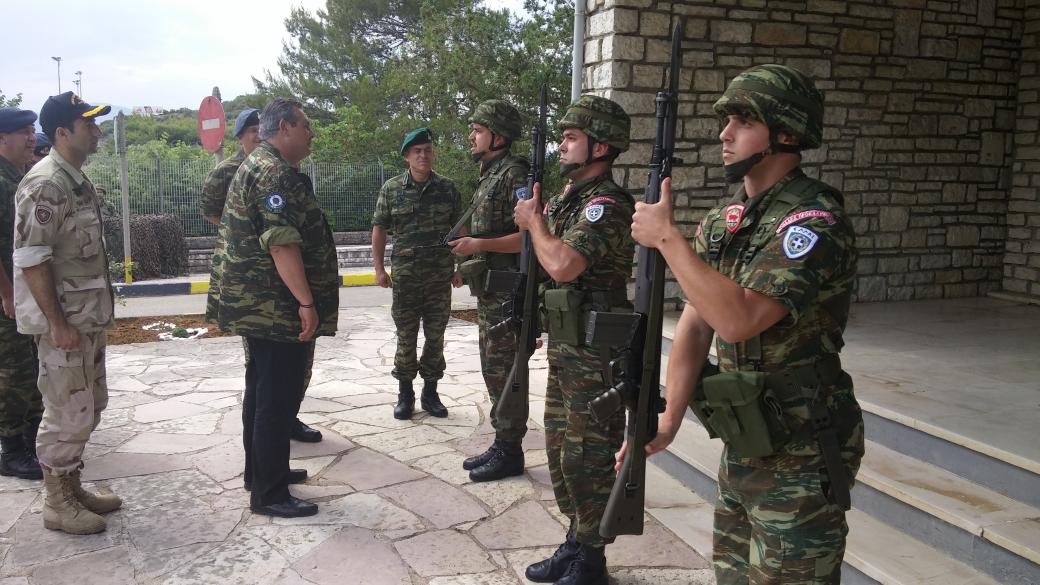
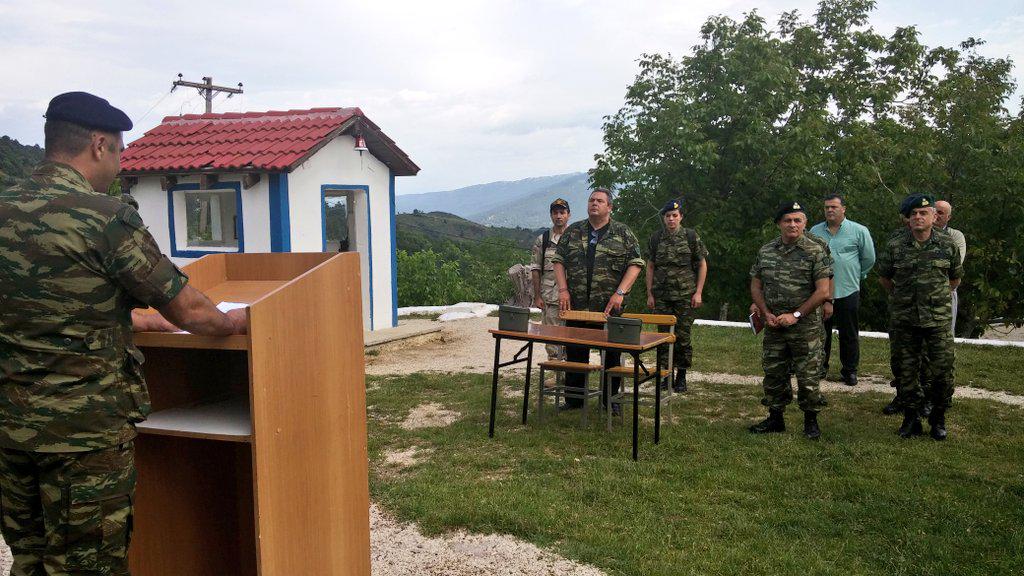
Reopening military outposts and strengthening the army at the Greek - Albanian border, heralded the frontier outpost of Kakavia, Drimades and Pogoni of Ioannina Prefecture, the Defence Minister Panos Kamenos, a development which will satisfy the constant demand of the residents in the villages of the border, seeking to feel secure.
Mr. kamenos, who is touring the fringe military outposts of Epirus, told ANA-MPA response to a question. "Already we redesigned throughout the region. The redesign of the defense structure will be announced in a short time. In summer, as part of the reorganization is done, and according to the commands given by me and by the Chief of the Army, from the front row, the next few days, the presence of conscripts will be strengthened further reopening outposts, commando units will do exercises in the region, and helicopters operating in the area to give residents a sense of security. "
Minister of National Defence, stated that the existing forces, the Army, the Greek police and local authorities make efforts, do a good job, but "we must revive the villages." As stated, the "young guys who left their homeland and are unemployed in Athens, to return again to cultivate our land. We must put forward the motherland to work. "
In Drimades outpost of the Minister of National Defence honored Sophia Demetriou, wife of the border guard, who lives alone in the village Mountain. The minister commended the courage and said it would integrate the National Guard, directly changing the law, as it provides serve only men. "You give courage to all. We feel secure as you are here, "he told her features and added," will be part of the defense of our country. " Indeed he gave honorary board of the Ministry of National Defense.
European
Parliament President Martin Schulz says that the European Union is
willing to meet Greece halfway on the cash-for-reforms deal.
MOSCOW
(Sputnik) — The European Union is willing to meet Greece halfway on the
cash-for-reforms deal, European Parliament President Martin Schulz told
German newspaper Welt Am Sonntag.
"The European Union is ready to meet the Greek
government halfway," Schulz said, adding Athens must also bear
responsibility for the Eurozone.
The unresolved debt stalemate between Greece and its creditors – the
International Monetary Fund, the European Commission and the European
Central Bank – is expected to weight on the G7 summit of world leaders
which kicks off in Germany on Sunday.
Relations
between Athens and Brussels soured over the past months after the
ruling Syriza party, which was elected in January to form the
government, went along with its pre-election promises to end the painful
austerity program and handed the bailout plan back to money lenders.
"The government in Greece must finally admit
that they have a responsibility not only to the voters of their Syriza
party but also to the entire country and, as part of the EU, to the Euro
and Europe," Schulz stressed.
Greek Prime Minister Alexis Tsipras is going to meet with his key
European creditors at an EU summit next week, in particular with the
German and French leaders. He was reportedly due to Brussels for bailout
talks on Friday. Instead, the premier opted to stay in Athens to brief
the Greek parliament on the country’s debt policy and denounce
creditors’ proposals.
Greece now has until the end of June to hammer out a bailout pact
with international financial institutions before the current agreement
runs out.
Russian president tells an Italian newspaper that the West should not fear Russia, and rules out conflict with NATO.
Al Jazeera and agencies
Ukraine's east has seen a fresh flare-up in violence despite a peace deal in place since February [Reuters]Russia
President Vladimir Putin has told an Italian newspaper that his country
was "not a threat to the West", and that he was still committed to a
Ukraine peace deal despite a fresh flare-up in violence.
"I would like to say - there's no need to be afraid of Russia," Putin
told Corriere della Sera in an interview published on Saturday, ruling
out a major conflict between Russia and NATO member countries.
Only a sick person - and even then only in his sleep - can imagine that Russia would suddenly attack NATO.
Vladimir Putin, Russian president
"The world has changed so much that people in their right mind cannot imagine such a large-scale military conflict today."
His comments come as three Baltic countries prepare to ask for a
permanent presence of NATO troops as a deterrent to the Russian
military. Nato says Russia is backing rebels in Ukraine - which Moscow
still denies.
"Only a sick person - and even then only in his sleep - can imagine that Russia would suddenly attack NATO," Putin said.
The Russian president spoke ahead of his visit to Italy next week that will include a meeting with Pope Francis.
Putin's interview was released by the Kremlin just as Group of Seven leaders are gearing up to meet in the German Alpine town of Garmisch-Partenkirchen for a summit this weekend without Russia. Strategic balance
In the interview, Putin stressed that Russia merely sought to defend itself from outside threats.
He pointed out that NATO members have defence expenditures that are
10 times Russia's military spending, adding that the US military budget
was the biggest in the world.
To ensure a strategic balance, Russia will develop "systems to overpower anti-missile defences", Putin said.
Russia's annexation of Crimea from Ukraine last year has jangled
nerves in Europe, with Baltic and Nordic countries reporting an uptick
in Russian military activity over the past year.
Pentagon officials said on Friday that the United States was
considering a range of moves to beef up security, including bolstering
missile defences or even deploying land-based missiles in Europe.
Speaking about the Ukraine crisis, Putin accused Kiev authorities of
being unwilling to implement a European-brokered peace deal agreed in
February and enter into dialogue with pro-Moscow rebels who control
territories in the country's east.
MOSCOW
(Sputnik), Anna Liatsu — Greek Prime Minister Alexis Tsipras rejected
opposition leader Antonis Samaras' proposal to join the government and
adopt a common stance on stalled debt repayment talks, Greek Deputy
Defense Minister told Sputnik on Saturday.
"Mr. Samaras informed Mr. Tsipras through his speech that he would
not accept any type of common front with Mr. Tsipras, unless Nea
Demokratia became part of the government," Costas Isychos said.
Tsipras addressed the Greek parliament on Friday after the latest
failed attempt to reach an agreement on a bailout package with European
lenders.
Samaras, former prime minister who lost this year's election
to Tsipras' left-wing Syriza, lambasted Tsipras for lack of achievements
in negotiations and called on him to "join the national consensus"
offered by New Democracy.
"Mr. Tsipras did not agree on this," the defense official told Sputnik.
Isychos added that European Commission President Jean-Claude
Juncker's plan was largely rejected by "most of the leaders of the
opposition."
"But at the same time [they] were in disagreement with Mr. Tsipras' proposal to the institutions," he told Sputnik.
Greece skipped a scheduled $330-million repayment to the
International Monetary Fund (IMF) on Friday, offering instead to make a
single payment by the end of June.
Under Athens' current bailout deal with IMF, expiring at the end
of the month, Greece is expected to repay a total of $1.8 billion.
Culture Minister Ivan
Tasovac on Thursday in Belgrade opened a festival dubbed "Mirdita, Dobar
Dan," that showcases works of artists from Kosovo.
Source: B92, Tanjug
Expressing his satisfaction because of the opportunity to
declare the festival open, Tasovac in his address recounted attending
"an unusual cultural event recently."
"In a new production of Shakespeare's great play 'Romeo
and Juliet', directed by Miki Manojlovic, actors from Belgrade and
Pristina performed together. Although the dramatic action was not
removed from Verona, in this version of the play about the destructive
force of hatred and the timeless power of love, the Capulets speak in
Serbian, and the Montagues in Albanian, without translation."
The minister went on to say that "at the very end, when the lights are
turned on and the last masks fall, the actors leave the stage and go
among the audience, each saying their name and shaking hands with the
members of the audience."
"Through this gesture - a gesture of
breaking theatrical illusions, but at the same time one quite ordinary,
simple gesture of good will - they reminded us strongly and honestly,
that in any deeply divided society, with fresh, unhealed wounds, it is
quite impossible to imagine reconciliation without dialogue between
different cultures," Tasovac said, and added:
"Culture is there
to help us overcome the misunderstanding, because culture knows no
borders. Culture is the single constant that strengthens individuals and
entire communities, changes them and makes them capable not only of
understanding each other but also of enjoy the complex diversity of the
human creative expression. Through culture we all develop a strong sense
of belonging but also the awareness of the excellence of different
traditions, beliefs, and worldviews."
The festival is held for
the second time in Belgrade on June 4-8, "presenting Kosovo's works of
culture," Tanjug reported earlier.
The festival opened at
Belgrade's Dom sindikata by Isa Cosja's film "Three Windows and a
Hanging", awarded at the Sarajevo Film Festival and the International
Film Festival in Thessaloniki.
The Belgrade audience "will be
acquainted with Kosovo musicians, actors, theatre and film directors and
social activists and analysts," the agency quoted the organizers.
The program will also include a promotion of the book "Billionaire" by
Veton Suroi, published in the Serbian language by Samizdat B92, a
concert by singer and actress Edona Resitaj, as well as a performance of
Fatos Berisa's play "Shopping and Fucking", a statement said.
The festival will also feature a multimedia exhibition titled "I Am" by
six renowned Kosovo women artists, and visitors will also have the
opportunity to hear debates on social and political issues, aimed at
establishing an open dialogue and normalization of relations between
Belgrade and Pristina.
The festival will continue in Pristina in September.
The festival will be held on various locations and, like last year, entrance to all events will be free of charge.
President
Vladimir Putin’s upcoming meeting with Pope Francis could signal the
start of “unprecedented fence-mending” between Russia and the West and
could contribute to the settlement of the conflict in eastern Ukraine,
French media reported on Friday.
Pope
Francis helped ease tensions between Israel and the Palestinians and
restore long-severed ties between the United States and Cuba, Le Figaro
wrote.
The Pontiff’s engaging personality and political activity has won the
Vatican’s diplomacy an internationally respected status it never
enjoyed before, the paper added.
The Ukrainian crisis will take center stage during the Pope’s upcoming meeting in the Vatican with the visiting Russian leader.
The Holy See encouraged the Eastern Catholics to “make peace”
with their Orthodox fellow Christians, denounced the ongoing violence
in Ukraine and remains a good friend of Russia, Le Figaro wrote in a
comment Friday.
During their meeting Wednesday Vladimir Putin and Pope Francis will
also discuss ways to end the protracted crises in Syria and elsewhere
in the Middle East.
“The Vatican diplomacy realizes that without Russia this will hardly be possible,” the paper emphasized.
Scores of ships and aircraft from 17
countries are taking part in Baltic Sea naval drills as part of exercise
BALTOPS which starts on Friday (5 June 2015) and runs until 20 June.
Allied participation demonstrates NATO's resolve to defend the Baltic
region, and will hone the ability of Allies and partners to work
together.
The exercise will feature anti-submarine warfare, air
defence, intercepting suspect vessels and amphibious landings. A total
of 49 ships, 61 aircraft, one submarine, and a combined amphibious
landing force of 700 U.S. Finnish and Swedish troops will participate in
the drills. Fourteen NATO Allies are joined this year by NATO partners
Finland, Georgia and Sweden. Overall, 5,600 troops will be involved.
"This exercise represents an important opportunity for our
forces, as allies and partners, to enhance our ability to work together
and strengthen capabilities required to maintain regional security," said Vice Admiral James Foggo III, the Commander of Naval Striking and Support Forces NATO. He added: "this
exercise will be conducted in a truly joint environment, and I look
forward to working with and learning from so many different nations and
services".
While BALTOPS is a United States-led exercise, Vice Admiral Foggo and
his NATO staff are responsible for executing this year's exercise.
Participants include Belgium, Canada, Denmark, Estonia, Finland, France,
Germany, Georgia, Latvia, Lithuania, the Netherlands, Norway, Poland,
Sweden, Turkey, the United Kingdom, and the United States.
The annual BALTOPS exercise is not held in response to any specific
threat. The exercise has been held since 1971, and is now in its 43rd
year. BALTOPS is one of several major multinational exercises this month
which also includes exercise Noble Jump - the first deployment test for
NATO's new quick reaction force - which will take place in Poland from
9-19 June.
(Bloomberg) -- Albania has prepared a loan from Deutsche Bank to
manage liquidity and service its maturing debt this year if rising
yields ruin its plan to sell a new Eurobond in the next few months,
Deputy Finance Minister Erjon Luci said.
Premier Edi Rama’s cabinet wants to raise 300 million euros ($340
million) on international markets and may increase the amount to 500
million euros if there’s good demand, Luci said in an interview during a
Euromoney conference in Bucharest on Thursday.
“We’re keeping our options safe,” Luci said. “We are finalizing
another loan with Deutsche Bank with the guarantee of the World Bank of
250 million euros, which is sufficient for managing the liquidity
situation this year, including the repayment of Eurobond, in case the
yields and everything else changes.”
The country of more than 2.8 million people is working to join the
European Union, and Rama’s government needs to bolster economic growth,
consolidate public finances and reduce public debt levels to 60 percent
of gross domestic product by 2019 under its program with the
International Monetary Fund.
Deutsche Bank AG and JP Morgan Chase & Co. have been selected as
lead managers to prepare the sale the international bond, as a previous
five-year Eurobond is maturing in November. If the government raises 500
million euros, it will use 200 million euros to repay some of its
public debt, Luci said.
The yield on Albania’s Eurobond maturing in November rose 34 basis
points to 3.292 percent by 12:25 pm in Tirana, its highest level since
Feb. 11, according to data compiled by Bloomberg. Its currency, the lek,
traded 0.1 percent weaker at 140.87 per euro.
Luci sees Albania “able to go to the market hopefully before August,
but if needed, maybe later.” The government is open to selling the bond
after August “but without putting us into difficulty of having to sell
at any cost,” he said.
--With assistance from Gordana Filipovic in Belgrade.
To contact the reporters on this story: Irina Vilcu in Bucharest at
isavu@bloomberg.net; Andra Timu in Bucharest at atimu@bloomberg.net To
contact the editors responsible for this story: James M. Gomez at
jagomez@bloomberg.net Michael Winfrey, Balazs Penz
bloomberg
Albanian Journalist Threatened by Suspected Islamic Militant
Advertisement
TIRANA,
Albania — An Albanian media group says one of their journalists has
received a threat from a suspected Islamic militant wanted in the
country on terrorism charges.
Police
spokesman Gentian Mullai said Thursday that authorities were treating
the threat against Aurora Koromani of the Gazeta Shqiptare newspaper as
serious and were providing protection for her.
Koromani's
media group News24 said the journalist has extensively covered Albanian
Muslims recruiting people to fight alongside the Islamic State group in
Syria. Nine Albanian Muslims, including two preachers, are on trial on
such charges.
News24 says Koromani received a threatening message on Tuesday saying "you will pay."
About
two-thirds of Albania's 3.2 million people are Muslims. Dozens are
believed to be fighting in Syria, despite mainstream religious leaders'
calls for them to not join rebel groups.
The five-page draft agreement of the institutions
presented to the Greek side does not constitute a basis for discussion
in its current form, according to government sources. They expressed,
however, the view that it leaves room for compromises in order to allow a
deal in the immediate future.
According to Athens News Agency,
the same sources said, it is a proposal for an agreement on a technical
level (staff level agreement) that reintroduces measures that were out
of question in the negotiations at Brussels Group level.
The same
sources said that the proposals included measures such as higher VAT on
energy, restaurants and medicine, that will generate revenues of 1.8
billion euros in 2015, social security spending cuts of 1 percent of GDP
in 2015 and 2016 and abolition of the supplementary pensions of
low-pension retirees, known as EKAS, by the end of 2015.
The
government sources expressed their content over the primary surplus
targets which were set as follows: 1.0 percent in 2015, 2.0 percent in
2016, 3.0 percent in 2017 and 3.5 percent in 2018.
Discussion on
debt was 'superficial', the sources said, as the issue is not included
in the deal at technical level, while the institutions' proposal on
labour issues was not very clear.
The Prime Minister Alexis
Tsipras' contacts and technical staff's proceedings will continue on
Thursday, possibly not at a Brussels Group level, with the view to
reaching a deal before June 14.
The same sources said that the
creditors have also proposed an extension of some months in order to
implement the agreed measures. ANA MPA
A
special Parliament Committee set up to examine war reparations and
debts owed by Germany was briefed Thursday on a report concerning
Greece's claims for German reparations and the repayment of a forced
occupation loan, drafted by a special finance ministry committee.
According
to the honorary general director of Greece's General Accounting Office
Panagiotis Karakousis, who was on the committee that drafted the report,
"there is no evidence to indicate that Greece has at any time given up
on or withdrawn any of its demands from either World War I or World War
II."
Based on its findings, Greece's claims on Germany are
in the region of 280 and 340 billion euros, by what Parliament
President and committee chair Zoi Konstantopoulou described as "the most
conservative estimates".
BELGRADE – Serbian Deputy Prime Minister and Foreign Minister Ivica
Dacic discussed on Thursday with Ambassador Thrasyvoulos Stamatopoulos,
NATO Assistant Secretary General for Political Affairs and Security
Policy, the furthering of the Serbia-NATO cooperation through the
Partnership for Peace (PfP) programme and the implementation of the
Serbia-NATO Individual Partnership Action Plan (IPAP).
Image from: bezbednost.org
Also discussed was the current security situation in the region and
Kosovo-Metohija, the Serbian Ministry of Foreign Affairs said in a
statement.
Dacic noted that the adoption of the IPAP has been the most
significant qualitatative step in Serbia-NATO relations since Serbia’s
entry into the PfP and that the country is very committed to its
implementation, the statement said.
Serbia stands by its position of military neutrality but recognises
the significant room that exists for further improvement of the
partnership within the PfP and it has a major role in preserving
regional security and stability, he said.
Speaking about the very good cooperation with KFOR, Dacic urged its
undiminished presence in Kosovo-Metohija and particularly noted the
significance of the role of NATO/KFOR as a guarantor of security and the
implementation of the Brussels Agreement.
"USA will support our EU path. With Chairman of the
Senate Committee on Armed Services, Sen JohnMcCain," Vucic wrote on
Twitter on Wednesday and posted two photographs with McCain.
The two officials were very satisfied with the meeting, Voice of America (VOA) reported.
McCain voiced support for Prime Minister Vucic's government and
everything it has done so far, but also for Serbia's EU path, reads a
report by the Serbian editorial staff of the official external broadcast
institution of the U.S. federal government.
McCain also expressed his wish to visit Serbia, although it was not said whether this will take place soon.
According to VOA, Vucic also met with Serbian caucus co-chairs, Congressmen Ted Poe and Emanuel Cleaver.
Another round of
top-level talks failed to resolve the standoff between Greece and its
international creditors as Prime Minister Alexis Tsipras rejected
proposals that would unlock bailout funds necessary to avert a default.
After a meeting
with European Commission President Jean-Claude Juncker and Dutch
Finance Minister Jeroen Dijsselbloem, who also heads the group of his
euro-area counterparts, Tsipras said the basis for any accord must be a
Greek proposal meant to avoid spending cuts and tax increases, rather
than a plan drafted in recent days by creditors.
More from Bloomberg.com: Jamie Dimon Becomes Billionaire Ushering in Era of the Megabank “The
realistic proposals on the table are the proposals of the Greek
government,” Tsipras told reporters early Thursday in the Belgian
capital. We can’t “make the same mistakes, the mistakes of the past,” he
said. The commission said in a statement that “intense work” will
continue and “progress was made in understanding each other’s positions
on the basis of various proposals.” More from Bloomberg.com: Putin's Secret Budget Hides Shift Toward War Economy
Months
of antagonism and missed deadlines have given way to a greater urgency
to decide the fate of Greece. Without access to capital markets, the
country has to meet four payments totaling more than 1.5 billion euros
($1.7 billion) to the International Monetary Fund in June, while its
euro-area-backed bailout also expires this month.
Tsipras
signaled that Greece will meet its first June IMF payment, which is due
Friday. “Don’t worry,” he said in response to a reporter’s question
about the matter.
The
single currency was little changed at $1.1261 as of 10:48 a.m. in
Tokyo. It rose as much as 1.2 percent to $1.1285 on Wednesday, the
highest since May 19.
‘Constructive Will’Tsipras said demands by
the euro area and the IMF for cuts in the income of poor pensioners and
increases in value-added tax on power are unacceptable, highlighting
what have been “red lines” in Greece’s stance since his anti-austerity
Syriza party swept to power in snap elections in January. More from Bloomberg.com: A 99-Year-Old Wall Street Veteran Reveals Secrets of Her Success “Ideas
like cutting benefits for low-income pensioners, or raising the VAT
rate for electricity by 10 percentage points, can’t be a basis for
discussion,” he said. The premier sought to paint the commission,
the European Union’s executive arm, as more favorable to his proposals
than are other creditor representatives deemed by Greece to be taking a
harder line in the aid deliberations.
“There was a constructive will from the European Commission to reach a common understanding,” he said.
The
Tsipras government has looked to the commission for support to dilute
the austerity-first formula that’s underpinned two Greek rescues
totaling 240 billion euros since 2010. This has led to clashes with
creditors who say such bailout conditions have worked for other
countries such as Ireland now out of aid programs and Greece should get
no special treatment. Market RallyThe euro area now wants an
agreement to be wrapped up by June 14, according to a Greek official.
The new deadline emerged in the talks between Tsipras, Juncker and
Dijsselbloem, the official said, asking not to be named because the
meeting was private.
Greece’s
creditors want the targets for the primary budget surplus -- the budget
balance excluding interest payments -- to be 1 percent of gross domestic
product this year, 2 percent of GDP in 2016, 3 percent in 2017 and 3.5
percent in 2018, said the Greek official, who called these proposals a
“good basis” for further deliberations on the matter.
Tsipras said both sides were “very close” to an agreement on the targets for the primary surplus.
Greek
stocks and bonds rallied Wednesday on expectations that the talks in
Brussels would yield a breakthrough, with the Athens Stock Exchange
index gaining 4.1 percent. Yields on two-year notes fell 118 basis
points to 22.8 percent.
European
Central Bank President Mario Draghi on Wednesday called for a “strong
agreement” to end the deadlock, which has pushed the country into a
double-dip recession, amid renewed doubts over its place in the
19-nation euro area.
First entry: 3 June 2015 - 10:20 Athens, 07:20 GMT
Last update: 10:20 Athens, 07:20 GMTPolitics
Greece
will not make a June 5 loan repayment to the International Monetary
Fund (IMF) if there is no prospect of an aid-for-reforms deal with its
international creditors soon, Nikos Filis, the spokesman for the ruling
Syriza party's lawmakers said on Wednesday.
"If there is no
prospect of a deal by Friday or Monday, I don't know by when exactly, we
will not pay," Nikos Filis told Mega TV.
Greek Prime Minister
Alexis Tsipras will travel to Brussels on Wednesday for a meeting with
European Commission President Jean-Claude Juncker as Athens and its
lenders seek to agree on a deal that will unlock remaining bailout
funds.
Source: Reuters
BRUSSELS – Macedonia’s political leaders agreed on Tuesday (2 June)
to hold elections in early 2016 in order to overcome a deep political
crisis, EU Enlargement Commissioner Johannes Hahn said, EurActiv.com
reports.
“It was agreed that by the end of April next year there should be
early elections,” Hahn told reporters after a day-long meeting with key
political actors in Macedonia, including Prime Minister Nikola Gruevski
and main opposition leader Zoran Zaev.
Details of the EU-brokered agreement are expected to be hammered out next week in Brussels, Hahn stated.
Macedonian politicians did not talk to reporters after the meeting also joined by US Ambassador Jess Baily.
Macedonia’s last elections were held in April 2014, with the next one’s normally due in April 2018.
WASHINGTON – Serbian Prime Minister Aleksandar Vucic conferred in the
White House on Wednesday with Assistant to the President for National
Security Affairs Susan Rice and after the meeting, he stated that Serbia
can count on U.S. support.
Photo: Supplied
This was a good and useful meeting with Susan Rice concerning
Serbia’s future and its EU path, Vucic said on his official Twitter
profile after the meeting, adding that Serbia can count on U.S. support.
Vucic is paying a several-day visit to the U.S. and on Tuesday, he
conferred with representatives of U.S. companies like General Electric,
Microsoft, Freeport and others.
During his stay, the Serbian prime minister will have political talks
with U.S. officials and he will also visit the John Hopkins University
where he is due to deliver a speech.
Serbian Prime Minister
Aleksandar Vucic will on Wednesday meet with National Security Advisor
to U.S. President Barack Obama Susan Rice.
Source: B92, Tanjug
Vucic (right) is seen during his meeting with General Electric and Freeport representatives (Tanjug)
B92's reporter in Washington said that Vucic will hold a
meeting with Rice, who has held the position of Obama's advisor since
June 2013, and previously served as U.S. ambassador to the UN.
Vucic is visiting the United States, where he should
holding a series of meetings, including the most important one with U.S.
Vice President Joseph Biden.
However, there has been no
confirmation for now that this meeting will take place, considering the
recent death of Biden's son.
Tanjug is reporting that
Aleksandar Vucic said that all the meetings he has had with
representatives of large U.S. companies were "very good" and "stressed
the importance of preserving political and economic stability in
Serbia."
"That is what we talked about everywhere I went - political and economic stability, low deficit," Vucic said last night.
"I think that respect for Serbia is growing steadily, and I am proud of
this fact, and when you receive this kind of treatment in the United
States, I think that Serbia can count on a far better future," the prime
minister said.
Vucic met with representatives of Microsoft, General Electric, Freeport, NCR and other companies in Washington on Tuesday.
All the talks went very well, they were energetic and both sides in all
meetings expressed interest in cooperation, said Vucic.
He is
continuing his official visit to the United States ON Wednesday with
meetings with U.S. officials and discuss bilateral relations, economic
cooperation and Washington's support to Serbia’s European path.
NATO
members don’t care about thousands of African refugees dying in the
Mediterranean, instead choosing to focus on senseless military drills in
the Baltic and Black Seas, a former Turkish general said.
NATO naval exercises in the Black Sea is money thrown to the wind, Er Ali, a retired Turkish Brigadier General told Sputnik.
Instead of wasting money on senseless naval exercises in the Black
Sea, NATO should use the available resources to solve the issue
of illegal immigration in the Mediterranean Sea, Ali said.
"Such exercises are expensive. But this money
is wasted for nothing. Millions of dollars. Instead, it would have been
better to send NATO naval units to the Mediterranean Sea."
Joint
US-Ukrainian naval drills began on Tuesday in the Black Sea. Moreover,
Poland and the three Baltic states — Lithuania, Latvia and Estonia —
have started large scale exercises in the Baltic Sea, codenamed NATO
Saber Strike 2015. Over six thousand military personnel from 13 NATO
member states will participate in the drills.
These military drills carry an anti-Russian political message, as
"NATO is trying to threaten Russia and that is not good." This political
course won't help to reach global peace, the former Turkish general
said.
Meanwhile,
the situation with illegal immigration in the Mediterranean is reaching
catastrophic levels, Ali said. Instead of flexing muscles and provoking
Russia for no reason, it would have been much better and more logical
to send ships to help out African refugees and prevent the escalating
humanitarian tragedy on the threshold of the European Union.
Unfortunately, the members of the military alliance don't pay
attention to the lives of thousands of refugees, choosing to demonstrate
their military power by other means, Ali said.
US
State Secretary John Kerry's visit to Sochi was not a new 'reset' in
relations between the US and Russia, Russian Foreign Minister Sergei
Lavrov told Bloomberg.
US
Secretary of State John Kerry's visit to Sochi on May 12 was not a
diplomatic "reset" but a return to normal relations, Russian Foreign
Minister Sergei Lavrov told Bloomberg on Tuesday.
Kerry's meeting with Lavrov and Russian President Vladimir Putin
in May generated speculation about its implications for US-Russian
relations and the crisis in Ukraine.
"I think we are sufficiently realistic. President Putin talks
to President Obama on the phone from time to time, the dialogue is
pretty pragmatic, they discuss specific areas of cooperation where both
countries could benefit," Lavrov told Bloomberg.
"I would call this a realization of the need for normalcy," Lavrov added.
Lavrov also said that he and Kerry agreed to maintain contacts
between Moscow and Washington on a regular basis to exchange assessments
of the situation. Some Must Decide on Syria
Lavrov told Bloomberg that the US "obsession" with overthrowing Assad is not helping resolve the Syrian conflict.
"Some external players must answer the question of who presents a greater threat, Assad or the Islamic State," Lavrov said.
He
added that the Syrian conflict can only be resolved politically, based
on the communique agreed on during the Geneva II conference on Syria.
The American bombing of ISIL-held Syrian territory without its
government's agreement was also a mistake, Lavrov said, calling the
decision to begin the bombing campaign without a United Nations Security
Council (UNSC) resolution regrettable.
Late-night mini summits in Berlin.
A no-surrender stance in Athens. A deadline to meet in Washington DC by
the end of the week. The Greek crisis is coming nicely to the boil,
with three possible outcomes.
Option one is that Greece leaves the euro, either by accident or
design. Despite the often spiky negotiations, the assumption has been
that a deal will be done between Greece and its creditors to keep the
single currency intact. That assumption could prove to be as erroneous
as the assumption that a buyer would be found for the ailing US
investment bank, Lehman Brothers, in September 2008. Greece could decide
that the terms being demanded by the European commission, the European Central Bank and the International Monetary Fund are too harsh. The so-called troika could lose patience and throw Greece out.
Euro exit could prove the least bad economic choice for Greece, which
would then devalue and write off a large chunk of its unpayable debt.
Life would still be tough, but life will be tough anyway if Greece – after a recession that has already led to the economy shrinking by a quarter – agrees to more austerity.
A Grexit now would probably cause fewer economic shockwaves than it
would have done two or three years ago, but there would still be
knock-on effects on Europe and the wider global community. The political
ramifications would be more serious. Greek departure would embolden
anti-austerity parties across Europe,
most notably Podemos in Spain. It would be the first setback to
ever-closer European integration over six decades and would cast a
shadow over David Cameron’s renegotiation of Britain’s EU membership
ahead of a referendum.
Option two is that the Greeks cave in. Alexis Tsipras
has been gamely trying to ride two horses at once since he became prime
minister in January: the desire of Greek voters to both end austerity
and stay in the euro. The moment is rapidly arriving when Tsipras has to
decide which of the two policy goals is the more important, because it
looks as if he can’t achieve both. Far from being the prelude to exit,
the ratcheting up of the rhetoric in recent days might be the
government’s attempt to show the Greek people that it has gone as far as
it can to resist the demands of the troika for further wage and pension
cuts but continued euro membership means there is now no choice but to
surrender on the best possible terms available. This would involve
slightly easier debt repayment terms and less onerous budget targets to
meet. But if Tsipras is going to capitulate, he is showing little sign
of it. The late-night meeting in Berlin, attended by Christine Lagarde,
the managing director of the IMF and the president of the ECB, Mario
Draghi, suggests the troika is worried. Angela Merkel hosts a meeting of
the G7 in Bavaria this weekend and does not want it to be overshadowed
by Greece.
Advertisement
All
that points to option three, a good old-fashioned euro fudge. Greece
does not want to leave the euro. Merkel does not want to be the
politician held responsible for derailing the European project. So there
is a temptation to do what Europe has done throughout its six-year
sovereign debt crisis: play for time. This would involve Greece’s
creditors providing bridging finance that would allow Tsipras to meet
the series of debt repayments due this summer and for a referendum to be
held on whether the Greeks believe yet more austerity is a price worth
paying for staying in the euro. Athens would give a solemn commitment to
step up the pace of economic reform; the troika would say that any
backsliding will result in the money being cut off.
So which of the three options is it going to be? Kicking the can down
the road looks the most likely, but the risk of something nasty and
messy is rising all the time.
The Greek section of the
Turkish Stream pipeline will cost USD 2 billion, Greek Minister of
Energy Panagiotis Lafazanis has said.
Source: Beta
(Thinkstock)
He told the Rossiya 24 broadcaster that there is "enormous interest" among Greek companies to build and use the gas pipeline.
"We already know that it will be a Greek public company
which would be in charge and furthermore, the question of financing is
already resolved: the infrastructure costs are estimated at around two
billion dollars," said Lafazanis.
According to him, the
project's implementation will create about 20,000 new jobs in Greece,
which will affect not only the country's economic development, but also
that of the whole region, reports TASS.
"This is a very
important moment for the Greek economy, which is going through a
difficult period. The Greek people will benefit from it all," the
minister is convinced.
Greece expected to sign a memorandum on
Turkish Stream during the St. Petersburg International Economic Forum,
which will be held June 18-20.
"As far as the Economic Forum
will try to sign the agreement, a so-called memorandum of political
support for the pipeline, between Greece and Russia," added Lafazanis.
The negotiations have so far been unsuccessful, despite a series of
visits of delegations and statements about the imminent conclusion of an
agreement already in mid-April. On Friday, the Russian company Gazprom
announced, after meeting between CEO Alexei Miller and Lafazanis, that
it was "ready to explore opportunities related to its participation in
the construction of gas pipeline in Greece."
Russia has yet to
sign a final agreement with Turkey on the first section of the pipeline
to the Turkish territory, hoping that the pipeline will start operation
in late 2016.
The Beta news agency is quoting the Russian press
as saying that "several European countries through which the pipeline
might be extended after Greece seem restrained, fearing the hostility of
the European Union, which has already led to the sudden abandonment of
the Russian gas pipeline project South Stream, which is now being
replaced by South Stream."
Aleksandar Vucic has started
his official visit to the United States where he will be until June 4.
Vucic was invited by U.S. Vice President Joseph Biden.
Source: B92, Tanjug
Immediately upon his arrival in Washington, the prime
minister told the Serbian state broadcaster RTS that this visit was
"very important for our country and that he was happy that to have a
full schedule," and added:
''U.S. investors do not think about continuing their
investments in one country, or their arrival there, unless there is
political stability and unless it is also approved by the policy of the
United States."
He added that "this is primarily about
cooperation with three IT sector related companies," and listed them as
General Electric, Microsoft, and NCR.
As previously announced,
Vucic will discuss with Biden and other U.S. officials bilateral
relations, economic cooperation and Washington's support for Serbia's
European path.
The Serbian government has announced that Vucic
will on the first day of his official visit meet representatives of
major U.S. companies such as General Electric, Microsoft, NCR, followed
by a planned meeting with U.S. Deputy Secretary of State Anthony
Blinken, and later with representatives of the Serbian diaspora.
During the second day of his visit, he is scheduled to meet Biden at the White House.
Earlier, the news that Biden's eldest son had died cause doubt about
whether this meeting will take place. Vucic will also speak with Senator
John McCain.
This will be followed by meetings with Serbian
Caucus co-chairs Congressman Ted Poe and Emanuel Cleaver, as well as
with the chairman of the Senate Subcommittee on Europe, Senator Ron
Johnson.
On Thursday, Vucic will visit the Johns Hopkins
University, where he speak, and then resume a series of meetings with
members of the Committee and the Subcommittee on Foreign Relations of
the U.S. Senate.
The director of the Lawyers Committee for
Human Rights (YUCOM) Milan Antonijevic said that the upcoming visit of
Prime Minister Aleksandar Vucic to the U.S. was positive.
In addition, the Moscow daily Kommersant wrote that the visit could lead to a shift in the foreign policy of Belgrade.
However, Advisor to the President of Serbia and former Foreign Minister
Ivan Mrkic said that Vucic will with the visit strengthen relations
with Washington, but that the trip and the latest developments in
connection with gas are not moving Serbia away from Russia.
Criminals originally from
Serbia and Montenegro "control the criminal underground in Australia and
have connections with gangs in Colombia, Mexico, and Asia."
Source: B92
This is reported by the Daily Telegraph, which quoted "a lengthy News Corp Australia investigation."
According to this, one of the biggest narco-cartel in the
world is led by criminals from the Balkans, immigrants from the former
Yugoslavia, notorious crime figures that in the 1990s "who once
controlled Kings Cross’ Golden Mile but have now formed offshore bases
in Montenegro, Spain and Holland to move the drugs, guns and cash
about."
According to the paper, they left crime and Australia
during the last decade and returned to the Balkans, but have now
"carefully planned their return" and operate a global criminal network.
According to the article, drugs are brought and distributed in
Australia through local motorcycle gangs, while the cartel is now
"activating its sleepers" in the second and third generation of
Australian criminals.
A police official said that this criminal
organization was the greatest threat to Australia thanks to its firm
basis, discipline and influence in local communities.
"Those
families are described as being either direct relatives or from
well-established and historical Mafia-like clans from the former
Yugoslavian states who moved to Australia in the second migration wave
from the Balkan region in the 1980s and 1990s in state-sponsored
infiltration of Australia by the former regimen of Serbian Slobodan
Milosevic," reported the paper.
The article went on to say that
some of the criminals believed to have withdrawn in the 1990s returned
to head the cartels from their bases in Serbia and Montenegro. According
to this, "the mostly Australian nationals run group, led by former
Kings Cross identity Vaso Ulic who left Australia in 2005 never to
return."
The paper said that the network brings at least six tons of drugs, cocaine and ecstasy, to Australia each year.
It added that "it has been confirmed the prosecution's office in
Montenegro has an extensive file on Ulic and other figures in the
country as part of an international arrest warrant to break the cartel
up," but that "while no extradition treaty exists with Montenegro, both
police there and in Serbia have been actively working with AFP agents to
establish if the source of the global crime was perpetrated locally and
therefore the arrest warrants can be pursued and prosecuted locally."
The same report said that the drugs are smuggled from South America to Europe, China, and Nigeria.
Skopje. Crisis in Macedonia is fuelled from abroad
and is connected with the construction of the Turkish Stream gas
pipeline. Vladimir Chizhov, Russian Ambassador to the EU, made the
comment, Macedonian online news edition Net Press reports.
The news outlet writes Chizhov’s statement was cited by media in Athens
and there were comments the situation could lead to lots of scenarios in
Greece.
The Greek media paid a lot of attention to events in Macedonia,
especially after the fact Athens intends to sign the agreement on
Turkish Stream by the end of June.
“It is clear Washington does not allow the gas pipeline passing through
Bulgaria, Macedonia, and Albania. The political leadership in Bulgaria
and Albania was replaced over this reason and they now wish to replace
the government in Macedonia,“ Greek Pentapostagma commented.
According to Greek environment and energy minister Panagiotis Lafazanis,
Washington’s stance on Turkish Stream is negative yet Athens’ opinion
remains unchanged.
[JURIST] Judges of the EU Rule of Law Mission (EULEX) [official website] in Kosovo issued verdicts in the Drenica I and Drenica II
[press releases] cases on Wednesday and sentenced 11 Kosovo Albanian
men to prison. The charges included the intentional perpetration of
violence, cruel treatment, beating, torture, humiliating and degrading
treatment of civilians and for some the killing of a Serbian police
officer. All of the acts were committed between June and September of
1998 at a Kosovo Liberation Army detention center in Likovac. The
sentenced men include [Reuters report] Kosovo's current ambassador to neighboring Albania, Sylejman Selimi, and two close allies to the former Prime Minister Hashim Thaci [Britannica bio]. The prison sentences range from three to 12 years. EULEX was created [JURIST report] in 2008 to investigate crimes committed by ethnic Albanian rebels during the 1998 war with Serbia
[BBC backgrounder]. Various courts and organizations have been
dedicated to prosecuting war crimes committed on both sides of the
conflict, resulting in convictions of both Serbian and Kosovar
[JURIST reports] participants. Rebels during the conflict allegedly
killed approximately 400 civilians. In April 2013 Serbia and Kosovo entered [JURIST report] into a historic agreement on EU membership, signaling a reduction in hostility between the two nations.



![Ukraine's east has seen a fresh flare-up in violence despite a peace deal in place since February [Reuters]](https://lh3.googleusercontent.com/blogger_img_proxy/AEn0k_syAWx51-1e1BkOB0UhFT16N278sBj0ixr_r9akGRrLC1Ex4OTjwtiTeTfENjE6nsaOuy8g7qvd3dUW9gzrpuczs3V3D39S9NfGXGoihEe9i5B2n1wl9fM_WPCMUGOPNW3oL95T6ZZa3MCqG00AKt_vY2iqGRi9YROt_Jqw77ikyIobTtxjGXA6jFoCNuI4iSOLK52gqdX1Sw=s0-d "Vladimir Putin says Russia not a threat to the West")


