Friday, April 17, 2015

Greece Might Allow Russia to Use Its Military Bases – Greek Defense Analyst


© Flickr/ Duncan Rawlinson
Military & Intelligence
In an interview for Russia's RIA Novosti, Greek defense analyst Ilias Iliopoulos noted that in the interests of closer military-technical cooperation with Russia, Greece could allow the country to use of its military bases, and that this possibility may well be discussed during the Greek Defense Minister's visit to Moscow later this week.
Greek Defense Minister Panos Kammenos is set to arrive in Moscow for a two day visit starting Wednesday. The visit will include a meeting with Russian Defense Minister Sergei Shoigu. Russian experts believe that Kammenos's meeting with his Russian counterpart might include the provision of spare parts for Russian weapons systems, including the S-300 air defense system, Kornet anti-tank missiles, and Zubr-class hovercraft. Last December, the Greek Defense Ministry signed contracts with Russia on the purchase of spare parts for the Top-M1 and Osa-AKM mobile air defense systems. Iliopoulos, a lecturer at Hellenic National Defence College, welcomes Kammenos's visit, noting that in a time of growing tensions between Russia and the West, "contacts, visits, and communication between members of the European Union and NATO with Russia can help to reduce tensions."
The analyst recalls that the event, which "has great political and symbolic significance," comes on the heels of Prime Minister Alexis Tsipras' "historic" visit to Moscow last week.
"The Tsipras visit held a great political importance. As for defense matters and Kammenos's visit, I believe that Greece must do everything it can to move closer to Russia on issues of defense, defense policy, technology, cooperation and defense diplomacy. Greece, as you know, is the only NATO country to which several advanced Russian defense systems were exported several years ago. The country's air defense is very largely based on Russian systems."
Iliopoulos believes that Kammenos may attempt to reach an agreement with Russia on the technical maintenance and modernization of the Russian weapons systems Greece possesses. The analyst notes that "this must be done urgently. These systems presently have serious issues, and not because of [any error from] the Russian side, but because the previous government simply used them and, under Western pressure, underestimated the importance of maintenance and modernization."
The defense expert also believes that while Greece's options are presently limited by the economic crisis, the country should do everything it can to avoid "closing this window [on defense cooperation with Russia] for good. On the contrary, the Greek side must bear in mind that Russian defense systems are Greece's best and most reliable option. And not only technically, but politically as well." Regarding Russia's possible use of Greek military bases, Iliopoulos is optimistic.  "And why not? 25 years have passed since the fall of communism. We must discuss seriously, rationally, and realistically the issue of Greece providing Russia with an opportunity to use Greek ground, sea and air bases, on the Aegean Sea and in the Dodecanese Islands, as well as the Ionian Sea and Corfu, the seven islands liberated by Admiral Fyodor Ushakov [during the Second World War]."
The expert notes that such an agreement would not break any of Greece's agreements with NATO, or any other international treaties. "No international statute prohibits the cooperation of two countries."  In fact, Iliopoulos notes, Russian-Greek defense cooperation would assist in the maintenance of global stability, including the fight against terrorism and Islamic extremism in Syria and elsewhere in the Middle East. "I do not think that anyone in the West would have a problem with this," the expert notes. Ilias Iliopoulos is a lecturer at Hellenic National Defence College, the country's highest defense educational institution, and a former analyst at the Greek Ministry of Defense. He is also the former Chair of the Political and Strategic Studies Department at the Baltic Defense College in Tartu, Estonia

Kiev Tries to Hammer Another Nail Into Coffin of Minsk Accord - Cohen


© REUTERS/ Grigory Dukor
Opinion
Belarus' President Alexander Lukashenko (L), Russia's President Vladimir Putin (2nd L), Ukraine's President Petro Poroshenko (R), Germany's Chancellor Angela Merkel (C) and France's President Francois Hollande pose for a family photo during peace talks in Minsk, February 11, 2015.
 
After Minsk: Will Peace Come to Ukraine? (444)
38650
The US-backed Ukrainian leadership is making every effort to sabotage the Minsk accord, Stephen F. Cohen emphasized, warning that the alternative to the Minsk 2 agreement is a larger war between Moscow and Washington.
The Ukrainian leadership is deliberately undermining the Minsk 2 agreement, brokered by Germany, France and Russia in February 2015, underscored Stephen Cohen, a prominent American historian and professor of Russian studies at Princeton University and New York University, noting that Kiev can do nothing significant without Washington's backing.

The historian referred to a number of legislative bills signed by Ukraine's President Poroshenko, who evidently reversed the promises made by Kiev during the Minsk negotiations. Although Poroshenko himself approved the Minsk accord, since then Kiev has acted in contradiction to the deal.
Furthermore, several days ago the Ukrainian President announced that "any concept of federalization or home rule was a poisonous cancer that would destroy Ukraine," the professor noted.
Another nail in the coffin of the Minsk deal is the legislation banning Communist ideology and symbols and eventually equating communism to Nazism. The point is that the majority of those civilians who supported the Communist party of Ukraine are living in the East, the historian underscored.
On the other hand, the legislation is not a good sign for democracy in Kiev, since it imposes censorship. The Communist party of Ukraine has long been a very important party, enjoying public support in the country. Now it is banned and anyone who speaks in favor of this party is committing a criminal offense, according to the new law, the historian pointed out.
"Electorally, politically it is undemocratic," Stephen Cohen noted.
At the same time Kiev is supporting ultra-nationalists, adding fuel to the fire of the political crisis in the country.
Remarkably, Kiev's anti-Minsk stance is evidently supported by both Republican and Democratic lawmakers in Washington, the historian emphasized.

The professor noted that Washington continues to blame the Kremlin of the Ukrainian crisis and "military aggression" against Kiev. Still, the US and NATO leaderships failed to provide any evidence of Russia's alleged engagement in the Ukrainian turmoil. By aggravating further tensions with Moscow over Ukraine's crisis, Washington and its allies risk dealing a severe blow to the current geopolitical status quo in Europe. Russia is still an important element of global security and it cannot be isolated, the historian stressed, referring to the fact that since the West imposed sanctions on Moscow, the Kremlin has signed a huge number of international deals, much more that the US itself.
While Washington urges EU leaders to toughen their sanctions policy against Russia, it is obvious that the majority of NATO European allies are against direct confrontation with Moscow and a military resolution of the conflict. The US' irresponsible policy may lead to an undesirable transformation of geopolitics in the European region, the professor warned.

Turkish News Website: 156 Greek Islands Belong to Turkey

News from Greece

agathonisi
  

by Philip Chrysopoulos - Apr 17, 2015


agathonisiNot 16, but 156 Turkish islands and islets in the Aegean Sea are occupied by Greece, said a Turkish news website odatv.com report.

The report comes after a discussion in Turkish parliament a few weeks ago regarding 16 islands of the Aegean that supposedly belong to Turkey but are under “Greek occupation.”

The Turkish side claims that under a treaty, Italy gave Greece some islands in the Aegean without specifying which, therefore several islands belong to the successor of the Ottoman Empire, Turkey.

In the past, Turkey has claimed that the island of Gavdos — off Crete — is not named in the treaty that pertains to Crete, therefore it belongs to Turkey. The Turkish claim was dismissed by NATO.

Now a new report from Turkey focuses on Agathonisi. According to odatv.com, the particular island, along with the other 155, is occupied by Greece since 2004.

According to the report, Greece has achieved to occupy and establish sovereignty of the islands with the collaboration of Frontex, the European Union agency that manages cooperation between national border guards, and Latvia. Odatv.com said that Greek and Latvian coast guard ships operate around Agathonisi illegally, thereby violating Turkish territory.

As proof of the claim, the report uses a 1951 British map and a 1957 U.S. map in which Agathonisi belongs to the Turkish Republic.

On the Greek side, Konstantinos Koutras, a Foreign Ministry official, said that, “No doubt exists on the status of any island or islet in the Aegean and Eastern Mediterranean. Besides, international law is one of the foundations of European civilization and cannot be altered by unilateral declarations or actions.”
- See more at: http://greece.greekreporter.com/2015/04/17/turkish-news-website-156-greek-islands-belong-to-turkey/#sthash.ZFO5QmTR.dpuf

Thaci wants to travel to Belgrade to "express goodwill"


PRISTINA -- Hashim Thaci has said that his intention to travel to Belgrade is an expression of goodwill for peace, cooperation, and reconciliation of "Kosovo and Serbia."
Thaci, formerly a leader of the so-called Kosovo Liberation Army (KLA), who now serves as Kosovo's foreign minister, told the Gazeta Express website that "that is in the interest of the whole region."
Thaci has been accused of terrorism and convicted in absentia by a Serbian court, and there is also a valid Serbian arrest warrant for him for the murder of a policeman in Kosovo in the 1990s.

Interior Minister Nebojsa Stefanovic said on Thursday that if Thaci arrives in Belgrade at the invitation of an NGO, he will be "detained and brought to justice."

However, Thaci, who, in addition to his foreign affairs portfolio, also serves as a deputy prime minister in the government in Pristina, described "the time" during which he was found guilty in Serbia as "a dark period for Serbia and the region," and, as "the past."

"We have new leaders in Belgrade now and what I see during the meetings in Brussels represent hope and a will for European integrations. My will and message to the leaders of Serbia is to work together for a peaceful region of cooperation, good neighborly relations with a certain Euro-Atlantic future," said Thaci.

According to him, a new round of the Kosovo talks on April 21 will be dedicated to "the international calling code for Kosovo," which will be "according to European standards and a new reality in Kosovo."

"There will be other topics, but we will continue with implementing previous agreements, particularly the justice system that has started to be concretely implemented," said Thaci.

Kosovo's ethnic Albanians in Serbia's southern province of Kosovo in early 2008 unilaterally declared independence. Serbia rejected the proclamation as a violation of its sovereignty and territorial integrity. The two sides have been involved in EU-sponsored negotiations since 2011.

Sabotage Feared İn Mosque Blaze İn Northern Greece

A fire broke out at a mosque just before Friday prayers in Komotini city in northeastern Greece that left the roof and interior damaged.

A fire broke out at a mosque just before Friday prayers in Komotini city in northeastern Greece that left the roof and interior damaged.

Komotini authorities told the Anadolu Agency that firefighters had to be called in to put out the blaze in the New Neighborhood. 

An elected mufti at the Komotini Ibrahim Sharif told the Anadolu Agency that it was not yet known what exactly caused the fire in the mosque, but there was suspicion that it was an act of sabotage.

He said that the fact that another masjid in the same area was attacked at the same time was deeply suspicious.

Unidentified people had damaged trees at a courtyard of another mosque in the same neighborhood. A number of freshly-planted saplings and trees in the rear of that mosque had been uprooted.

 "These two incidents cannot be a coincidence. Personally, I think that this was sabotage," the mufti added.

The Komotini prosecutor has launched an investigation to see if the incidents were acts of sabotage.  

www.aa.com.tr/en - Ankara

Presidential advisors recount "mid-air drama"


BELGRADE -- "As far as the Presidency staff is concerned, we will in the future use only regular flights," presidential advisor Stanislava Pak has said.
(P. Obradovic/Tanjug, file)
Pak spoke on Friday, hours after President Tomislav Nikolic's plane - a government-owned Falcon - en route to Rome had to turn back and land in Belgrade when one of its engines failed.
"We will be celebrating this day as our second birthday," Pak, who was traveling with the president, told the Belgrade-based daily Vecernje Novosti and added:

"It was only thanks to our pilot's great professionalism and exceptional skill that a tragedy has been avoided. Believe me, we were at one point literally dropping like a rock."

Three more presidential advisors - Ivan Mrkic, Oliver Antic, and Jasmina Mitrovic-Maric - were also on board the plane.

"We went through a real mid-air drama, and all I can say is that President Nikolic and his associates landed in Belgrade unharmed only thanks to the incredible composure and skill of the pilot and the copilot," Mrkic said.

"We departed from Belgrade at around eight o'clock (CET) and suddenly, at around nine, one of the engines failed. The aircraft became unstable, there was turbulence, we were literally thrown around the plane. I claim that we only survived thanks to the pilot," the former Serbian foreign minister told the newspaper.

Mrkic also stressed that the Falcon is a 34 years old craft, and that he personally already went through "various incident situations" while flying on that plane.

Tsipras: Greece and Cyprus are pylons of stability in the region


First entry: 17 April 2015
Tsipras: Greece and Cyprus are pylons of stability in the region
Greece and Cyprus are a field of stability in a wider region of conflicts and destabilisation," Prime Minister Alexis Tsipras said after his meeting with President of Cyprus Nicos Anastasiades.
"We agreed on a trilateral meeting with Egypt that contributes towards the safeguarding of the peace and stability in the wider area of the Eastern Mediterranean," Tsipras said adding that the trilateral meeting is an invitation to other forces of the region to cooperate always within the framework of the international UN principles.
Our first target is the focus on the continuation until the final successful outcome of the bi-community discussions for a just and viable solution to the Cyprus issue, underlined Tsipras.
The Turkish provocative actions and their repercussions over the solution of the Cyprus issue were discussed at the meeting. "We underlined that after Barbaros withdrawal, the conditions are better for the restart of the discussions," Tsipras added.
ANA MPA

Thursday, April 16, 2015

President Obama Hosts Greek Independence Reception with Greek FinMin Varoufakis in Attendance

Greek Reporter USA
View image on Twitter

by Anastasios Papapostolou - Apr 16, 2015

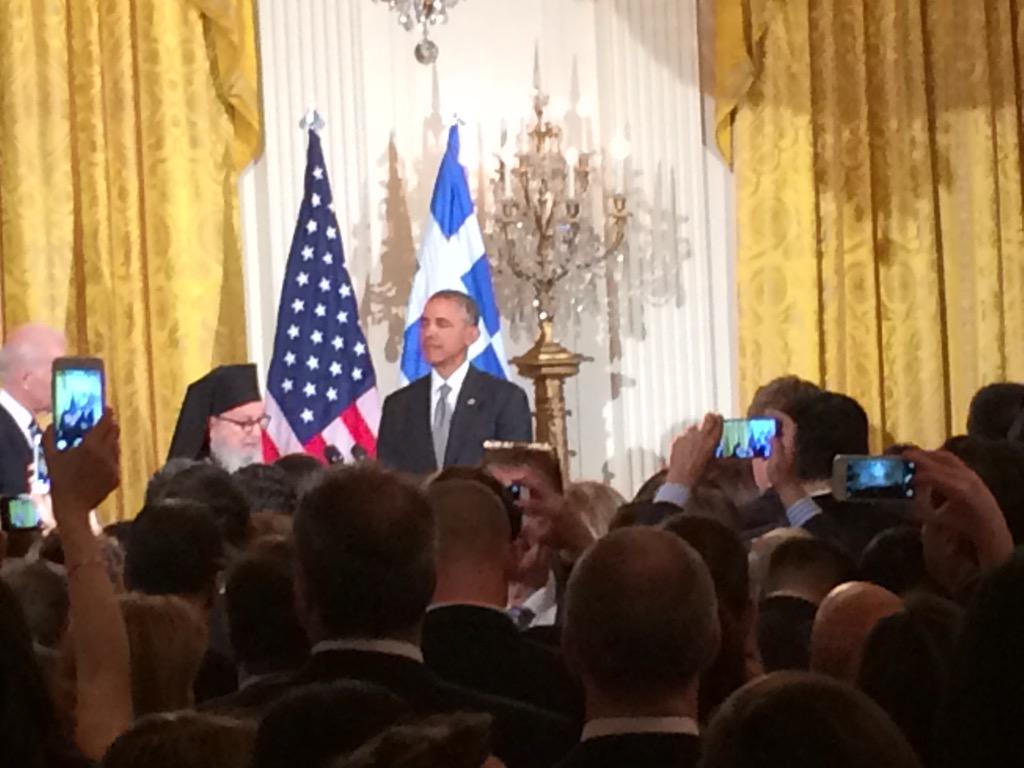
President_Obama_White_House_Greek_Independence_ReceptionWith Greek Finance Minister Yanis Varoufakis and hundreds of Greek-Americans including John Stamos in attendance, President Barack Obama’s reception in honor of Greek Independence was literally a Full House.

President_Obama_Yanis_Varoufakis_white_House_Greek_Independence_reception
Guests were welcomed at the White House’s East room at 5.15pm on Thursday April 16, 2015.  Vice President Joe Biden offered introductory remarks and welcomed President Obama to address the Greek-American audience.

Among the attendees were many prominent members of the Greek American community including Archbishop Demetrios of America. Greece’s Finance Minister Yanis Varoufakis led the delegation of Greek officials to the White House.

There was a direct chat during the event between Yanis Varoufakis and Barack Obama, however the White House itinerary didn’t have programmed a private meeting among the two.President_Obama_Yanis_Varoufakis_white_House_Greek_Independence_reception

The informal chat with the President makes Varoufakis the first official of the newly elected Greek government to interact with the US President amid crucial negotiations between Greece and its international creditors.

Last month President Obama had also issued a Declaration on the occasion of Greek Independence Day.


- See more at: http://usa.greekreporter.com/2015/04/16/obama-greek-independence-reception-greece-varoufakis-white-house/#sthash.A61QlYK1.dpuf

Greece in talks with Russia to buy S-300 missiles — Report


First entry: 16 April 2015
Greece in talks with Russia to buy S-300 missiles — Report
Greece is negotiating with Russia for the purchase of missiles for its S-300 anti-missile systems and for their maintenance, Russia's RIA news agency quoted Greek Defense Minister Panos Kammenos as saying on Wednesday.
The report followed a visit by Greek Prime Minister Alexis Tsipras last week to Moscow, where he won pledges of Russian moral support and long-term cooperation but no fresh funds to help avert bankruptcy for his heavily indebted nation.
NATO member Greece has been in possession of the Russian-made S-300 air defense systems since the late 1990s.
"We are limiting ourselves to replacement of missiles [for the systems]," RIA quoted Kammenos, who is in Moscow for a security conference, as saying.
"There are negotiations between Russia and Greece on the maintenance of the systems … as well as for the purchase of new missiles for the S-300 systems," he said.
The Greek defense ministry in Athens later issued a statement quoting Kammenos as saying: "The existing defense cooperation programs will continue. There will be maintenance for the existing programs."
No other details were immediately available.
It was unclear where Greece, whose leftist government is struggling to secure the funds to meet its debt repayments, would find the money to buy more missiles.
Russian President Vladimir Putin said after his talks with Tsipras in Moscow last week that Athens had not asked for money to ease its debt crisis.
However, Greece is keen to revive its traditionally good relations with Moscow, prompting unease among some of its European partners at a time of deep tension between Russia and the West over the Ukraine crisis.
On Monday, the Kremlin said Putin had signed a decree ending a self-imposed ban on delivering its S-300 anti-missile system to Tehran after world powers, including Russia, reached an interim deal with Iran on curbing its nuclear program.
The Moscow Times

Prosecutor: Thaci could be arrested in Belgrade


BELGRADE -- Serbian War Crimes Prosecutor Vladimir Vukcevic has said that the warrant for the arrest of Hashim Thaci is valid in Serbia.
(B92, file)
(B92, file)
That means that if he arrived in Belgrade, Thaci, a former leader of the KLA who now serves as Kosovo's foreign minister and deputy prime minister, could be arrested, Vukcevic explained.
"The investigation about Thaci is interrupted, because he is not accessible to Serbian investigative organs. The central Interpol office did stop the validity of the warrant against Thaci in other countries with the explanation that this is about top-ranking Albanian officials. However, it is in force in Serbia, so if he comes here, we can arrest him," Vukcevic told the Blic newspaper.

The media in Pristina reported on Wednesday that Thaci was invited by an NGO to attend a conference in Belgrade in late April, and that he accepted the invitation.

Serbian Foreign Minister Ivica Dacic reacted by saying that there was "no need for Thaci to come to Belgrade," as the gathering would not be organized by the government, and he had no plans to attend it.

Iran urges India, China & Russia to counter NATO missile system


Published time: April 16, 2015
USS Higgins with Aegis interceptor systems (Reuters / Atef Safadi)
3.8K4134
Iran has announced its readiness to cooperate with Russia, China and India on the issue of NATO’s missile shield and related threats from the military bloc, the head of its defense ministry said in Moscow.
“I'd like to support the idea of developing multifaceted defense cooperation between China, Iran, India and Russia to counter NATO eastwards expansion and installing a missile shield in Europe,” Hossein Dehghan said on Thursday, at an international security conference in Moscow.
Hours later Dehghan was cited by RIA Novosti as saying that Russia, China and Iran may hold tri-party defense talks.
"We discussed certain aspects of regional security. It was proposed to hold a trilateral meeting of Russia, Iran and China," Dehghan said after meeting with Russian Defense Minister Sergey Shoigu.

 
Read more 
 
Tehran threat? Russia questions US, EU motives behind missile shield in Europe
Despite a deal on Tehran's nuclear program, the US is still going to site its missile defense installations in Europe. They are being deployed over a perceived threat from “nuclear Iran” – a pretext which Moscow called a “fairytale.”
“The threat to NATO countries posed by the proliferation of ballistic missiles continues to increase… the framework [of the Iran nuclear program] agreement does not change that fact,” NATO spokeswoman Oana Lungescu told Sputnik.
According to Russia, the controversial missile shield in Europe is staying because “the Missile Defense System was never about Iran.”
READ MORE: US commissions ‘crucial’ NATO missile shield facility in Romania
“This serves as yet more proof that references to the ‘Iranian [missile] threat’ served as a smokescreen, whereas the genuine objective is the creation of an anti-missile program with quite a different purpose,” the Russian Foreign Ministry wrote.

The US has for years insisted the missile defense system is needed for protection against potential missiles from rogue states, such as North Korea and Iran. Moscow strongly objected to new unilateral NATO military installations, citing national security threats. Russia proposed the creation of a joint system, but Washington rejected it.

Russia reacts to Albanian PM's "unification" comments


MOSCOW -- The "pan-Albanian" rhetoric will not contribute to preserving the climate of stability and good-neighborly relations in the Balkans, Moscow has said.
(freeimages.com)
(freeimages.com)
Russia's foreign ministry in this way reacted to Albanian Prime Minister Edi Rama's recent statement about the future unification of his country and Kosovo "through the EU, or the classic way."
"Moscow has paid attention Albanian Prime Minister Edi Rama's April 4 statement about the possibility of Albanians unifying in the classic sense, that is, by changing the borders in the region, unless Albania's and Kosovo's Euro-integration has been accelerated," the ministry said, according to TASS.

"We assume that no matter what considerations or motives could stand behind Rama’s words, the recurrence of the pan-Albanian rhetoric is unlikely to contribute to preserving the climate of stability and good-neighborliness in the Balkan region, which is vital for Russia and other European countries," the Russian Foreign Ministry stressed.

Why Russia Will Send More Troops to Central Asia

Stratfor

Summary

Russia is making a concerted effort to increase its military and security presence throughout Central Asia, just not for the reasons it would have you think. Though the Kremlin is concerned with the threat of spillover violence from Islamist militancy in Afghanistan — its purported motive for deploying more troops — it is far more alarmed by what it sees as Chinese and Western encroachment into lands over which it has long held sway. It is this concern that will shape Moscow's behavior in Central Asia in the years to come.

Analysis

Central Asia has played an important role in the projection of Russian military power since the Russian Empire's expansion in the 18th and 19th centuries. During this period, Russia established military outposts as it competed with the British Empire for influence in the region. By the mid-19th century, Russia had brought modern-day Kazakhstan, Uzbekistan, Turkmenistan, Kyrgyzstan and Tajikistan into its empire. In the early 20th century, the countries were incorporated into the Soviet Union.
After the collapse of the Soviet Union, Russia retained a military presence in Central Asia and played a major role in regional conflicts, such as the 1992-1997 Tajik civil war. Today Russia still has military bases in Kyrgyzstan and Tajikistan. Kazakhstan is a member of the Collective Security Treaty Organization, a military bloc dominated by Moscow. And while Uzbekistan and Turkmenistan are not members of the bloc, they do have important security and military ties with Russia through arms purchases.

Concerns of Militancy

Russia's long-standing influence in Central Asian military affairs frames several of the country's recent moves. On April 2, the base commander of Russia's 201st military base in Tajikistan said Russia would increase the number of troops stationed there from 5,900 to 9,000 over the next five years and add more military equipment through 2020. Then on April 3 an unnamed source in the General Staff of the Russian armed forces told Kommersant that Russia was prepared to grant Tajikistan $1.2 billion in military aid over the next few years. Russian military specialists were reportedly dispatched to Turkmenistan's border with Afghanistan on March 24 as well. Turkmen officials have yet to confirm this, but local media report that Ashgabat requested Russian assistance to protect the Afghan border.

Officially, these developments are tied to growing concern over violence spilling over from Afghanistan into Central Asia. It is a legitimate fear for many Central Asian governments as NATO and the United States draw down their forces in Afghanistan. Regional governments have voiced discomfort with the increased militant presence in northern Afghanistan, including the Taliban and the Islamic State.
Russia has echoed this fear. Russian President Vladimir Putin's special representative for Afghanistan alleged that Islamic State fighters in the north are training thousands of militants near the Tajikistan and Turkmenistan borders. Collective Security Treaty Organization summits have focused on the issue, and Tajikistan urged the bloc to do more to counter the threat at the April 1-2 Dushanbe summit.
Despite a definite uptick in militant attacks in northern Afghanistan, no concrete evidence has emerged of attacks over the border in Central Asian states. Central Asia's last major wave of regionwide militancy was 1999-2001, when the Islamic Movement of Uzbekistan conducted attacks in the Fergana Valley in Tajikistan, Kyrgyzstan and Uzbekistan. The U.S. intervention in Afghanistan following 9/11, however, wiped out much of the group. Surviving elements then dispersed throughout the Afghanistan-Pakistan border area.
Since then, Uzbekistan, Tajikistan and Kazakhstan have seen some attacks by Islamist militants. But many were related to political dynamics, not the movement in Afghanistan. A spillover of Afghan militancy is possible, but so far the threat is minimal.

More Pertinent Factors

Because Islamist spillover from northern Afghanistan is still a relatively minor threat, Russia's push into Central Asia may have other motivations. Moscow is engaged in a tense standoff with the West over Ukraine, just one theater in the competition for influence along the former Soviet periphery. Central Asia is another key region in this contest. The region possesses sizable oil and natural gas resources that are attractive to the European Union as it seeks to diversify energy supplies and end its dependence on Russia. Europe has already pursued Turkmenistan to join the Trans-Caspian pipeline project.
The United States has also been active in Central Asia, particularly from a security standpoint. The United States no longer uses Central Asian military bases that had been logistical centers for operations in Afghanistan, such as the Kant Air Base in Kyrgyzstan or the Karshi-Khanabad Air Base in Uzbekistan. These bases, however, have left a regional legacy. Washington maintains some security operations that include counternarcotics training with Kyrgyzstan and Tajikistan.
The United States has also expressed interest in increasing its commitment. The commander of U.S. Central Command, Gen. Lloyd Austin, said the United States was willing to provide military equipment and technology to support Turkmenistan's efforts to secure its border with Afghanistan. The United States also announced in January that it would grant over 200 Mine Resistant Ambush Protected vehicles to Uzbekistan previously used in the U.S. Northern Distribution Network in Afghanistan. Such gestures point to a U.S. desire to develop more cooperative security relationships with Central Asian states.
Moscow's military and security expansion efforts stem partly from its concern about these gestures. But Russia has not limited itself to deploying military personnel. Moscow has expanded the scope and membership of its Eurasian Union to include broader cooperation on issues including border controls. Kazakhstan is already a member, and Kyrgyzstan will soon join. Russia increased the number of exercises held by Collective Security Treaty Organization members. It also called on Uzbekistan and Turkmenistan to cooperate more with the security bloc, though both have been hesitant.
However, Moscow's ability to solidify its position in Central Asia will be limited. Russia has a weak economy. Already, many Central Asian migrants who once worked in Russia have left, causing a decline in Russian remittances to the region. The West, and particularly the United States, will continue to have influence in the region. China, too, will continue to make economic and energy inroads.
Meanwhile, instability in the region will probably increase. Kazakhstan and Uzbekistan both have potential succession crises in the offing. Moreover, demographic growth and competition over water resources are likely to threaten the region's security. Russia will see its position in Central Asia tested in the coming years. Islamist militancy is just one concern among many for Moscow and Central Asian governments.

Wednesday, April 15, 2015

NATO in Tirana, for recent Euro-Atlantic Security Challenges

18th Annual International Conference of the Atlantic Council of Albania: NATO IN FACE OF THE RECENT EURO-ATLANTIC SECURITY CHALLENGES

On February 25-26, 2015, the Atlantic Council of Albania, supported by the NATO PDD organized its 18th Annual International Conference titled: ‘NATO in face of the recent Euro-Atlantic Security Challenges’. This conference successfully served as a long-established opportunity for civil society and political actors to make significant contributions to encourage cooperation for security and development in the Europe and Western Balkans and to discuss NATO approaches to the current security challenges. The conference had representatives from the region and beyond. The conference was held at Hotel Mondial in Tirana on 26th February 2015 and was attended by over 150 participants, including government representatives, political leaders, diplomats, security and defense experts, military officers, university professors, researchers, civil society representatives, media people, ACA members and students. The conference featured four sessions of high-level speakers and was followed by questions, debates, and good discussions.

Juncker's is running out of patience with Greece, EU official says


First entry: 15 April 2015 -
Juncker's is running out of patience with Greece, EU official says
European Commission President Jean-Claude Juncker seems to be upset with the lack of progress in discussions with Greece, according to an EU official , as Reuters reports.
In Brussels, Juncker, told a closed-door meeting of the EU executive that his patience with Greece was wearing very thin and there had been no progress in recent days, an EU official said.
But he said Juncker had insisted there should be no contingency planning for a possible Greek exit from the euro zone. "A 'Grexit' is a taboo topic for Juncker," the official noted.

Albania launches Investment Council with EBRD support

Wednesday, 15 April 2015 00:00 Written by  Viktorija Melohina

The FINANCIAL -- The EBRD’s Investment Climate and Governance Initiative (ICGI) is reaching a milestone on April 15 with the launch of Albania’s Investment Council, an institution with the goal of enhancing public private dialogue and spurring concrete action to strengthen the business climate in the country.
The launch at a high-profile event in the Albanian capital Tirana is gathering key decision-makers from the business community, as well as government officials and representatives of international financial institutions, to tackle impediments to investment and to foster both domestic and foreign investment in Albania, according to EBRD.

The first meeting of the Council will be followed by a press briefing and a special address by the Prime Minister of Albania, Edi Rama. The event will be attended by the Chair of the Investment Council and Minister of Economic Development, Tourism, Trade and Entrepreneurship, Arben Ahmetaj, the Head of the Secretariat of the Investment Council, Diana Leka, EBRD Managing Director for External Relations and Partnerships, Alan Rousso, EBRD Director for the Western Balkans, Holger Muent, the Head of the EBRD Tirana Office, Christoph Denk and EBRD Senior Counsellor for Investment Climate and Governance, Franklin Steves amongst others.

The Council is a platform set up by the Albanian authorities with support from the EBRD to intensify the dialogue between the government and the private sector, improve the business climate and promote good governance. The work of the Council is supported by a Secretariat, an independent body of professionals selected and contracted by the EBRD to directly engage with the business community. The initial funding for the Secretariat is provided by Italy.

Ahead of the launch, the Prime Minister of Albania, Edi Rama, called the event an important milestone for Albania. The Council will serve as a bridge between the business community and the government and will become a catalyst, helping to create the right business environment for investments. He also expressed confidence that with EBRD’s help Albania will make rapid progress towards economic prosperity.

“This is a landmark moment in our cooperation with the EBRD. Creating the right investment conditions is a critical task and we are confident that we will make further progress through the work of the Investment Council. We are convinced that strengthening the investment climate and enhancing governance will increase Albania’s attractiveness to investors,” added Albania’s Minister of Economic Development, Arben Ahmetaj.

“We are proud to support the launch of the Investment Council. This is an important step forward and we are happy to see the Albanian authorities tackle head-on the challenges that the country faces. Improving the business environment is one of the priorities of the EBRD’s work in Albania and it is an integral part of everything we do,” said Christoph Denk, Head of the EBRD Office in Tirana.

“This is an important moment for Albania. We are proud to be one of the pioneering countries in the Western Balkans to step up efforts to improve the business environment. Thanks to our cooperation with the EBRD Albania is taking another step towards unleashing its full economic potential,” said the Head of the Secretariat of the Investment Council of Albania, Diana Leka.

“This step shows the Albanian authorities’ strong commitment to the reform agenda. We are pleased to see our Investment Climate and Governance Initiative deliver results as economic growth can be re-energised only through the process of change and adoption of market-friendly reforms,” said EBRD Managing Director for External Relations and Partnerships, Alan Rousso.

The independent Investment Council plays an important role in the implementation of objectives set in the Memorandum of Understanding signed by EBRD President Sir Suma Chakrabarti and Albania’s Prime Minister Edi Rama in February 2014.

Albania was the first country to sign up to the ICGI. Since then,  Moldova, Serbia and Ukraine have joined the Initiative.

Since the start of its operations in Albania, the EBRD has invested almost €1 billion in some 70 projects in various sectors of the economy.

"No need for Thaci to come to Belgrade"


BELGRADE -- Foreign Minister Ivica Dacic has said that he "doubts" that Hashim Thaci will come to Belgrade "without an agreement with the Serbian government."
(Beta, file)
(Beta, file)
Dacic was asked to comment on announcements from Pristina that Thaci, who serves as Kosovo's foreign minister and deputy prime minister, would this month attend a conference in Belgrade organized by an NGO.
"You don't think that he will really come here without an agreement with the Serbian government," Dacic asked reporters on Wednesday, and then noted that the gathering will be organized "by the civil sector, not the government."

"I have no plans to participate, so I don't think there's any need to go," he was quoted as saying, and adding:

"We have no information about that, we found out (about the conference) from the media."

Dacic then described Thaci's announced trip to Belgrade as "unilateral action," and remarked that "such serious issues should not be the subject of a frivolous approach."

Asked "whether Thaci's arrival could represent a problem," and, "whether some investigative procedure is being taken against him," Dacic replied: "I think there's no need for him to come here."

Dacic added that "the two sides have made many steps to normalize relations, in a manner that was mutually agreed on - but this has not been agreed on."

Thaci accepts NGO's invitation to attend Belgrade event


BELGRADE -- Kosovo Foreign Minister and Deputy PM Hashim Thaci has accepted an invitation "to come to Belgrade" on April 24, his deputy has confirmed.
(Beta/AP, file)
(Beta/AP, file)
According to Petrit Selimi, Thaci has provided "a preliminary positive reply." He added that "it is now the task for the Serbian authorities to guarantee his safe stay."
Selimi also observed that "the Kosovo government and the police have been able to guarantee complete security to President Nikolic, Prime Minister Vucic and other top-ranked Serbian officials who visited Kosovo."

Thaci was invited by the Youth Education Committee non-governmental organization, and should attend a conference they will organize in Belgrade on April 24.

Selimi noted that the conference will be focused "on youth and reconciliation - and we believe these topics are of importance for both Kosovo and Serbia since we hope there is willingness to move forward in the process of European integrations."

"Deputy Prime Minister Hashim Thaci has never been to Belgrade before, and perhaps this visit could be a test of how far we have come with the normalization of circumstances between Kosovo and Serbia," Selimi told the Beta agency.

Kosovo's ethnic Albanians in 2008 unilaterally declared independence, which Serbia rejected as a violation of its territorial integrity. Belgrade and Pristina have been involved in EU-mediated dialogue since 2011.

According to Albanian language media in Pristina, Belgrade is now "in an uncomfortable situation" due to great pressure coming from the EU to allow Thaci's trip. The same media claim that "4,000 police officers" will be deployed to ensure his safety.

The Belgrade-based daily Danas writes on Wednesday that the EU is lobbying for the visit to happen, while the government is expected to make a decision this week.

Thaci was one of the leaders of the now disbanded so-called Kosovo Liberation Army (KLA) who has been accused by Serbia of committing war crimes - "but it is unclear if there are currently any ongoing process against him," reported Tanjug.

Dozens of new migrants arrive in the port of Piraeus


First entry: 15 April 2015
Dozens of new migrants arrive in the port of Piraeus - VIDEO
The migration wave to Greece from the Turkish coast continues unabated. A ship has docked in Piraeus port carrying dozens of immigrants who have entered Greece illegally.
The migrants refused to speak to the cameras upon arrival.
On Tuesday the Greek government announced a series of emergency measures to deal with an anticipated new wave of migrants and refugees entering Greece.
Athens is stressing that the problem is "above all a humanitarian issue."

Tuesday, April 14, 2015

John Kerry Thanks Russia for Rescuing US Citizens from Yemen Air Strikes

Russian plane evacuating people from Yemen at Chkalovsky Airport
© Sputnik/ Alexei Kudenko
Russia
19:02 14.04.2015
The US Secretary of State expressed appreciation for Russia's action in evacuating Americans from Yemen, after the United States refused to engage in evacuation efforts for its citizens.
State Department Deputy Spokeswoman Marie Harf speaks during a briefing at the Washington Foreign Press Center

© AFP 2015/ Brendan SMIALOWSKI

US Provides Information to Americans on How to Flee Yemen
The US government has thanked the Russian authorities for their help in evacuating Americans from Yemen, after the US State Department said it had no plans to evacuate its citizens from the war-torn country, leaving hundreds stranded.

US Secretary of State John Kerry "expressed gratitude for assistance in the evacuation of American citizens," from Yemen in a telephone conversation with Russian Foreign Minister Sergey Lavrov on Monday, after 18 US citizens were evacuated aboard a Russian ship taking 308 people, including 45 Russians from the port of Aden to Djibouti.

Two airplanes carrying 366 people of varying nationalities fleeing the Yemeni capital Sanaa landed in Moscow on Sunday, where one American traveling on the plane told RT, "We feel like we’re left behind. No support. I called every Embassy – all the embassies in Riyadh, in Cairo, in Djibouti – to help me and my family, but they always apologize. They said 'help is coming' – but it never came. People now think that Yemeni American are like second-class Americans."


The US State Department evacuated its American Embassy staff from Yemen in February, having suspended Embassy operations due to the deteriorating security situation in the country, but maintains it has "no plans for a U.S. government-coordinated evacuation of U.S. citizens at this time."

"For more than 15 years, the State Department has been advising U.S. citizens to defer travel to Yemen, and we’ve been advising those U.S. citizens who are in Yemen to depart," said State Department spokesman Jeff Rathke last week.

According to a statement on the website of the Russian Foreign Ministry, the acknowledgement from Kerry came in the course of a telephone call in which the two sides discussed a range of pressing international issues, including the agreement reached regarding Iran's nuclear program, and the Syrian crisis.

People evacuated from Yemen land in Moscow Region
© Sputnik/ Alexey Kudenko
Another Aircraft Evacuating People From Yemen Lands in Moscow Region
The British Foreign Office likewise thanked Russia for assistance in evacuating its citizens from the country on Monday, having advised that "the British government can’t provide any form of assisted departure to British nationals in Yemen."

A UK Foreign Office spokesperson said on Monday, "we can confirm that six British nationals left Yemen at the weekend on a Russian Navy vessel. We thank the Russian authorities for their assistance."

The above tweet is from the Ambassador of the Russian Federation to the United Kingdom, Alexander Yakovenko.

Last week 41 American citizens stranded in Yemen filed a federal lawsuit against the State Department and Defense Department for their refusal to evacuate them from Yemen, where a Saudi-led coalition, with the backing of the US government, has been carrying out air strikes on Houthi-controlled targets since March 26.

"Despite the clear danger to Americans in Yemen – and the death of at least one American – the Obama administration has not yet taken any substantive steps to help citizens or permanent residents reach safety," reads the court filing.

Read more: http://sputniknews.com/russia/20150414/1020884807.html#ixzz3XJfELeDz

Read more: http://sputniknews.com/russia/20150414/1020884807.html#ixzz3XJev8O00

Putin to Netanyahu: Iranian S-300 Missiles Pose No Threat to Israel

Vladimir Putin meets with Benjamin Netanyahu
© Sputnik/ Aleksey Nikolskyi

Russian President Vladimir Putin stressed that the S-300 missile system is purely defensive and will not pose threat to Israel or any other country in the Middle East in telephone conversation with Israeli Prime Minister Benjamin Netanyahu.
S-300 launch (File photo)
© Sputnik/ Vyacheslav Afonin
Iranian Minister to Discuss S-300 Missile Defense System Delivery in Moscow
MOSCOW (Sputnik) — Russian President Vladimir Putin has reassured Israeli Prime Minister Benjamin Netanyahu that lifting of the embargo on deliveries of advanced S-300 air defense systems to Iran will not threaten Israel's security, the Kremlin said Tuesday.

Putin and Netanyahu discussed the Russian president's decision in a phone call earlier on Tuesday.

"Putin stressed that the S-300 missile system is purely defensive and will not pose threat to Israel or any other country in the Middle East," the Kremlin press service said in a statement.

Read more: http://sputniknews.com/politics/20150414/1020888453.html#ixzz3XJeFsSW2

"Order Seselj back in custody immediately"


THE HAGUE -- The Hague Tribunal prosecution has sent an urgent proposal to the Appeals Chamber on the execution of the decision to end Vojislav Seselj's provisional release.
(file)
(file)
The proposal was signed by Chief Prosecutor Serge Brammertz and asks the Appeals Chamber to order the Trial Chamber to revoke its decision on the provisional release "within one day" after deciding on the proposal.
Recalling that on March 30 the Appeals Chamber ordered the Trial Chamber to "immediately" issue an order to revoke the decision on Seselj's provisional release and order him to return to the detention unit, the prosecution claims that two weeks later the Trial Chamber failed to carry it out.

The decision of the Appeals Chamber was unambiguous, said the prosecution, adding that the Trial Chamber was not given the right to decide whether to act on it, or a period of time in which to do so.

However, as pointed out, the Trial Chamber has not yet implemented the decision and instead waited ten days before taking any action - and then only to order the registry to obtain medical information pertaining to Seselj's health.

The prosecution sees this as "undue delay" in carrying out "the unequivocal order of the Appeals Chamber" and adds that Seselj's health condition is "irrelevant for the implementation of the decision," cannot prevent it, considering that his health "should suffer no damage from his return to the Hague."

The leader of the Serb Radical Party (SRS), who was in early 2003 indicted for war crimes and voluntarily surrendered to the tribunal shortly after, is ill with cancer and was granted temporary release on medical grounds last November, after spending more than 11 years in custody without a verdict.

Defence minister Kammenos to visit Russia


First entry: 14 April 2015
Defence minister Kammenos to visit Russia
Defence minister Panos Kammenos will visit Russia on Wednesday and Thursday.
Kammenos was invited by his Russian counterpart, Sergei Shoigu, to attend, and speak in, the Fourth Moscow Conference on International Security, an event organized annually by the Russian Defense Ministry.
"Defence ministers and delegations of defence agencies from 79 states, heads of international organizations, Russian officials, experts and academicians have been invited to the forum," Russian Deputy Defense Minister Anatoly Antonov was quoted as saying by news agency Interfax.

Varoufakis to meet Obama on Thursday in Washington


First entry: 14 April 2015
Varoufakis to meet Obama on Thursday in Washington
The Greek economy and the eurozone will be the main topics of the conference by the Brookings Institution, to be held on Thursday, April 16, 2015 in Washington, with Greek Finance Minister Yanis Varoufakis being the keynote speaker in the thematic table on "The Greek economy and its global partners."
Later he is expected to meet the US President Barack Obama.
German Finance Minister Wolfgang Schaeuble will also be a keynote speaker in the thematic table on "The eurozone at a crossroads (again)."
The unit in which the Greek minister will participate will touch upon the challenges facing the Greek economy, the prospects for reforms and economic recovery and the details of a possible future strategic agreement between Greece, its European partners and the IMF.
After his speech, Varoufakis will have a brief discussion with economist and former finance minister of Turkey Kemal Dervis as well as David Wessel, an executive at the Brookings Institution.
Varoufakis is also expected at the White House on Thursday to attend celebrations for the March 25th Greek Independence Day celebrations, becoming the first official of the recently elected Greek government to meet with the US President Barack Obama.
According to sources the Greek finance minister will have a few moments to talk with Obama and US Vice President Joe Biden at a time when Greece is in crucial negotiations with its international creditors.
Sources: ANA-MPA, enikonomia

EU commissioner Avramopoulos: Let's prepare for a heavy migratory season


First entry: 14 April 2015
EU commissioner Avramopoulos: Let's prepare for a heavy migratory season
We have to prepare for a heavy migratory season, Greece's EU Commissioner for Migration, Home Affairs and Citizenship, DimitrisAvramopoulos told the Committee on Civil Liberties, Justice and Home Affairs (LIBE) in the European Parliament.
Reffering to the situation in the Mediterranean, Avramopoulos said "the arrival of more than 7000 migrants - according to Frontex estimates - to the Greek, Italian and other European coasts over the past few days reminds us that we have to be well aware of the immediate realities at our borders".
"Europe finds itself amidst a widening arc of instability ranging from the East all the way to North Africa. On our Eastern flank, the conflict in the Ukraine fuels instability and anxiety in the entire region. The conflicts in Syria and Iraq generated a historic displacement of people, with serious security and socio-economic implications for neighbouring countries, including Turkey, Lebanon and Jordan. Then, of course there is Libya, which has been a recurrent theme in many of your recent debates. With such a set of circumstances in our neighbourhood, we have to prepare for a heavy migratory season, and the Commission is ready to do its part to support and assist those Member States that are affected the most and have urgent needs" Greek EU Commissioner told in his speech.
"In fact, we have recently offered emergency financial support to a number of Member States and we are ready to do this again in the future if needed", he added.
As Avramopoulos said, the EU Commision is ready to assist member States protecting their borders through Frontex in all affected Member States; not only Italy, but also along the Eastern Mediterranean border in Greece and Bulgaria.
"The recent incidents in the Mediterranean, with thousands of migrants crossing - mainly from Libya but also from Turkey - to Italy and Greece, is a stark reminder that we also need to engage in a substantial way with third countries. That is why I will also visit key third countries (Morrocco, Egypt, Tunisia). We have to enhance cooperation with third countries and also apply tools from foreign policy, neighbourhood policies, development aid and trade in order to achieve the objective of better-managed migratory flows. This cannot be a one-way relationship. Third countries must also see the benefits of working with us on migration" he noted.

Mohammed bin Zayed receives Albanian Prime Minister, discuss cooperation


(Wam) / 14 April 2015

The two sides discussed bilateral relations and ways to enhance cooperation, particularly in economic, developmental and commercial fields.

His Highness Shaikh Mohammed bin Zayed Al Nahyan, Crown Prince of Abu Dhabi and Deputy Supreme Commander of the UAE Armed Forces, received on Monday evening at Al Bahr Palace Prime Minister of Albania Edi Rama who is currently on a visit to the UAE.

Photo from Wam

Shaikh Mohammed bin Zayed welcomed the Albanian Prime Minister and his accompanying delegation and expressed the hope that his visit would contribute in furthering ties of friendship and cooperation between the two countries.

The two sides discussed bilateral relations and ways to enhance cooperation, particularly in economic, developmental and commercial fields.

Shaikh Mohammed bin Zayed said the UAE was looking forward to exchange views on the best means for fruitful cooperation and for realising the common goal of creating partnerships, benefiting from the potentials available in the two countries.

Edi Rama said he was delighted with his visit to the UAE and his meeting with Shaikh Mohammed bin Zayed to discuss ways of strengthening cooperation. He praised the progress made by the UAE in different domains.

The meeting also touched on current regional and international developments and issues of mutual interest.

Shaikh Mohammed bin Zayed and Edi Rama witnessed signing of an agreement on the exemption of entry visa requirements for holders of diplomatic, special and service passports on reciprocal basis and a Memorandum of Understanding on environment. The agreement and the MOU were signed by the Shaikh Abdullah bin Zayed Al Nahyan, UAE Foreign Minister and his Albanian counterpart, Ditmir Bushati.

Present were Shaikh Hamdan bin Zayed Al Nahyan, Ruler’s Representative in the Western Region;  Shaikh Nahyan bin Zayed Al Nahyan, Chairman of the Board of Trustees of Zayed bin Sultan Al Nahyan Charitable and Humanitarian Foundation; Shaikh Omar bin Zayed Al Nahyan, Deputy Chairman of the Board of Trustees of Zayed bin Sultan Al Nahyan Charitable and Humanitarian Foundation; Shaikh Khalid bin Zayed Al Nahyan, Chairman of the Board of Zayed Higher Organisation for Humanitarian Care & Special Needs (ZHO); Shaikh Nahyan bin Mubarak Al Nahyan, Minister of Culture, Youth and Community Development; Shaikhs, ministers and senior officials.

TAP pipeline awards first major contract in Albania

Italy’s Sicilsaldo has been selected as part of a joint venture formed for the construction and rehabilitation of access roads and bridges in Albania.

14.04.2015 - 18:02
The Trans Adriatic Pipeline AG (TAP) said it has selected a joint venture formed by Albania’s Gener 2 and Italy’s Sicilsaldo for the construction and rehabilitation of access roads and bridges in Albania. TAP will connect with the Trans Anatolian Pipeline (TANAP) at the Turkish-Greek border at Kipoi, cross Greece and Albania and the Adriatic Sea, before coming ashore in Southern Italy.

See also: TAP issues contract notice for Italy onshore construction

The decision concludes TAP’s pre-qualification process (launched in April 2014), followed by bid assessments from the shortlisted companies that met TAP’s rigorous pre-qualification criteria, TAP said in a press release on April 14. The building of Albanian access roads and bridges is a crucial step in TAP’s preparations for pipeline construction, to begin in 2016.
The scope of work for the contract covers construction and rehabilitation of over 100 kilometres of road along the pipeline’s route: in Vishocice, Trestenik, Vithkuq and Shtyllas in the Korca region, Corovode, Kakruke as well as in the surroundings of Potom in the Berati region and Seman and Topoje in the Fier region.
The contract also covers onstruction of two new bridges and rehabilitation of approximately 50 existing bridges in the regions of Korce, Berat and Fier. Works are expected to begin in the second quarter of 2015.
Leading the joint venture is Gener 2, an Albanian construction and development company with almost 20 years of relevant experience. The company has executed numerous projects, including engineering and design, management, coordination, and supervision of various privately owned and government funded construction and development activities.
Sicilsaldo is an Italian company specialised in engineering, procurement and construction services in the oil and gas as well as in the power sector. The services they provide range from design and construction to maintenance of plant and pipelines.
“Today’s announcement is an important step for TAP’s execution phase, as it will allow for pipe-laying to begin in 2016,” TAP Managing Director Ian Bradshaw said. “I want to express our gratitude to all those who participated in this process and congratulate the winning joint venture company on their success,” he added.
Bradshaw reinforced that TAP remains committed to acting as a responsible corporate citizen. “In addition to our community investment programme in Albania, the access roads and bridges will be left behind for the benefit of the local communities for decades to come,” he said.

Greece most popular destination worldwide for luxury cruise ships


First entry: 14 April 2015
Greece most popular destination worldwide for luxury cruise ships
Greece is the most popular destination in the world for luxury cruise ships, while the most popular port worldwide is the port of the southern Aegean island of Santorini, according to a recent research.
The research has been conducted by "CruiseTrends" for the month of April 2015.
The Bahamas in the western North Atlantic Ocean, is the most popular destination worldwide for premium - category cruise lines and Germany is the most popular destination for river cruise ships.
Source: enikonomia.gr

Monday, April 13, 2015


EP official on Rama's statement, Russia


BELGRADE -- EP official Eduard Kukan says that he "got nervous" when he "heard what Albanian Prime Minister Edi Rama said about the unification of Kosovo and Albania."
(Beta, file)
(Beta, file)
The chairman of the EP group for Serbia told the Belgrade-based tabloid Blic said that he "does not like" such declarations. Rama said last week that his country and Kosovo would unify either through membership in the EU, "or the classic way."
Kukan also said that "relations between Serbia and Russia do not directly affect membership negotiations between Belgrade with the EU," but that "all political decisions and behaviors do, as well as the general image of the country."

"It is not true that a year after a country becomes a candidate it all starts to happen, because everything must go through screenings, and it will happen soon. Your work will soon pay off," said Kukan, adding that he "hopes it will be this year."

He then pointed out that in the EP, there was "no written document which requires Serbia to recognize Kosovo."

Asked whether participation in the Victory Day parade in Moscow May 9 was "a problem for Serbia," Kukan said this was Serbia's decision, "and no one can tell you what to do."

"But, nobody from the EU is going there except the army of Serbia, it will surely will be mentioned somewhere or recorded by some member states," he said, adding that "serious consequences should not be expected."

Asked by the paper if Serbia "can be neutral" when it comes to the EU and Russia, Kukan said he personally thought that "today it is impossible to be neutral."

"I do not see the advantage of being someone's 'bridge', because when something happens, bridges are usually the first to suffer," said he.

Albanian group claims responsibility for attack on govt. HQ


A group calling itself the National Liberation Army has claimed responsibility for Saturday's explosion in front of the Macedonian government HQ in Skopje.
This has been reported by the Albanian language, Pristina-based daily Koha Ditore.
Serbia's state broadcaster RTS carried the report and said the Macedonian police "offered no comment for the time being."

The group bears the same name as the ethnic Albanian "guerrillas from the 2001 war (in Macedonia)," and has twice in the past two months claimed responsibility for attacks on the government building in Skopje, which did not result in injuries or significant damage.

According to these reports, the National Liberation Army's statement was signed by "the previously unknown Commander Kushtrimi"

A total of three missiles have been fired at the seat of the Macedonian government during the two incidents. The police said both attacks "came from the same direction."

The National Liberation Army, headed by Ali Ahmeti and Gzim Ostreni, was disbanded according to the Ohrid Agreement of 2001, a deal thanks to which "Macedonia stepped back from the brink of civil war."

Ever since, "phantom Albanian guerrilla organizations crop up periodically," and take responsibility for "not excessively frequent" incidents.

The Albanian National Army is, according to the report, the best-known such group. In 2007 they clashed with Macedonian security forces on Mt. Sara, when seven members of the ethnic Albanian group were killed and weapons "sufficient to equip a 500-men unit" seized.