Scottish independence: Turn off, tune in, drop out?

Currently a Research Associate at the INSYTE Group, Dr. Roslyn
Fuller has previously lectured at Trinity College and the National
University of Ireland. She tweets at
@roslynfuller
Published time: September 09, 2014 12:21

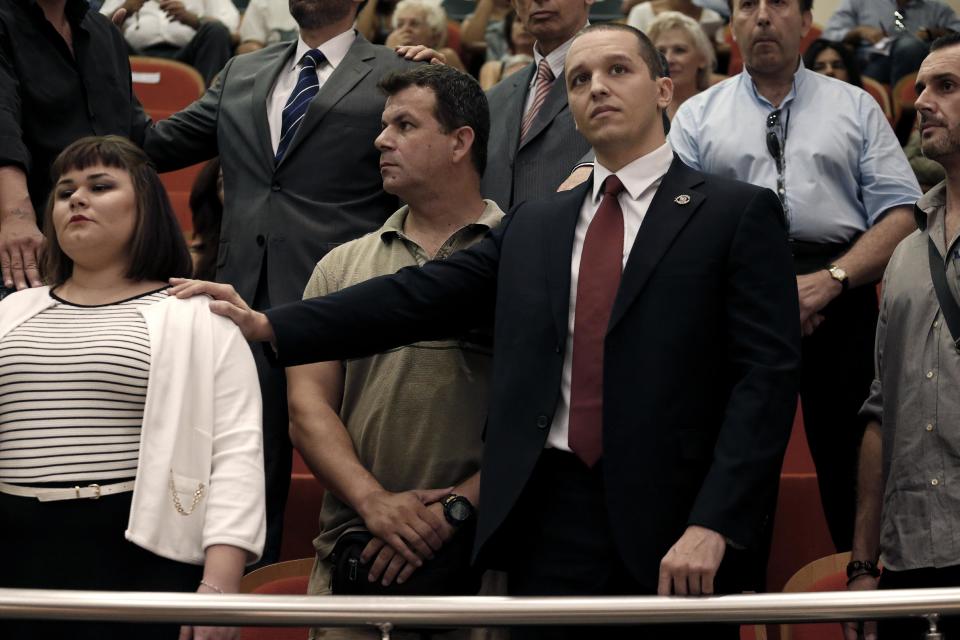
Opposing
supporters wait for the leader of Britain's opposition Labour Party, Ed
Miliband, during a campaign visit, ahead of the forthcoming Scottish
vote for independence from the United Kingdom, in East Kilbride,
Scotland September 4, 2014. (Reuters/Russell Cheyne)
With less than two weeks to go to
a Scottish referendum on independence from the United Kingdom, the
number of voters indicating that they will vote ‘yes’ to independence
has surged ahead for the first time, with 51% for as compared to 49%
against.
With less than two weeks to go to a Scottish referendum on
independence from the United Kingdom, the number of voters
indicating that they will vote
‘yes’ to independence has
surged ahead for the first time, with 51 percent for as compared
to 49 percent against.
Whatever the margin of error might be, the upshot is that more
Scots than anyone previously thought are seriously contemplating
separation from the United Kingdom.
Unsurprisingly, the fact that this referendum definitely has a
realistic chance of passing has led to a lot of speculation about
what would be “the better deal” for the Scottish people. The
Scottish financial industry, North Sea oil and the cost of
services like healthcare and third-level education have all come
under scrutiny, not to mention the future of Scottish trade links
with Europe and the UK under an as-yet-unspecified currency. Even
Yes Scotland’s website focuses on the economics, claiming that a
yes vote will “unleash” Scotland’s economic potential. The
message would seem to be that the Scots should do the math and
figure out where they are going to get a sweeter deal, in the UK
or outside of it.
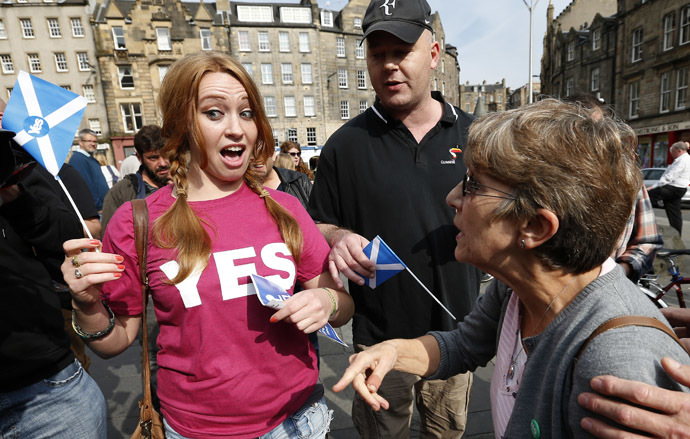
Opposing supporters for the Yes (L) and No campaigns, argue in Edinburgh, Scotland September 8, 2014.(Reuters/Russell Cheyne)
Which is quite ironic, because it’s basic game theory that the
person who gets the best deal is always the person who is
generally “in” but occasionally threatens to get
“out.”
Studies conducted at the UN General Assembly show that developing
nations who often vote with Western countries but occasionally
vote against them receive the best foreign aid packages – better
than countries who consistently vote against foreign aid donors,
but also better than countries who always vote with them.
So from a purely materialistic point of view, the best outcome
for Scotland is an
“almost yes.” In fact, the current
“almost yes” state of affairs is already paying
dividends with alarmed British politicians promising to give
Scotland greater autonomy over taxes (meaning it could
potentially undercut other regions of the UK on top tax rates),
the moment they vote
“no.” Clearly, there are some big
questions about Scotland’s economic future riding on this
referendum.
In fact, there are generally big questions about just what this
referendum is about.
While the “yes” side has campaigned on an anti-nuclear,
anti-imperialist and socially inclusive platform focusing on
green energy, it also apparently wants to keep Queen Elizabeth II
as head of state (nothing, apparently, says “freedom and
equality” like a hereditary foreign monarch technically running
your country), stay in NATO (known to have a nuke or two lying
about), stay in the EU (where judges estimate that about 95
percent of all national laws now originate), is advised on
economic affairs by billionaire James McColl, who has been known
to complain that Scotland just doesn’t offer the same
attractions, as say Canada or China where his businesses don’t
have to do pesky things like
pay tax,
and wants to fund its social equality programs with oil revenues
(not the most uncompromising eco-warrior message I have ever
heard).
So Scotland, I see your plan to stand up to the raving
imperialists by laundering their tax dollars and wailing a
thoughtful ballad or two about the empty materialism of corporate
accountancy in your off hours, but I have news for you: Ireland
got there first. That niche is filled, my friend.
So with the economics and politics of the situation failing to
deliver what one would normally consider clear-cut alternatives,
why are so many Scottish people leaning
“yes”?

Cakes
are seen at a tea-party organised by members of the group 'English
Scots for YES' near Berwick-upon-Tweed on the border between England and
Scotland September 7, 2014. (Reuters/Russell Cheyne)
It is, I would say, a sign of the general malaise of a bankrupt
political system where most people – not just Scots – simply want
out. Or maybe in. Or somewhere other than the place they are
currently at. Somewhere where it feels like they aren’t just
swimming in treacle in an endless circle of doom. Somewhere they
might actually be able to affect their own life, just a little
bit (and as long as Scotland stays in NATO and the EU, I
guarantee you, it will be
“a little bit”).
According to the deputy leader of the Scottish National Party,
Nicola Sturgeon, every single person in Scotland could vote
Labour and still end up living under David Cameron’s Conservative
government. This is entirely correct, because
Scotland simply doesn’t have enough seats in parliament to sway
an election. In the last national election Scotland did vote
overwhelmingly Labour and did end up living under a Conservative
government, so it is unsurprising that they are beginning to
wonder why they bother going to the polls.
But did you know that much of the UK could vote Labour or
Conservative and still end up with the opposite party in
government, because of the possibility of a manufactured
majority? A manufactured majority means that the party that got
the most votes actually forms the opposition. This is possible,
and even prevalent in first-past-the-post systems like the UK,
because the political system rewards parties that win seats,
instead of those that win votes. Manufactured majorities occurred
in three of the last 15 British elections (so one-fifth of the
time). The rest of the time (all the rest of the time), British
people live under a relative majority government, which means
that most British citizens vote for a party other than the
winning party, but the winning party still wins more votes than
any other single party. Tony Blair’s New Labour, for example,
generally received around 40 percent of the vote, but managed to
get over 60 percent of parliamentary seats. What this means is
that whatever government you live under, chances are you voted
for someone else. It’s no wonder people tend to feel a bit
disgruntled.

'No
Thanks' badges are displayed during campaigning by Alistair Darling,
the leader of the campaign to keep Scotland part of the United Kingdom,
in Edinburgh, Scotland September 8, 2014. (Reuters/Russell Cheyne)
And that is before you factor in that even if your vote and MP
temporarily match up, chances are you won’t have much in common
with them. In 2005, out of 561 seats in the UK House of Commons,
72 were held by either barristers or solicitors, 44 by professors
or lecturers and 87 by politicians or political organizers. In
addition, over 33 percent of MPs attended a fee-paying school,
while the national average of children attending such schools is
8 percent. Seventy-five percent of MPs held a university degree,
with 25 percent of them graduating from just two universities:
Oxford and Cambridge. It’s hard to see the link between these
“representatives” and their constituents, and it all adds up to
those constituents not so much being violently oppressed as just
ignored; consistently pacified with cheap gestures and easy
platitudes from a political class so focused on winning election
that it has little time left over to even try to comprehend the
priorities of ordinary voters who live under a set of conditions
that they themselves have never experienced.
It’s not just Scottish people who don’t have a real stake in our
democracies – everyone in Britain lives under a politics that
rarely reflects true majority preferences and which
uncompromisingly gives those with the most money the most say.
Scottish people are fortunate enough to have a national identity
that allows them to give expression to their disenfranchisement
in rather a constructive way.
And perhaps the fact that modern politics sweeps the inconvenient
under the rug with the illusion of representation instead of
confronting it head-on like a proper feudal lord is why the
Scottish referendum feels less like freedom’s last stand and more
like a quest to sit down with a cup of herbal tea and “find”
oneself. Like the California hippies, Scotland might not have a
crystal-clear idea of where it’s going – just that it isn’t there
yet. Time to turn off, tune in, drop out and see what happens
next.