Saturday, August 9, 2014

IMF "warned" the Bank of Albania 
07/08/2014
IMF "warned" the Bank of Albania
One day ago, after the special meeting for the theft of the Albanian Treasury, the Supervisory Council of the Bank of Albania declared that the procedures, instructions and internal rules of the Bank are according to the law and guarantee its security.

In the official declaration after the meeting, the Council declared that the theft has been caused by the failure of the employees to implement these rules.

But Top Channel brings in attention an official document of the International Monetary Fund, published one month ago, noting that the regulatory basis and the auditing procedures used by the Bank of Albania are not based on the best international standards.

In the first part of the report, the IMF recognizes the improvements, noting that the Bank of Albania has reinforced its guarantees for some sectors, such as the external and internal audit, and the financial reporting functionalities.

But the document notes that the Bank structure lacks of the effective supervision of the internal audit, the financial reporting and the inspection issues.

IMF says that the policies and the policies and procedures for selecting the external audit are unclear. Facing these problems, the IMF recommends the Bank of Albania to establish a special Council that should survey the internal audit and that should be composed of people outside the executive circle of the bank.

In other words, they should not depend from the Bank's leaders. This recommendation aimed to detach this process from the influence and control of the highest bank leaders.

Top Channel has learned that this decision has been taken from the Bank on July 29th, four days after the Bank theft was made public. In parallel, the IMF asked the Bank to approve a formal policy for the selection of the external audit with a rotation procedure.

This was a clear rule defining how the external audit was selected and how long could the maximal deadline be for a company to serve as external audit. The IMF recommends the Bank in this document to undertake a special evaluation on the quality of functionality for the internal audit, which has failed for four consequent years to prevent the theft.

The Bank of Albania has been aware that the audit, the internal financial inspections and other procedures were not according to the financial standards.

This is proved by the same document in which the Bank says that they will reinforce the audit and internal inspection, in full accordance with the recommendations of the last IMF mission, for the protective and preventive measures.

The Bank promises to undertake others steps for harmonizing the internal auditing procedures with the international standards.

The  internal and external audit were the key links that failed preventing the theft of 7.1 million USD for more than four consequent years. These links seem to have been problematic for years, since in another document of 2007, before leaving Albania, the IMF expresses almost identical concerns about the quality of the external and internal audit of Bank of Albania.
Ingram Pinn illustration


Saudis have lost the right to take Sunni leadership
David Gardner

The kingdom spews out the corrosive poison that helps fuel religion-based fanaticism

When Abu Bakr al-Baghdadi, the jihadi leader whose blackshirts over-ran swaths of northern and central Iraq in June, gave his Ramadan rant last month after proclaiming himself caliph, he had it translated into English, French, German, Turkish, Russian – and Albanian. Why did his Islamic State of Iraq and the Levant (known as Isis), which now styles itself narcissistically as the Islamic State, take the trouble?
Since the end of the cold war and after the wars of the Yugoslav succession, the western Balkans – in particular Albania, Kosovo, Bosnia, Macedonia and even bits of Bulgaria – have been carpeted with Saudi-financed Wahhabi mosques and madrassas. This is moving local Muslim culture away from Turkic-oriented, Sufi Islam towards the radical bigotry of Wahhabi absolutism, which groups such as Isis have taken to its logical conclusion. This is fertilised ground for jihadi ambition.

Saudi Arabia not only exports oil, but tanker-loads of quasi-totalitarian religious dogma and pipelines of jihadi volunteers, even as it struggles to insulate itself from the blowback; and King Abdullah, in his end of Ramadan address, warns against the “devilish” extremism of “these deviant forces”. Jihadi extremism does present a threat to the kingdom. But in doctrinal terms it is hard to see in what way it “deviates” from Wahhabi orthodoxy, with its literalist and exclusivist rendering of Sunni Islam. Its extreme interpretation of monotheism anathematises other beliefs, in particular the “idolatrous” practices of Christians and Shia Muslims, as infidel or apostate. That can be read as limitless sanction for jihad. The modern jihadi is a Wahhabi on steroids. His main grievance with the House of Saud is that it deviates: its profligate deeds do not match its Wahhabi words.

The late King Fahd, Abdullah’s predecessor, for example, acquired a reputation as a playboy and gambler in his youth. Yet during his reign he built 1,359 mosques abroad, together with 202 colleges, 210 Islamic centres and more than 2,000 schools, according to official Saudi data. There seem to be no figures for Wahhabi “outreach” under Abdullah, a more austere and ecumenical figure. Anecdotal evidence says Saudi mosque-building is powering ahead wherever believers are found, especially in south, central and southeast Asia, home to about 1bn of the world’s 1.6bn Muslims.

The House of Saud, facing a potentially wrenching succession to the ailing Abdullah at a time of upheaval across the Arab world, is in a delicate position. As custodian of the holy cities of Mecca and Medina, it is the closest modern equivalent to the old Islamic caliphate. It thus abominates the violent presumption of Isis as much as it abhors the rival brand of pan-Islamic fundamentalism of the Muslim Brotherhood. Yet the kingdom still spews out the corrosive poison that helps fuel religion-based fanaticism. The Isis rampage of destruction of shrines and mosques, for instance, continues the two centuries-old record of Wahhabi iconoclasm. Nor should it be forgotten that the House of Saud used Wahhabi zealots as its shock troops in the last century to unite by force most of the religiously diverse Arabian peninsula – won by the sword in 52 battles over 30 years. There are no churches in Saudi Arabia, and permits to build Shia mosques are rarer than desert rain.

Saudi Arabia is not solely responsible for the result; resurgent jihadism amid the virulent battle within Islam between the majority Sunni and minority Shia is playing out across the Levant, down into the Gulf and across to the Indian subcontinent. But it is a primary source of doctrinal bigotry, as Saudi schoolbooks enjoining believers to shun all but their own well attest.
The modern jihadi is a Wahhabi on steroids. His main grievance with the House of Saud is that it deviates
The worldwide surge in Wahhabi mosques began in response to Iran’s attempts to export the Shia radicalism of its 1979 revolution. The Anglo-American overthrow of Iraq’s minority Sunni regime in the 2003 invasion of Iraq – which installed a Shia majority and ignited sectarian carnage – and the west’s failure to support the rebellion of the Sunni majority in Syria, have fed Sunni grievances, sharpened by the Iran-backed Shia axis across the region. It is uncertain whether the Saudi state and its Gulf allies finance groups such as Isis, but their citizens do, encouraged by the Sunni supremacist discourse and tactical promiscuity of their rulers, fearful of being outflanked from the religious right.

Saudi Arabia’s position as the world’s leading oil exporter, a leading purchaser of western arms and a counterweight to Iran in the Gulf has shielded it from criticism. In the current turmoil in the Middle East – characterised by an absence of state and institutions, a loss of shared national narrative in mosaic countries such as Syria and Iraq, and the feebleness of previously influential big powers – there is a lack of mainstream Sunni leadership.

The petrodollar theocracy of Saudi Arabia, in its contest with the petrodollar theocracy of Iran, has smothered Sunni space – except for the vacuum in which Isis is building its (also oil-rich) cross-border caliphate, now striking east into Kurdistan and west into Lebanon.
Previous generations of mainstream Sunni Arabs gave their allegiance to pan-Arab nationalists such as Gamal Abdel Nasser, tarnished paladins of a dead-end ideology. The potential disaster now facing the Arabs demands a new generation of Sunni leaders, able to defeat extremism within their own camp. That is something Saudi Arabia, whose Wahhabi absolutism is part of the genetic code of groups such as Isis, cannot do.
david.gardner@ft.com

Wednesday, August 6, 2014

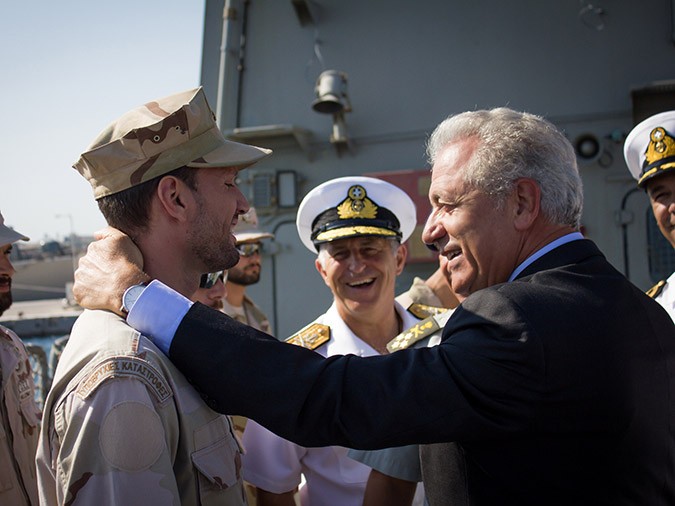
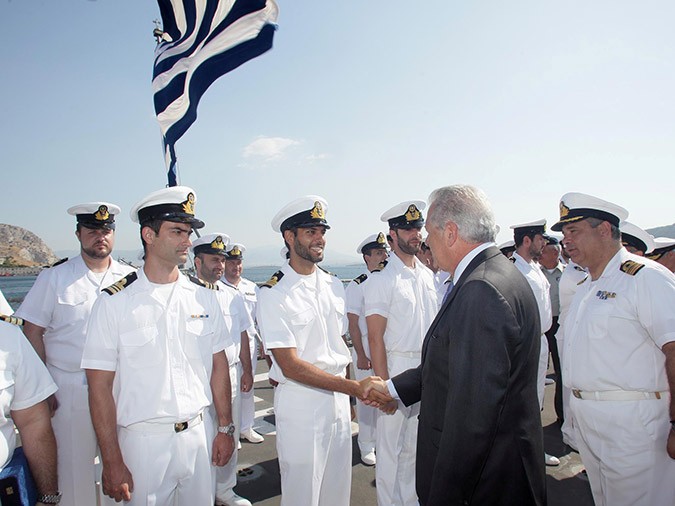
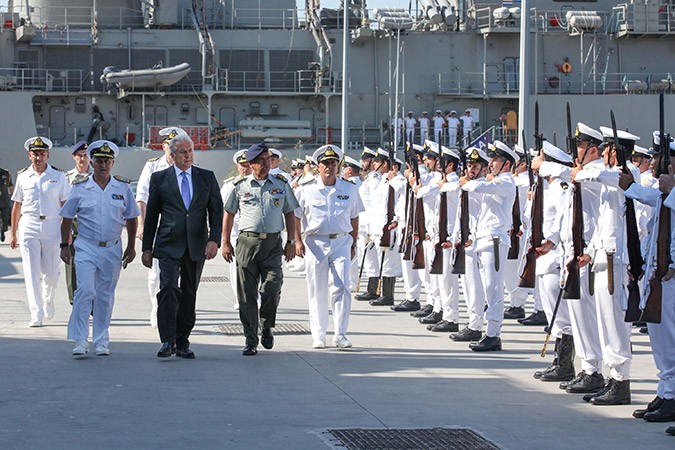
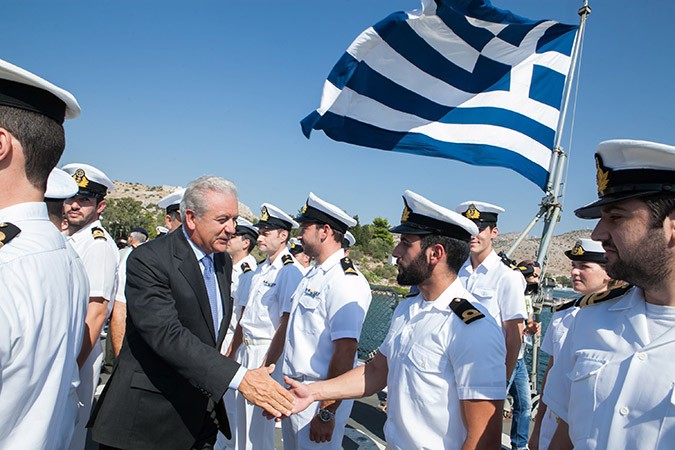
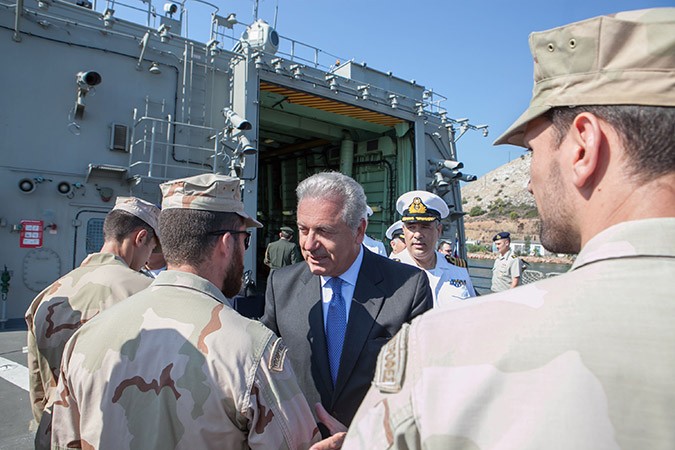
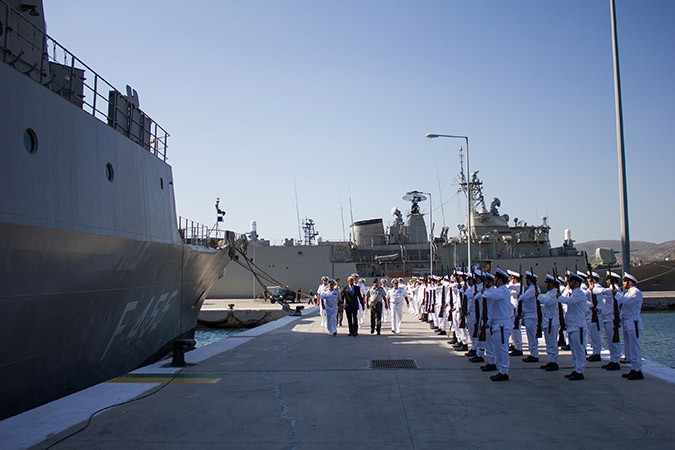
Defence Minister Avramopoulos on board the “Salamis” frigate

Mr. Avramopoulos praised the professionalism and combat effectiveness of the Armed Forces staff who worked on the Libyan Mission
National Defence Minister Dimitris Avramopoulos went aboard the Salamis frigate yesterday in order to thank and congratulate on behalf of the Greek state the crew for the successful evacuation of Greek and foreign nationals from Tripoli, Libya.
In his address, Mr. Avramopoulos praised the high professionalism and combat effectiveness of the staff of the Armed Forces and thanked the families of the frigate crew for “boosting the moral” of the men.
Mr. Avramopoulos underlined that the national defense system “is always ready to respond to anything that contributes to the stability, peace and security in this region during this period of instability and uncertainty.”
The Defence Minister was accompanied by the Chief of Defence, General Mikhail Kostarakos and Chief of Hellenic Navy Vice Admiral Evangelos Apostolakis.

avram8
avram7

av5
av4
av3
av2
The government reacts for Bank of Albania theft: A serious crime
06/08/2014


The government reacts for Bank of Albania theft: A serious crime
Two weeks after the huge unprecedented theft at the Bank of Albania, the government reacted by calling it a serious crime and a big challenge for justice.

Through an announcement for the media, the Council of Ministers says that the Prosecution should make a quick and comprehensive investigation for punishing anyone involved in this shocking crime.

This act is also a huge challenge for the authority and safety of the Bank of Albania, the announcement says, which should review all rules and mechanisms so that these things will not happen again in the future.

The government’s declaration didn’t mention Governor Fullani, who has been in the center of the media attention for the past days, and not even the Supervisory Council. According to the government, this is a big challenge for other institutions, the Parliament and the Government, for analyzing and come up with constructive conclusions for their cooperation with international financial institution, for the legal measures that are needed for guaranteeing a solid and transparent inspection system for the activity of this key institution.

This paragraph leaves to be understood that the government is not happy with the transparency of the Bank of Albania, that’s why they ask the Parliament Speaker, Ilir Meta, for a legal intervention.

The government underlines that they are following the progress of the investigation very closely, and they are determined to play their role fully for any initiative that might be needed for a functional security system for the Bank of Albania.

“Banking activity is not damaged”
Banks Association guarantees: Our activity is not affected by the theft

The Albanian Banking Association declares that what happened at the Bank of Albania will not affect their activity.

Through an official press release, the association guarantees the public and bank clients that the activity continues normally.
Criminal Prosecution for the maritime border agreement
 
Top channel TV


Criminal Prosecution for the maritime border agreement
“The Prosecutor General has all the respective documentation and the Constitutional Court verdict on his hand, together with the international practice, which has been violated by the Court”, declared Ditmir Bushat one day ago.

“The Tirana Prosecution has strong suspicions that the interests of Albania have been violated through the maritime border agreement. For this reason, a criminal lawsuit has been filed, some days after the Prosecution filed a voluminous material for the most debated case of 2009. The Prosecutors verified this case for some time, until they were convinced that the material of the Foreign Ministry has enough data to make them suspect that the criminal code has been violated”.

11 experts involved in the maritime border agreement of 2009 are expected to testify at the Tirana Prosecution.

“We have verified the documentation, the most important of which is the verdict of the Constitutional Court, which cancelled in January 26th, 2010, the implementation of this agreement by considering it anti-constitutional and against the national interests”, the Prosecutors say.

Among the experts that will be called for questionings are specialists who served as negotiators. The main negotiator of the Albanian side, Ferit Hoxha; Rear Admiral, Kristaq Gerveni, then Deputy Chief of the General Staff of the Armed Forces; the former General Secretary of the Foreign Ministry, Gazmend Turdiu; Director of legal and international cases, Ilir Tepelena; the Director of Tractates, Ledia Hysi, and photogrametry specialists like Ferdinand Bebreri and Anduel Cauli, from the Digital Map Sector.

The Prosecutors have not confirmed if the former Foreign Minister, Lulzim Basha, will be called for testifying as the man who signed the agreement with the Greek counterpart, Dora Bakojanis. According to the sources, it is still early to confirm this without the interrogation of the 11 experts.

The consumption of the criminal act foresees that the agreements made with foreign countries to hand over the territory are punished with five to ten years in prison.
Tom Hanks, Rita Wilson: My Big Fat Greek Vacation!

Tom Hanks_Rita Wilson1

by Nikoleta Kalmouki - Aug 5, 2014

Tom Hanks_Rita Wilson1

Rita Wilson, wife of famous Hollywood star Tom Hanks and an actress herself is proud of her Greek roots. So it was no surprise that Tom and Rita were seen enjoying the sun and the beautiful beaches during their vacation in Greece.

The couple, married for 26 years, was seen on Antiparos in the Cyclades, where they showed off their sporting skills with high-energy activities. Instead of letting the hours drift by sun bathing on the beach, the screen stars were seen enjoying some stand-up paddling.
Tom-Hanks_Rita-Wilson

Tom Hanks, who won an Oscar for the 1994 film “Forrest Gump,” displayed his athletic body in a pair of black surfing shorts, while Rita Wilson wearing a striped form-fitting top and white shorts was accompanying her husband.

The couple’s visit to Greece comes after Tom’s July trip to Egypt to shoot a part of his upcoming movie “A Hologram For The King.”

Rita was born Margarita Ibrahimoff to a Greek mother and Bulgarian father in Los Angeles. She was raised Greek Orthodox. Rita Wilson was responsible for getting Nia Vardalos‘ “My Big Fat Greek Wedding” to the big screen.

“Tom and Rita insisted on it to being Greek all the way,” Nia told Filmcritic.com of their input.

Rita and Tom also served as executive producers on “Mamma Mia,” the ABBA-based musical starring Meryl Streep, which was shot on the islands of Skopelos and Skiathos in Greece.
- See more at: http://greece.greekreporter.com/2014/08/05/tom-hanks-rita-wilson-my-big-fat-greek-vacation/#sthash.Mp9BrT0D.dpuf

Monday, August 4, 2014

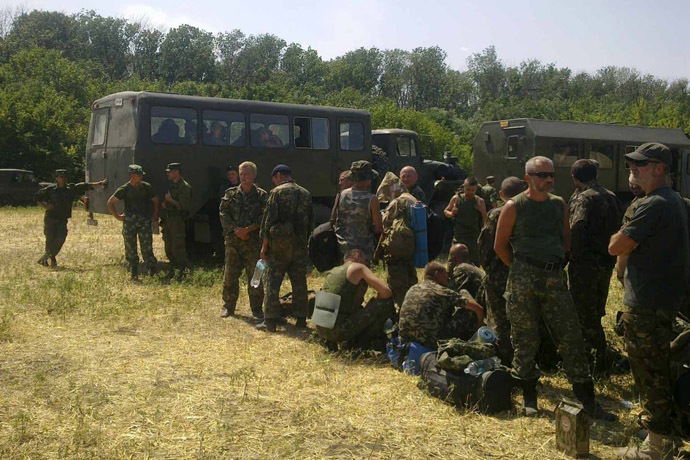
Over 400 Ukrainian troops cross into Russia for refuge

Published time: August 04, 2014 06:23
RIA Novosti/Yulia Nasulina

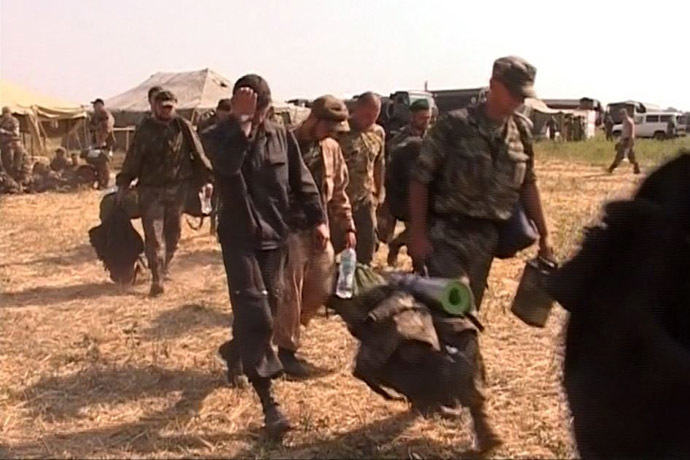
More than 400 Ukrainian troops have been allowed to cross into Russia after requesting sanctuary. It’s the largest, but not the first, case of desertion into Russia by Ukrainian soldiers involved in Kiev’s military crackdown in the east of the country.
According to the Rostov Region’s border guard spokesman Vasily Malaev, a total of 438 soldiers, including 164 Ukrainian border guards, have been allowed into Russia on Sunday night.
One of the Ukrainians was seriously injured on his arrival in Russia. He was taken to the hospital for surgery, the officials added.
The other Ukrainian soldiers have been housed in a tent camp deployed near the checkpoint via which they entered Russian territory. The Russian border guards are providing them with food and bedding.
Footage taken by the Russian media at the scene showed the Ukrainian soldiers being handed ration packs and resting in their temporary shelter. Those who agreed to speak on camera said they were relieved to be in safety for the first time in weeks.
“We were given an order to leave out positions and go to Russia trough a corridor. We were told it would be safe. Of course they, I would say, made us go fast from behind,” one of the soldiers, a BMP driver who would not reveal his name or even show his face on camera, said.
“It was so bad back there. Hot, and so many deaths and bad things,” another one, Dmitry, said. “Folks can rest here. They gave us a chance to wash, gave us new clothes. We are thankful.”
“We have been in those fields for more than six months and are very tired,” he added.
Another one, Yaroslav, said he wishes to go back to his family in Ukraine.
“I want to do something peaceful. My contract expired four months ago,” he explained.

RIA Novosti/Yulia Nasulina
The Ukrainian Security Council said it is keeping in touch with the soldiers “through diplomatic channels,” but it did not give an exact number of how many troops had crossed the border.
“A Foreign Ministry representative is working with them, and negotiations over their return are now ongoing,” Ukraine Security Council representative Andrey Lysenko said.
On Sunday, the Ukrainian anti-government militia reported that it was in negotiations with a large contingent of Ukrainian troops they encircled in Lugansk region on a possible surrender. The negotiations were being hampered by the troops’ intention to destroy some 70 armored vehicles in their possession before laying down arms, which the militia wanted to capture intact.
The Gukovo border checkpoint, through which the Ukrainian troops crossed into the Russian territory, is located on Russia’s border with the Lugansk Region of Ukraine, indicating that these are the same troops that were negotiating with the militia. If so, it was not immediately clear whether the vehicles they had were really destroyed.
OSCE monitors and journos come under shelling from Ukraine at Russian border
The flow of deserters from the ranks of Ukrainian Army and National Guard seems to be increasing amid the escalating violence in Donets and Lugansk Regions, where Kiev is fighting against armed anti-government militias.
In late July 41 Ukrainian troops fled to Russia to escape fighting in eastern Ukraine. They are now being prosecuted in Ukraine for deserting in the heat of battle.

RIA Novosti
RIA Novosti
Several Ukrainian units have been reported to recently to be cut off from supply lines after attempted offensive operations, which brought them behind the militia-controlled territories and close to the Russian border.
The Ukrainian troops, while far superior to the militia in terms of heavy weapons, suffer from poor logistics. Many soldiers complain about lacking even basic supplies like food and water on the frontline. The situation is aggravated by cases of apparent negligence from the command, with units being supplied with faulty equipment, coming under friendly fire and simply left behind while retreating from militia counter-attacks.

A YouTube video allegedly shows a Ukrainian soldier explaining how he has to catch and cook snakes because his unit receives no rations.
Kiev’s National Guard unit mutiny: ‘We’ve been discarded like trash’
This causes serious morale problems in the army, with more critical voices saying the Ukraine de facto has no infantry troops and has no other way to fight but by leveling militia-held cities to the ground with artillery and air strikes.
There is a growing resistance to the military campaign among Ukrainian population, with several cases of mass protests against the latest mobilization drive, as mothers and wives of conscripts took to the streets to demand that their loved once not be drafted into the army.
Protesters in Tirana Demand Dismissal of Bank of Albania Governor

Bulgaria: Protesters in Tirana Demand Dismissal of Bank of Albania Governor 
World | August 4, 2014

Bulgaria: Protesters in Tirana Demand Dismissal of Bank of Albania Governor Protesters show banners reading `Resignation` during a protest to ask for resignation of Ardian Fullani, Governor of Bank of Albania, in front of the national bank`s headquarters in Tirana, Albania, 04 August 2014. Photo by EPA/BGNES

Several hundred citizens, including journalists, organized a protest Monday in front of the headquarters of Albania's central bank in downtown Tirana.

Protesters demanded the instant dismissal of Ardian Fullani, governor of the bank, due to the theft of around EUR 5 M from a storage facility of the bank.

The participants in the protest called on the ruling coalition and the opposition to immediately remove Fullani, according to reports of the BGNES news agency.

They insisted that he should have resigned, while the prosecuting authority should have already pressed charges and convicted him, sending him in jail for playing games with the money of Albanians.

Several arrests have already been made in connection with the unprecedented theft.


- See more at: http://www.novinite.com/articles/162491/Protesters+in+Tirana+Demand+Dismissal+of+Bank+of+Albania+Governor#sthash.LQo9KfeI.dpuf

More than 400 Ukrainian soldiers "flee to to Russia"

MOSCOW -- Ukrainian authorities' orders to troops to fight their own people are "impossible," Russian Foreign Minister Sergei Lavrov has told Itar-Tass on Monday.
(Beta/AP, file)
(Beta/AP, file)
His comments came as 438 Ukrainian military personnel reportedly fled across the border into Russia overnight.
“We have repeatedly helped Ukrainian law enforcers asking for help, asking us to receive their wounded friends. We have helped, offering medical assistance and given the possibility of return to all those who wanted it without impeding them, without keeping anyone forcibly,” Lavrov said, and added:

“To tell the truth, those who had wished to return to Ukraine were then accused of deserting and were court-martialed."

The news agency also quoted Lavrov as saying that he "expected the Ukrainian authorities to show humanity in the long run and will realise the absolute inadmissibility of the situation when Ukrainians are waging war against each other, when they are made to fight against their own people while those who refuse are seen as traitors to their own country."

Previously, head of the Rostov region customs service Vasily Malayev told reporters that more than 400 Ukrainian military personnel had crossed the border and sought asylum in Russia.

The border service decided to open "a humanitarian corridor" for asylum seekers, Malayev explained.

The 1914 in the wars of 2014

100 years on, the jigsaw pieces of old empires are being reassembled in new puzzles.
Ukrainian government artillery guns in a field near the village of Debaltseve, Donetsk region, on July 31 (Beta/AP)
There is war in Europe. No, I'm not using the historic present tense to evoke August 1914. I'm talking about August 2014. What is happening in eastern Ukraine is war – 'ambiguous war' as a British parliamentary committee calls it, rather than outright, declared war between two sovereign states, but still war. And war rages around the edges of Europe, in Syria, Iraq and Gaza.

I do not say 'Europe is at war'. I leave the hyperbole to Bernard Henri-Levy. Most European countries are not directly engaged in armed conflict. Still, we should be under no illusions. For decades, we have lived with the comforting notion that 'Europe has been at peace since 1945'. This was always an overstatement. In parts of eastern Europe, low-level armed conflict continued into the early 1950s, followed by the Soviet invasion of Hungary in 1956 and of Czechoslovakia in 1968. In the 1990s, former Yugoslavia was torn apart in a series of wars - as a recent report by the EU's Special Investigative Task Force, credibly charging Kosovo Liberation Army leaders with 'war crimes', has just reminded us.

Kosovo was where I first saw the corpses sticking out of makeshift body bags and the blood in the snow. While that blood was still fresh, I talked to one KLA commander, Ramush Haradinaj, who memorably observed: 'me, I couldn't be no Mother Teresa'. (He subsequently became prime minister of Kosovo, resigned when indicted for war crimes in The Hague, but was twice acquitted.) Then I would fly back to Western Europe, to find people arguing over which acronym had 'kept the peace' in Europe. Was it the EU, NATO, or perhaps the OECD (i.e. economic interdependence), the OSCE (i.e. pan-European security structures), or even the UN? The premiss was false then, and is even more so now. There is war in Europe, and around its ragged edge.

For all the differences, the dirty little wars of 2014 have an important connection to the horrendous 'great' one that began in 1914. Many of them involve struggles of definition and control over patchwork territories left behind by the multi-ethnic empires that clashed 100 years ago, and their successor states. Thus, for example, the battle for eastern Ukraine is about the boundaries of the Russian empire. Some of the Russians, from Russia itself, who are now leading the armed pro-Russian movement in eastern Ukraine, have characterised themselves as 'imperial nationalists'. (From their point of view, they are not 'separatists' but unionists.) In a fine piece of satire in the New York Review of Books, Vladimir Sorokin describes Putin's Russia as being pregnant with Ukraine. 'The infant's name,' he writes, 'will be beautiful: Farewell to Empire'.

During the Balkan wars of the 1990s, jigsaw pieces from the Austro-Hungarian and Ottoman empires were fought over, and then reassembled into new, smaller puzzles, such as Bosnia, Kosovo and Macedonia. Many of the frontiers on today's map of the Middle East go back to the post-First World War settlement, when Western colonial powers spliced together disparate parts of the former Ottoman Empire into new protectorates – Iraq, Syria, Palestine. The big exception is of course the state of Israel; but that, too, can trace a lineage back to the deadly after-life of European empires. For Nazi Germany, which attempted to exterminate the Jews, was the last hideous fling of German racial and territorial imperialism.

So what is Europe going to do now about its own long-term consequences? The first thing we must do is simply to wake up to the fact that we live in a dangerous neighbourhood. Being Greater Switzerland is neither a moral nor a practical option: not moral, because Europeans, of all people, should never be silent while war crimes are being committed; not practical, because we cannot insulate ourselves from the effects. Today's fighters in Syria will be tomorrow's terrorists in Europe. Today's dispossessed are tomorrow's illegal immigrants. Let these little wars burn, and you will be shot down out of the sky on your way from the Netherlands to Malaysia on flight MH 17. No one is safe.

Whereas in the past the irresistible wake-up call was the annexation of a territory, most West Europeans slept through Putin's Anschluss of Crimea. As Stephen Holmes and Ivan Krastev point out in Foreign Affairs, the shooting down of the Malaysian airliner on July 17 was a turning point, not least because commercial air corridors are the place where businesspeople live. Without that transformative event, it is unlikely that chancellor Angela Merkel could have persuaded German public opinion, and German business, of the need for tougher sanctions on Putin's Russia.

But what use is the EU's slow, soft economic power against the Kremlin's rapid, hard power? Or, indeed, against all the rapid hard powers of the Middle East? What use is butter against guns? The answer is: more than you might think. Europe alone cannot stop war in the Middle East. Only working with the United States, and with some more cooperation from – of all places – Russia, can it bring peace to Syria or Gaza. It does, however, have the power to punish Russia for having its artillery shell the regular Ukrainian army, from Russian soil, while that army tries to reconquer its own territory - and to persuade and enable the legitimate Ukrainian authorities to make the most generous internal settlement possible, as soon as control over its sovereign territory has been restored.

Even the minor sanctions that Europe has thus far implemented have been gnawing away at the edges of the Putin regime. The larger sanctions Europe agreed this week will, with time, have a larger impact. Liberal democracies are usually more slow to act than dictatorships, and a voluntary community of 28 such democracies is bound to be slower still. Economic measures take more time to bite than military ones, but they can be more effective in the end.

100 years ago we had 'the guns of August', in Barbara Tuchman's resonant phrase. Now we have the butter of August. Note the different role played by Germany, then and now. Slowly, step-by-step, the Berlin government is doing the right thing. Germany is bringing the unique weight of its economic relationship with Russia to bear, while quite reasonably insisting that the pain is shared with France, Britain and Italy. Some things do change. Some even get better.

Timothy Garton Ash is Professor of European Studies at Oxford University, where he currently leads the freespeechdebate.com project, and a Senior Fellow at the Hoover Institution, Stanford University. His latest book is Facts are Subversive: Political Writing from a Decade Without a Name.

Sunday, August 3, 2014

An Albanian escape from Libya from Greek special forces

 Greek Frigate Returns After Libya Evacuation


A Greek navy frigate carrying embassy staff and nearly 200 people from Greece, China and other countries evacuated from the conflict in Libya returned early Saturday to a port near Athens.
Passengers on the frigate Salamis described a deteriorating security situation in the Libyan capital Tripoli, with frequent power and water cuts.
The Greek Defense Ministry the ship transported 77 people from Greece, 78 from China, 10 from Britain, seven from Belgium, one each from Russia and Albania.
The Greek evacuation followed similar action by a number of European countries, as fighting between rival militias in recent weeks.
Poland's Foreign Ministry said Friday that it has evacuated two dozen Poles and citizens of two other countries. All of Poland's diplomats have now left the country. Britain says it will suspend work at its consulate in Tripoli once it has completed assisting the departure of British nationals.
"We were hearing explosions all the time, but the fighting was on the outskirts of Tripoli," said Mustafa Avocat, a Greek-Libyan accountant, who was holding his crying infant son, moments after stepping off the Greek frigate.
"Things are getting worse. The power is cut 5-7 hours every day. There are water cuts too ... and the shops are closed."
Constantine Koutras, a spokesman for the Greek Foreign Ministry, said moving embassy staff to the port was the most difficult part of the operation.
"I was on the phone to our charge d'affaires at the embassy to get an update and I could hear the sound of gunfire in the background," he told state TV.
"So in places like this and in these kinds of situations there is a very small difference between things going well and going very, very badly," he added.
In Manila, about 20 Filipinos arrived Saturday after escaping from Libya through Tunisia.
"At the border in Tunisia, it was like we had one foot already in the grave," Abraham Brios, a cook for a Libyan family who returned with his wife, told reporters at the Manila international airport.
"There was shooting in front of us, so we just prayed. ... Now that we are here, we now feel reassured."
Philippine Department of Foreign Affairs spokesman Charles Jose said that more than 800 of about 13,000 Filipinos in Libya had returned to their homeland.

Saturday, August 2, 2014

Russia joined WW1 because it had to protect Serbia - Putin

MOSCOW -- The tragedy of the Great War is a reminder of the consequences of aggression, egotism, and excessive ambition taking precedence over common sense.
(Beta)
(Beta)
This is what Vladimir Putin said in Moscow on Friday during a ceremony to honor the First World War Heroes.
"Instead of guarding the safest continent in the world, Europe, they put it in danger,," the Russian leader said, Itar-Tass reported.

"We should not forget that today. We should learn to see at least one step ahead," he said, adding that "violence begets violence," while "a path to peace and prosperity rests on goodwill and dialogue, and memory and lessons of past wars. And about who and why started them."

"On the even of the First World War Russia did everything to resolve the conflict between Serbia and Austria-Hungary peacefully, without bloodshed. But Russia was not listened to. As a result Russia had to answer the challenge to defend the brotherly Slavic people," Putin said.

Friday, August 1, 2014

Antonis Remos Sang With Julio Iglesias in Mykonos
Julio-Iglesias_Antonis-Remos  

by Ioanna Zikakou - Jul 31, 2014


Julio-Iglesias_Antonis-RemosA glamorous evening filled with music took place Wednesday night in Mykonos. Greek singer Antonis Remos sang with world-famous Julio Iglesias in a special event attended by many Greek celebrities in the most cosmopolitan island in Greece.

The beach of Psarou – that was transformed to a concert venue — was filled with people, with big names from the world of Greek show business attending. Among them were singers Pantelis Pantelidis and Irini Papadopoulou, businessman Kostas Piladakis, Marilena Panagiotopoulou, Gogo Farmaki and Annita Nathanail.

The 71-year-old Spanish singer appeared on stage first and he was warmly welcomed by the enthusiastic audience. He then sang a duet with Antonis Remos, who continued the concert and took the crowd with him on a fun musical journey.

Antonis Remos welcomed all the concert attendees in Nammos beach club and told Julio Iglesias that “this is how we have fun in Mykonos.”

Furthermore, when champagne was brought to the stage, Remos jokingly said “Not this again. I’ve been giving interviews about this for two weeks now. Take them away and treat everyone who is back there serving.”

At the end of the night, the sky of Mykonos, Greece was illuminated by scores of fireworks.
 

- See more at: http://greece.greekreporter.com/2014/07/31/antonis-remos-sang-with-julio-inglesias-in-mykonos/#sthash.5W7VJ3DY.dpuf

Trip Tips: Porto Palermo, unveiled from a communist Albania


August 1, 2014

The castle of Ali Pasha Tepelena, some 235km south of the Albanian capital Tirana, which together with the Bay of Porto Palermo and its deep blue waters makes up one of Albania’s top tourist attractions. — Reuters/Arben Celi pic
The castle of Ali Pasha Tepelena, some 235km south of the Albanian capital Tirana, which together with the Bay of Porto Palermo and its deep blue waters makes up one of Albania’s top tourist attractions. — Reuters/Arben Celi picThe castle of Ali Pasha Tepelena, some 235km south of the Albanian capital Tirana, which together with the Bay of Porto Palermo and its deep blue waters makes up one of Albania’s top tourist attractions. — Reuters/Arben Celi picBAY OF PORTO PALERMO, Albania, Aug 1 — In 1984, when Albania was an isolated communist state in the same mould as today’s North Korea, a Mercedes in a convoy carrying a visiting German official overheated on Mt Llogara, overlooking a bay on Albania’s rugged Ionian coastline.

Emerging from his car, Franz Josef Strauss, then minister-president of Bavaria and one of the rare Western officials to set foot inside Enver Hoxha’s Albania, was struck by what he saw.

“Virgin California,” he remarked.

Three decades later, Albania’s Bay of Porto Palermo, its castle and its deep blue waters are one of the country’s top tourist attractions, featured on European newspaper and Internet lists of places to visit for those with a taste for adventure.

Once host to military vessels and submarines, Porto Palermo was closed to the public under Hoxha. It opened a couple of years after communism ended in 1991 and Albania began its white-knuckle ride to capitalism.

Nowadays, the bay takes its appeal from its seclusion, situated just below a two-lane coastal road and as inviting to foreigners as it was once forbidden. German, Czech and Hungarian tourists lose no time in stripping off and bathing naked.

“No one bothers them; no one’s around,” said the bay’s caretaker, Klearko Koci. The area is rich in history, myth and legend, part of a coastline blighted in parts by high-rises but still unspoilt in others.

Just down the road, a tiny isthmus reaches out to a round rocky island, between two capes embracing the blue waters on both sides. On the island sits a castle believed by some to have been built by the Ottoman Albanian ruler Ali Pasha in the early 19th century, surrounded by trees and bushes of vibrant colours, contrasting with the deep blue.

The best view is from the balcony where Ali’s young bride used to comb her hair, Koci says.

Legend

“Seamen! Sail your ships inside the bay where there is no wind. I was built by the Himara women to be kind to friends and fierce to enemies. I belong to the Lord of sea and land, Ali Pasha,” declared a plaque that once stood on its gate.

Informed by local legend and song, Koci says Pasha built the castle on the ruins of the Monastery of St Nicholas. Foreign scholars, however, say the structure was originally a Venetian fort used to protect trade routes.

Whether the Lion of Saint Mark really featured on the lost plaque will never be known unless it shows up one day. It was stolen in 1997, when Albania plunged into anarchy with the collapse of pyramid investment schemes and the country became known as a Balkan Wild West. It’s now a member of NATO and a candidate to join the European Union.

Ceramic amphorae, used to carry oil and wine and found at the bottom of the bay, show ships plying the route from Corfu to Italy would stop at Porto Palermo, local diver Xhemal Mato said.

The bay that takes its appeal from its seclusion, where German, Czech and Hungarian tourists lose no time in stripping off and bathing naked. — Reuters/Arben Celi pic
The bay that takes its appeal from its seclusion, where German, Czech and Hungarian tourists lose no time in stripping off and bathing naked. — Reuters/Arben Celi picThe bay that takes its appeal from its seclusion, where German, Czech and Hungarian tourists lose no time in stripping off and bathing naked. — Reuters/Arben Celi picOn the shallower side of the island, the seabed bears the marks of fishing with explosives and mining of rock for mussels.

Built of stone, the castle lets in light through small windows. Once past the main gate, visitors find their way to the top or the balcony through arcades from a main hall. Directions in Italian are a sign of its occupation during World War Two.

The well is still unexplored, the caretaker laments.

English tourist Danny Foster, visiting with his family, wondered who fought whom and why, in such a tranquil spot. “It’s travel back in time,” he said. “I never expected such beautiful views. Too much to take in.”

In 1803, Ali Pasha offered the castle and port to the British Royal Navy. A British scholar wrote that it had up to five cannons at the time, which meant that Pasha “did not see the fort as important for him”.

On a narrow strip of land connecting the castle to the mainland, old, squat army barracks still bear the red-paint slogans of the communist era — “Long live the Albanian-Chinese friendship” and “Long Live the Communist Party of China and Comrade Mao Zedong”.

Grand plans

Oak trees dot the top of a mountain rising steeply behind the bay. Agave trees were imported from China and presumably planted to discourage a landing from the air with their thick pointed ends. Hoxha was notoriously nervous about the possibility of a foreign invasion.

Unfortunately, Porto Palermo has yet to get the care it deserves to highlight its treasures beyond the passionate tales of a caretaker enchanted by his stones, trees and flowers.

Zamir Dedej, head of an Albanian NGO, works with the World Wildlife Fund to protect the area, so it offers a sustainable future in tourism. They see a second fish-growing operation in the bay as an abomination since their secretions pollute it.

Auron Tare, the head of a newly created coastline agency, said the castle and a kilometre-long underground tunnel built in communist times would provide the main attractions.

“The Albanian government has plans to open up the bay of Porto Palermo to tourism, specifically boat, yachts, pleasure yachts, cruise liners who come around here but do not stop here,” Tare told Reuters.

The government has mobilised the army and volunteers to clean up rubbish from roads and the beaches. At one southern beach this week, a group of British tourists cleaned the beach as locals sat in beach recliners.

At Porto Palermo, Dutch vacationer Agnes Kuijl said her family had come travelling on their mobile home via Greece and had found both countries a great experience.

Other foreigners with vehicle-drawn homes had camped out on the isthmus at Porto Palermo. Kuijl’s family were bathing.

Such vacationers fit well with the new motto Albania is using to promote itself to the world: Go your own way. “And in Albania it’s cheap,” Kuijl said. — Reuters
- See more at: http://www.themalaymailonline.com/travel/article/trip-tips-porto-palermo-unveiled-from-a-communist-albania#sthash.XUrUlo3Y.dpuf
Albania: Edi Rama Acknowledges Greeks of Himara

by Ioanna Zikakou - Aug 1, 2014

Himara 
Himara. Edi Rama became the first prime minister in the history of Albania to recognize and acknowledge the Greek community of Himara. Until recently, Albanian prime minister believed that the city’s population was considered bilingual.
 

During his speech at the latest meeting of the Albanian Parliament, he mentioned that a Greek minority lives in Himara.

After the confrontation between the prime minister and the president of political party Unity for Human Rights Party (KEAD), Vangjel Dule, the parliament approved a reform that divides the country in 61 administrative regions.

Vangjel Dule, who is also deputy president of the Albanian Parliament, voted against the new territorial reform, while Greek-Albanian Vangjel Tavo abstained and another Greek-Albanian MP Andrea Martos of the Socialist party voted in favor of the new territorial division.


 The Greek community has rejected the new reform, because Himara will be incorporated in a Muslim region with different economic interests, and diverse cultural and ethnic backgrounds.

- See more at: http://eu.greekreporter.com/2014/08/01/albania-edi-rama-acknowledges-greeks-of-himara/#sthash.GGncyzUc.dpuf
The Albanian demographic crime against Greece

by Konstantinos Cholevas

ewspaper "Democracy"
(29-7-2014)


"It is time to understand that the "Greek-Albanian friendship" is a joke as the "Greek-Turkish friendship." But in this case we must act instantaneously. On July 31-barring unforeseen-will be discussed and voted on in the Albanian Parliament Act and the administrative restructuring of the country and the creation of new municipalities-monstrosities. If you do not give strict and clear message in Albania, we will be responsible for the continued shrinking the greeks of Northern Epirus. 

We must exert every pressure, especially now that Tirana has gotten a promise from as Candidate Country that will open accession negotiations with undetermined however horizon.

The Albanian government must understand that any financial assistance or other relationship with the European institutions will be evaluated based on its behavior towards Greece and the Greek ethnic community living in Northern Epirus and elsewhere in Albania.


more in greek see:  http://ellogosar.blogspot.gr/2014/08/blog-post.html

Thursday, July 31, 2014

Rama: "Himara is Albanian territory"

Rama: The fact that there is a Greek minority living there, is an indicator for its integration


31/07/2014


Rama: HImara is Albanian territory
Before the voting of the territorial reform, the Albanian Prime Minister, Edi Rama, addressed to the head of the UHRP, Vangjel Dule, and said that Himara is an Albanian territory and will be treated as any other area of our country.

“Himara is like Tropoja, Kavaja and any other area. The fact that there is a Greek minority living there, is an indicator for its integration. Himara has always been an Albanian region. The residents of Himara, Dhermi and Palasa speak Albanian”, Rama declared.

Dule reacted and said that the passing of this territorial reform damages the rights of the Greek minority in Himara.

“Those who make others be part of the institutional life of a country should be proud, not those who simply pass laws”, he said, addressing to the Prime Minister.

Rama denied that the rights of the Himara Greek minority are being violated:

“I have always valued your intelligence, but don’t offend mine. There is no effort to limit the rights and freedoms of the Greek minority in Himara. We have recognized the presence of that minority and we will always respect it”, Rama declared.

“The topic of Himara is sensible because it is related to a 23-year-old effort of some people who wanted to see Himara for what it is not. We will treat residents without distinctions for their ethnicity”, Rama declared.

After a debate with Mr.Dule, Rama spoke about the advantages of the territorial reform: “This reform involves even more the communities that have been excluded from the education system, and allows us to offer transportation services, by making it possible for every child to attend school. The same thing goes for health, social support and security”, Rama declared.

He referred to the results of a poll published yesterday by the Minister of the Local Government, which proved the support of most of Albanians in this effort.

“The Albanian people supports this reform. We saw from the independent poll that 70% support the territorial reform”, Rama declared.
Parliament approved territorial reform
Top Channel TV
31/07/2014


Parliament approved territorial reform
The Albanian Parliament has approved the draft-law for the territorial reform with 88 votes in favor, 1 against from Vangjel Dule, one abstaining from Vangjel Tavo.

"I insist in the respecting of the human rights and of minorities. Albania is an EU candidate, and the government must know that the respecting of the minorities are part of the negotiations. If the draft-law passes, it will be a burden for our country in the negotiations. I propose that the administrative unit of Himara should be together with Himara and Lukova. Vranisht and some other communes should join with Selenica. Trusting in your dedication to the law I hope in a positive vote for these amends", Dule declared.

The MPs have approved two variants offered by Dule, and rejected three others.

Rama-Dule Debate

Before the voting of the territorial reform, the Albanian Prime Minister, Edi Rama, addressed to the head of the UHRP, Vangjel Dule, and said that Himara is an Albanian territory and will be treated as any other area of our country.

“Himara is like Tropoja, Kavaja and any other area. The fact that there is a Greek minority living there, is an indicator for its integration. Himara has always been an Albanian region. The residents of Himara, Dhermi and Palasa speak Albanian”, Rama declared.

Dule reacted and said that the passing of this territorial reform damages the rights of the Greek minority in Himara.

“Those who make others be part of the institutional life of a country should be proud, not those who simply pass laws”, he said, addressing to the Prime Minister.

Rama denied that the rights of the Himara Greek minority are being violated:

“I have always valued your intelligence, but don’t offend mine. There is no effort to limit the rights and freedoms of the Greek minority in Himara. We have recognized the presence of that minority and we will always respect it”, Rama declared.

“The topic of Himara is sensible because it is related to a 23-year-old effort of some people who wanted to see Himara for what it is not. We will treat residents without distinctions for their ethnicity”, Rama declared.

After a debate with Mr.Dule, Rama spoke about the advantages of the territorial reform: “This reform involves even more the communities that have been excluded from the education system, and allows us to offer transportation services, by making it possible for every child to attend school. The same thing goes for health, social support and security”, Rama declared.

He referred to the results of a poll published yesterday by the Minister of the Local Government, which proved the support of most of Albanians in this effort.

“The Albanian people supports this reform. We saw from the independent poll that 70% support the territorial reform”, Rama declared.

Debate for Himara in numbers

Himara is one of the three local units that is being part of the new territorial reform, creating a municipality with the same name, part of which will be Lukova and the Hor Vranisht commune.

The unification of the Vlore River villages with Himara and Lukova has been opposed by the leader of the United for Human Rights Party, Vangjel Dule, claiming that Vranisht will be used as an electoral body with the purpose to withhold the local government of Himara.

This claim falls even if it is taken in consideration, based on the recent census. Himara has 2822 residents, while the Lukova commune, with which UHRP has no problem unifying, has 2916 residents, which it will change the electoral relations that the UHRP claims.

The Hor Vranisht commune is the smallest, with 2080 residents. The territorial reform commission has rejected the request of the UHRP that Himara is a Greek minority and as such it should be in a separate municipality.

Government sources declared for Top Channel that the territorial reform has simply returned the 400-year-old local borders of the Himara region.

Population of the new Himara municipality

Hor Vranisht   2.080
Lukove           2.916
Himare           2.822

Dodik wants Serbia to give passports to Serbs abroad

BELGRADE -- RS President Milorad Dodik believes it would be good to allow Serbs from abroad to be elected as deputies in the Serbian parliament in Belgrade.
(Tanjug, file)
(Tanjug, file)
Dodik, who heads the Serb Republic (RS) entity in Bosnia-Herzegovina, recently received a Serbian passport, and in an interview for the Belgrade-based daily Danas noted that he asked for a permanent "liberalization" of the process of granting Serbian passport - "because Serbs in the RS want Serbian citizenship."
He expressed gratitude to Serbian Prime Minister Aleksandar Vučić for making sure he became a citizen "under accelerated procedure" - but noted he though the procedure "should be even faster."

"I think every Serb should obtain Serbian citizenship, so we can show our commitment to the mother country that we consider our homeland," Dodik said, adding that he always felt bad when traveling with his Bosnian passport.

"When I go somewhere with the passport of Bosnia-Herzegovina, people always looking at me strangely. Once I went to the United States via the Netherlands where I was searched at the airport. When I told them I was traveling to a meeting at the State Department, I became even more suspicious. The flight was delayed 45 minutes," he said.

Noting that his Serbian citizenship gives him the opportunity to participate in Serbian elections, to vote and be elected, Dodik pointed out that he was "primarily a citizen of the RS" - but saw no reason why Serbia would not act like other countries, such as Croatia, that has a quota in its parliament for deputies from Croat communities living abroad.

"When there are elections in Croatia you can see billboards showing candidates in Banja Luka (RS). I know a Croat woman from Banja Luka who lives there, and was elected to the Croatian parliament. Not to mention the Hungarians. I do not see why Serbia would not launch changes of the electoral law, to enable quotas. Regardless of how many of us come out to vote, that quota could be four or five deputies for the RS, two or three for Montenegro, one of Macedonia and Western Europe each... that would be a good message from the Serbian leadership. Since there has been talk about amending the Constitution, this could also be considered," said Dodik.

The RS president does not believe that an investigation into the war crimes committed by ethnic Albanians against Serbs in Kosovo, led by Clint Williamson, will result in an indictment against Hashim Thaci - because, in his opinion, "there has not been enough engagement until now, and because of the passage of time."

Dodik pointed out that the only novelty in the Williamson statemennt presented on Monday was "recognition from such a high place that there is reasonable doubt that organ trafficking took place."

"Obviously, there is evidence that it did. Dick Marty also had the evidence, but he was prevented from conducting an investigation, Carla del Ponte also had it. Many Serbs are judged on the basis of collective responsibility. (Former RS President) Biljana Plavšić, who had nothing to do with crimes but held office, was sentenced. Now (in the case of the KLA) a huge amount of evidence is needed," he remarked.

Dodik believes that western countries will increasingly seek to soften the Serbian side, and then "at the most difficult moment demand recognition of Kosovo in exchange for full membership in the EU."

"They will not grant Serbia membership regardless of the reforms that it carries out. I think the actors in Serbia are clear on this being a requirement regardless of the fact that Kosovo is not recognized by the whole EU, and that the EU is violating its own principles. How would one explain the fact the EU is working on the Stabilization and Association Agreement with Kosovo, while five EU countries have not recognized Kosovo? The games of the big (countries) are clear. Sometimes I do not understand what their great interest is... Today I felt sick to my stomach when I read that (former German Chancellor) Schroeder said he regretted supporting the 1999 (NATO) bombing (of Serbia)," he said.

Dodik also believes that the EU is "heterogeneous" when it comes to Russia and possible pressures on Serbia with regard to the country's relations with Moscow.

"Russia has a right to defend its national interests. If the French were able to defend their interests in some far-off destinations, in Libya for example, why would Russia not defend its people, several tens of millions out there? In any event, they wish to set up a challenge for Serbia. I think its leadership is not having an easy time. The hypocrisy of some important ambassadors who seek recognition of Ukraine along with Crimea, while Kosovo is a striking example of a different policy, speaks about the hypocrisy of the great powers. I am convinced that Serbia will not introduce any sanctions against Russia and side with the west. The crisis in Ukraine will pass, while sanctions against of Serbia against Russia would not be forgotten. It would be a luxury for Serbia to impose sanctions against a friendly country like Russia," said Dodik.

When it comes to the conflict in the Gaza Strip, it is known that the RS has developed relations with Israel, and Dodik "does not hide that he was the first to say that Israel has a right to defend itself and resist terrorist attacks."

"I was the first to say that, later we could hear Obama, Merkel and other leaders use the same phrase... Of course, I sympathize and I am distressed by the scenes of suffering on both sides. I said that peace should be achieved as soon as possible. Israel is developing very friendly relations with us. The RS and Israel find themselves in similar environments. With the environment from Sarajevo, we have an almost identical problem, of course, no rockets and conflicts, that is in the past. A homogenization of the Muslim population is taking place. (Bakir) Izetbegović's statement that Muslims have to be strong to be appreciated is a message is for us, too. Israel is our ally and a friend who respects us," said Dodik.

Wednesday, July 30, 2014

Large anti traffic operation of the Greek army on the Greek - Albanian Border


Anti guerrilla operation Delta Force in Thesprotia with support of AH-64 Apache helicopters


Albanian movements involved in unrest in Skopje and from Kosovo who have been identified near the Greek - Albanian border, caused the sudden exercise of Delta Force "Pirpolitis 5/14" at Thesprotia regiment.

Specific considered "adjacent nationalist extremist groups" (usually so designated groups who had founded the "Liberation Army of Camouria" - UCC) and combined with the fact the recent arrest Albanians revealed the crypt significant number of aggressive AK-47 rifles and ammunition in Greek Albanian border.

The exercise aimed at rapid development and transfer members of the special Delta Force, who are involved in a battle with rebel groups, to support attack helicopters AH-64 Apache.

The group of special forces transferred by helicopter UH-1H, and Defence sources reported that "Were all the planned to development time."

Note that this is the first time in a proportional counter guerrilla operation Delta Force used attack helicopters.


Source: http://www.defencenet.gr