UK airstrikes against Islamic State extremists in
Syria could be illegal without the agreement of President Bashar Assad’s
government or a UN Security Council resolution, according to a House of
Commons Library assessment.
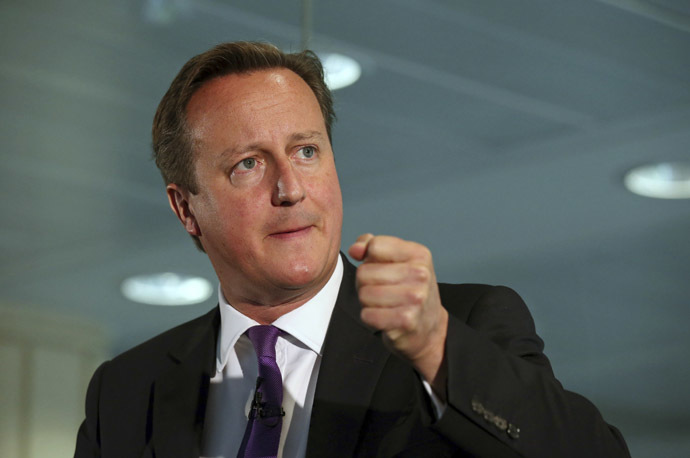
Prime Minister David Cameron will recall MPs to parliament to
outline his plans for deeper military intervention in Iraq and
Syria when he returns from the UN General Assembly in New York
next week.
The House of Commons Library paper, however, says air strikes in
Syria “will be difficult to justify legally” unless the
Syrian president requests assistance from Western powers, as
Iraqi President Fuad Masum has.
“Any action against ISIL (ISIS) in Iraq will be inadequate
without action against them in Syria and the rhetoric against the
Assads may be toned down,” the paper notes.
“Action in Syria will be difficult to justify legally without
a request for assistance from the Assad government, and it is
unlikely that the West could be seen to be responding to such a
request. “The British government has said that any action in Syria
will comply with international law, and the most likely way to
achieve this would be to claim that military action is for
humanitarian purposes, using the Responsibility to Protect
doctrine. This remains controversial, however, without a United
Nations Security Council resolution to authorize it.”
UK Foreign Secretary Philip Hammond was in Paris on Monday,
meeting leaders and foreign ministers from over 30 countries to
discuss plans to fight ISIS militants.
The summit focused on US plans to weaken the militant group by
offering military support for Iraq, together with plans to stop
foreign fighters joining the group, cutting its funding streams
and trying to counter its ideology.
Cameron says he has not “ruled anything out” and Britain
could still take part in US-led airstrikes.
A number of British MPs have voiced concerns about UK military
intervention in Syria, as they fear such action could be
construed as tacit support for the Assad government.
Former British defense chief, Lord Richards, however, recently
said the UK should work with Assad, Moscow and Iranian
authorities to defeat Islamic State.
His statement followed a previous call from Sir Malcolm Rifkind,
who urged the UK government to collaborate with Damascus to
defeat jihadist militants in Syria and Iraq.
The UK’s hardening line on military intervention follows the
execution of British aid worker David Haines, who had been held
hostage by Jihadists since his abduction last year.
The masked killer in the latest video, which appeared on the
Internet on Saturday, claims that Haines was killed because of
Cameron’s pledge to arm Kurdish forces to battle the jihadist
group.
The militants also threatened to kill a second British hostage,
Alan Henning.
Cameron said he has an “iron determination” to destroy
ISIS and pledged to “hunt down” Haines’s killers.
“David has been murdered in the most callous and brutal way
imaginable by an organization which is the embodiment of
evil,” Cameron said on Sunday. “We will hunt down those
responsible and bring them to justice no matter how long it
takes.”
‘Stick your license fee up your a***!’ Pro-indy Scots denounce ‘liar’ BBC journo in protest
Published time: September 15, 2014 13:14
Edited time: September 15, 2014 15:51
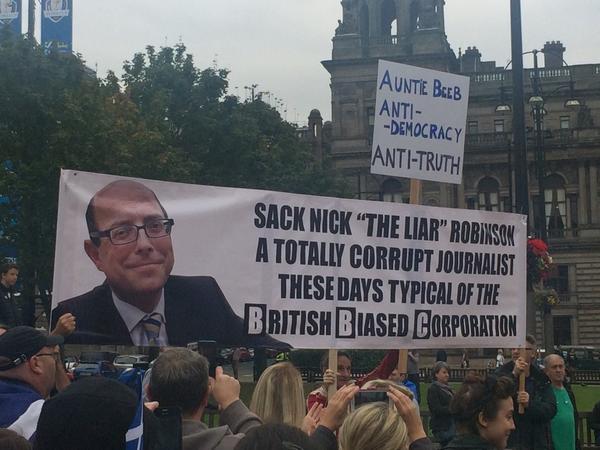
Pro-independence Scots rallied outside the BBC’s
Glasgow headquarters on Sunday to protest the public broadcaster’s
pro-union “bias” and demand the resignation of political editor Nick
Robinson.
Waving Scottish flags and “Yes Scotland” banners,
protesters chanted, “You can stick your license fee up your
a***!” while banners read “Auntie Beeb, anti-democracy,
anti-truth”.
One giant banner read: “Sack Nick ‘The Liar’ Robinson, a
totally corrupt journalist, these days typical of the British
Biased Corporation.”
Bank Governor released on house arrest, Inspector General remains in prison 15/09/2014
The Court of Appeal gave a “house arrest” security measure for the
former Governor of the Bank of Albania, Ardian Fullani. The former
Inspector General, Elivar Golemi, remained in prison. The Court also
issued an arrest measure for another employee.
Fullani declared in Court that his
work was led only by the law, dedication and passion. “I worked for
raising an institution based on the law, a model for central and
european banks. The theft was a low and isolated act. As soon that it
was identified, we cooperated with the Prosecution”, Fullani declared.
The
defensive lawyer of Fullani, Maks Haxhia, declared that his client has
not violated the law. “The law says that the Bank should function even
without the Deputy Governor”, Haxhia says. For the journalists he said
that he wasn’t happy with the Court decision, claiming that Fullani
should have been free.
The former Governor was discharged by the
Commission of Economy, a decision that will be voted in Parliament on
September 18th. Fullani’s arrest was seen as something positive by the
public opinion, who asked for his resignation. It was also seen as
positive due to the fact that during eight years of right wing rule,
despite the promises for “clean hands” and fight against corruption,
there have been no arrests for corruption higher than the level of a
Deputy Minister.
Fulani is being investigated for other
violations. Only a few days ago, the Supreme State Audit has filed
another case for abuses with public funds.
‘No extra security for Pope in Albania’
September 15 2014
Vatican City -
The Vatican says it's not taking any extra security measures to
protect Pope Francis during his upcoming trip to majority Muslim Albania
despite reports of Islamic militants returning from the Mideast.
Vatican spokesman the Reverend Federico Lombardi said on Monday that
Francis would use the same open-topped vehicle he uses in St Peter's
Square when he greets crowds in Tirana on Sunday.
Francis has said he wanted to visit Albania to highlight the rebirth
of Christianity that was wiped out during communist rule, and to
showcase how Catholics, Orthodox and Muslims are working together to
govern the country.
Lombardi said that while there is general concern about the Islamic
State threat, “there are no specific threats or risk that would change
the pope's behaviour or the way the trip is organised.” - Sapa-AP
Serbs in Bosnia "closely watching" Scottish referendum
Source: AFP, Tanjug
Bosnian Serbs are "closely watching Scotland's independence referendum," the French agency AFP is reporting on Monday.
According
to this, they are hoping that if Scots vote to break away from Britain
"it would set a precedent that could boost their own chances of
proclaiming a separate state."
President of the Serb entity,
Serb Republic (Republika Srpska, RS) Milorad Dodik "has not hesitated to
evoke the spectre of separation," in the wake of Crimea split from
Ukraine and joined Russia following a disputed referendum in March, said
the agency, and quoted him as saying:
"We are following what
is going on in Italy (South Tyrol), in Scotland and even in Catalonia.
These are crucial experiences for the RS."
But according to the
article, "In multi-ethnic Bosnia, with the bloody legacy of its
1992-1995 war during the breakup of the former Yugoslavia, observers say
talk of independence also raises the danger of a new armed conflict."
The article noted that Serbs boycotted Bosnia's 1991 referendum to
break away from Yugoslavia which was successful thanks to the votes of
Muslims and Croats, but that the independence came after a war that
broke out in 1992 "pitting Serbs against Muslims and Croats" and
claiming more than 100,000 lives.
The peace agreement reached
in Dayton, Ohio in 1995 created the Serb entity, and the Muslim-Croat
Federation (FBiH), both described as "highly autonomous and inked by a
loose central government in charge of foreign matters, finance and
defense."
To this day many Serbs have never really accepted the
new post-war Bosnian state, despite the level of autonomy they have in
the RS, said the French agency, and quoted Miloš Šolaja, professor of
international relations at the University of Banja Luka:
"If a
referendum was organized tomorrow, most of the Serbs would be in favor
of independence. The RS has gradually become a solid political entity
that most of its inhabitants, Serbs, identify with."
Šolaja was
also quoted as saying that he thought "secession was not realistic at
this moment" but that the RS is "de facto already a state given its huge
statehood attributes."
Ahead of the October 12 elections Dodik
made talk about independence "part of his campaign speeches," while the
main Muslim party, the SDA, said that "Bosnia will never be put into
question."
High Representative Valentin Inzko, however, was
quoted as saying that "the country's constitution allows no possibility
for either entity to secede":
Radio Free Europe analyst Dragan
Štavljanin told AFP that Dodik's statements "amount to electoral
rhetoric," but added there would be "a much stronger reaction if the
threat of independence became more concrete."
"I believe that
it could not happen without a new war in Bosnia," he said, and added
that "such a conflict would risk attracting Muslim extremists who, as
they did in the 1990s, would come to help fellow Muslims in Bosnia."
The agency also quoted Hajrudin Caluk, "a Muslim and Bosnian war
veteran," as saying that "Serb separatist politics paralyse the
functioning of the state," and an unnamed European diplomat in Sarajevo
who said the situations in Bosnia and Britain were "completely different
as the September 18 Scottish referendum was to be held with the consent
of the British government."
Scottish independence would be a
disaster for NATO, putting the UK nuclear deterrent in jeopardy. It
would also put into question national borders all over Europe, including
Catalonia, Belgium, France's Brittany and Corsica, Italy's South Tyrol
-- and Ukraine. Russian Foreign Minister Sergei Lavrov warned in 2008 that Kosovo's independence "would be the beginning of the end for Europe." Crimea's recent secession from Ukraine was justified with a reference
to "the Kosovo precedent," which Putin pointed out, "our Western
partners created with their own hands."
This Thursday, Scotland will be holding a referendum on independence.
Polls predict that it may go either way; a narrow victory for those who
want Scotland to become an independent nation or for those who want it
to remain a part of the United Kingdom. While in most European capitals,
governments are hoping that the 'No' side will win the day, Russian
president Vladimir Putin in the Kremlin has several reasons to cheer if
the Scots decide to go their own way. Scottish independence would be a disaster for NATO. The Scottish
nationalists have made it very clear that they want all British nuclear
weapons to be removed from Scottish soil. This will put the UK nuclear deterrent in jeopardy.
But Scottish independence is also likely to bring national borders into
question all over Europe, including the fragile boundaries of the
Ukraine.
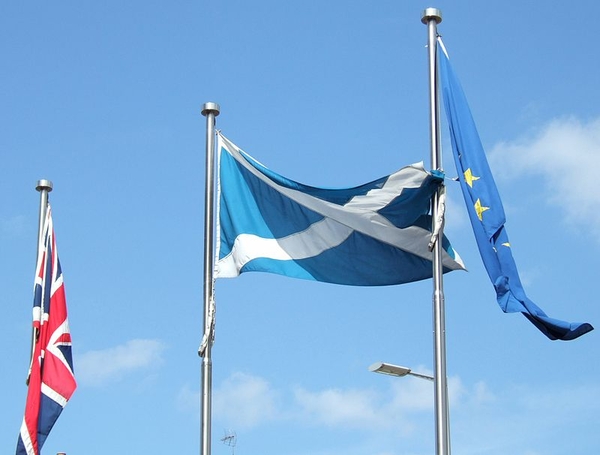
The
United Kingdom flag, flag of Scotland, and European Union flag flying
outside the Scottish Parliament in Edinburgh. (Image source: Wikimedia
Commons/Calum Hutchinson)
Last week, German Foreign Minister Frank-Walter Steinmeier broke with
Germany's postwar policy of not interfering in British domestic
politics. In an unprecedented statement, he made clear that Berlin hoped that the Scots would vote 'No' and Great Britain would remain together. Yet, as an interesting article in the London Daily Telegraph
pointed out last Thursday, Germany is one of the European countries
that will be least affected by the repercussions of a Scottish 'Yes'
vote. Next November, the Spanish region of Catalonia wants to hold its own referendum
on secession. The Catalan separatists will be greatly boosted by a
Scottish "Yes." If, on Thursday, Great Britain unravels, then Spain is
almost certain to follow. The next domino might be Belgium, where last
June a party of Flemish regionalists became by far the biggest party in
the country. Scottish and Catalonian independence will pressure Flanders
to follow. And that will probably not be the end of it. France has
separatist movements in Brittany and Corsica. Italy has a problem with
German-speaking South Tyrol, where the majority in the region feels more
affinity with Austria than Italy. There are Swedes in eastern Finland
and large Hungarian minorities in most of Hungary's neighboring
countries. And there are the Russians in the Ukraine. Vladimir Putin is a shrewd Machiavellian, who aims to reunite all
Russian ethnic minorities in former Soviet republics with the Russian
Motherland. While NATO has refused to recognize the separation of Crimea
from Ukraine, Scottish independence from Britain following a referendum
deprives NATO of an important argument. Peace and stability in Europe since 1945 is built on the sanctity of
the postwar boundaries. Although the Soviet Union, Czechoslovakia and
Yugoslavia broke up following the fall of Communism in 1989, the
principle is still adhered to. The Soviet Union, Czechoslovakia and
Yugoslavia were three relatively young federations, all of them created
after 1918, which broke up along the existing borders within the
federation. The only exception to the rule so far, was the independence
of Kosovo from Serbia in 2008. It is significant that Kosovo's
independence was opposed by both Spain, which feared a precedent for Catalonian independence, and by Serbia's traditional ally Russia, which cited the sanctity of postwar boundaries as one of its arguments. Russian Foreign Minister Sergei Lavrov even warned
in 2008 that Kosovo's independence "would be the beginning of the end
for Europe." It was clear that Russia would not hesitate to use the
precedent to its own advantage when the time would be ripe to do so. And so it did. Crimea's recent secession from Ukraine was justified with a reference to "the Kosovo precedent," which, as Putin pointed out when signing the treaty to incorporate Crimea into Russia, "our Western partners created with their own hands." There is little doubt that if this week's referendum allows Scotland
to become independent from Britain, the West loses the argument to
deprive Crimea or Eastern Ukraine of the right to become independent
after referendums. Kiev, obviously, will have to accept such
referendums, because if London has allowed a referendum, what argument
could Kiev invoke to refuse it? If the Scots vote 'Yes' on Thursday, the repercussions will be felt
as far as Donetsk. Putin will certainly use the Scottish precedent in an
attempt to try to gain the moral high ground in the conflict over
Russian ethnic minorities in Eastern Ukraine. Along with the Russian threat to retaliate to Western economic
sanctions by reducing gas supplies to countries such as Germany (which
is dependent on Russia for 40% of its gas supply), Poland (54%) and
Finland and the Baltics (100%), a Scottish precedent would seriously
handicap European governments in their attempts to convince public
opinion of the need for a strong stance against Russia.
In Albania, it is being held the Joint
Albanian-British Exercise “Albanian Lion”. The exercise began on August
30 and will end on October 16, 2014.
This exercise is divided into
two phases, the “Albanian Lion ‘14”, from 30 August - 16 September 2014,
and the “Dragon Hammer ‘14”, 16 September - 17 October 2014.
At the opening ceremony of the exercise
at the Air Force Command, in Rinas, attended the Land Force Commander,
Major General Zyber Dushku, the UK Ambassador in Tirana, Mr. Nicholas
Cannon, the Deputy Commander of the Royal Marines Commando, Colonel
Kevin Oliver, and other senior officers, participants at this exercise.
In his speech, The Ambassador of the
United Kingdom, Nicholas Cannon said that “the Armed Forces of the
United Kingdom and Albania will conduct the fourth exercise “Albanian
Lion”. These exercises will enable the Air Force, Navy and Land Force
units to practice different scenarios learning from each other’s
experiences.” The British Ambassador expressed gratitude to the Ministry
of Defence and Armed Forces that made possible the use of their
excellent facilities for training of the soldiers and sailors.
Ambassador Cannon, speaking about the latest security developments in
the world, took the opportunity to thank the Albanian Government for its
contribution to the joint operation in support of the Iraqi government.
For the British Ambassador, it is an excellent example of NATO
solidarity.
“Albanian Lion ‘14” exercise will focus
on the conduct of civilian evacuation operations, “Non-Combatant
Evacuation Operations (NEOs)” through naval, land and air operations.
600 troops will participate in this exercise and they will perform
military demonstrations in Biza, Zall-Herr, Kepi i Palit, Kuçova,
Pashaliman and Porto Palermo. The troops will be supported from the sea
by four military ships. While the exercise “Dragon Hammer ‘14” will take
place in Biza, in order to conduct tactical mountain scenarios. During
this phase of the exercise, the base of Kepi i Pali will be used as
logistic supply base, as well as for the withdrawal of troops and
vehicles participating in the “Albanian Lion 2014” exercise.
Albania: The government is preparing to arrest former Prime Minister Sali Berisha
12 September 2014 | 10:34 | FOCUS News Agency
Skopje. Government in Albania prepares arrest of former Prime Minister Sali Berisha, Macedonian electronic edition Telegraf announced.
According to information Berisha will be arrested for corruption. With
his arrest the government wants to prove that they are prepared to deal
with this phenomenon. Fight against corruption and organized crime were
the main reason for failure of Albania to get a date to start
negotiations for EU membership.
A Solution for Slavo Macedonia?
Albanian, Confederation with Slavs - Creating The Albanian Army!
Last week the state Southslavia of Skopje announced, publicly, the announcement of the so-called "Republic of Illyridas" or Albanian «Ilirida Republik», so that the geographical area inhabited by Albanians to have that name.
The notice stated:
"We Inform the Albanian and international public opinion, including the Republic of Kosovo - RKS, the Government of Albania and all the embassies of friendly countries to Kosovo and Albania that soon Albanians in Illyrida will create their government, which will announce occasionally Republic Illyridas in the name of the union confederation Illyridas - Skopje.
The right of peoples to self-determination is guaranteed by the Atlantic Charter of 1941, the Charter of the League of Nations in 1948, the decision of the UN Resolution 1945 (etc., etc..)
Below:
Our application is based on the population numbers of Albanians in FYROM, which covers 40% of the total population of the state.
The decision is of our conference will be notified in the USA, CIA, the United States Senate Committee, Brussels etc.
The 'Republic of Illyridas' will be a factor of stability in the Balkans and in the EU, why not infringe or touching the external borders and aims to create a confederation between the two republics Illyridas and Skopje, which will guarantee democracy, the gender minorities under international law.
Army of Illyridas
According to the conference Illyridas, the 'democracy' will have limited military power with conventional weapons and the National Guard (Guard of the Republic of Illyridas) to respond to situations and challenges against those who would violate the democratic order and threaten the population of the Republic of Illyridas.
The text signed by the commander of the Guard of the Republic of Illyridas, Hamdi Ndrecaj - Panteri,.
About 930 France’s residents and citizens, including
60 women, are either already fighting in Iraq and Syria or are planning
to go there, the country’s interior minister said. Dozens of women and
children were stopped on their way there. “930 French citizens
or foreigners usually resident in France are today involved in
jihad in Iraq and Syria,” France’s Interior Minister Bernard
Cazeneuve told Le Journal du Dimanche.
According to Cazeneuve, at least 350 people “are on the
ground, including 60 women.” “Around 180 have left from Syria and 170 are en route for the
zone,” he said, adding that about 230 people want to get to
the areas with Islamic militants.
Also, at least 36 have already died fighting alongside the ISIS
jihadists. These numbers are not included in the 930 figure, he
added.
15% of French people back ISIS militants, poll
finds
There are those who “claim to have left on a humanitarian
mission,” said the minister, adding that this is not true as
French authorities “have reliable information that they
fought in jihadist ranks.”
Cazeneuve added that “at least 70” French citizens and
residents were stopped from leaving to Iraq and Syria after the
country’s government received around 350 alerts about alleged
jihadists.
Among those who were stopped on their way to jihad were 80
children and 150 women.
Earlier, a parliamentary report stated that about 950 people are
fighting within the Islamic militants. Among them 350 are already
fighting there, 150 are on their way to war-torn zones, 180 came
back to France from Syria and Iraq and 220 are planning to
depart, French media reported.
In June, the authorities arrested Mehdi Nemmouche, a 29-year-old
French citizen wanted in connection with the shooting in
Brussels’ Jewish museum in May.
“The perversity of the terrorist jihadist system means that
you do not necessarily have to receive a mission to carry out a
terrorist act,” said Cazeneuve, answering a question by Le
Journal du Dimanche about Nemmouche.
“When people are psychologically destroyed by daily acts of
extreme violence, decapitations or other acts of barbarism, all
their moral values fall, all their points of reference are wiped
out,” he added.
School out for jihad? Two French 15-year olds
'travel' to Syria to fight
In July France introduced stricter anti-terrorist legislation
amid growing concerns that its nationals are fighting abroad
alongside Islamic militants.
Muslim barred from France’s nuclear sites due to
alleged jihadist ties
Individuals who are suspected of terrorism will be banned from
traveling abroad for up to six months. The passports of the
suspects may also be confiscated for some time or invalidated.
"The objective of this bill is to increase the number of
hurdles to discourage those who want to go and to stop them
[from] actually going," the Interior Minister said.
Germany authorities raise alarm over growing number of
jihadist-related cases
Meanwhile, Germany’s Federal Ministry of Justice is alarmed over
the growing number of cases connected with jihadists fighting in
Iraq and Syria, reports Der Spiegel.
There are about 140 cases concerning the terrorists and their
alleged accomplices in Islamic State.
On Friday, Germany announced a ban on IS in the country.
"The terrorist organization Islamic State is a threat to
public safety in Germany," said Interior Minister Thomas de
Maiziere. "We don't know what they are doing, but it could be
that they will carry out attacks.”
US authorities are investigating a “curious case” of US
women joining the IS (Islamic State). At least three families of
Somali origin in the Minneapolis-St. Paul area said that women
from their community had gone missing in the last six weeks.
According to relatives, they joined the jihadists in Syria and
Iraq.
Another example shows a 19-year-old US Somali woman who joined
the Islamic militants. She first travelled to Turkey and then
joined the IS militants in Syria.
According to Mia Bloom from the Center for Terrorism and Security
Studies at the University of Massachusetts Lowell, "ISIS is
recruiting these women in order to be baby factories. They are
seeing the establishment of an Islamic state and now they need to
populate the state," Bloom said.
Austria to ban ISIS symbols
On Friday Austrian authorities announced they are planning to ban
terrorist-related symbols, starting with the flag of the IS
(formerly ISIS) extremist movement, reported the newspaper Wiener
Zeitung.
The authorities agreed on an amendment to the Abzeichengesetz
(Badge Law), which bans the display of symbols, flags and
uniforms of several organizations, primarily Nazis and extreme
far-right race hate groups.
According to a spokesman for Interior Minister Johanna
Mikl-Leitner, a final agreement is not yet confirmed, but will be
ready next week, when the authorities agree on sentencing options
for courts.
NATO members start supplying weapons to Kiev – Ukrainian Defense Minister
NATO member states have started supplying weapons to
Ukraine, the country’s Defense Minister said on TV. His comments came a
few days after a similar statement by a Ukrainian presidential aide
sparked a diplomatic scandal and a rash of denials.
In an interview with Channel 5, Ukrainian Defense Minister Valery
Geletey said that he had held verbal consultations with the
defense ministers of the “leading countries of the world,
those that can help us, and they heard us. We have the supply of
arms under way.” “This process has begun, and I feel that this is exactly the
way we need to go,” the minister said.
Ukrainian President Petro Poroshenko, who attended the Sept. 4-5
NATO summit in Wales, announced that he had negotiated direct
modern weapons supplies with a number of NATO member states.
NATO to give Ukraine 15mn euros, lethal and
non-lethal military supplies from members
Poroshenko claimed that some of the NATO member states said
during bilateral consultations they are ready to supply Ukraine
with lethal and non-lethal arms, including “high precision
weapons,” as well as with medical equipment.
NATO has had repeatedly said that the alliance is not going to
supply any weapons or military equipment to Ukraine. At the same
time, NATO Secretary-General Anders Fogh Rasmussen said that the
alliance would not interfere if member states made decisions of
their own regarding arms supply to Ukraine.
When Poroshenko’s aide Yury Lutsenko wrote on his Facebook page
that the US, along with France, Italy, Poland and Norway, would
supply modern weapons to Ukraine, the news prompted all the
countries mentioned in Lutsenko’s post to say they had no
information about supplies.
Last Sunday, US Defense Secretary Chuck Hagel was the first to
deny the arms delivery, saying he was not aware of a secret deal
to supply Ukraine with lethal weapons.
Paths to War, Then and Now, Haunt Obama
Photo
President Obama on Wednesday in Washington. Mr. Obama says he is aware of the “political price” he pays for being deliberate.Credit
Pool photo by Saul Loeb Mr. Obama said
ruefully, “and probably the one after that.” But he alternated between
resolve as he vowed to retaliate against President Bashar al-Assad if
Syrian forces shot at American planes, and prickliness as he mocked
critics of his more reticent approach to the exercise of American power. the main story
WASHINGTON — Just hours before announcing an escalated campaign against Islamic extremists last week, President Obama
privately reflected on another time when a president weighed military
action in the Middle East — the frenzied weeks leading up to the
American invasion of Iraq a decade ago.
“I was not here in the run-up to Iraq in 2003,” he told a group of visitors who met with him in the White House before his televised speech to the nation, according to several people who were in the meeting. “It would have been fascinating to see the momentum and how it builds.”
In
his own way, Mr. Obama said, he had seen something similar, a virtual
fever rising in Washington, pressuring him to send the armed forces
after the Sunni radicals who had swept through Iraq and beheaded
American journalists. He had told his staff, he said, not to evaluate
their own policy based on external momentum. He would not rush to war.
He would be deliberate.
“But I’m aware I pay a political price for that,” he said.
His
introspection that afternoon reflected Mr. Obama’s journey from the
candidate who wanted to wind down America’s overseas wars to the
commander in chief who just resumed and expanded one. For Mr. Obama,
that spring of 2003, when President George W. Bush sent troops to topple Saddam Hussein, has framed his own presidency. He has spent nearly six years trying to avoid repeating it.
In forming a plan to destroy the Islamic State in Iraq and Syria
using airpower and local forces, but not regular American ground
troops, he searched for ways to avoid the mistakes of the past. He felt
“haunted,” he told his visitors, by the failure of a Special Forces raid
to rescue the American hostages James Foley and Steven J. Sotloff
— “we just missed them,” he said — but their subsequent murders were
not the real reason he opted for war, although he noted that gruesome
videos released by ISIS had helped galvanize public support for action.
He
was acutely aware that the operation he was about to embark on would
not solve the larger issues in that region by the time he left office.
“This will be a problem for the next president,” Mr. Obama said
ruefully, “and probably the one after that.” But he alternated between
resolve as he vowed to retaliate against President Bashar al-Assad if
Syrian forces shot at American planes, and prickliness as he mocked
critics of his more reticent approach to the exercise of American power.
“Oh,
it’s a shame when you have a wan, diffident, professorial president
with no foreign policy other than ‘don’t do stupid things,’ ” guests
recalled him saying, sarcastically imitating his adversaries. “I do not
make apologies for being careful in these areas, even if it doesn’t make
for good theater.”
Mr.
Obama went on to reveal his thoughts on challenges he faces in
combating the threat from ISIS. He expressed his frustration with the
French for paying ransoms to terrorists, asserted that Americans are
kidnapped at lower rates because the United States does not, resisted
the idea of Kurdistan’s breaking away from Iraq and even speculated on
what he would have advised ISIS to do to keep America out of the war in
the region.
This
account of Mr. Obama’s thinking as he arrived at a pivotal point in his
presidency is based on interviews with 10 people who spoke with him in
the days leading up to his speech Wednesday night. In quoting his
private remarks, the people were recalling what he said from their best
memories.
The
president invited a group of foreign policy experts and former
government officials to dinner on Monday, and a separate group of
columnists and magazine writers for a discussion on Wednesday afternoon.
Although three New York Times columnists and an editorial writer were
among those invited to the second session, this account is drawn from
people unaffiliated with The Times, some of whom insisted on anonymity
because they were not supposed to share details of the conversations.
The
president they described was calm and confident, well versed on the
complexities of the ISIS challenge and in no evident rush to end the
discussions. A briefing book sat in front of him during the second of
the sessions, but he never opened it. Vice President Joseph R. Biden Jr.
and Secretary of State John Kerry joined him for the dinner, and Denis
McDonough, the White House chief of staff, and Susan Rice, the national
security adviser, sat in on the meeting with the journalists, but none
of them said very much.
Mr.
Obama was relaxed enough, as he discussed the array of foreign policy
crises facing him, that at one point he ridiculed President Vladimir V.
Putin’s rationale for intervening in Ukraine to protect Russian speakers
by saying the United States should intervene in Mexico to protect
enclaves of Americans. When a writer jokingly asked if he was announcing
plans to invade Mexico, he laughed and said no, Canada, because it has
more oil.
The
guests came away with different impressions; some said they thought he
still seemed ambivalent about the course he was taking in Iraq and
Syria, while others said he appeared at peace.
“It’s
fair to say when the president imagined where he’d be in this sixth
year, I doubt he expected to be here,” said Richard N. Haass, president
of the Council on Foreign Relations and a former Bush administration
official who was among the guests at the dinner Monday. “But he’s been
forced to react to events here.”
Jane
Harman, a former Democratic congresswoman from California who now heads
the Woodrow Wilson International Center for Scholars, said she thought
Mr. Obama had evolved. “He was all in,” she said. “I don’t know what the
definition of reluctant is, but I certainly think he’s totally focused,
this man at this time.”
If
his thinking has evolved, Mr. Obama admitted no errors along the way.
While some critics, and even his former secretary of state, Hillary
Rodham Clinton, have faulted him for not arming moderate Syrian rebels
years ago, Mr. Obama does not accept the premise that doing so would
have forestalled the rise of ISIS.
“I
have thought that through and tried to apply 20-20 hindsight,” he told
some of his guests, as one recalled. “I’m perfectly willing to admit
they were right, but even if they were right, I still can’t see how that
would have changed the situation.”
He
defended his decision to wait to approve airstrikes until last month in
Iraq and last week in Syria, saying he wanted first to force Iraq to
replace its government with a more inclusive coalition that could draw
disaffected Sunnis away from supporting ISIS and take on the task of
combating it.
But
while Mr. Obama sees bolstering the new Iraqi government as his path to
ultimate success on that side of the border, he struck his guests as
less certain about the endgame on the Syrian side, where he has called
for Mr. Assad to step down and must now rely on the same moderate Syrian
rebels he refused to arm in the past.
Mr.
Obama acknowledged it would be a long campaign, one complicated by a
dearth of intelligence about possible targets on the Syrian side of the
border and one that may not be immediately satisfying. “This isn’t going
to be fireworks over Baghdad,” he said.
Asked
by one of the columnists what he would do if his strategy did not work
and he had to escalate further, Mr. Obama rejected the premise. “I’m not
going to anticipate failure at this point,” he said.
He
made clear the intricacy of the situation, though, as he contemplated
the possibility that Mr. Assad might order his forces to fire at
American planes entering Syrian airspace. If he dared to do that, Mr.
Obama said he would order American forces to wipe out Syria’s air
defense system, which he noted would be easier than striking ISIS
because its locations are better known. He went on to say that such an
action by Mr. Assad would lead to his overthrow, according to one
account.
Mr.
Obama dwelled on the killings of the two American journalists, Mr.
Foley and Mr. Sotloff, telling guests that he had authorized the
Pentagon to develop a rescue attempt this summer on the same day the
matter was brought to him. It was conducted within days and executed
flawlessly, he said. He noted that the United States does not pay ransom
to terrorists, but remarked with irritation that President François
Hollande of France says his country does not, when in fact it does.
Mr.
Obama had what guests on Wednesday afternoon described as a bereft look
as he discussed the murders of Mr. Foley and Mr. Sotloff, particularly
because two other Americans are still being held. Days later, ISIS would
report beheading a British hostage with another video posted online
Saturday.
But
the president said he had already been headed toward a military
response before the men’s deaths. He added that ISIS had made a major
strategic error by killing them because the anger it generated resulted
in the American public’s quickly backing military action.
If
he had been “an adviser to ISIS,” Mr. Obama added, he would not have
killed the hostages but released them and pinned notes on their chests
saying, “Stay out of here; this is none of your business.” Such a move,
he speculated, might have undercut support for military intervention.
It
was clear to the guests how aware Mr. Obama was of the critics who have
charged him with demonstrating a lack of leadership. He brought up the
criticism more than once with an edge of resentment in his voice.
“He’s
definitely feeling it,” said one guest. At one point, Mr. Obama noted
acidly that President Ronald Reagan sent Marines to Lebanon only to have
hundreds of them killed in a terrorist attack because of terrible
planning, and then withdrew the remaining ones, leaving behind a civil
war that lasted years. But Reagan, he noted, is hailed as a titan
striding the earth.
“He’s
not a softy,” Zbigniew Brzezinski, who was national security adviser to
President Jimmy Carter and attended the dinner Monday, said of Mr.
Obama. “I think part of the problem with some of his critics is they
think he’s a softy. He’s not a softy. But he’s a person who tries to
think through these events so you can draw some long-term conclusions.”
Mr.
Haass said attention to nuance was a double-edged attribute. “This is
someone who, more than most in the political world, is comfortable in
the gray rather than the black and white,” he said. “So many other
people in the political world do operate in the black and white and are
more quote-unquote decisive, and that’s a mixed blessing. He clearly
falls on the side of those who are slow or reluctant to decide because
deciding often forces you into a more one-sided position than you’re
comfortable with.”
OCN received a copy of the above photograph today, after a team from OCN attended the IDC Summit
in Washington, DC, this week. The accompanying letter notes that
President Obama met with these Patriarchs and Bishops for 40 minutes,
together with his National Security Advisor Susan Rice and Deputy National Security Advisor Ben Rhodes.
The purpose of the conversation was to discuss the support of
persecuted Christians in the Middle East. Additional information about
this historic meeting has been reported here by the Syriac International News Agency (SINA). SINA notes: “For
the first time in history, five Christian Patriarchs representing
Christian communities in the Middle East visited the White House to
discuss the protection of Christians in the Middle East with President
Obama and National Security Advisor Susan Rice.” It should be noted that His Beatitude
Patriarch John X of Antioch and All the East was not able to atten. His
Eminence the Most Reverend Metropolitan Joseph Al-Zehlaoui, Archbishop
of New York and All North America of the Antiochian Orthodox Christian
Church attended the meeting as the official representative of Patriarch
John X.
Greece on standby
By Nikos Xydakis Greece is nervous and stagnating. Europe too is nervous, yet in motion.
France is jolting along: President Francois Hollande is trying to deflect attention from the unpleasant situation at home (also after the intimate and damaging account of his stormy relationship with former first lady Valerie Trierweiler portrayed in her recent book) with French involvement in conflict-torn Syria.
In Italy, Prime Minister Matteo Renzi is also behaving nervously as he tries to loosen the noose of fiscal discipline while attempting to check the incoming waves of undocumented migrants.
Both leaders are pinning their hopes on the promotion of growth and jobs at the European Union’s emergency summit on October 7. They both expect some relief from the monetary policy shift of the European Central Bank under Mario Draghi.
Nervousness gives way to anxiety as we turn to the geopolitical sphere. After the split in Ukraine and the damage done to Europe-Russia relations, the EU is holding its breath over Scotland’s independence referendum. A yes vote could break up the United Kingdom, but also rekindle separatist movements across the continent.
Nervousness in major European governments is naturally taking a toll on Athens as the Greek problem is slipping off the EU agenda. Meanwhile Germany is expected to strike a new balance with France, Italy and the ECB, and of course Russia and the United States. All that means it is even less likely to be in the mood for compromises as far as Greece is concerned. It is one thing to expect some loosening of German economic orthodoxy vis-a-vis France and Italy but it is quite another to expect Berlin to offer concessions to the small and purportedly sinful nation that is Greece.
It is likely that the Greek problem will be left unsolved, that is without a meaningful adaptation of the bailout program. It will be dealt with as a Greek problem, not a European one. Even the next troika assessment in late September will take place in the shade of the October 7 summit in Italy.
Serbian FM on two-day visit to Skopje
Source: Tanjug
BELGRADE -- Serbian Foreign Minister and First
Deputy Prime Minister Ivica Dačić will be on an official visit to
Macedonia on September 14 and 15.
The
Serbian Ministry of Foreign Affairs announced on Friday that this will
be Dačić's first official visit to the neighboring country since he took
office.
According to announcements, Dačić will meet with
Macedonian President Gjorge Ivanov, Foreign Minister Nikola Poposki, and
Assembly Speaker Trajko Veljanoski.
Dačić and Poposki will
discuss "the current state of bilateral relations and perspectives to
improve them, as well as most important international topics," the MFA
said.
Vaticanstill does not recognizean independentKosovo, followed byGreece, Spain,Romania, Slovakia andCyprus
13September 2014
PRISHTINE-outgoingPrime MinisterHashimThacihas asked theauthoritiesofAlbaniaduring the visit ofPopeFrancisin Tirana,on 21 September,toenable them tobepart ofthe officialagendameetingswithCatholicleader,butthe Vaticanhas rejectedsuch a possibility.
ExpressNewspapersourcesin Tirana writes that the Vaticanhas rejectedthe possibility thatHashimThacitobepart ofthe officialagendaof PopeFrancismeetingswithauthoritiesin Tirana.
"Minister askedlast nightto bepart of meetingthe Popewilldoin Tirana.Vaticanofficialwas contactedandhehas refusedtobepart of"informed the sourcesof the Gazette.
The Kosovo Prime Ministerlast year took partinthe inauguration ofa new Pope,whilehis officehad announcedthat hewaswaitinginprivate audienceby PopeFrancis.
Vaticanstill does not recognizean independentKosovo, followed byGreece, Spain,Romania, Slovakia andCyprus
Friday, September 12, 2014
Berisha: Fullani’s arrest, a Stalinist act 12/09/2014
“The arrest of the Bank Governor is a stalinist act by the same police
state. I condemn it very harshly”, this is how Sali Berisha broke his
silence and that of the Democratic Party about the Fullani issue, after
his arrest one week ago.
Berisha said that every citizen who doesn’t share this opinion, must take in consideration some facts and circumstances.
“Those
who will criticize this must think. How would you feel if you get
arrested without being asked about your name? This cannot happen in a
free country. This happens only in police states”, Berisha declared.
The
other fact, according to the Prime Minister, is the Security Director
of the Bank of Albania, who is responsible for everything that is
related to the Bank’s security. He has been interrogated by the
Prosecution only after the Governor has been arrested, and chances are
he will not be taken as a defendant.
Although he tries to spare
critics to the Prosecutor General, the former Prime Minister didn’t
spare anything against Prime Minister Edi Rama.
“I asked for a
thorough and complete investigation of everyone person in the Bank who
is related to this ugly act. But I cannot accept a Stalinist action by
the police. Arresting a Governor on political grudges, which were
described on the book “Kurban” (referring to Rama’s book), arresting him
for the fact that his wife was the judge in the trial when you denied
your son, means that you are meaner than anyone”, Berisha declared.
The
former Prime Minister was careful to not identify the Democratic Party
with his stance. “These are my personal stances and certainly they do
not reflect the stance of the Democratic Party”, Berisha declared.
In
fact, the DP leader, Lulzim Basha, changed only the form of this
reaction, but not the content. “These acts, created only for media
consumption when they are against the Constitution and the Criminal
Code, cannot happen without a political encouragement by Edi Rama and
his oligarchs who want to capture Bank of Albania, as he has attempted
to capture every other independent organ. When Fullani was chosen for a
second mandate he said that he would fire him”, Basha declared.
Decentralization reform after territorial division 12/09/2014
The majority considers the start of the decentralization reform a kept
promise, and now they have started the meetings about the most difficult
and most important part, the fiscal decentralization.
In presence of the Association of
Municipalities and Communes from both the left and the right wings,
today were presented the two platforms, one of which comes from USAID
and the Ministry of Finance and divides the country in 61
Municipalities, from 385 units that have been so far.
6 billion
ALL will be saved from this reduction, money will be given to the local
governments for investments, according to the Minister of Finances,
Shkelqim Cani. The local governments will have other revenues from the
tax reforms, which are expected to affect even the national ones.
“The
most affective tax is that on wealth, of which not even half is
collected. We are seeing to create a reform for this tax. We think that
very soon we will create a fiscal cadaster. Very soon we will realize
it, maybe by 2015. Whenever it will happen, we must progress quickly
with it. The fiscal package also requires reviews. It might affect 2015.
We also want to review the mining Royalty Tax”, Cani declared.
The promises of Minister Cani have satisfied even one of the biggest supporters of the local government, Bashkim Fino.
“If
these reforms will be realized within 2015, there will be big revenues
and the 2.1% growth of the GDP will turn to 3% very soon, and even 4 or
later 6, because this gives independence to the local governments. The
citizens’ requests tomorrow will not go to the Minister of Finances or
the Local Government, but will go to the Mayor and Municipal Council who
have been elected directly to serve, clean and invest”, Fino declared.
The
decentralization will be led by the Minister of Local Government, a
process that will be followed by the planning of a new integral law for
the fiscal decentralization. Minister Cuci declared that these
mechanisms will be discussed.
“There are some mechanisms that are
related to the fiscal model, with the inclusion of taxes and their
national division. This includes the concept for changing the
administration of the revenue collection. This is a system of rules of
instruments that increases the absolute and relative weight of the local
government revenues in relation with the GDP. We are inheriting a very
low GDP growth, the lowest in the region. We found it 2.1% in 2013, and
we brought it up to 2.4% in 2014. We plan to raise it even more in the
future”, Minister Cuci declared.
"Kosovo to introduce sanctions against Russia"
Source: Tanjug
PRIŠTINA -- The government in Priština led by
outgoing Prime Minister Hashim Thaci "plans to introduce sanctions
against Russia," according to media reports.
This would be done "guided by the moves of the European Union," the Albanian-language daily Express writes on Friday.
"Adviser
to the minister of foreign affairs Bashmir Xhemaj has said that the
government and the ministry have coordinated and analyzed the
possibility of introducing sanctions against Russia as our partners the
United States and the EU have done," the report said.
"We have
taken all the measures and legal preparations and all that is left is
for the government to effect the decision," Xhemaj was quoted as saying.
Thursday, September 11, 2014
How Obama can really defeat Isis in Syria, Iraq and beyond
by Ret Adm James G Stavridis
•
Goals: know the resources, but don’t blink
To contain Isis, you must understand its resources – of fighters and ammunition, fuel and financial support – that allow Isis to flourish. Then, cut those off, essentially turning the organization inside-out to kill it. But you must put safeguards must in place to ensure the fire does not, in effect, re-flash the moment you look away.
Strategies: a three-front war to degrade resources, then western on-the-ground troops to re-train Iraqis ... and an anti-gang future
isis iraq mapIsis has a central position, but not for long.
Short-term: Isis has enjoyed the interior or central position thus far, allowing it to move a relatively small number of fighters – to the north to attack the Kurds, to the south to threaten Baghdad, or to the west for relief and resupply in Syria. It is an advantage at the moment, but it will become a disadvantage when Isis faced with a three-front war: rearmed Kurds pressing from the north, reinvigorated Iraqi Security Forces from the south, plus heavy bombing while the militants are trying to get to open desert in the west. Western special forces, ammunition, fuel, intelligence and cyber operations will all be key.
Medium-term: A powerful addition would be a western force, of around 10,000 troops on the ground in Iraq and specialized in training, advising, mentoring and quick reaction. This would effectively put back in place the training mission rejected by the Iraqis several years ago. It’s also crucial to go after Isis funding streams. And there must be a significant cyber component that degrades and denies Isis’ ability to use the internet for propaganda, recruiting, command and control, and offensive actions.
Long-term: It can be helpful to install strategic communication that emphasizes the utter inhumanity, anti-Islamic actions and brutal behavior of Isis. This could be coupled with development, jobs, education and opportunities for young men who currently see Isis as a better path – they’re essentially anti-gang techniques already used in many urban areas, but they work.
Outcomes:
Restore a functioning, multi-religious / ethnic government in Baghdad
Retrain effective Iraqi Security Forces
Strengthen the Kurdish Peshmurga
Kill Isis leadership
Root out Isis and its inhumanity
What the pundits are missing: airstrikes aren’t enough
Bombing just won’t be sufficient. Isis demands a western force on the ground, roughly along the lines of what is envisioned in Afghanistan – and what we already discussed with the Iraqi government. The ground forces would not start at 10,000-15,000 troops, of course, but the number could built up to that many over many months; they would most certainly be trainers, mentors and logisticians – but some would have to be special forces, combat aviators and quick-reaction combat forces. And the Sunni-Shia conflict driving so much of this is not unlike the Wars of the Reformation– those took a century to conclude ... and still sputter along in Northern Island three centuries later. This is going to take a long time.
James Stavridis is dean of the Fletcher School of Law and Diplomacy at Tufts University. He is a retired US Navy admiral and served as Nato’s supreme allied commander for Europe.
Yes, you can really defeat Isis, by Ret Lt Gen Michael D Barbero
german isis shipment
Last week, German armed forces shipped non-lethal military hardware to Kurdish peshmerga forces in northern Iraq. Photograph: Ronny Hartmann/Getty Images
Goals: a key political ingredient with the necessary military ingredients
For any strategy, you must incentivize the Sunni population in Iraq to expel Isis from the occupied areas. This means allowing Sunnis to perceive representation in the new government in Baghdad and trying to remove the threat of Isis from occupied Sunni areas. You must have both the political and military.
Strategies: arm Iraqis and Kurds, keep up the airstrikes and choke off external Isis funding
Short-term: Increase airstrikes to attack the entire Isis structure, including Syria. But you have to accompany this with immediate support – and arms – for Iraqi Security Forces and Kurdish forces, so that they can execute ground operations to dislodge Isis control.
Medium-term: Continue airstrikes on high-value targets and the Isis support network in Syria. But don’t forget to build up and keep supporting the capabilities of Iraqi and Kurdish security force to further defeat Isis and secure Iraqi territory.
Long-term: Build a coalition of regional allies to directly support military operations. But don’t forget to build an international coalition to cut off external Isis support such as funding and foreign-fighter flow.
Outcomes:
Defeat Isis. (Yes, it’s possible.)
Build up Iraqi and Kurdish security forces
Defend the integrity of Iraq
What the pundits are missing: time waits for no one
The more time passes, the more Isis benefits. The longer we wait, the more we fail to support Iraqi security forces and Kurdish forces – when they could be conducting offensive operations against Isis. We can’t just complain about Isis, because they’re only becoming stronger and more entrenched by the day.
Michael D Barbero is a retired US Army lieutenant general. He also served as director of the Joint Improvised Explosive Device Defeat Organization (JIEDDO).
A real coalition of the willing, by Ret Maj Gen Paul D Eaton
erdogan obama kerry
Turkey could become a true regional power to offset Iranian influence and exercise moderate Muslim power. Photograph: Charles Dharapak/AP
Goals: don’t degrade and destroy without diplomacy
The disrupt-and-defeat phase may be coming, but the US would be foolish not to apply our diplomatic, economic and military power simultaneously. This means developing a a coalition to deploy joint ground forces – to encircle Isis and reduce it territorial control. This means filling the vacuum with help from Turkey, Saudi Arabia, Iraqi, Iran and Jordan. And it means isolating Isis, denying access to the international banking system while ID-ing its donors – and punishing them. We can provide airspace management over Iraq and Syria, but it’s not just our military might.
Strategies: make Isis cash-only, storm the ground with a coalition and empower Sunni leaders
Short-term: Air strikes into both Iraq and Syria are required, with tacit Syrian government approval or acceptance, but all electronic communications from Isis must be denied or allowed and intercepted – with an emphasis on social media and a shutdown of all electronic access to funds, effectively reducing Isis to a cash-only entity.
Medium-term: A coalition ground-force assault on Isis territory – enabled by air forces, intelligence, surveillance, reconaissance and logistics, but including special-ops raids – must disrupt Isis command. But simultaneous assaults on the Isis perimeter could reduce controlled territory while installing moderate governance.
Long-term: The defeat of Isis is a political shaping exercise – you find moderate Sunni leaders, empower and install them in Syria and Iraq. (It sounds all too easy, so the US will have to think more carefully than ever about its commitment to democracy by way of self-determination.) But as you encourage the Syrian government to “do no harm” within its borders, the Turks – by virtue of their geo-political position – are ideally suited to take the lead.
Outcomes:
Establish Turkey as a true regional power: even though it already is strong, and the Kurds are key, the region needs a moderate leader that is not just America
Offset Iranian influence – not easy while attacking Iran’s mutual Isis foe, but not impossible
Stabilize Iraq into a loose federation of empowered Sunnis and Kurds, and a more tolerant Shi’a population
Force Syria to accept a political solution – because it came from a coalition, not just the US
What the pundits are missing: everything
The media has observed. Congress has surrendered decision-making to the executive branch – sitting on the sidelines, carping and whining. We must demand an articulate mission statement before we again embark on warfare. We must demand an endgame that addresses failed assumptions and avoids sequels. President Obama can deliver that, just not in one speech.
Paul D Eaton is a senior advisor to the National Security Network and a retired US Army major general. He commanded operations to train Iraqi troops during Operation Iraqi Freedom.