Monday, October 29, 2012

Stuart Stevens' Shady Past Clients, Revealed

Doug Pensinger/Getty Images
“I have a very good team of extraordinarily experienced, highly successful consultants, a couple of people in particular who have done races around the world,” said Mitt Romney at the now-infamous private fundraiser in Boca Raton where he attacked the “47 percent.” While those comments seized the country’s attention, these strange remarks largely escaped notice: “These guys in the U.S.—the Karl Rove equivalents—they do races all over the world, in Armenia, in Africa, in Israel,” he said. “They do these races, and they see which ads work, and which processes work best, and we have ideas about what we do over the course of the campaign.”
“I’d tell them to you,” Romney joked, “but I’d have to shoot you.”
For Romney to brag behind closed doors that his consultants are using tactics honed in foreign elections is peculiar, to say the least. The well-traveled consultants he praised were almost certainly his chief strategist, Stuart Stevens, and Stevens’ longtime sidekick, Russ Schriefer. And before taking charge of Romney’s presidential campaign as its “Karl Rove equivalent,” Stevens helped lift at least two foreign strongmen into power, guiding them to victory in elections rife with irregularities and violence.
Stevens, whom The New Republic profiled in August, says he relishes politics “for the smell of napalm in the morning,” and, by his own admission, his political work is driven by something like a sublimated aggression—it provides “an outlet for my violent tendencies.” An article last month in Politico that portrayed Stevens as the target of vicious sniping within the campaign mentioned in passing that he worked in Albania and the Congo. But it didn’t name the leaders whose campaigns he ran: Albanian Prime Minister Sali Berisha and Congolese President Joseph Kabila, authoritarian figures who have alarmed human rights groups and, at times, the U.S. State Department.
The depth of Stevens’ involvement in the campaigns of Berisha and Kabila is evident from the LinkedIn profile of Joel Frushone, a former deputy at Stevens’ consulting firm, the Stevens & Schriefer Group. His resume says the firm managed almost every aspect of their election bids, from “high level multimedia campaigns” to “fundraising,” “policy development,” “in-depth opposition research,” and “political strategy, media plans and tactics”—virtually the same services Stevens provides Romney.
Frushone offered only a brief comment. “I know the intimate details of what we did there,” he said, “and it was all above board.”
According to an insider from the 2005 Albanian campaign, Stevens was recommended to Berisha by a Bosnian businessman and fixer, Damir Fazlic whom the U.S. State Department has described as “shady.” (State Department cables say Fazlic worked closely with Berisha on the campaign and received legal protection from his government. He has been followed in the Eastern European press by rumors of mafia ties. He did not reply to requests for comment.) Stevens was joined in Albania by a consort from Washington’s BGR Group, and the Americans had their work cut out for them: Berisha’s image needed serious rehab. His previous reign over Albania had ended in a surreal, almost apocalyptic catastrophe.
As an apparatchik in the country’s former Stalinist dictatorship, Berisha rode a democratic uprising to the presidency in the early 1990s and imposed a right-wing, one-party regime. While secret police kept order, monumental pyramid schemes grew to consume much of the GDP. When they crashed in 1997, Albania plunged into violent anarchy. Girding for civil war, Berisha surrounded himself with a paramilitary gang as his party handed out guns at campaign offices. In late 1997, he resigned under intense international and American pressure. The violence killed an estimated 2,000 people.
When Stevens was hired to resell Berisha’s leadership to the Albanian populace in 2005, Berisha’s image at home and abroad was that of a washed-up despot. Audaciously, Stevens and the BGR specialists set about crafting a platform based almost entirely on a pledge to reduce corruption. Thus, one of Eastern Europe’s most unsavory ex-rulers was resurrected as a crusading reformer.

more see:  http://www.tnr.com/blog/plank/109214/stuart-stevens-shady-past-clients-revealed#

Lagarde List Leaked: Greek Politicians, Big Names


Lagarde List Leaked

A closely-kept secret by the Greek government – the names of 1,991 people who made $1.95 billion in deposits in the Geneva, Switzerland HSBC bank branch – has been released by a Greek investigative journalist and immediately went viral on the Internet, listing several politicians, an advisor to Prime Minister Antonis Samaras, well-known businessmen, journalists, doctors, lawyers and engineers, actors and civil servants – some of them working at the Finance Ministry.
The list contains also the names of three former ministers, of whom one died sometime ago. Also the names of owners of enterprises that have gone bankrupt. But also students studying abroad, pensioners and housewives.
Former Minister George Voulgarakis is on the list
The names were said to come from an original list given by former French Finance Minister Christine Lagarde – now the head of the International Monetary Fund, one of Greece’s Troika of international lenders – to former Greek Finance Minister George Papaconstantinou who said he lost them.
That prompted his successor, Evangelos Venizelos, now the current head of the PASOK Socialists, to produce a copy he said he had on a memory stick and set off an investigation by Greek prosecutors as to whether any of those listed had evaded taxes. It’s not unlawful for Greeks to have accounts in another country as long as they are declared and taxes are paid on them.
Greek authorities did not confirm that the list printed on Oct. 27 in Hot Doc, a weekly magazine published by investigative journalist Costas Vaxevanis, were those on the Lagarde list, given to Greece in 2010 as part of a longer list on a CD that came from stolen records from the bank, the reason Venizelos said he never acted on it, although Lagarde said other countries who found names of their citizens have used it to prosecute tax cheats.
Neither Papaconstantinou nor Venizelos indicated there were any politicians on the list and the government wanted the names kept secret as Samaras is proceeding with a $17.45 billion spending cut and tax hike plan while tax evaders who owe the country $70 billion have largely escaped Greece’s crushing economic crisis. The plan includes more pay cuts, tax hikes and slashed pensions affecting workers, pensioners and the poor while Greece’s politicians, rich elite and tax heats have been relatively unaffected.
The embarrassing release came only a day after Supreme Court deputy prosecutor Nikos Pantelis asked for Parliament to be briefed regarding any politicians on list. Former minister Giorgos Voulgarakis, from Samaras’ New Democracy Conservatives, whose name is on the list, said it was “disinformation” and “mudslinging” and declared via his Twitter account, “Neither my wife nor I have any offshore companies or foreign bank accounts.”
BURN AFTER READING
Not only Greeks but also name of foreign nationals are on the list – apparently having transferred money to HSBC from Greek banks. Hot Doc stressed that people on the list should not be considered tax evaders unless it is proved they did not pay taxes on the deposits.
But it said: “It is apparent that a large portion of deposits are not justified with the income of depositors. Proof is that most accounts were closed after the bank briefed on the data leaking.” Vaxevanis wrote that he had received the list content on a USB memory stick “by somebody” who wrote to HOT DOC that s/he “believed that the list has been misused for political and economic purposes for two years.”
The HSBC data were stolen by former bank employee Herve Falciani in 2007.  While countries like France, UK and Germany pursued tax evaders, Greece kept moving it from one place to another until Papaconstantinou said it was lost, and he blamed his aides and it became apparent that no politician wanted to get involved.
There was no immediate reaction from the government, which is rushing to finalize the new austerity plan and ram it through Parliament before a meeting of Eurozone finance ministers on Nov. 14 so that a pending $38.8 billion loan installment can be released.
The Hot Doc website stated:  “Our controls led to the conclusion that this is the list of Greek depositors to HSBC until 2007 when the leak started. So this list was identical to the Lagarde-List. But we cannot check if this is the (original) list received by Papaconstantinou or a list being formed later after the removal of some names in an potential attempt to hide evidence.”
Until now, one journalist said that he had no bank account abroad and a well-known lawyer declared that his family had transferred money abroad in the late 1980’ss to cover surgery expenses for a family member. Another journalist said he had no money abroad at that time, while a former New Democracy minister and his wife dismissed any connection to the list. While the Hot Doc list did not show how much money was deposited by each individual, that information was reportedly on the original list.

Sunday, October 28, 2012

"KATHIMERINI"

The Greeks and the diaspora

Jorgo Chatzimarkakis, seen in a file photo, is a member of the European Parliament for a German party. He stressed the need to project whatever good is happening in Greece, as well as informing Greeks about what is happening abroad.

By Nikos Konstandaras

Whenever Greece is in danger, the Greeks of the diaspora feel the need to contribute to the national struggle, honoring their roots, helping fellow Greeks whom they may never meet. The same applies today, with Greeks around the world wondering what they can offer. Many have reservations, fearing that whatever they offer will be lost in the chaos. The truth is that the Greeks need as much help as they can get, and there has to be a way that this can be achieved in the most effective manner.

It is difficult to know how many people are of Greek descent, as many descendants of emigrants have been assimilated in the lands where they settled. Some estimate the total at about 20 million, with 11 million of them in Greece. In a study published in 1987, the Greek Foreign Ministry estimated that about one-third of Greeks lived outside Greece – for a total of about 15 million. Whatever their number, the Greeks of the diaspora are many and their achievements significant. They are often outstanding businessmen, entrepreneurs, professionals, academics and intellectuals. Many maintain ties with their country of origin – through the Church, through pride at the achievements of Greeks of the past, and through the memories of parents and grandparents.

How the Greeks of the diaspora can contribute to dealing with today's crisis was the subject of an interesting discussion at a recent conference organized in Athens last week by the International Herald Tribune and Kathimerini. Participants focused on the value of maintaining open channels of communication between Greece and the diaspora. The issue is not to collect money and material aid, but to facilitate contacts. Jenny Bloomfield, the Australian ambassador in Athens, who was born in Greece to Greek parents, described the opportunities that her country offers its people by being an open society with an open economy. She spoke also of the benefits of “brain circulation” in today's world, as opposed to the “brain drain” of emigration in the past, when people could not move back and forth easily between countries.

Jorgo Chatzimarkakis, a member of the European Parliament for a German party, stressed the need to project whatever good is happening in Greece, as well as informing Greeks about what is happening abroad. The site www.resetgreece.gr is a contribution to this. Gregory C. Pappas from Chicago (who, among the many hats he wears is publisher of the Pappas Post [www.pappaspost.com] and founder of the Greek American Foundation) noted how Greek Americans mobilized to help Greece during World War II, in a huge effort that was generally underreported. He stressed the need to inspire young Greeks to become entrepreneurs, not public servants, as well as the need for exchange programs and support. Manos Sifakis, born in Larissa, president and CEO of the Customedialabs interactive agency, which is based in the US and Greece, with major global companies among his clients, was a living example of the success that talented young people can achieve when they seek it. In another discussion, Peter Economides, brand strategist and owner and founder of Felix BNI (and also a child of the diaspora, starting out in South Africa) presented a panel of friends and “heroes” – Greeks who have made an impact in their field. He stressed the need for 11 million Greeks (of Greece) to gain the strength “of 20 million” and show their talent: their love of life and creativity.

Participants had many interesting things to say, sharing experiences, talent and their concern for Greece. My conclusion (as I had the honor of chairing one panel) was that the greatest contribution that the Greeks of the diaspora can make is not charity but keeping open channels of communication with Greece. For the Greeks to be able to marshal the strength of Greeks everywhere, Greece must acquire a functioning economy, an education system that nurtures talent, and the effective public administration which, when Greeks encounter it elsewhere, helps them fulfill their potential as businessmen, professionals, academics, and so on.

In other words, for Greece to be able to receive the benefits that the world's Greeks can offer, it will first have to provide fertile ground for development for its own people and anyone who wants to create here. To gain from Greeks everywhere, Greece has to rise to the level of a modern society with an open economy.

4,000 policemen to be in charge of Clinton’s safety

BELGRADE -- Members of Serbian and U.S. special forces will be in charge of U.S. Secretary of State Hillary Clinton’s safety during her visit to Serbia, daily Press writes.
Hillary Clinton (Beta, file)
Clinton and EU High Representative for Foreign Affairs and Security Policy Catherine Ashton will come for on official visit to Belgrade on Tuesday.
The two officials will arrive in Belgrade from Sarajevo and they will fly to Priština in the evening.

They will spend only several hours in Belgrade and they will only have one meeting, with Serbian PM Ivica Dačić. The meeting will be held in the Palace of Serbia in New Belgrade, the daily has learnt from the Serbian government.

The highest security measures will be taken during Clinton’s trip from Belgrade Nikola Tesla Airport to the Palace of Serbia. 4,000 police officers will be deployed to the streets while members of the special police units and Security-Information Agency (BIA) will be present at the airport.

The highway and streets will be closed for traffic during Clinton and Ashton’s trip from the airport to the Palace of Serbia.

Police helicopters will provide air support and members of special units will be stationed on rooftops. Canine units, special detectors and a series of other security measures will be used to provide safety during Clinton and Ashton’s visit.

Faculty of Security professor Zoran Dragišić says that the highest security measures are expected.

“Our security forces already have enough experience from visits of Joseph Biden, Vladimir Putin, Dmitry Medvedev, Hillary Clinton and I don’t think that anything new will happen here,” he explained.

He added that Federal Bureau of Investigation (FBI) agents were involved in the organization, planning and safety during the visit.

“The U.S. Secret Service and FBI agents arrived to Belgrade a long time ago. They have been cooperating with our security services for a long time and that cooperation has several times proven to be perfect, exactly during visits of top U.S. officials,” he concluded.

ΒΟΡΕΙΟΣ ΗΠΕΙΡΟΣ 28 10 12


12 members of The "Golden Down" partecipated in Boularati Cimitery honoring the heroes of '40
Modernize the Albanian military, or going to regional conflict?


French military armored vehicles' ARAVIS "was tested a few days ago from the Albanian military forces rapid reaction., But does not provide explanations for the way the funding, the cost of which totals 2.5 million euros.

Ministry of Defence of Albania, has been under the charge of the sale of the assets of the Albanian army, and suddenly and without informing the public, buys weapons that will be used for regional conflicts.

Albanian opposition has demanded an explanation in parliament for the recent actions of the Ministry of Defence of Albania, but Prime Minister Berisha has refused.


 http://www.lajmifundit.al/lajme/2012/10/ushtria-shqiptare-teston-tankun-antiplumb-kushtoi-2-5-milione-euro/

Albanian Politic Party prepare to enter the Greek Parliament

Albanian immigrants wanting to enter the Greek parliament and prepare to party leaders in Tahir Mitsi and Odysseus Chennai! Recalled that Tahir  Mitsi for many years president of the Association of Albanian Immigrants in Greece. 


Odysseus Chennai was known about 10 years ago when a "national debate" on whether or not entitled, as a distinguished student in Greek school, holding the flag in the parade on Oct. 28.

Then, as the "Plan" was the young Greek citizenship with command-that-time by the Greek Foreign Minister Theodoros Pangalos. Today, studying Political Science at Boston University.


http://www.greeknation.blogspot.com/2012/10/blog-post_724.html
Himariotes celebrated the 100th anniversary of the liberation from the Turks and Epique of 1940.


In Presence of many officials from Greece and Himariotes citizens suporter of Omonia, they celebrated the 100th anniversary of their liberation from the Othoman Invasion and also honored the heroes of '40.


Terrence Kuik: The attack in Permeti, against the Greeks in Albania

"The Albanian regime monitors undisturbed challenges of extreme hatred Albanian politicians"


The Parliamentary Representative of the Independent Party, the known journalist Terrence Quick, from Skiathos Island, where he is accompanying the President of the Movement for Panos kamenos the festivities held on the island on the anniversary of OXI, made the following statement, learn the attack on today (28.10.2012) in Premeti the Greek ambassador in Albania:


"The collaboration with the occupying forces of Mussolini, reminiscent in some extreme Albanian politicians and their followers, the guilt of the evil past. The nostalgia for the supposedly "Greater Albania" expressed their hatred for Greece hosted and hosts thousands of Albanian immigrants in the worst way, this morning at the military hospital in historic Kleisouras Premeti. 


There on the hill where 731 Greek heroes of 1940 defeated the troops of Mussolini Italian, Albanian nationalists' puce Alliance "and threw stones at Chams bus carrying descendants of the heroes of Greece, but at the expense of the vehicle of the Greek ambassador Nikos Pazios. The Albanian regime undisturbed monitoring challenges in Greece and continues to deny the creation and third military cemetery for unburied Albanian epic heroes who have left their bones scattered in the mountains and valleys of Northern Epirus. "
New Greek Albanian Tension
Hit with rocks, the car of the Greek ambassador in Tirana


Homazhet e grekëve, incidente në Këlcyrë

.


28 October,  clashes in Kelcyra

Tension and incidents, the Greek ambassador's car attacked

October 28th, 2012 Written by: Tema

Recorded incidents in Kelcyre where Greeks hold tributes to fallen soldiers in World War II, which they claim are buried in the cemetery of Kosina..

According to preliminary reports by Top Channel TV, is stoned Greek Ambassador car, but the latter has not suffered injury. Many police forces have banned the Red and Black Alliance activists from approaching the cemetery where the Greek develops tributes.

The information tell that four buses arrived from Greece to these tributes, are mostly relatives of soldiers killed and not reported to Neo-Nazi activity Golden Dawn.

It was reported that at ceremonies to be held in Kelcyre, will also participate the Greek extremist activists to commemorate the fallen of the Greek soldiers during the Greek-Italian war.

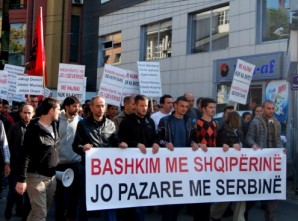
Some tens Red and Black Alliance supporters gathered on Saturday for a few hours Dragoti Bridge to protest the "Greek fascists march", as he dubbed them into Albanian territory, representatives of the Greek far right "Golden Dawn".

Day "not" that Greece turned Italy during the Second World War that followed the war between the two countries, but that took place in the Greek-Albanian border, commemorated with ceremonies at the graves of Greek soldiers.

In Kelcyre developed one of the largest battles between Greek and Italian soldiers and in this small town Permet launch memorial circle end in Bularat, where there is a cemetery of Greek soldiers.
Η συμμετοχη της Αλβανιας...

Saturday, October 27, 2012


Red and Black Alliance activists block the entrance to the ""Golden Down" in Përmet


As was announced a few days ago, the Red and Black Alliance has blocked the entry of Greek Party The Golden Down groups and some members of the Golden Dawn, who will travel to Këlcyra to celebrate the liberation of Greece. Dozen members of alleance have come up with flags and banners in the national road near the bridge Dragoti, where Greeks will spend more after Monastery Këlcyra.

"Red and Black Alliance strongly condemns and not kneeling diplomacy reaction of the Albanian government, which continues to despise and wellbeing and morale of the Albanian nation with an anti-national policy and in support of regional anti-Albanian Serbian-Greek," have Protest organizers said.
According to them, this protest was a clear message that it will not be accepted for any price and under any circumstances such behavior by the Golden Dawn, which are intended only to destabilize the south of Albania.

"Red and Black Alliance vows that Greece implement the principle of reciprocity where for every Albanian citizen who treated abnormal Greek border, the same would apply to every citizen of Greece that will pass right Albania. For every Albanian to be reversed, because it Cham, a Greek citizen will be allowed to pass right in our country.

Identity, moral and territorial integrity of the Albanians can not and will not ever be a mechanism used by the government anti-Albanian government of Sali Berisha citizens for personal political interests. Red and Black Alliance urges that the Ministry of Foreign Affairs of Albania to react against the visit tendentious anti-Albanian purposes and call for explanation Greek Embassy officials in Albania, who are seen to support Neo-Nazi activities and the Golden Dawn, "said AK notice after the organization of the protest.

Gazeta Shqip

Friday, October 26, 2012


http://www.balkanweb.com/TV/index.php?id_categoria=47&id_ansalive=16949

Janullatos: "Society and Albanian institutions have prevented the church from 1994-s"

Shekulli newspaper
http://shekulli.com.al/web/p.php?id=6652&kat=87


BERAT-head of the Albanian Autocephalous Orthodox Church, Dr Anastasios of Tirana, has issued a strong statement against the Albanian society and the Albanian authorities in recent years, as an obstacle to its progress in Albania.

These resentment accumulated over the years, His Grace, Janullatos made ​​to St. Demetrios Church in Berat, a cathedral that has been broken up in 1991, while is totally rikonstrktuar only four years ago, where he was to celebrate day of the saint of the same name.

Janullatos mentioned in 1994, when the Albanian society, but also media institutions began attacks then followed in the years to his prejudice or judgment as part of the Greek anti clans. Janullatos said that in 1994 the state authorities were not very positive towards the Orthodox Church, while the Albanian society is moving towards capitalism, another illusion, having no faith and religion.

"We hope not to come to the country of persecution scourge, which we have lived here many years ago. It was a great earthquake destroyed, bying that all things, but there are also other small fluctuations bother us. Life after the great illusion that lived about goods atheistic communist society is moving towards one another illusion of capitalism, there is no faith in religion and mainly found no value, "said Janullatos.
Clinton to visit Tirana on November 1st


Clinton to visit Tirana on November 1st
The Albanian Prime Minister, Sali Berisha, declared that the visit of the US State Secretary Hillary Clinton to Tirana is the most important event for the celebration of Albania’s 100th anniversary of independence.

Prime Minister Berisha, who invited Mrs. Clinton to Tirana for the independence celebrations during his visit in Washington, published a special declaration for welcoming the US State Secretary.

Clinton will arrive to Tirana on November 1st, after travelling to Algeria and the Balkan region.

The US State Department declared that during her visit in Tirana, Clinton will emphasize the solidarity of America with Albania as a NATO ally. She will hold a speech for the 100th anniversary of independence, where she will note the critical need for more political cooperation and for the rule of law”.

In his declaration, Berisha underlines that this visit is a testimony of the excellent relations between our two nations, the friendly sentiment and the respect that Secretary Clinton and the US government have for the Albanians, and a testimony of the support that they have given and give to Albania and the Albanian nation, in the effort to build a democracy based on the market values.

Berisha underlined that the visit of Secretary Clinton for the 100th anniversary of independence is a great honour and a special occasion for the citizens and the relatives of the country for expressing once again the deep support to the extraordinary role of the US in these 100 years of Albania’s efforts for freedom, national dignity and fir the inter-institutional and Euro-Atlantic integration”.

Hillary Clinton is the fourth US Secretary of State that visits Albania after the fall of communism: James Baker in 1991, Madeleine Albright in 1998, Colin Powell in 2003. There’s also the historical visit of President George Bush in June 2007, which show the support of the US for Albania.

President meets with Macedonian counterpart

BELGRADE -- Tomislav Nikolić and Gjorge Ivanov say similar obstacles that the two countries face in the EU integration pointed to the need to have closer cooperation.
Tomislav Nikolić and Gjorge Ivanov (Tanjug)
The presidents of Serbia and Macedonia met in Skopje on Friday.
Nikolic and Ivanov also agreed that all issues between the countries of the region should be settled through dialogue.

The two officials assessed that relations between Serbia and Macedonia were at a high level and the issues they had were not unsolvable and they were not an obstacle to a joint European future.

"Since Serbia and Macedonia have a similar problem to solve in order to become EU members, I think it points us to the closest possible cooperation," Nikolić said after the meeting.

He noted that he did not choose Macedonia as his first visit to the region by accident and that Serbia wanted to show that both those who had recognized Kosovo and those who had not were its dear friends.

Ivanov agreed that dialogue was the only way to solve the problems Serbia and Macedonia had in EU integration, as well as all issues in the region.

“We need to talk because we reach solutions through talks,” the Macedonian president stressed and added that it was in Macedonia's best interest to communicate with Greece, which is creating obstacles for its EU integration.

“I hope a solution will be found if there is readiness to solve the problem,” Ivanov pointed out.

The two officials called for talks to settle the problem between the Serbian Orthodox Church (SPC) and the Macedonian Orthodox Church, adding that they would assist in the process.

Nikolić met with Macedonian parliament Speaker Trajko Veljanovski on Friday as well.

This is Nikolić's first official visit to Macedonia since he assumed office as the president.

He laid a wreath at the Monument Honoring Macedonian Fallen Heroes on Friday.

On the third day of the visit, Nikolić will attend the ceremony to mark the 100th anniversary of the Battle of Kumanovo and lay a wreath to honor fallen heroes.


BREAKING NEWS - Disaster for Athens - Troika advises EWG to Reject Austerity Plans

Breaking_News
Breaking_News (Photo credit: kattanapilot)
Surprise, surprise – the meeting that the EU flatly denied would happen today just wound up.

The output is the biggest bombshell to hit the eurozone in a long time: Greece is to be denied access to the next bailout tranche … unless more cuts and reforms beyond those "agreed" to last Sunday are forthcoming.

In what looks to like a pretty serious case of stabbing Greek Prime Minister Antonis Samaras in the front, news reports are breaking in Athens as an anonymous EU official has confirmed the International Monetary Fund (IMF) report to the Eurogroup Working Group (EWG) is damning about the cuts "agreed" by the Athens government last Sunday.

This is a direct quote from the document:
“It is clear that Greece is off track and there is no chance they will cut the debt to 120 percent of GDP in 2020 as envisaged. It will be rather 136%. New prior actions will be needed, on top of the existing [ones] before any new tranches of eurozone and IMF emergency loans to Greece can be paid.“
Shortly after leaving the EWG meeting to leak its entire contents, the eurocrat noted in addition that the costs of a two year extension (the one Schäuble dismissed as “pure media speculation” on Thursday) to the Greek repayment schedule “are now seen at around 30 billion euros”.

As per the long-hold Slog view that some disguised debt foregiveness would, in the end, be involved, the report also notes that (debt) restructuring could take the form of a further reduction of the interest rate on existing loans to Greece and an extension of their maturities, but while that would reduce financing costs, alone it would not fill the funding gap’.

So, the good news is that a deal is on the table. The bad news is, Greece hasn’t fulfilled its side of the bargain ... assuming anyone in Athens was ever clear WTF that bargain was in the first place.

This is significant news, so much so that it’s been leaked just as most European financial and media executives were drifting off for the Friday lunch followed by another weekend of quiet denial in which to recover from reality.

Thursday, October 25, 2012

World Bank: Difficult tax system in Albania


Difficult tax system in Albania
The World Bank considers Albania as the country with the most difficult tax system in the region and among the most difficult in the world, which creates costs and penalizes business.

The last report of “Paying Taxes 2013”, which analyzes the fiscal systems of 185 world economies, ranked Albania among the last 25 spots. According to the Bank, the main causes for this precedent are the many procedures and the high administrative burden, compared to other countries.

The report says that an enterprise in Albania must pay 44 taxes each year, which includes the contributes, income tax, VAT and other local taxes. The same indicator for other Eastern Europe and Central Asian countries is 28 in average, while in the developed countries it is even 12.

The high number of taxes increases the cost and the time needed to pay them. According to the Bank, an enterprise in Albania spends 357 hours each year to close the preparation of documents and the payment of tax obligations. In the region this is 260 hours, while in the developed countries it goes to 176 hours each year.

The simplification of the tax procedures is one of the indicators where Albania has the lowest progress in business. In 2008, Albania was ranked better than the average of the region. But during this time, the other countries have made the tax payment easier, while in Albania they are unchanged. According to the World Bank, although Albania is among the countries with the lowest taxes, the fiscal procedures and the bureaucracies are the heaviest, not only for the region, but also for the world.

Albright clash with serbs for Kosovo


Ο Νίκος Μιχαλολιάκος στον ΣΚΑΪ


smanalysis

The leader of the Golden Dawn N. Michaloliakos explains the difference between the Northern Epirus and Albania
 
In Greece in 2012 still have to explain the difference of the Northern by Albanians, which necessarily take place in the media.

 
This role took on a public level, the General Secretary of the Golden Dawn Nikos Michaloliakos the premiere telecast of SKY "Directly" with Constantine Bogdanos.

 
During the broadcast journalist SKY wondered why the Golden Dawn racist behaves in "Northern Epirus" the director of the controversial theater play "Corpus Christi" Laertes king, but did not do the same for "Albanian" Roberto Chaido who is a member of the Golden dawn!

Mr. Nikos Michaloliakos tried to explain the obvious as to who is and who is Albanian and Northern Epirotes.

Watch the full video of the broadcast.

Catalan MEPs warn of Madrid's "military threats"

BRUSSELS -- Catalan European Parliament members caused a storm in Spain Wednesday when they sought EU's intervention over what they said was a military threat from Madrid.
Opponents of Catalonia's independence send their message to Europe during a recent gathering (Beta/AP)
Four MEPs stated in a letter to Brussels that the country's authorities threatened the northeastern region where demands are growing for independence.
"We are writing to you to convey our deep concern over a series of threats of the use of military force against the Catalan population," they wrote to European Justice Commissioner Viviane Reding.

The MPs recalled that hundreds of thousands of people had taken to the streets of Barcelona on September 11 this year, the Catalan national day, calling for independence.

The popular protest helped to convince the powerful region's president, Artur Mas, to call snap elections on November 25 with the aim of organizing a referendum on "self-determination".

But the MPs said many people including senior members of the military had since said that Spanish armed forces had a constitutional duty to guarantee the territorial integrity of Spain.

"Such threats limit Catalan and Spanish democracy as well as freedom of expression and protest for people in Catalonia. In these circumstances, the European Union should intervene preventively to guarantee that the resolution of the Catalan conflict be resolved in a peaceful, democratic manner," the letter, dated October 22, said.

It also urged Brussels "to make a public statement insisting on the withdrawal from the public debate of any military threat or use of force as a way of resolving this political conflict".

Greece Working Again on Diaspora Vote Law


Minister of Interior Evripides Stylianides noted the importance of solving the national issue of granting voting rights to Greeks in the Diaspora while addressing the Hellenic Parliament’s Special Committee on Greeks Abroad the Special Committee on Oct. 25.

The Minister explained that he believes the bickering between political parties will be set aside to find a solution, although all previous efforts to find a compromise had failed.
According to Stylianides, the Ministry has already assigned a working group to process a draft law mainly focusing on the right of Greeks living abroad to vote, equality in voting rights, reliability of the procedure, administrative preparedness and a low cost for the project. Once the draft law is ready, it will put to public consultation in order for the parties to make their amendments before going to Parliament.

The Minister also underlined that the Diaspora constitutes an important Hellenic presence outside the country’s borders, which makes it imperative to pass the right to vote. Referring to articles of the Greek Constitution and a decision against Greece issued by the European Court of Human Rights, Stylianides said that only Greece and Ireland refuse their Disapora the right to vote.
Balkan map is closed
To Channel.tv


Balkan map is closed
“The Map of South-Eastern Europe is closed”. This message was given by the British main diplomat, William Hague, who visited Kosovo for the first time, after the meeting held this Thursday morning with the Prime Minister, Hashim Thaci.

Hague declared that this was made clear two Serbia also two years ago.

“We made it clear what Serbia must do to receive the EU candidate status. I was in Serbia two year ago, together with my German colleague, where I declared that the South Eastern Europe map is now closed. We told them that if they want to be an EU candidate country, they should start the dialogue with Kosovo. We are very clear with Serbia about this matter”, Hague declared.

Hague underlined that in the first phase of the dialogue, baroness Catherine Ashton will identify the issues that will be discussed. She also supported the meeting between Thaci and Dacic.

“The Kosovo-Serbia dialogue for normalizing the relations is essential for both countries, in order to continue the European path. I strongly support the meeting between Thaci and Dacic, and I encourage all parties to continue like this. I will send the same peace messages to Belgrade”, Hague declared.

On the other hand, the Prime Minister of Kosovo, Hashim Thaci, declared for the journalists that Kosovo is ready to continue the dialogue process for which they have built a widen consensus, and that the chapter of conflicts is being closed gradually, opening this way that of Euro-Atlantic integrations.

“We don’t expect Serbia to recognize Kosovo as a state in the days, weeks and months to follow, but we expect an European behaviour as regards Kosovo, so that this EU relation between Kosovo and Serbia will bring the recognition of the five EU member countries and Kosovo’s membership in the UN”, Thaci declared.

The British diplomat appealed for the implementation of the conditions that bring Kosovo closer to the EU, and that are related with war against organized crime, against corruption and the fulfilment of the human rights for all communities.

Court Rejects Karadzic Subpoena of Greek President

By  


The UN’s Yugoslav war crimes court has rejected a call by Bosnian Serb former leader Radovan Karadzic to subpoena Greek President Carolos Papoulias to testify at his genocide trial.
“The requirements for the issuance of a subpoena have not been met,” the International Criminal Tribunal for the former Yugoslavia (ICTY) said in a document made public on Tuesday. “The chamber denies the motion.”

Now 67, Karadzic faces 10 counts of genocide, war crimes and crimes against humanity for his role in Bosnia’s 1992-1995 war, which left 100,000 dead and displaced 2.2 million others.
Papoulias was Greek foreign minister between 1993 and 1996 and Karadzic had said he was “one of the few international interlocutors whom the Bosnian Serbs trusted and with whom they could speak confidentially and candidly.”

Many Greeks supported Serbs during the conflict because of their common Orthodox Christianity. Karadzic was given a triumphal welcome when he visited Athens during the war in June 1993.
He said at the time that the Serbs only had two allies: “The Greeks and God.”
(source: the news)

Polls of SManalysis: 

Members of the Community of Himara, vote for Autonomy from Greece and Albania
 

In a survey poll, made ​​under monitoring of SManalysis, members of The Himara Community in three countries, Albania, USA and Europe, regarding the historical and regional respective, have voted for independence of The Himara Region, in its historical context, while only two votes, have meant that currently involved with Albania, felt themselves better than involvement with Greece, which has been the sharp decline economically.

The polls also show that a small part, think that Himara may be included within a state historic tipicaly as was Epirus, which ranks third behind Albania and Greece, in preference polls.

In total 38% of Polls, think that Himara should be independent, 36% think that Himara should be involved in the Albanian state, 24% think that Himara must be included with the state of Greece, and only 2% think the inclusion Himara inside historic Epirus


The poll has been claimed on SManalysis from three months.

One such survey was conducted two years before, in which The Himara Community, vote involvement with Greece, was dominant against Albania and the Independence of Himara, which was ranked third ..

According to polls, the difficult economic situation that Greece is going through has changed positions, having more returns opinion migration to Himara, to manage the perspective of tourism and property care.


According to INSTAT the Albanian Statistic Institute, The Himara Region composes about 8% of the total tourism of Albania, with about 80 million euro GDP in year. 

Belgium returns 51 Albanian asylum seekers


Belgium returns 51 asylum seekers
Belgium returned 51 people from Albania who hade demanded political asylum. The General State Police Director warned that whoever will violate the EU residence permit will be returned and now they are easily identified, because their names are on the police database.

“Certainly that we are continuing with these operations. We guarantee the Albanian citizens that whoever will violate the EU residence rules will be returned to Albania”, Burgaj declared.

The head of the Belgian Police, who led the operation for returning the Albanians, considered as unacceptable the fact that 70 Albanians are demanding political asylum in Belgium. According to him, most of them have lost their job in Greece and are demanding political asylum in Belgium.

From January to August 2012 there has been a dramatic increase of the asylum requests in Sweden. 1043 people have asked asylum during this period.

The Swedish authorities have issued an interior order that will return all Albanian asylum seekers within 6 months, since most of them are of not threat and their asylum requests is purely economic.

Wednesday, October 24, 2012

"Change of borders would contribute to lasting peace"


BELGRADE -- Former British Ambassador to Yugoslavia Sir Ivor Roberts believes that "a correction of borders in the Balkans would contribute to a lasting peace".
Ivor Roberts is seen at the Belgrade Book Fair (Tanjug)
This "correction" would also include Kosovo, the now retired British diplomat told B92 in Belgrade on Wednesday.
Roberts, who currently serves as president of Oxford's Trinity College, is in Serbia to promote his book "Conversations with Milosevic", which was presented during the ongoing International Belgrade Book Fair.

He added that it was his personal opinion that insistence on unchangeable borders was "absurd":

"We always had these mantras about Yugoslavia. For instance, after the NATO bombing, the Security Council adopted a resolution containing the mantra about the territorial integrity of Yugoslavia. After that Serbia and Montenegro separated, and later Kosovo. The idea that such positions are carved in stone is absurd, just as is insistence that a country with unsolved territorial issues cannot join the EU. In that case Great Britain would have to leave immediately because we have territorial disputes with three countries."

The former ambassador also noted that instead of debating whether a change of existing borders would be good or bad, more focus should be put on the interest of the citizens.

"What will stability bring? We have a saying that 'good fences make good neighbors'. If people are still unable to live in peace and tolerance - and incidents in Kosovo show that the situation is not good, and that's not my impression, those are facts on the ground - then perhaps it's best to redefine some of those borders," Roberts concluded.

Tuesday, October 23, 2012

Protest in Tirana over Serbian minister's visit

TIRANA -- Scores of Albanian nationalist staged a protest in Tirana over the first visit in eight years to their country by a Serbian foreign minister.
The protest in Tirana (Beta/AP)
The Associated Press reported that supporters of the Red and Black Alliance party shouted slogans and held banners reading “Kosovo is Albania” at Tirana's airport Monday as Serbian Foreign Minister Ivan Mrkić arrived.
The nationalist party is unhappy with the Albanian government's ties to Serbia, the agency reported.

Mrkić is on a two-day visit to Albania, where he will confer with Albanian officials on the relations between the two countries and other issues. On Tuesday, Mrkić met with Albanian Prime Minister Sali Berisha and Foreign Minister Edmond Panariti.

Mrkić told Sunday's edition of Belgrade-based daily Politika that this is the first visit by a Serbian foreign minister to this country after many years, and voiced expectation that his visit will create a foundation for a better cooperation.


"Greater Albania poses threat to all of Balkans"

BELGRADE -- Serbia's Ambassador to France Dušan Bataković says that the Greater Albania project is seriously endangering the fragile stability in the Balkans.
This diplomat, a historian by trade, noted that the term "Natural Albania" was but another name for "Greater Albania", and added:
"For a number of years this project has had a significant support of Albanian elites in all the countries where Albanian live, and it is, as has been announced, gradually becoming a reality."

"This process has advanced a long way, and it threatens our vital national interests in an essential manner, and seriously endangering the fragile stability in the Balkans," Bataković told the Belgrade-based tabloid Blic.

As a historian, Bataković has been studying the Kosovo problem for decades, to recently publish a book on the subject entitled, "Serbia's Kosovo drama: A historical perspective". In it, he points out to the neglected aspects of the Serb-Albanian relations from the era of the Yugoslav Communist dictator Josip Broz Tito, and the roots of the conflicts after 1945, especially the methods used to drive Serbs and other non-Albanian ethnic groups out of Kosovo.

"There was a scientific need for a comprehensive study to take into account the whole Kosovo drama, and especially its dominant, Serb dimension, as opposed to books published in English based on a one-sided concept, which treat the one thousand years of history of Old Serbia's central region as exclusively a part of the Albanian question," he told the newspaper.

Bataković also stressed that it was "a great ideological misconception that the Kosovo legend was our grand illusion", and added that as a nation, we are at this point undergoing "a great identity crisis, shaken at the foundations by the negative aspects of Yugoslavism and Titoism".

"A return to the tried-and-tested values offered by our heritage, aerated by modern sensibilities, is a big task ahead of our elites," the ambassador concluded.

Serbia, Albania "should focus on topics that connect them"

TIRANA -- Serbian Foreign Minister Ivan Mrkić met on Tuesday in Tirana with Albanian Prime Minister Sali Berisha and Foreign Minister Edmond Panariti.
Mrkić and Panariti address reporters (Beta)
Mrkić, who was greeted with protests as he arrived in Albania on Monday, said that the meetings today concluded that Serbia and Albania should focus on topics that bring them together, rather than on those dividing them.
According to Mrkić, it is well known how deep the differences between the two countries are when it comes to certain issues, but today most of the time is dedicated to topics of mutual interest.

"The main message is that we should cooperate and be led by common interests in the future. We should recognize what brings us together, since in the past we lost pace in many things," Mrkić told Tanjug.

This refers to economic and parliamentary cooperation and Serbia and Albania's common future in the EU, said the minister who is paying a two-day visit to Albania.

"I conveyed the message that Prime Minister Ivica Dačić has invited Prime Minister Sali Berisha to Belgrade. My counterpart Panariti will, I believe, also come to Belgrade, perhaps even next spring," Mrkić said.

Kosovo, over which there are "known differences", was also discussed, but we did not discuss in detail the dialogue between Belgrade and Priština, since Belgrade's platform is yet to be formed.

When it comes to investigation of illicit trafficking into human organs, this topic is fully present in the Albanian political public, he noted.

"I received assurances that they will cooperate maximally in this investigation. I was told that the Albanian parliament has adopted a decision which obliges the administration and the government to do so and that they will allow investigating authorities to investigate about everything and anywhere," the foreign minister pointed out.

While in Tirana, Mrkić also conferred with representatives of the Serb minority "about the approach to the Albanian partners", in order to improve their living conditions, activities, education and contacts with their homeland.

"We hope that the results of this meeting will be visible in the near future," he added.

Mrkić's visit is the first visit by a Serbian foreign minister to Albania after many years.

"Cooperation should improve"

Albanian Foreign Minister Edmond Panariti said Tuesday after a meeting with his Serbian counterpart Ivan Mrkić that his country is ready to foster cooperation with Serbia in the spirit of good neighborly relations, the Albanian media reported.

"We agreed that the relations between the two countries have improved and that they should develop in a more dynamic, open and sincere way," Panariti told a joint press conference with Mrkić.

Commenting on a recent meeting between Ivica Dačić and Hashim Thaci,, he said that this was "an indicator of good will for cooperation".

Panariti, however, said that Albania "would welcome Serbia's decision to recognize the independence of Kosovo", adding that "this would be a sign of readiness to break with the past of violence and repression from the time of Slobodan Milošević", the, ATA news agency reported.

Top PM of  "The Golden Down", calling for the unification of the Greeks in Epirus

Greek united policy, should seek urgent "The Protocol of Corfu" to Tirana

Papas: Epirus has been and will be a united

Kristo Papas of "The Golden Down": The Northern Epirus, was betrayed by 100 years of the great powers. Problems of Northern Epirus, will raise the most powerful in the Parliament and in the EU, by "the Golden Down"

Papas: The opening in the middle of Athens Cham issue, in a time that was abducted properties Greeks in Northern Epirus currently, this is the great paradox of time.

Papas: You must be stronger to fight for the future of your children, that the land not be caught from other people.

Papas: "The Golden Down" will stay close to the people in Northern Epirus, and will make it impossible to have security in difficult times.