Thursday, September 3, 2020

Athens denies NATO statement that Greece and Turkey will begin talks

SManalysis


Athens has denied that Greece and Turkey will soon begin talks to de-escalate tensions in the East Mediterranean, according to Hellas Journal.

Hellas Journal reported that “the information that came to light about alleged technical talks in NATO do not correspond to reality, according to diplomatic sources in Athens.”

Only moments before the denial, NATO Secretary-General Jens Stoltenberg said “the two Allies have agreed to enter into technical talks at NATO to establish deconfliction mechanisms and reduce the risk of incidents and accidents in the East Mediterranean.”


In a statement made in a link in the same tweet, Stoltenberg said that he believes the tensions can be relieved “in the spirit of NATO solidarity.”

“Greece and Turkey are valued Allies, and NATO is an important platform for consultations on all issues that affect our shared security. I remain in close touch with all concerned Allies to find a solution to the tensions in the spirit of NATO solidarity,” he said.

Wednesday, September 2, 2020

Πρίστινα: Ο πρόεδρος του DUI, Αλί Αχμέτι, καταθέτει στους ανακριτές του Δικαστηρίου της Χάγης Αποστολή με μήνυμα ηλεκτρονικού ταχυδρομείου

SManalysis


Ο πρόεδρος του αλβανικού κόμματος στη Βόρεια Μακεδονία -  της Δημοκρατικής Ένωσης για Ενσωμάτωση (DUI), Αλί Αχμέτι

Σεπτέμβριος 2, 2020. ECHEDOROS
 

Ο πρόεδρος του αλβανικού κόμματος στη Βόρεια Μακεδονία -  της Δημοκρατικής Ένωσης για Ενσωμάτωση (DUI), Αλί Αχμέτι,  σήμερα στις εγκαταστάσεις της αποστολής της ΕΕ - της EULEX στην Πρίστινα, κατέθεσε ενώπιον των ανακριτών της Ειδικής Εισαγγελίας για Εγκλήματα Πολέμου στο Κοσσυφοπέδιο.


Σύμφωνα με το Euronews Albania, ο Αχμέτι έφτασε στις εγκαταστάσεις της EULEX μετά τις εννέα το πρωί.

 Η ανάκριση πραγματοποιείται στην Πρίστινα, και όχι στη Χάγη, όπου βρίσκεται η Ειδική Εισαγγελία, η οποία λειτουργεί εκεί για πρακτικούς λόγους,  όταν οι καλεσμένοι μάρτυρες δεν μπορούν να ταξιδέψουν στις Κάτω Χώρες.

Ο Αλί Αχμέτι, ολοκλήρωσε μετά από οκτώ ώρες τη συνέντευξη από εξειδικευμένους εισαγγελείς στο Κοσσυφοπέδιο σχετικά με τον πόλεμο του «Απελευθερωτικού Στρατού του Κοσσυφοπεδίου»- UÇK.


Στο κτίριο της  EULEX, το οποίο χρησιμοποιείται ως χώρος για ανάκριση σε όσους προσκαλούνται από το ειδικό δικαστήριο και δεν μπορούν να ταξιδέψουν στη Χάγη, ο Αχμέτι μπήκε στις 09:30 το πρωί και έφυγε στις 17:30 το απόγευμα.

Η ανταποκρίτρια του 'Euronews Albania',  Εριόνε Ποπόβα [Erjonë Popova] αναφέρει από το Κοσσυφοπέδιο ότι η ανάκριση του αναμένεται να συνεχιστεί την επόμενη μέρα, τις πρώτες ώρες του πρωινού.

Ο αρχηγός του DUI Αλί Αχμέτι είναι ένας από τους ιδρυτές του Απελευθερωτικού Στρατού του Κοσσυφοπεδίου (UÇK) και πρώην μέλος του Γενικού Επιτελείου, αλλά δεν υπήρξαν συγκεκριμένες κατηγορίες εναντίον του.

Ο Αλί Αχμέτι γεννήθηκε στις 4 Ιανουαρίου 1959 στο χωριό Ζαγιάζ στο Κίτσεβο της Βόρειας Μακεδονίας  και σπούδασε φιλοσοφία στην Πρίστινα. 

Στις αρχές της δεκαετίας του 1980 ασχολήθηκε με φοιτητικές διαμαρτυρίες, οι οποίες τότε έδειχναν ανοιχτή αντίθεση στις γιουγκοσλαβικές πολιτικές κατά του αλβανικού πληθυσμού στο Κοσσυφοπέδιο. Για την πολιτική του δραστηριότητα συνελήφθη και καταδικάστηκε σε φυλάκιση 1 έτους.


Στις αρχές της δεκαετίας του 1990 ήταν ένας από τους ηγέτες που δημιούργησαν το UÇK  ως στρατιωτικό σχηματισμό, το οποίο το 2000, μετά την απόσπαση του Κοσσυφοπεδίου από τη Σερβία, αυτός και άλλοι ηγέτες ενταγμένοι στον «Εθνικό Απελευθερωτικό Στρατό» επέκτειναν τη δραστηριότητά του στην επικράτεια της Βόρειας Μακεδονίας.

Monday, August 31, 2020

ΠΟΣΟ ΕΠΗΡΕΑΖΕΙ ΤΗΝ ΕΛΛΑΔΑ Η ΑΛΒΑΝΟΠΟΙΗΣΗ ΤΩΝ ΣΚΟΠΙΩΝ?

SManalysis
Is Macedonia on the Brink of Another Ethnic Conflict?


Είναι υπερβολή να μιλούμε για «αλβανοποίηση» της πολιτικής ζωής και των θεσμών στο κράτος των Σκοπίων; Μετά τις πρόσφατες βουλευτικές εκλογές, όχι. Η αλβανική κοινότητα, η οποία επισήμως αποτελεί το 25% – και ανεπισήμως το 30% λόγω υψηλής γεννητικότητος- σε μία χώρα με 2,1 εκατομμύρια κατοίκους, καταλαμβάνει πολλές και σημαντικές θέσεις – κλειδιά. Θυμίζω ότι ο Ζόραν Ζάεφ του Σοσιαλδημοκρατικού Κόμματος ανέλαβε την Πρωθυπουργία χωρίς να έχει την απόλυτη πλειοψηφία. Στην κυβέρνησή του μετέχουν δύο αλβανικά κόμματα. Οι Αλβανοί θα ορίσουν Πρόεδρο της Βουλής, Υπουργό Εξωτερικών, Υπουργό Οικονομικών και στις τελευταίες 100 ημέρες προ των εκλογών θα ορίσουν και τον Πρωθυπουργό. Έτσι υλοποιείται η υπόσχεση του Αλβανού πολιτικού Αλί Αχμέτι για Αλβανό Πρωθυπουργό στο γειτονικό μας πολυεθνικό κράτος.

Θυμίζω ότι ήδη από τα προηγούμενα χρόνια η αλβανική μειονότητα έχει κερδίσει την ισοτιμία της αλβανικής γλώσσας με τη σλαβική των Σκοπίων (αυτή που κακώς αναγνωρίζει ως «μακεδονική» η Συμφωνία των Πρεσπών). Θυμίζω επίσης ότι από το 1991, οπότε ανακηρύχθηκε ανεξάρτητο το κράτος αυτό, μέχρι και σήμερα η αλβανική μειονότητα έχει διεκδικήσει ακόμη και με τα όπλα την ενίσχυση των δικαιωμάτων της.

Τι σημαίνει για τα ελληνικά εθνικά συμφέροντα η αλβανοποίηση των Σκοπίων;

Ενθαρρύνεται ή μάλλον αποθρασύνεται ο αλβανικός εθνικισμός. Ήδη γίνονται συζητήσεις για την ενοποίηση Αλβανίας και Κοσσυφοπεδίου κάτω από το έμβλημα του αετού της Μεγάλης (ή Φυσικής) Αλβανίας. Οι Αλβανοί διανοούμενοι προτιμούν τον όρο Φυσική Αλβανία, διότι θεωρούν ότι τα φυσικά σύνορα του αλβανικού έθνους περιέχουν εδάφη πέραν της σημερινής Αλβανίας. Ο αλβανικός εθνικιστικός άνεμος θα πιέσει την Ελλάδα με μοχλό το τεχνητό ζήτημα των Τσάμηδων- απογόνων των συνεργατών των Ναζί και εις βάρος των Βορειοηπειρωτών. Στην κεντρική πλατεία των Τιράνων ο Πρωθυπουργός Ράμα τοποθέτησε συμβολικά και μία πέτρα από την ελληνική Θεσπρωτία, την οποία η αλβανική κυβέρνηση αποκαλεί Τσαμουριά.

Ενισχύεται ή ήδη υπαρκτή τουρκική επιρροή στα Σκόπια. Οι υποστηρικτές της εθνικώς επιζήμιας Συμφωνίας των Πρεσπών διακήρυτταν ότι …κατόρθωσαν να απομακρύνουν την τουρκική επιρροή. Κάτι τέτοιο βεβαίως δεν έγινε, όπως διαπιστώνουμε και από τη συμμετοχή των Σκοπιανών βουλευτών κάθε χρόνο στις εκδηλώσεις του Τουρκοκυπριακού ψευδοκράτους για την εισβολή του 1974. Τώρα, με την παρουσία Αλβανών πολιτικών σε καίριες θέσεις, η Τουρκία αυξάνει την επιρροή της στα Σκόπια.

Το ερώτημα είναι αν και πού θα σταματήσουν οι Αλβανοί τώρα που τους άνοιξε η όρεξη. Τι άλλο θα διεκδικήσουν; Το Κοσσυφοπέδιο- Κόσσοβο είναι δίπλα και αποτελεί κίνητρο για μελλοντική ένωση όλων των εδαφών που θεωρούνται «αλβανικά». Με απλά λόγια: Θα αποσχισθούν από τα Σκόπια οι δυτικές περιοχές με τον αλβανικό πληθυσμό και τις αλβανικές σημαίες, που ήδη κυματίζουν σε δημαρχεία και πανεπιστήμια; Η Ελλάς πρέπει να είναι έτοιμη να αντιμετωπίσει τέτοια διαλυτικά φαινόμενα στη γειτονιά της.

Η αλβανοποίηση οδηγεί λόγω φόβου σε μία αμυντική βουλγαροποίηση του σλαβικού στοιχείου. Πολλοί από τους λεγόμενους «Μακεδόνες» ανακαλύπτουν ότι οι γονείς τους ήταν Βούλγαροι και μακεδονοποιήθηκαν δια της βίας από το κομμουνιστικό καθεστώς του Τίτο. Χαρακτηριστικό παράδειγμα ο πρώην Πρωθυπουργός των Σκοπίων Λιούπτσο Γκεοργκίεφσκι, ο οποίος τώρα δηλώνει Βούλγαρος και τον ακολουθούν δεκάδες χιλιάδες Σκοπιανών. Για την Ελλάδα η επιρροή του βουλγαρικού εθνικισμού στους Σλάβους των Σκοπίων ανακαλεί μνήμες της φονικής συγκρούσεως μεταξύ Βουλγάρων κομιτατζήδων του ΒΜΡΟ και ελληνικών ενόπλων ομάδων στη διάρκεια του Μακεδονικού Αγώνος (κυρίως 1903-1908). Η επίσημη βουλγαρική θέση είναι ότι η ιστορία και η γλώσσα του σλαβικού στοιχείου των Σκοπίων αποτελούν τμήμα της βουλγαρικής ιστορικής, εθνολογικής και γλωσσικής παράδοσης.

Καντονοποίηση: Μήπως τελικά αυτή θα είναι η μέση λύση για να αποφευχθεί η διάσπαση του πολυεθνικού κράτους; Ομοσπονδιακή δομή με ένα αλβανικό καντόνιο στα δυτικά, ένα βουλγαρικό στα ανατολικά, ένα μικρό σερβικό στον βορρά, κάποιο άλλο για όσους επιμένουν να δηλώνουν «Μακεδόνες» κ.λπ. Αυτή είναι η προσωπική μου πρόβλεψη για τα αμέσως επόμενα χρόνια. Τότε, όμως, θα τεθεί το ερώτημα: Αν οι αυτοαποκαλούμενοι «Μακεδόνες» αποτελέσουν ένα από τα 4-5 καντόνια σε μία ομοσπονδιακή χώρα, με ποιο δικαίωμα θα επιβάλλουν το όνομά τους σε όλη τη χώρα; Θα ανοίξει νέα συζήτηση για το όνομα του κράτους καταδεικνύοντας ότι η Συμφωνία των Πρεσπών δεν έλυσε κανένα ουσιαστικό πρόβλημα.

Ας παρατηρήσουμε προσεκτικά την προϊούσα αλβανοποίηση των Σκοπίων.

Άρθρο στην ιστοσελίδα defencepoint.gr, 30.8.2020


4


Election in Montenegro: Opposition parties jointly win a tight majority of seats

SManalysis

By EWB - 30.08.2020
Parliament of Montenegro; Photo: Parliament of Montenegro
PODGORICA – According to the 89% of the data in the sample of Centre for Monitoring and Research (CeMI), three opposition coalitions have won 42 out of 81 seats in the Assembly of Montenegro. The ruling Democratic Party of Socialists (DPS) has achieved the worst result in its history and could relinquish power for the first time since the establishment of the multi-party system in 1990.

President of Montenegro Milo Đukanović, who is also the leader of DPS, remains in office regardless of the result, with his mandate expiring in 2023.

According to CeMI, DPS has won 34,8% of the vote and 29 seats, 7 less than in 2016. The coalition around the Democratic Front, “For the Future of Montenegro”, is closely behind with 32,7% and 28 seats.


In order to form a ruling majority, the Democratic Front, which is mainly representing ethnic Serbs and Serbian Orthodox population in Montenegro, will have to reach a coalition agreement with a pro-EU Democratic Montenegro, which has won 10 seats, as well as progressive URA movement, which has won 4 seats, according to the projections.

Coalition partners of DPS, the Social Democrats, are projected to win 3 seats, while the Bosniak and Albanian minority parties, which also support the current government, are expected to have 5 seats altogether.

The Social Democratic Party, which was a coalition partner of DPS until 2016, is projected by CeMI to win 2 MPs. Even with their support, a possible coalition around DSP currently has 39 seats, two short of a majority. Coalitions around the Democratic Front, Democratic Montenegro and URA have excluded post-election cooperation with DPS.

If a government is formed without DPS, it would be the first such case in 30 years. MP Slaven Radunović, a member of the Democratic Front, announced that the “Berlin Wall has finally fallen in Montenegro”, referring to the fact that DPS is a successor party of the Yugoslav Communists in Montenegro.

The turnout was high, with 75% of the voters going to the polls, 3 points more than in 2016 and 11 points more than at 2018 presidential election.

Montenegro has been experiencing a political turmoil ever since December last year, when DPS majority adopted a controversial Law on Religion, fiercely opposed by the Serbian Orthodox Church, which invited its members to vote against DPS. The coalition around Democratic Front seems to have profited the most from the polarisation caused by the Law.

DPS has also experienced serious anti-corruption protests in 2019.

CeMI and Center for Democratic Transition, which have monitored the election day, have reported a number of irregularities.

Sunday, August 30, 2020

Φράνκος Φραγκούλης, μήνυμα προς Έλληνες πολιτικούς από το Όρος Γκράμοζ: "Ενώστε την Ελεύθερη Ήπειρο με τη σκλαβωμένη Βόρεια Ήπειρο"

SManalysis

ΦΡΑΓΚΟΣ ΦΡΑΓΚΟΥΛΗΣ - Newsbomb

Πρώην Αρχηγός  του Ελληνικού Στρατού και πρώην Υπουργός Άμυνας Φράνκος Φραγκούλης, μήνυμα προς Έλληνες πολιτικούς από το Όρος Γκράμοζ: "Ενώστε την Ελεύθερη Ήπειρο με τη σκλαβωμένη Βόρεια Ήπειρο"

 Θυρανοίξια Εκκλησιας της Παναγίας Γοργουπηκόου στο ύψωμα 2.199 του Γράμμου

. Ηλίας Μάκος
Με μια σεμνή τελετή έγιναν το Σάββατο 29 Αυγούστου 2020 τα θυρανοίξια της Εκκλησίας Παναγίας Γοργοϋπηκόου, στο ύψωμα 2.199 του Γράμμου, από τον Σεβ. Μητροπολίτη Κονίτσης κ. Ανδρέα.
Νωρίτερα ο Σεβασμιώτατος τέλεσε τρισάγιο στο παρακείμενο μνημείο για τους πεσόντες μαχητές του Ελληνικού Στρατού την περίοδο 1946-1949, ενώ στο ναό τελέστηκε μνημόσυνο για την ανάπαυση των ψυχών τους.
Η εκκλησία της Παναγίας Γοργοϋπηκόου ανεγέρθηκε σε σύντομο χρονικό διάστημα με πρωτοβουλία του Στρατηγού ε.α. και πρώην Αρχηγού ΓΕΣ και πρώην υπουργού Εθνικής Αμύνης Φράγκου Φραγκούλη, ο οποίος ανταποκρίθηκε σε σχετικό αίτημα του Μητροπολίτου Ανδρέου.
Συνέβαλαν και ο ιερομόναχος Αθανάσιος Μετεωρίτης, καθώς και άλλοι δωρητές, παρακινούμενοι από το Φράγκο Φραγκούλη για την εκπλήρωση του τάματος.
Ο κ. Φράγκος, ο οποίος ήταν παρών στα θυρανοίξια, καθώς και δεκάδες άτομα, τόνισε ότι "παρακαλούμε η Παναγία να μας έχει υπό τη σκέπη της τις δύσκολες αυτές στιγμές, που περνάει το Έθνος μας".
Και πρόσθεσε: "Εμείς δεν φοβόμαστε,οι Ένοπλες δυνάμεις της Χώρας είναι ισχυρές, αρκεί οι πολιτικοί να μην ακολουθούν τακτική κατευνασμού και να έχουν φοβικό σύνδρομο".
Σε επιστολή του, που αναγνώστηκε στη λιτή εκδήλωση, προς τον Φράγκο Φραγούλη ο Μητροπολίτης Κονίτσης Ανδρέας, αναφέρει, μεταξύ άλλων, αφού τον ευχαριστεί, ότι στην ανέγερση της εκκλησίας αυτής και στον εξοπλισμό του με όλα τα χρειώδη, συνετέλεσε "η ευγνωμοσύνη σας προς τους ηρωικούς αγώνες του στρατού και της αεροπορίας μας ώστε να παραμείνει η πατρίδα μας ελεύθερη και αδούλωτη από την τυραννία".


Ο πέτρινος αυτός ναός με εικονογραφίες αγίων κατά κύριο λόγω στρατιωτικών ή σχετιζόμενων με το στρατό ως προστάτες του (όπως ο όσιος Παΐσιος ο ασυρματιστής), που φιλοτεχνήθηκαν από τη γυναικεία αδελφότητα της Μονής Αγίου Στεφάνου Μετεώρων, αποτελεί ένα μικρό κομψοτέχνημα.
Να σημειωθεί ότι στην κορυφή του Γράμμου, σε ύψος 2.520 μ., στρατιώτες έχτισαν, το 1948, ένα εκκλησάκι αφιερωμένο στην Παναγία, στην Υπέρμαχο Στρατηγό του Έθνους, ως αφιέρωμα τιμής για την προστασία της, αλλά και ως ορμητήριο πνευματικών ανατάσεων την ώρα των μαχών.
Αυτό το εκκλησάκι έγινε ερείπια, σωριασμένες πέτρες, λόγω της εγκατάλειψης και της αδιαφορίας.
Στη θέση του, όχι στο ίδιο σημείο, αλλά χαμηλότερα ήρθε να υψωθεί ένα νέο παρεκκλήσι της Παναγίας, αφού προηγουμένως αποκαταστάθηκε ο δρόμος προς το μνημείο, που τα προηγούμενα χρόνια ήταν σχεδόν απροσπέλαστος.
Για να θυμίζει στους προσκυνητές των αιματοπότιστων και αιματοβαμμένων εδαφών την υποχρέωση όλων μας να υπερασπιζόμαστε την Ελλάδα και την Ορθοδοξία με θάρρος και παρρησία.
Η προσευχή προς την Παναγία, μέσα και σ' αυτό το ταπεινό εκκλησάκι εκεί ψηλά στο Γράμμο, ας είναι μια παράκληση προς τη Θεοτόκο ο ίλιγγος της διχόνοιας να μη ζαλίζει το νου, να καταλαγιάσει η σκόνη, που κατά καιρούς σηκώνεται, και δεν μας αφήνει να δούμε το φως και η ζωή μας να είναι καθαρή και όχι βουτηγμένη στα κάθε είδους πάθη.
Δείτε τα βίντεο:

Wednesday, August 26, 2020

Greek DM tells NATO that Greece’s equal standing with Turkey is “not acceptable”

SManalysis
Image


It has been a busy day for Greek Defense Minister Nikos Panagiotopoulos who informed the European Union’s Defense Ministers and NATO’s head about the current situation with Turkey in the East Mediterranean.

“At the Informal Meeting of the EU Defense Ministers, I informed my counterparts extensively, the Secretary General of NATO Jens Stoltenberg and Deputy Secretary General of the UN Jean – Pierre Lacroix, on the developments in the Eastern Mediterranean and the provocative actions by Turkey in an area of ​​the Greek continental shelf,” Greek Defense Minister Nikos Panagiotopoulos said on Twitter.


However, in speaking with Stoltenberg, Panagiotopoulos did not shy away from telling the NATO head that the Alliance’s equal treatment of Greece and Turkey, in spite of the latter’s war mongering and provocations, is not “acceptable.”

“NATO’s policy of equal distances is detrimental to our country, but also to the cohesion of the Alliance, and therefore is not acceptable,” Panagiotopoulos told Stoltenberg.

The Minister of National Defense participated in the Informal Meeting of the Ministers of Defense of the European Union that took place today in Berlin. He briefed his counterparts, as well as NATO Secretary-General Jens Stoltenberg and UN Under-Secretary-General for Peacekeeping Operations Jean-Pierre Lacroix, about the latest developments in the East Mediterranean following provocative actions by Turkey.

During the first Working Session, Panagiotopoulos pointed out the challenges of security and stability in the East Mediterranean from Turkey’s delinquent behavior within the Greek continental shelf. He stressed that Turkey’s general stance and its destabilizing illegal actions in the East Mediterranean constitute a blatant violation of Greece’s sovereign rights and pose the risk of escalating tensions in the region.

The Minister also made it clear to his counterparts that Greece, with absolute respect for international law, consistently faces the current challenge and fully defends its national sovereignty and the external borders of the EU, highlighting the important and difficult task of the Greek Armed Forces. However, he also stressed the European Union’s commitment to maximum vigilance and its role in order to restore the environment of peace, security and stability in the region.

During the discussion on EU co-operation with partners in the operational part of the Common Security and Defense Policy, Panagiotopoulos particularly noted that cooperation with third countries must presuppose that the latter share the principles and values ​​of the Union while acknowledging the consistently positive and constructive EU cooperation.

On the other issues on the agenda, the Minister of National Defense emphasized the support of Greece in processes, such as the strategic compass aimed at developing a strategic culture within the Union, in order for it to be able to take autonomous action where circumstances require it.

During the working dinner that followed, he did not fail to mention the importance of maintaining the resilience of the EU in the face of multiple challenges that lurk in the present period, attaching particular importance to the demonstration of solidarity and readiness.

Turkish FM makes threats to Greece during joint statements with German ally

SManalysis
Turkish FM makes threats to Greece during joint statements with German ally (VIDEO) 2

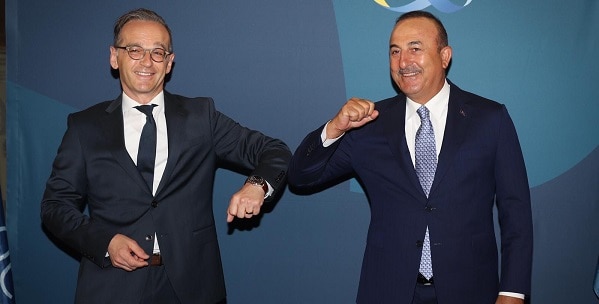
Turkish Foreign Minister Mevlüt Çavuşoğlu threatened Greece with use of force and said Turkey’s response will not be an accidental one, but a direct action with no hesitation.

The remarks were delivered in a joint presser with visiting Germany Foreign Minister Heiko Maas who attempted to mediate by just calling for dialogue despite his Turkish ally directly threatening Greece next to him.

“I want to make the following recommendation to Greece. Give up on being bratty. You talk like this with unconditional and full EU support. When not received, you blame those EU countries as well. You have to understand that you will not get anywhere with this,” he said.

“Especially do not put yourself at risk by following the encouragement of some countries. In other words, if you make statements like ‘we will defend our rights here,’ or ‘we will do exercises there,’ or if you take the wrong steps, we will not have an accidental response this time,” Çavuşoğlu continued.

“Whatever is necessary, we do it without hesitation. So, do not get agitated, encouraged by these countries and act with common sense,” the Turkish Foreign Minister said.


“In order for Greece to behave more sane, the European Union and other countries should also warn Greece. So they should warn instead of unconditional support,” he said.

“Greece has already seen in recent meetings that they will not receive this unconditional support. In other words, if such messages continue to be given, then Greece will think healthier and take better steps. But these provocative steps do not help Greece at all,” Çavuşoğlu concluded in his speech given next to his German ally.


Germany has been a centuries long ally with the Turks and for this reason is completely unprepared to place sanctions on Turkey despite its constant threats against European Union member Greece and its daily violations of Greece’s air and maritime space.

Monday, August 24, 2020

We are on the verge of a military confrontation with Turkey: Greek MP

SManalysis
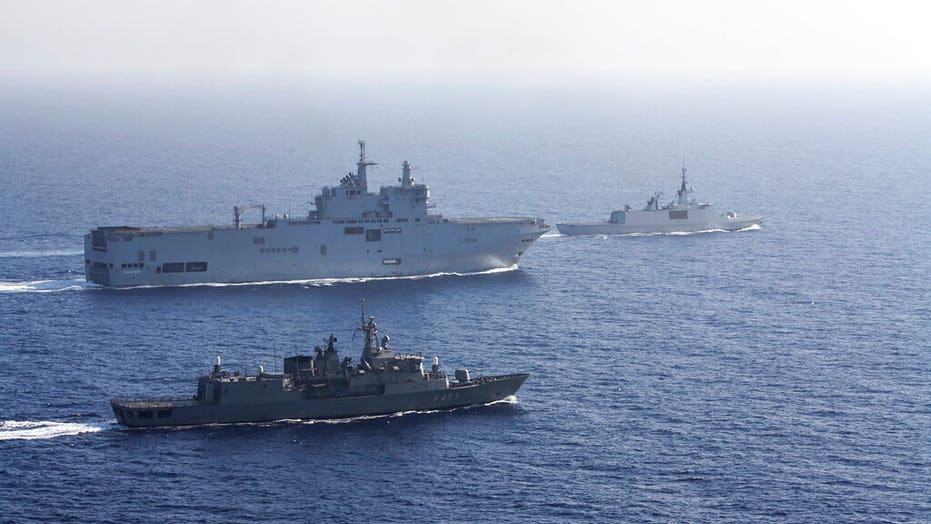
France sends forces into eastern Mediterranean to quell tensions between  Greece, Turkey | Fox News

At a time when the Greek government is trying to keep a low profile regarding Turkish delinquency in the Aegean in order to start, through German mediation, investigative contacts, Maximos Harakopoulos stressed in Parliament that Greece’s neighbour “have pushed us to the brink of military confrontation,” Documento News reported.

After the revelation of the Oruç Reis Turkish research vessel violating Greece’s maritime space and the resignation of the Greek Vice Admiral and former National Security Adviser to the Prime Minister, Alexandros Diakopoulos, the chairman of the Public Administration Committee, Maximos Harakopoulos, argued more or less that we are one step away from a military conflict with Turkey.

“Greece is facing a crescendo of Turkish challenges,” said the Member of Parliament that belongs to the ruling New Democracy party.

He added that this situation “has pushed us to the brink of military confrontation.”

According to Harakopoulos, Ankara has chosen a revisionist policy, which is subject to the neo-Ottoman proposals. He added that instead of international law, Turkey has adopted the law of power and conquest.

This is of course beyond doubt as Turkey refuses to resolve its manufactured crisis with Greece over maritime space by utilizing international law or institutions.

Turkey is one of 15 countries in the whole world to not sign and/or ratify the United Nations Charter Law of the Sea, and it is also one of the few countries in the whole world to not recognise the authority of the International Court of Justice in The Hague. Both of these mechanisms could be used to resolve the maritime issue, but Turkey refuses to do this.

On August 12, things became tense when the Turkish Kemal Reis frigate that was escorting the Oruç Reis research ship collided with the Greek Limnos frigate which was monitoring the illegal movements of the Turkish fleet in Greeece’s continental shelf, as reported by Greek City Times.

The Limnos was watching the Oruç Reis from a safe distance. The Kemal Reis, considered one of the best ships in the Turkish Navy, estimated that the Greek warship was planning to obstruct the navigation of Oruç Reis.

The captain of the Greek frigate, Lieutenant Captain Saliaris, followed a steady course and continued the voyage to monitor the Turkish research vessel without changing direction. The Kemal Reis continued to approach the Greek warship.

When it was about 450 yards away from the Greek warship, the captain of the Turkish frigate had to according to international navigation rules give priority to the Greek frigate – but did not. The result was that the Greek frigate with its bow collided with the rear of the Turkish frigate through exceptional seamanship.

Saturday, August 22, 2020

How Did the Eastern Mediterranean Become the Eye of a Geopolitical Storm?

SManalysis
Sailors standing on the deck of a warship at a parade during the Turkish International Ceremony at Mehmetcik Abidesi Martyrs Memorial near Seddulbahir Turkey on April 24, 2015.
The region’s powers and the West are facing off against Turkey—and Turkey is not going down without a fight.

BY MICHA’EL TANCHUM FP | AUGUST 18, 2020, 10:30 AM

Sailors standing on the deck of a warship at a parade during the Turkish International Ceremony at Mehmetcik Abidesi Martyrs Memorial near Seddulbahir Turkey on April 24, 2015.

Sailors standing on the deck of a warship at a parade during the Turkish International Ceremony at Mehmetcik Abidesi Martyrs Memorial near Seddulbahir Turkey on April 24, 2015. CARSTEN KOALL/GETTY IMAGES

In mid-August, a Turkish and a Greek warship collided in the Eastern Mediterranean, raising tensions in the most combustible naval stand-off the region has witnessed in 20 years. The crisis had started two days before, when Turkey deployed an energy exploration ship along with its naval escort to search for oil and natural gas in waters near the Greek island of Kastellorizo—waters Athens claims as its own maritime territory.

More than ever before, the latest cycle of escalation risks spiraling into a multinational conflict.  Making a show of staunch support for Greece against Turkey, France dispatched warships to the contested waters and promised more. Egypt and Israel, which hold regular joint military exercises with Greece, have also expressed their solidarity with Athens. With France and Egypt already in open conflict with Turkey in Libya, observers around the world fear that any further escalation in the Eastern Mediterranean could set off a Euro-Middle Eastern maelstrom.

How did the Eastern Mediterranean become the eye of a geopolitical storm?

For decades, Eastern Mediterranean maritime boundary disputes were a local affair, confined to sovereignty claims and counterclaims among Cyprus, Greece, and Turkey. But over the past five years, the region’s offshore natural gas resources have turned the Eastern Mediterranean into a key strategic arena through which larger geopolitical fault-lines involving the EU and the MENA region converge. Italy and France have played integral roles in driving that change, which has placed the EU and Turkey’s already complicated relationship onto more adversarial terms.

The game changer was the August 2015 discovery of the massive Zohr natural gas field in Egyptian maritime territory by the Italian energy major Eni. The largest Eastern Mediterranean gas find to date, Zohr’s advent meant the region suddenly collectively had marketable volumes of natural gas. Eni, which is also the lead operator in Cyprus’s natural gas development, began promoting a plan to pool Cypriot, Egyptian, and Israeli gas and use Egypt’s liquefaction plants to cost-effectively market the region’s gas to Europe as liquified natural gas (LNG). The Italian company also happens to be a lead stake holder in one of Egypt’s two LNG plants.

Although commercially sensible, there was a geopolitical glitch to the Egypt-based LNG marketing scheme: It left no role for Turkey and its pipeline infrastructure to Europe, dashing Ankara’s in-progress plans to become a regional energy hub. In 2018, French energy giant Total, the EU’s third largest company by revenue, dealt another blow to Turkey by partnering with Eni in all of the Italian firm’s gas development operations in Cyprus, placing France in the middle of the eastern Mediterranean energy morass. Around the same time, Cyprus officially agreed to supply Egypt’s LNG plants for export. After Cyprus inked that deal, Israel, which had previously been considering building an Israel-Turkey undersea gas pipeline, followed suit and contracted to sell its gas to Egypt as well.

Turkey expressed its displeasure at these developments by engaging in a series of measured exercises of gunboat diplomacy, sending exploration and drillships into Cypriot waters, each with naval escort. The country continues to refuse to recognize Cyprus’s maritime boundaries, which Ankara maintains were drawn illegally at Turkey’s expense.The country continues to refuse to recognize Cyprus’s maritime boundaries, which Ankara maintains were drawn illegally at Turkey’s expense. In doing so, it claims to be defending the rights of Turkish Cypriots in the northern half of the ethnically divided island, who have been left out of the development of Cyprus’s offshore natural gas reserves despite being the legal co-owners of Cyprus’s natural resources.
With each Turkish action, the Egypt-Israel-Cyprus-Greece front increasingly gained military support from France, Italy, and the United States, each of which has significant economic investments in Eastern Mediterranean gas. For Turkey, its NATO allies’ support of this group is a betrayal, and tantamount to a policy of containment, which it cannot tolerate.

How did Libya enter the Eastern Mediterranean Morass?

In a bid to break out of its regional isolation, in November 2019 Turkey signed its own maritime demarcation agreement with the Tripoli-based Government of National Accord (GNA) in war-torn Libya. The deal was an attempt to gain greater legal standing to challenge the maritime borders Greece had established with Cyprus and Egypt, upon which their eastern Mediterranean natural gas development plans depend. The Ankara-Tripoli maritime boundary agreement was accompanied by a military cooperation pact providing the GNA a security guarantee against the efforts of General Khalifa Haftar’s forces, backed by France and Egypt, to topple the Tripoli-based government.  The GNA formally activated its military pact with Ankara in December, linking the already tense maritime stand-off in the Eastern Mediterranean to the Libyan civil war.

READ MORE

Turkish President Recep Tayyip Erdogan and Russian President Vladimir Putin
Congress Pushes for Sanctions on Turkey, Russia Over Libyan War
Putin and Erdogan “act when there’s a stick involved,” a House aide said.

REPORT | JACK DETSCH, AMY MACKINNON
An employee sorts Turkish lira banknotes at a bank in the town of Sarmada in Syria’s northwestern Idlib province on June 14.
Erdogan Has Hidden an Economic Disaster Deep in Turkish Banks
And he won’t be able to keep the game going for much longer.

ARGUMENT | CHRIS MILLER
Kyriakos Mitsotakis
Greece Accidentally Steered Into a Foreign-Policy Crisis
Turkey is redrawing its borders in the Aegean—and the Greek government is failing to do much about it.

ARGUMENT | YIANNIS BABOULIAS
Ankara’s overt intervention in the conflict in the first half of 2020 turned the tide of the Libyan civil war.Ankara’s overt intervention in the conflict in the first half of 2020 turned the tide of the Libyan civil war. Having succeeded in preserving the GNA, Turkey’s large military presence in Libya now provides Ankara a platform from which to challenge Cyprus, Egypt, and Greece over the Eastern Mediterranean’s maritime boundaries. Taking advantage of its newly enhanced regional position, Turkey sought to press its claims against Greece by sending its Oruç Reis seismic survey ship, accompanied by a group of five naval vessels, to the contested waters near Kastellorizo.
So what’s Turkey beef in the Eastern Mediterranean?

From Turkey’s viewpoint, Eastern Mediterranean’s de facto maritime boundaries unjustly and illegally deny Turkey part of its rightful maritime territory. Therefore, the region’s arrangements for offshore natural gas development, which depend on these de facto boundaries, are likewise illegitimate. In turn, Turkey regards its actions as defending international law. The divide goes back to the so-called Seville map that informs the region’s commonly accepted maritime boundaries. This European Union-commissioned map study, which was prepared by the University of Seville in the early 2000s, made the decision to define maximal boundaries for Greece and Cyprus at Turkey’s expense by using the coast of every inhabited Greek island—no matter how small and no matter how close to Turkey’s shores—as its starting point. Turkey has a point about the demarcations being unfair. Turkey’s Mediterranean coastline is longer than the U.S.-Mexico border. Under the United Nations Convention on the Law of the Sea (UNCLOS) principle of equity and the international case law based upon it, Turkey is likely entitled to a larger maritime zone than it is has received on account of that extensive coastline. However, Turkey refuses to become an UNCLOS signatory, closing off its avenue of legal recourse.

Instead, Turkey found a partner with which to make its own map. In a mirror-image move to the Seville Map, the map of the Turkey-Libya maritime boundary agreement defines a maximal maritime zone for Turkey by denying any of Greece’s islands a continental shelf or an exclusive economic zone (EEZ), which provides sovereign rights over offshore energy resources. The agreement establishes an 18.6 nautical mile boundary segment between Turkey and Libya, and then, projecting out from that line, the Ankara-Tripoli map exclusively divides the entire maritime zone between Turkey and Libya, an area stretching from Turkey’s southwestern corner to the opposite coast in eastern Libya. All of Greece’s islands are effectively ignored.

Turkey’s method for drawing the Ankara-Tripoli map is specious. Most egregiously, the map ignores the presence of Crete, which is 3,219 square miles and between these coasts. UNCLOS Article 121, an article dealing with the legal status of islands, affirms that island coastlines generate continental shelves and EEZs the same as any coastal land formation, except those that “cannot sustain human habitation or economic life of their own.” Crete, with a population of almost 650,000 (nearly the same as Athens), would unquestionably generate an EEZ.

On Aug. 6 this year, Greece decided to answer Turkey in kind by signing a similar maritime delimitation agreement with Egypt. Days later, the Oruç Reis research ship and its naval escort charged into waters within Greece’s maritime boundaries.

What’s Next? 

There are strong incentives for most of the parties in the region and the European Union to contain the current escalation and find an off-ramp to the crisis. Despite backing Greece, neither Egypt nor Israel can afford to be drawn into a war with Turkey in the Eastern Mediterranean. The EU has expressed its unequivocal support for members Greece and Cyprus, but the bloc is divided on how to handle the current crisis. The six Mediterranean EU countries are evenly split.  Greece, Cyprus, and France advocate strong action against Turkey while Italy, Malta, and Spain—which all share significant commercial interests with Turkey in the central and western Mediterranean—have refrained.

Germany, holding the EU presidency since July, could break the deadlock.

Although Berlin typically defers to Paris on Mediterranean policy, it is keen to keep Ankara as close to the EU as possible. Still, Turkey is playing close to the edge.  If it pushes too far, the European Union, as well as the United States, will swing fully over to the side of Greece. The red line that Turkey cannot cross is Crete, whose southern waters are thought to contain significant volumes of oil or natural gas. Although internationally recognized as Greek territorial waters, the Ankara-Tripoli map assigns the area to Libya. If Turkey sends its energy exploration ship near the southern shores of Crete, then all bets are off.

So far, Turkey has not crossed that line. Ankara may be holding exploration in Crete’s waters as a negotiating card. Any serious deescalation process between Turkey and Greece requires a third party with sufficient sway to push Ankara and Athens into serious talks. In that respect, perhaps the most hopeful sign for the region is the recent constructive efforts of the United States to achieve a cease-fire and buffer zone in Libya. The de-linking of the various regional conflicts creates an opening for a pragmatic dialogue on Mediterranean maritime boundaries. There is a window for an off-ramp. That opportunity will require the United States, perhaps in concert with Germany, to act with diplomatic skill and commitment.

Michaël Tanchum teaches international relations of the Middle East and North Africa at the University of Navarra, Spain and is a senior fellow at the Austrian Institute for European and Security Studies (AIES). He also holds fellow positions at the Truman Research Institute for the Advancement of Peace, the Hebrew University, Israel, and at the Centre for Strategic Policy Implementation at Başkent University in Ankara, Turkey (Başkent-SAM). Twitter: @michaeltanchum

Greek PM's message to Turkey on CNN- ‘Stop provocations’

Greek PM's message to Turkey on CNN- ‘Stop provocations’
by GCT

Greek Prime Minister Kyriakos Mitsotakis called on Turkey to “stop the provocations” in the Eastern Mediterranean, during an interview on CNN with Christiane Amanpour on Wednesday evening.

“My message to Turkey is very simple: stop the provocations and let’s start talking as civilised neighbours,” Mitsotakis stated, adding that the only disagreement with Turkey is the delimitation of maritime zones.

“What we’ve told Turkey very openly is that we should sit and discuss as civilised neighbours,” and if the issue cannot be resolved between the two, “then we can always take it to the international court,” he added.


The PM stressed that Greece “cannot tolerate is unilateral activity by Turkey,” which challenges Greece’s EEZ “by sending not just an exploration ship but also a significant number of military vessels to the area. Greece has never escalated tension first.”

Turkey is behaving in a manner that does not accord with international law, he said, especially towards a fellow NATO member. “If Turkey considers these areas to be disputed and we consider them to be part of the Greek EEZ, they should sit down with us and discuss about it. This is what we have always proposed. What we cannot accept is a fait accompli as a result of Turkish provocation,” he continued.

This issue, Mitsotakis further said was not a Greek-Turkish one. “I don’t think this is a disagreement between two neighbours. I think this is a challenge for Europe, it’s a challenge for the world,” he stressed.

Mitsotakis also said that the neighbouring country should know that if it continues its unilateral path, it will damage its relationship with the EU, and there will be consequences.

The Greek PM also referred to the recent agreement with Egypt for the demarcation of exclusive economic zones, saying it could “serve as a blueprint” for other agreements in the region. “But this cannot happen if we are engaged in sabre-rattling and if we have to face now and then half the Turkish fleet sailing in the Aegean or the eastern Mediterranean,” he continued.

When asked about the New York Times article claiming that the Greek Coast Guard had abandoned migrants at sea, he said that Greece had been a victim of a misinformation campaign. This is part of Turkey’s efforts to “weaponise the migration issue,” he pointed out, as Europe saw at the Evros borders between the two countries. It also insults the Greek Coast Guard, which has saved tens of thousands of lives in the sea and the Greek islands that took so many migrants in.

“Greece is a country that respects international rules. We have granted asylum to tens of thousands of people and helped them integrate in Greek society. We are working with Europe on a new pact on immigration and refugees. We want the Europeans to be our partners in this effort. We do not want to be left alone in managing this problem. We are the first country to organise returns of migrants whose asylum applications have been rejected, in tandem with the International Migration Organisation. We have a comprehensive migration/refugee strategy, which at its premise has the need to protect both our land and sea borders,” he concluded.

Friday, August 14, 2020

Ο Μέτα επιστρέφει νόμο που ορίζει ολόκληρη την ακτογραμμή ως κρατική ιδιοκτησία

SManalysi

την 8/14/2020 Link


Ο Πρόεδρος της Αλβανίας, Ίλιρ Μέτα, επέστρεψε τον πρόσφατο «νόμο περί ακινήτων», ο οποίος είχε ως στόχο να μετατρέψει τις ακτές σε κρατική περιουσία.

Ο Πρόεδρος υποστηρίζει ότι ο νόμος συζητήθηκε και ψηφίστηκε εντός επτά ημερών, σε μια στιγμή που η προσοχή του κοινού επικεντρώθηκε στις συνταγματικές τροποποιήσεις της εκλογικής μεταρρύθμισης.


Ένα άλλο ζήτημα με το οποίο ο Πρόεδρος δεν συμφωνεί είναι ο τρόπος εφαρμογής του νόμου.

Η πρωτοβουλία αναλαμβάνει να περάσει την ακτογραμμή από τη Βελιπόγια της Σκόδρας, μέχρι τα Εξαμίλια των Αγίων Σαράντα υπό κρατική περιουσία, αλλά ο νόμος δεν προσδιορίζει ποια περιοχή θεωρείται ως «ακτογραμμή», πόσα μέτρα από την ακτή προς την ενδοχώρα.

Ο Πρόεδρος ισχυρίζεται ότι ο νόμος θα πρέπει να έχει έναν χάρτη συνδεδεμένο με ολόκληρη την επικράτεια όπου θα τεθεί σε ισχύ ο νέος νόμος.


Να υπενθυμίσουμε πως ο νόμος αφορά άμεσα την Εθνική Ελληνική Μειονότητα, ενώ, κατά πολλούς θα αποτελέσει το όχημα της κυβέρνησης Ράμα για την υφαρπαγή της περιουσίας των μελών της.

Athens supported by France and Israel - tensions are growing every day

SManalysis
Foto: Tanjug/French Defense Ministry via AP
The Turkish research ship "Oruç Reis", located halfway between Crete and Cyprus, is being followed by a Greek flotilla.

SOURCE: RTS, TANJUG FRIDAY, AUGUST 14, 2020 | 23:02

The eyes of the whole world are focused there because of the new, dangerous tensions between Athens and Ankara, RTS writes, referring to the Greek media.

Athens is demanding the deployment of American forces.

The close meetings of Turkish and Greek frigates, which have aroused passions in the eastern Mediterranean in the last 24 hours, have been replaced by the inflammatory rhetoric of Ankara officials, so Finance Minister Berat Albayrak said it was time for the new generation to pay the price of independence.

"Our leader did not give up. It is our duty. If they attack us, we will fight back. We will fight to the end," Albayrak said, daily Hurriyet reports.

The Turkish minister's statement followed a series of similar words by President Recep Tayyip Erdogan, who warned Greece that the fleet accompanying the research ship "Oruç Reis" would retaliate against any provocation by Greek ships.

Although the media in Greece and Turkey report a significantly growing number of fighter jets in the zone where several hundred incidents have been registered over the past year, it seems that the two fleets, after a close encounter between frigates, are still enough far away to avoid any future problems.

According to the Marintrafik website, which monitors maritime traffic, the Turkish flotilla and "Oruç Reis" were about halfway between Crete and Cyprus on Friday afternoon, with occasional confusing maneuvers.
Foto: Tanjug/Greek National Defence via AP
Greece's "Ta nea" states that "Oruç Reis" changed course by 180 degrees, and that the next destination of the Turkish flotilla is not known now.

"Oruç Reis" changed course only 24 hours after the collision of the Greek and Turkish frigates during, apparently, clumsy maneuvering, which later led to serious accusations by the two sides and threats by Recep Tayyip Erdogan that Turkish ships would respond fiercely in the next such incident.

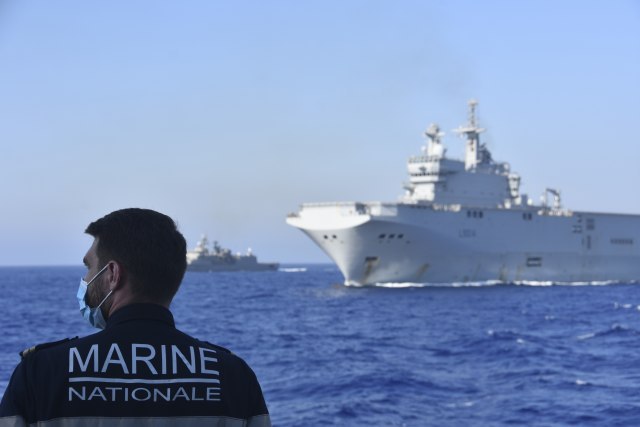
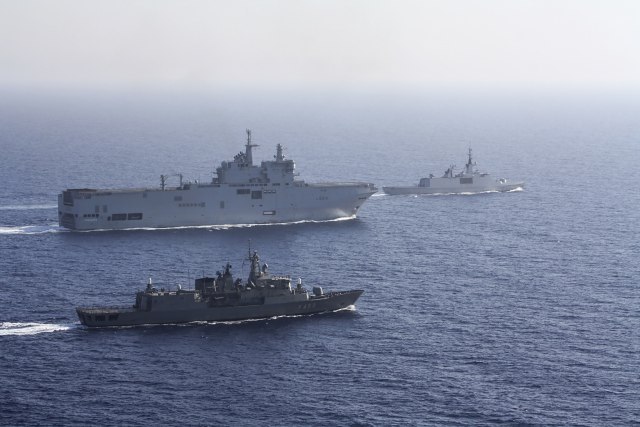
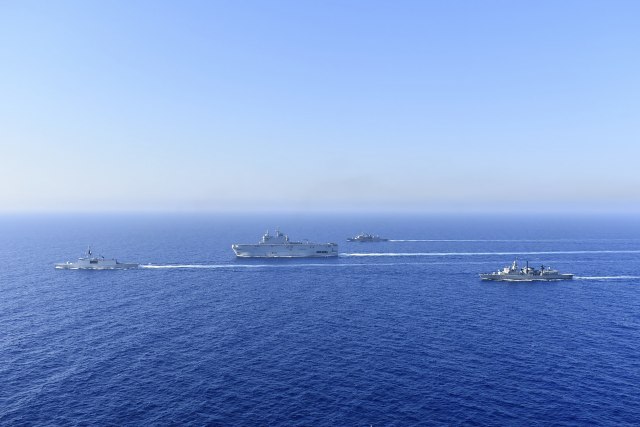
Tensions in the relations between Athens and Ankara provoked reactions, so France immediately sided with Greece and sent a helicopter carrier, a frigate and two "bursts" to the region. Athens was also supported by Israel, while Germany called on the conflicting parties to come to their senses.

Greece, meanwhile, has called on Americans to step up their presence in the Eastern Mediterranean. Greek Minister of Foreign Affairs Nikos Denidas requested a more significant engagement of American forces from US Secretary of State Mike Pompeo in Vienna, "Ta nea" reports.
Foto: Tanjug/Greek National Defence via AP
EU in solidarity with Greece

Tonight, the foreign ministers of the European Union member states expressed "full solidarity" with Greece and Cyprus and called on Turkey for "urgent deescalation", after the Turkish ship started exploring for oil and gas in the disputed waters of the eastern Mediterranean.

EU High Representative for Foreign Affairs and Security Policy Josep Borrell wrote after the emergency meeting on Twitter that the EU expresses full solidarity with Greece and Cyprus and called on Turkey to urgently deescalate and return to negotiations.

The European Union's foreign policy chief expressed "full solidarity" with Greece and Cyprus and urged a "immediate deescalation" by Turkey after EU foreign ministers held urgent talks Friday on high military tensions over offshore drilling rights in the eastern Mediterranean.

Foto: Tanjug/Greek National Defence via AP 
Foto: Tanjug/Greek National Defence via AP
Greek Foreign Minister Nikos Dendias, who met with US Secretary of State Mike Pompeo in Vienna earlier today, said he was "satisfied" with the solidarity of EU partners and their condemnation of "Turkey's illegal behavior".

"Turkey is the only (party) responsible for the escalation of tension in the eastern Mediterranean, and it must immediately leave the Greek continental shelf," Dendias said after Friday's talks. "That is a necessary precondition for deescalation."

The Turkish ship "Oruç Reis" began exploration two days ago in the disputed area in the eastern Mediterranean, rich in oil and gas, despite the opposition of Greece, which claims that the area overlaps with its continental shelf.

Turkish President Recep Tayyip Erdogan said earlier that Ankara would continue exploratory drilling until August 23, as planned, but after a telephone conversation with German Chancellor Angela Merkel, he hinted that Ankara and Berlin had agreed to "soften" the position when it comes to date.

However, he said on Friday that Turkey continues to work on oil and gas exploration in the eastern Mediterranean, because Greece has not kept its promises regarding those activities in the region.

Thursday, August 13, 2020

Από την κρίση Ελλάδας- Τουρκίας, κινδυνεύει το …Κοσσυφοπέδιο!

SManalysis

Αύγουστος  13, 2020. Echedoros
Πρίστινα.

Ο καθηγητής πανεπιστημίου του τμήματος φιλοσοφίας, Μπλερίμ Λατίφι, έχει προβεί σε προειδοποιήσεις για κινδύνους στο Κοσσυφοπέδιο, εξαιτίας του ξεσπάσματος μεγάλης κρίσης μεταξύ Τουρκία και Ελλάδας.


Σημειώνει ότι η σύγκρουση των δύο χωρών οφείλεται στα αποθέματα υδρογονανθράκων.


Σύμφωνα με ανάρτησή του στα μέσα κοινωνικής δικτύωσης έγραψε ότι τα ισχυρά κράτη, όπως οι ΗΠΑ, η Ρωσία, η Αίγυπτος, το Ισραήλ, αλλά και η ΕΕ εμπλέκονται σε αυτήν τη σύγκρουση.

Ο Λατίφι σημειώνει  ότι «κανείς πλέον δεν ασχολείται με το Κοσσυφοπέδιο, και ο χρόνος δεν λειτουργεί πια για εμάς».

«Η χημική έκρηξη στο Λίβανο και η πτώση της κυβέρνησης εκεί θα μπορούσαν εύκολα να ξαναρχίσουν έναν κύκλο εμφυλίων πολέμων στον αραβικό κόσμο. Σε αυτό το πλαίσιο, είναι απολύτως σαφές ότι κανείς δεν θα έχει χρόνο να πάρει σοβαρά το Κοσσυφοπέδιο. Ο χρόνος δεν λειτουργεί για εμάς. Αντιθέτως, όλες οι τάσεις μιλούν το αντίθετο. Όταν προσθέτουμε σε αυτό το γεγονός ότι  και εμείς οι ίδιοι δεν παίρνουμε στα σοβαρά την κατάστασή μας, δεν είναι καθόλου δύσκολο να μαντέψουμε ποιες θα είναι οι συνέπειες», γράφει χαρακτηριστικά.

Ρωσικό δημοσίευμα: «Ελληνική φρεγάτα ‘εμβόλισε’ τουρκικό πολεμικό πλοίο με πλήρη ταχύτητα»

SManalysis

Αύγουστος 13, 2020. Echedoros
Φρεγάτα του ελληνικού πολεμικού ναυτικού κατά τη διάρκεια της πρόκλησης του τουρκικού ναυτικού, χτύπησε με πλήρη ταχύτητα ένα τουρκικό πολεμικό πλοίο που εμφανίστηκε κοντά στα χωρικά ύδατα της Ελλάδας και προσπάθησε να παραβιάσει τα ελληνικά όρια.


 Έγινε γνωστό ότι τουλάχιστον δύο Τούρκοι ναύτες που ήταν στο κατάστρωμα εκείνη τη στιγμή τραυματίστηκαν, ωστόσο, τίποτα δεν απειλεί τη ζωή και την υγεία τους.


Σύμφωνα με τα στοιχεία που διατέθηκαν στη ρωσική ιστοσελίδα Avia.pro, το ελληνικό πολεμικό ναυτικό,  προσπάθησε να αποτρέψει ένα τουρκικό πολεμικό πλοίο να εισέλθει στα χωρικά ύδατα της χώρας, και έκανε έναν ελιγμό με πλήρη ταχύτητα, ως αποτέλεσμα του οποίου να χτυπήσει μια τουρκική φρεγάτα. 

Το τουρκικό πολεμικό πλοίο δεν υπέστη σοβαρή ζημιά, ωστόσο, κατά τη διάρκεια της σύγκρουσης, το τουρκικό πλοίο έστρεψε επικίνδυνα το πηδάλιο για να αποφύγει τη σύγκρουση, ως αποτέλεσμα του οποίου οι ναυτικοί στο κατάστρωμα γκρεμίστηκαν και δέχθηκαν μώλωπες και μικρούς τραυματισμούς. 


Η επιδείνωση της κατάστασης αποφεύχθηκε, ωστόσο, η Ελλάδα δήλωσε ότι είναι έτοιμη να λάβει πιο σοβαρά μέτρα εάν η Άγκυρα αποφασίσει να συνεχίσει την κλιμάκωση της κατάστασης στην περιοχή.

Πρόσφατα έγινε γνωστό ότι η Ελλάδα χρησιμοποίησε για πρώτη φορά τα συγκροτήματα S-300 που αποκτήθηκαν από τη Ρωσία εναντίον των τουρκικών F-16, τα οποία παραβίασαν δύο φορές τα εναέρια σύνορα της χώρας - η πυροδότηση δεν άνοιξε, ωστόσο, τα συγκροτήματα ήταν σε πλήρη επιφυλακή.

Νωρίτερα έγινε γνωστό ότι οι περισσότερες χώρες της ΕΕ και τα μέλη του ΝΑΤΟ υποστήριξαν την Ελλάδα, κατηγορώντας την Τουρκία για κλιμάκωση της κατάστασης, σημειώνει το ρωσικό δημοσίευμα.

Τι λένε οι Τούρκοι…


Οι Τούρκοι στα μέσα κοινωνικής δικτύωσης, ανατρέπουν τα γεγονότα του περιστατικού και τα παρουσιάζουν με τη δική τους εικόνα, της παραπληροφόρησης:

«Η ελληνική φρεγάτα Λήμνος F451, που πλησίασε την φρεγάτα TCG Kemalreis για να την εμποδίσει, υπέστη ζημιά. Αναφέρθηκε ότι η φρεγάτα Λήμνος F451 ρυμουλκήθηκε με τη βοήθεια ενός ρυμουλκού», γράφει ο Τούρκος με το όνομα Mavi Vatan.


MaviVatan.net
@mavivatannet
·
22 ώ
TCG Kemalreis fırkateynini engelleme ve tahrik amaçlı yaklaşan Yunan F451 Limnos fırkateyni hasar aldı. F451 Limnos fırkateyni römorkör yardımı ile çekildiği aktarıldı.

Friday, August 7, 2020

Greeks are more prepared to go to war than Turks are, poll finds

SManalysis
Greeks are more prepared to go to war than Turks are, poll finds
by PAUL ANTONOPOULOS


Greeks are more prepared to go to war than Turks are, poll finds

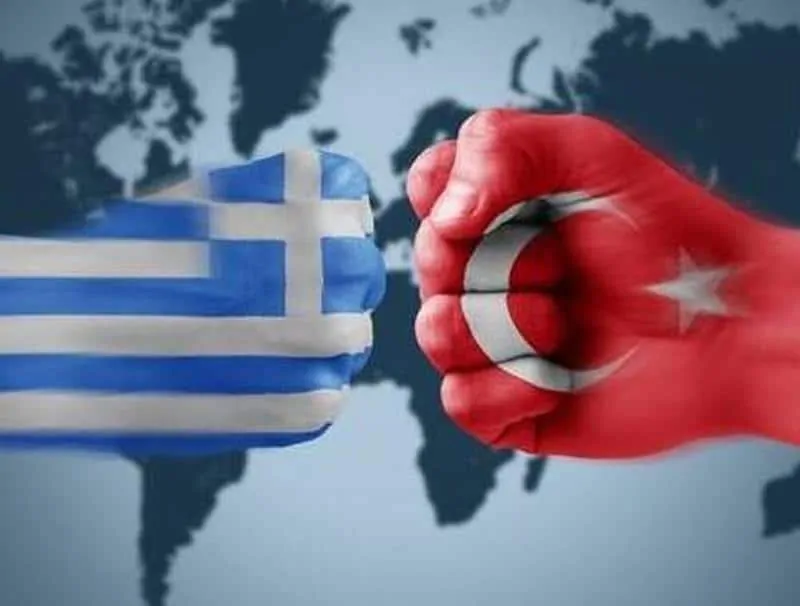
A poll has found that Greeks are more willing to go to war with Turkey, compared to Turks willing to go to war with Greece.

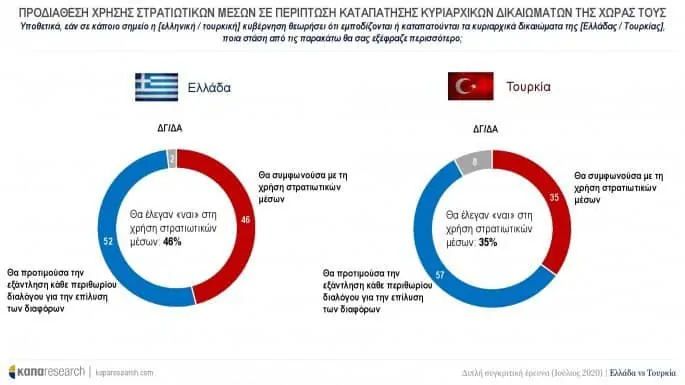
Kapa Research analyzed several issues relating to Greek-Turkish relations, including the conversion of Hagia Sophia into a mosque, gas resources in the Eastern Mediterranean, the predisposition for the use of the army in case of violations of sovereign rights, and views of world leaders.

On the subject of Hagia Sophia, the vast majority (86%) of Greeks said that Turkey should keep Hagia Sophia as a museum. Only 45% of Turks also believe that the historic church should not be turned into a mosque.

On the issue of the exploitation of natural resources in the Eastern Mediterranean, the positions are diametrically opposed. Greeks (91%) consider that research carried out by Turkish ships in the region violate international law and have become a factor of instability in the region. 81% of Turks say that their country has rights in the Aegean and the Eastern Mediterranean and properly conducts exploration for gas and oil fields.
Greeks are more prepared to go to war than Turks are, poll finds 3
In the hypothetical scenario, where things get worse and if at some point the Greek and Turkish government considers that the sovereign rights of Greece/Turkey are being obstructed or violated, both nationalities want to exhaust the possibilities of dialogue instead of war. However, the inhabitants of Greece are more prepared for military use (46%) than Turks (35%).

Greeks are more prepared to go to war than Turks are, poll finds 3

The issue of coronavirus worries the residents in Turkey as according to the research, 77% state that they are worried that they or a member of their family will get sick. In Greece, only 54% are worried.

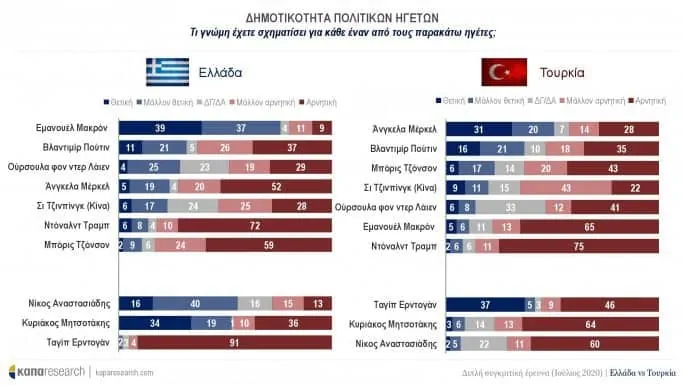
As for the leaders, 95% of the population in Greece has a negative or rather negative view of the Turkish President, Recep Tayyip Erdoğan, while 55% of Turks themselves have a negative view of their president. On the other hand, Greek Prime Minister Kyriakos Mitsotakis enjoys 53% acceptance in Greece and only 9% in Turkey.

Greeks are more prepared to go to war than Turks are, poll finds 4
As for the leaders of other countries, it seems that in Greece the most liked are Emmanuel Macron (76% positive opinion) and Vladimir Putin (31% positive opinion), while the most disliked are Donald Trump (14%) and Boris Johnson (11%). In Turkey, the most beloved are Angela Merkel (51%) and Vladimir Putin (37%) and the most disliked are Emmanuel Macron (11%) and Donald Trump (8%).

Ερντογάν για ΑΟΖ Ελλάδας – Αιγύπτου: «Δεν υπάρχει συμφωνία – Ξεκινάμε γεωτρήσεις»

SManalysis

Ερντογάν για ΑΟΖ Ελλάδας – Αιγύπτου: «Δεν υπάρχει συμφωνία – Ξεκινάμε γεωτρήσεις»
ΕΘΝΙΚΑ ΘΕΜΑΤΑ , ΕΘΝΙΚΗ ΑΜΥΝΑ , ΕΝΕΡΓΕΙΑΚΑ , ΤΟΥΡΚΙΑ 7 Αυγούστου 2020


Σε αναμμένα κάρβουνα είναι στην Τουρκία, ύστερα από την ιστορική συμφωνία της χώρας μας με την Αίγυπτο για την οριοθέτηση θαλασσίων ζωνών και μάλιστα, πριν προλάβει να στεγνώσει το μελάνι των υπογραφών των ΥΠΕΞ, εξέδωσε προκλητική NAVTEX για άσκηση με πραγματικά πυρά από τις 11 έως τις 20 Αυγούστου.

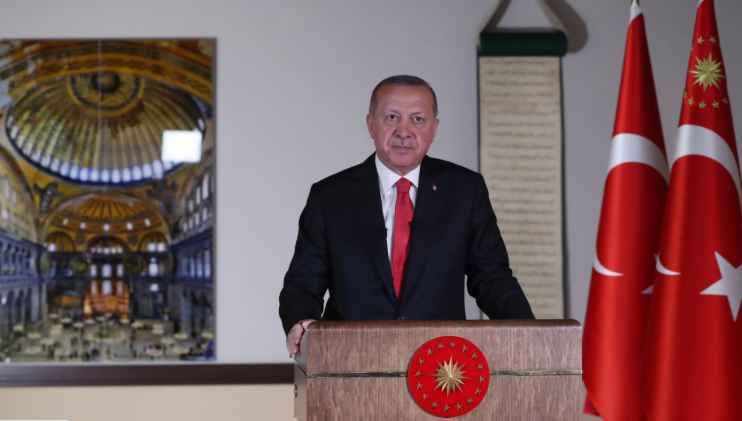
Την ίδια ώρα, ο Ρετζέπ Ταγίπ Ερντογάν παρευρέθηκε στην Αγιά Σοφιά για την προσευχή της Παρασκευής και με δηλώσεις του δεν έκρυψε την οργή του για τα τετελεσμένα ανάμεσα σε Ελλάδα και Τουρκία.


«Δεν υπάρχει τέτοια συμφωνία. Η Μέρκελ μου ζήτησε να σταματήσουμε τις γεωτρήσεις. Τώρα τις ξεκινούμε και πάλι. Ενημερώσαμε σχετικά την Μέρκελ», είπε χαρακτηριστικά ο Ερντογάν.


«Τι κάνουν εκεί η Ελλάδα και η Αίγυπτος; Αφού υπογράψαμε τη συμφωνία με τη Λιβύη, όλοι έπεσαν σε αυτό το γεγονός. Αυτή η συμφωνία μεταξύ Ελλάδας και Αιγύπτου δεν έχει αξιοπρέπεια. Η Μέρκελ μου ζήτησε να σταματήσω τις εργασίες γεώτρησης. Είπαμε, “Εάν εμπιστεύεστε την Ελλάδα, θα σταματήσουμε να δουλεύουμε για μερικές εβδομάδες, αλλά εμείς δεν τους εμπιστευόμαστε.”


Δεν τήρησαν τις υποσχέσεις τους και τώρα συνεχίζουμε αμέσως τις εργασίες γεώτρησης. Θα συνεχίσουμε τη συμφωνία μας με τη Λιβύη με αποφασιστικότητα. Ειδικά στις ναυτιλιακές δικαιοδοσίες, δεν χρειάζεται καν να διαπραγματευτούμε με εκείνους που δεν έχουν δικαιώματα ή νόμους», τόνισε.

ΠΗΓΗ: Newpost.gr

Thursday, August 6, 2020

Don’t Leave the Balkans to Europe

SManalysis
Kosovo - Wikipedia

For all its bungling and missteps, the Trump Administration’s decision to pay attention to the Kosovo-Serbia dispute is a step in the right direction.

Transatlantic relations, on fragile footing for the better part of the last three and a half years, have been fracturing further across a region that has in the recent past been a rare area of policy consensus. The Western Balkans, always a difficult portfolio, had seen a rare breakthrough agreement in 2018, when Greece and North Macedonia signed the Prespa Agreement, putting an end to a contentious dispute that had lasted for decades. Behind the scenes, Washington and Brussels had been instrumental in brokering the deal, paving the way for North Macedonia to resume its journey to full euroatlantic integration.

There was hope that the Serbia-Kosovo dispute, an even thornier issue, might see a similar breakthrough. Serbia’s President Aleksandar Vucic and Kosovo’s President Hashim Thaçi had been promising one for years, dropping hints that an agreement was within reach. Such hopes were dashed late last month. First, the government of Kosovo collapsed during the coronavirus pandemic. Kosovo’s former Prime Minister Albin Kurti, a darling of Berlin and a critic of the ongoing discussions, subsequently alleged that Richard Grenell, Trump’s top official for Kosovo-Serbia talks, had engineered his ouster. In June, Thaçi was indicted for war crimes as he travelled to meet Vucic in Washington at a summit put together by Grenell. His backers allege that the charges—and their timing—were politically motivated to scuttle the talks.

In early July, the EU resumed the Belgrade-Pristina Dialogue for the first time since 2018. Unsurprisingly, however, the only outcome was more meetings—another round of which is taking place today. If the past is any indication, these talks are going nowhere. The stench of stale thinking permeates the corridors in Brussels. The European promise of speeding Serbia’s accession to the EU, its main “carrot” for inducing Serbia to compromise, is barely credible any longer. The EU, meanwhile, has not delivered on its promise of visa liberalization for Kosovo despite its meeting the relevant criteria two years ago. That “carrot” is so rotten that waving it in front of Kosovo’s face is borderline insulting.

This mental sclerosis is compounded by some truly bizarre personnel choices. At least from Kosovo’s perspective, Europe doesn’t just look incompetent; it looks malicious. Its two top officials for Kosovo are from Spain and Slovakia, two states that still do not recognize Kosovo as independent. EU foreign policy chief Josep Borell’s appointment of Miroslav Lajcak, the former Slovak Minister of Foreign Affairs, was met with skepticism in Kosovo, as well as in Bosnia where he served as High Representative over ten years ago. Lajcak lobbied hard within the EU to be in charge of the entire Western Balkans and “requested a much broader portfolio than just the Kosovo-Serbia negotiations, despite knowing very well that this in itself is a full-time job.” In practice, this means that he managed to connect the Serbia-Kosovo dispute to Bosnia. 

This may appear to be only of symbolic consequence, but symbolism matters in these parts. The much-criticized idea of land swaps, rumored to be the “secret sauce” that could get both Belgrade and Pristina to come to an agreement, originated within the office of Borrell’s predecessor Federica Mogherini. Critics correctly point out that this idea has the potential to negatively impact Bosnia, as well as North Macedonia with its large ethnic Albanian minority. By appointing Lajcak as a pan-Balkan hand, all these issues become linked. Allegations that the Trump Administration has taken up Mogherini’s idea of land swaps are indeed worrisome, as we believe that these ideas could be hard to contain. But the silver lining is that there is a clear division of responsibility within Washington: Grenell is exclusively in charge of Kosovo-Serbia talks while Deputy Assistant Secretary and State Department’s Special Envoy Matthew Palmer is in charge of the rest of the region. Tackling issues in the region one-by-one and on clear terms is the only way to make progress. And if Kosovo and Serbia want to make a bilateral agreement in accordance with the Helsinki Final Act, the issue needs to be carefully compartmentalized lest it wreak havoc more broadly. 

Beyond the fumbles in staffing, the EU has shown that it has no broader strategy for confronting Russia in the region. Russia’s goals are simple: Moscow wants to maintain its regional leverage by acting as both spoiler and final arbiter to any solution. The latest manifestation of Russian interference is happening in Serbia, where Russian far-right groups, along with Russian intelligence, are said to have instigated violent riots during anti-lockdown protests. As the riots died down, in the most recent meeting at the Russian National Security Council, Moscow labeled the Kosovo-Serbia dispute as a top priority. 

Russia was one of the most outspoken critics of the NATO intervention in 1999, which has made it popular among Serbs today. Russia routinely uses the 1999 bombing of Yugoslavia as legal precedent for its interventions in Ukraine and its annexation of Crimea. As a permanent UN Security Council member with veto power, Russia can protect Serbia by blocking votes to recognize Kosovo’s sovereignty. During Russian Foreign Minister Sergei Lavrov’s recent visit to Serbia, he and Russia’s closest Serb ally, then Minister of Foreign Affairs Ivica Dacic, wrote a joint letter emphasizing that compromise is only possible if the 1244 UN Security Council Resolution is respected. While the letter stated that “Moscow will agree only with a settlement that Belgrade will accept,” Minister Lavrov firmly stated that Russia’s approval would be required for any solution reached in peace talks. Following recent elections, the Serbian government is now in formation talks, and Moscow is likely lobbying for its closest allies to have prominent roles within it. 

For reasons that aren’t entirely clear, the Trump Administration has taken a keen interest in Kosovo. Some suspect the president simply hopes to make a deal; others that he wanted to beat Angel Merkel on her own turf. The good news for Kosovo is that it is again a foreign policy topic the American Presidential campaign. Former Vice President Biden has come out with a strongly worded statement all but guaranteeing that the United States will remain involved no matter who wins in November. 

Whatever one thinks of Trump’s foreign policy—and we have many, many reservations—his administration’s decision to pay attention to the Kosovo-Serbia dispute is exactly what the experts have been advocating for years. While the EU’s track record in the region is somewhere between abysmal and unproductive, the United States has maintained its credibility throughout the last thirty years, and has many cards to play. The main impediment to regional progress, ironically, is not the Balkans’ sticky politics but Washington’s tensions with Berlin. And those are likely to outlast Trump’s term. Trump’s abusive attitude towards allies has won him few admirers in Europe, but it’s issues such as the use of Chinese 5G technology and the Nordstream 2 gas pipeline that have cast a pall over U.S.-German relations. None of these magically disappear if Biden is elected in November. 

A Biden Administration may be tempted to try to rebuild bridges with Brussels and Berlin by simply backing the existing pointless dialogue, a process that relies on promises of eventual EU accession as its main motive force. This would be a grave mistake. Let’s not beat around the bush: No one believes that countries in the Western Balkans will enter the EU any time soon. But the issue of Kosovo’s recognition cannot wait. If Kosovo does not get a UN seat in the next few years, the pressure to unite with Albania might become unbearable for Kosovo’s political elites. That would also mean redrawing of the borders that would particularly hurt American standing in the region. Taking land swaps “off the table” in no way means that borders will not be redrawn anyway. Should that happen, the Europeans will likely wriggle their hands and claim that Kosovo is a massive failure of multiple American administrations.

Differences between the U.S. and key European states have been growing since the Cold war ended, but the most recent Kosovo dispute shows that the transatlantic partnership has reached a turning point. European inability to solve the crisis in the Balkans in the 90s resulted in the bloodiest conflict Europe had seen since the World War II, which ended only when America took the lead. No matter who wins in November, the U.S. should not leave the region to the Europeans. It’s too important for that.

Published on: July 23, 2020
Reuf Bajrovic co-chairs the US-Europe Alliance. Ivana Stradner is a Jeane Kirkpatrick Fellow at the American Enterprise Institute.

Ο Σερβικός Στρατός απέκτησε έξι drone με βόμβες λέιζερ

SManalysis


Αύγουστος 6, 2020. 19:18
Βελιγράδι.

Η σερβική πολεμική αεροπορία και η αντιαεροπορική άμυνα ενισχύθηκαν πρόσφατα με την αγορά έξι μη επανδρωμένων εναέριων οχημάτων, δηλαδή τηλεχειριζόμενα από απόσταση,  αεροσκάφη CH-92A  καθώς και βόμβες αεροσκαφών που καθοδηγούνται με λέιζερ,  από τη Λαϊκή Δημοκρατία της Κίνας.


Με την αγορά νέων αυτών UAV, ο Σερβικός Στρατός έγινε ο πρώτος χρήστης τέτοιων αεροσκαφών στην περιοχή και βελτίωσε σημαντικά τις δυνατότητες αναγνώρισης και ασφάλειας του σερβικού εναέριου χώρου.


Αίθουσα χειρισμού μη επανδρωμένων εναέριων οχημάτων
Οι αεροπορικές βόμβες με λέιζερ, μπορούν να χρησιμοποιηθούν σε ελαφρά θωρακισμένα οχήματα και οχυρωμένες θέσεις.
«Σε μια εποχή που είναι αδύνατο να φανταστούμε σύγχρονα πεδία μάχης χωρίς την ενεργή χρήση μη επανδρωμένων αεροσκαφών, τόσο στην ξηρά όσο και στον αέρα και το νερό, η προμήθεια μιας νέας κατηγορίας αεροσκαφών φέρνει νέες ευκαιρίες ανάπτυξης στον σερβικό στρατό», σημειώνει το δημοσίευμα της σερβικής «Βετσέρνιε Νόβοστι»/«Вечерње новости».


--

Wednesday, August 5, 2020

Grenell's successor: These people have never been our friends

SManalysis
Douglas McGregor nominated for the post of U.S. Ambassador to Germany
The candidate for the new US ambassador to Germany, Douglas McGregor, criticized the US intervention in Kosovo in 1999

SOURCE: TANJUG WEDNESDAY, AUGUST 5, 2020 | 12:59

He assessed that it was directed against Orthodox Christian Serbs and that a Muslim drug mafia was set up after it, which was called a success for democracy, CNN writes in a text in which it reminds of his other statements, which he calls xenophobic and racist.

"These people have never been our friends," said McGregor, who will replace Richard Grenell as US Ambassador to Germany.

CNN states that, in addition to statements in favor of Serbia, although at that time as a military staff member he participated in the preparation of the NATO campaign, McGregor published statements that contradict the official policy of Washington, such as when he sided with Russia in the conflict in Ukraine.

The text estimates that, if his appointment is approved by the US Senate, it will mark another low point of the American-German relations, which worsened during the mandate of President Donald Trump.

White House spokesman Judd Deer told CNN by email that McGregor was highly qualified for the job of ambassador, referring to the knowledge of German history and language that he learned while serving in West Germany.

Vučić met with the Russian Ambassador - topic of conversation - Putin's visit

SManalysis
FOTO TANJUG/ INSTAGRAM &BUDUCNOSTSRBIJEAV
Today, the President of Serbia, Aleksandar Vučić, received the Ambassador of the Russian Federation, Aleksandar Botsan Kharchenko.

SOURCE: TANJUG WEDNESDAY, AUGUST 5, 2020 | 12:09

He discussed with him the current issues of Serbian-Russian relations and bilateral cooperation, especially the realization of concrete agreements and joint projects.

The two interlocutors expressed hope that the circumstances will soon allow both countries to fully commit to the realization of joint plans for cooperation in various fields.

They also expressed the expectation that they would enable more frequent interstate contacts and exchange of high-level visits, so that the announced visit of President Putin would be prepared in the best way.

Vučić and Botsan Kharchenko discussed the course of the dialogue between Belgrade and Priština, especially the missing and internally displaced persons, as well as the economic issues

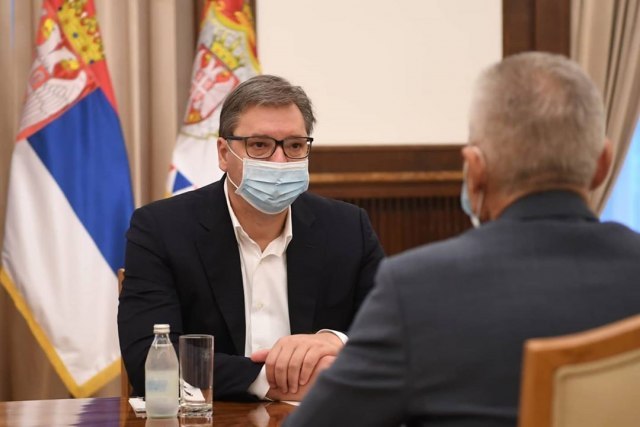
The two interlocutors agreed that it would be essential to implement previously reached agreements between Belgrade and Pristina, especially those concerning the Union of Serbian Municipalities.