Saturday, August 22, 2020

How Did the Eastern Mediterranean Become the Eye of a Geopolitical Storm?

SManalysis
Sailors standing on the deck of a warship at a parade during the Turkish International Ceremony at Mehmetcik Abidesi Martyrs Memorial near Seddulbahir Turkey on April 24, 2015.
The region’s powers and the West are facing off against Turkey—and Turkey is not going down without a fight.

BY MICHA’EL TANCHUM FP | AUGUST 18, 2020, 10:30 AM

Sailors standing on the deck of a warship at a parade during the Turkish International Ceremony at Mehmetcik Abidesi Martyrs Memorial near Seddulbahir Turkey on April 24, 2015.

Sailors standing on the deck of a warship at a parade during the Turkish International Ceremony at Mehmetcik Abidesi Martyrs Memorial near Seddulbahir Turkey on April 24, 2015. CARSTEN KOALL/GETTY IMAGES

In mid-August, a Turkish and a Greek warship collided in the Eastern Mediterranean, raising tensions in the most combustible naval stand-off the region has witnessed in 20 years. The crisis had started two days before, when Turkey deployed an energy exploration ship along with its naval escort to search for oil and natural gas in waters near the Greek island of Kastellorizo—waters Athens claims as its own maritime territory.

More than ever before, the latest cycle of escalation risks spiraling into a multinational conflict.  Making a show of staunch support for Greece against Turkey, France dispatched warships to the contested waters and promised more. Egypt and Israel, which hold regular joint military exercises with Greece, have also expressed their solidarity with Athens. With France and Egypt already in open conflict with Turkey in Libya, observers around the world fear that any further escalation in the Eastern Mediterranean could set off a Euro-Middle Eastern maelstrom.

How did the Eastern Mediterranean become the eye of a geopolitical storm?

For decades, Eastern Mediterranean maritime boundary disputes were a local affair, confined to sovereignty claims and counterclaims among Cyprus, Greece, and Turkey. But over the past five years, the region’s offshore natural gas resources have turned the Eastern Mediterranean into a key strategic arena through which larger geopolitical fault-lines involving the EU and the MENA region converge. Italy and France have played integral roles in driving that change, which has placed the EU and Turkey’s already complicated relationship onto more adversarial terms.

The game changer was the August 2015 discovery of the massive Zohr natural gas field in Egyptian maritime territory by the Italian energy major Eni. The largest Eastern Mediterranean gas find to date, Zohr’s advent meant the region suddenly collectively had marketable volumes of natural gas. Eni, which is also the lead operator in Cyprus’s natural gas development, began promoting a plan to pool Cypriot, Egyptian, and Israeli gas and use Egypt’s liquefaction plants to cost-effectively market the region’s gas to Europe as liquified natural gas (LNG). The Italian company also happens to be a lead stake holder in one of Egypt’s two LNG plants.

Although commercially sensible, there was a geopolitical glitch to the Egypt-based LNG marketing scheme: It left no role for Turkey and its pipeline infrastructure to Europe, dashing Ankara’s in-progress plans to become a regional energy hub. In 2018, French energy giant Total, the EU’s third largest company by revenue, dealt another blow to Turkey by partnering with Eni in all of the Italian firm’s gas development operations in Cyprus, placing France in the middle of the eastern Mediterranean energy morass. Around the same time, Cyprus officially agreed to supply Egypt’s LNG plants for export. After Cyprus inked that deal, Israel, which had previously been considering building an Israel-Turkey undersea gas pipeline, followed suit and contracted to sell its gas to Egypt as well.

Turkey expressed its displeasure at these developments by engaging in a series of measured exercises of gunboat diplomacy, sending exploration and drillships into Cypriot waters, each with naval escort. The country continues to refuse to recognize Cyprus’s maritime boundaries, which Ankara maintains were drawn illegally at Turkey’s expense.The country continues to refuse to recognize Cyprus’s maritime boundaries, which Ankara maintains were drawn illegally at Turkey’s expense. In doing so, it claims to be defending the rights of Turkish Cypriots in the northern half of the ethnically divided island, who have been left out of the development of Cyprus’s offshore natural gas reserves despite being the legal co-owners of Cyprus’s natural resources.
With each Turkish action, the Egypt-Israel-Cyprus-Greece front increasingly gained military support from France, Italy, and the United States, each of which has significant economic investments in Eastern Mediterranean gas. For Turkey, its NATO allies’ support of this group is a betrayal, and tantamount to a policy of containment, which it cannot tolerate.

How did Libya enter the Eastern Mediterranean Morass?

In a bid to break out of its regional isolation, in November 2019 Turkey signed its own maritime demarcation agreement with the Tripoli-based Government of National Accord (GNA) in war-torn Libya. The deal was an attempt to gain greater legal standing to challenge the maritime borders Greece had established with Cyprus and Egypt, upon which their eastern Mediterranean natural gas development plans depend. The Ankara-Tripoli maritime boundary agreement was accompanied by a military cooperation pact providing the GNA a security guarantee against the efforts of General Khalifa Haftar’s forces, backed by France and Egypt, to topple the Tripoli-based government.  The GNA formally activated its military pact with Ankara in December, linking the already tense maritime stand-off in the Eastern Mediterranean to the Libyan civil war.

READ MORE

Turkish President Recep Tayyip Erdogan and Russian President Vladimir Putin
Congress Pushes for Sanctions on Turkey, Russia Over Libyan War
Putin and Erdogan “act when there’s a stick involved,” a House aide said.

REPORT | JACK DETSCH, AMY MACKINNON
An employee sorts Turkish lira banknotes at a bank in the town of Sarmada in Syria’s northwestern Idlib province on June 14.
Erdogan Has Hidden an Economic Disaster Deep in Turkish Banks
And he won’t be able to keep the game going for much longer.

ARGUMENT | CHRIS MILLER
Kyriakos Mitsotakis
Greece Accidentally Steered Into a Foreign-Policy Crisis
Turkey is redrawing its borders in the Aegean—and the Greek government is failing to do much about it.

ARGUMENT | YIANNIS BABOULIAS
Ankara’s overt intervention in the conflict in the first half of 2020 turned the tide of the Libyan civil war.Ankara’s overt intervention in the conflict in the first half of 2020 turned the tide of the Libyan civil war. Having succeeded in preserving the GNA, Turkey’s large military presence in Libya now provides Ankara a platform from which to challenge Cyprus, Egypt, and Greece over the Eastern Mediterranean’s maritime boundaries. Taking advantage of its newly enhanced regional position, Turkey sought to press its claims against Greece by sending its Oruç Reis seismic survey ship, accompanied by a group of five naval vessels, to the contested waters near Kastellorizo.
So what’s Turkey beef in the Eastern Mediterranean?

From Turkey’s viewpoint, Eastern Mediterranean’s de facto maritime boundaries unjustly and illegally deny Turkey part of its rightful maritime territory. Therefore, the region’s arrangements for offshore natural gas development, which depend on these de facto boundaries, are likewise illegitimate. In turn, Turkey regards its actions as defending international law. The divide goes back to the so-called Seville map that informs the region’s commonly accepted maritime boundaries. This European Union-commissioned map study, which was prepared by the University of Seville in the early 2000s, made the decision to define maximal boundaries for Greece and Cyprus at Turkey’s expense by using the coast of every inhabited Greek island—no matter how small and no matter how close to Turkey’s shores—as its starting point. Turkey has a point about the demarcations being unfair. Turkey’s Mediterranean coastline is longer than the U.S.-Mexico border. Under the United Nations Convention on the Law of the Sea (UNCLOS) principle of equity and the international case law based upon it, Turkey is likely entitled to a larger maritime zone than it is has received on account of that extensive coastline. However, Turkey refuses to become an UNCLOS signatory, closing off its avenue of legal recourse.

Instead, Turkey found a partner with which to make its own map. In a mirror-image move to the Seville Map, the map of the Turkey-Libya maritime boundary agreement defines a maximal maritime zone for Turkey by denying any of Greece’s islands a continental shelf or an exclusive economic zone (EEZ), which provides sovereign rights over offshore energy resources. The agreement establishes an 18.6 nautical mile boundary segment between Turkey and Libya, and then, projecting out from that line, the Ankara-Tripoli map exclusively divides the entire maritime zone between Turkey and Libya, an area stretching from Turkey’s southwestern corner to the opposite coast in eastern Libya. All of Greece’s islands are effectively ignored.

Turkey’s method for drawing the Ankara-Tripoli map is specious. Most egregiously, the map ignores the presence of Crete, which is 3,219 square miles and between these coasts. UNCLOS Article 121, an article dealing with the legal status of islands, affirms that island coastlines generate continental shelves and EEZs the same as any coastal land formation, except those that “cannot sustain human habitation or economic life of their own.” Crete, with a population of almost 650,000 (nearly the same as Athens), would unquestionably generate an EEZ.

On Aug. 6 this year, Greece decided to answer Turkey in kind by signing a similar maritime delimitation agreement with Egypt. Days later, the Oruç Reis research ship and its naval escort charged into waters within Greece’s maritime boundaries.

What’s Next? 

There are strong incentives for most of the parties in the region and the European Union to contain the current escalation and find an off-ramp to the crisis. Despite backing Greece, neither Egypt nor Israel can afford to be drawn into a war with Turkey in the Eastern Mediterranean. The EU has expressed its unequivocal support for members Greece and Cyprus, but the bloc is divided on how to handle the current crisis. The six Mediterranean EU countries are evenly split.  Greece, Cyprus, and France advocate strong action against Turkey while Italy, Malta, and Spain—which all share significant commercial interests with Turkey in the central and western Mediterranean—have refrained.

Germany, holding the EU presidency since July, could break the deadlock.

Although Berlin typically defers to Paris on Mediterranean policy, it is keen to keep Ankara as close to the EU as possible. Still, Turkey is playing close to the edge.  If it pushes too far, the European Union, as well as the United States, will swing fully over to the side of Greece. The red line that Turkey cannot cross is Crete, whose southern waters are thought to contain significant volumes of oil or natural gas. Although internationally recognized as Greek territorial waters, the Ankara-Tripoli map assigns the area to Libya. If Turkey sends its energy exploration ship near the southern shores of Crete, then all bets are off.

So far, Turkey has not crossed that line. Ankara may be holding exploration in Crete’s waters as a negotiating card. Any serious deescalation process between Turkey and Greece requires a third party with sufficient sway to push Ankara and Athens into serious talks. In that respect, perhaps the most hopeful sign for the region is the recent constructive efforts of the United States to achieve a cease-fire and buffer zone in Libya. The de-linking of the various regional conflicts creates an opening for a pragmatic dialogue on Mediterranean maritime boundaries. There is a window for an off-ramp. That opportunity will require the United States, perhaps in concert with Germany, to act with diplomatic skill and commitment.

Michaël Tanchum teaches international relations of the Middle East and North Africa at the University of Navarra, Spain and is a senior fellow at the Austrian Institute for European and Security Studies (AIES). He also holds fellow positions at the Truman Research Institute for the Advancement of Peace, the Hebrew University, Israel, and at the Centre for Strategic Policy Implementation at Başkent University in Ankara, Turkey (Başkent-SAM). Twitter: @michaeltanchum

Greek PM's message to Turkey on CNN- ‘Stop provocations’

Greek PM's message to Turkey on CNN- ‘Stop provocations’
by GCT

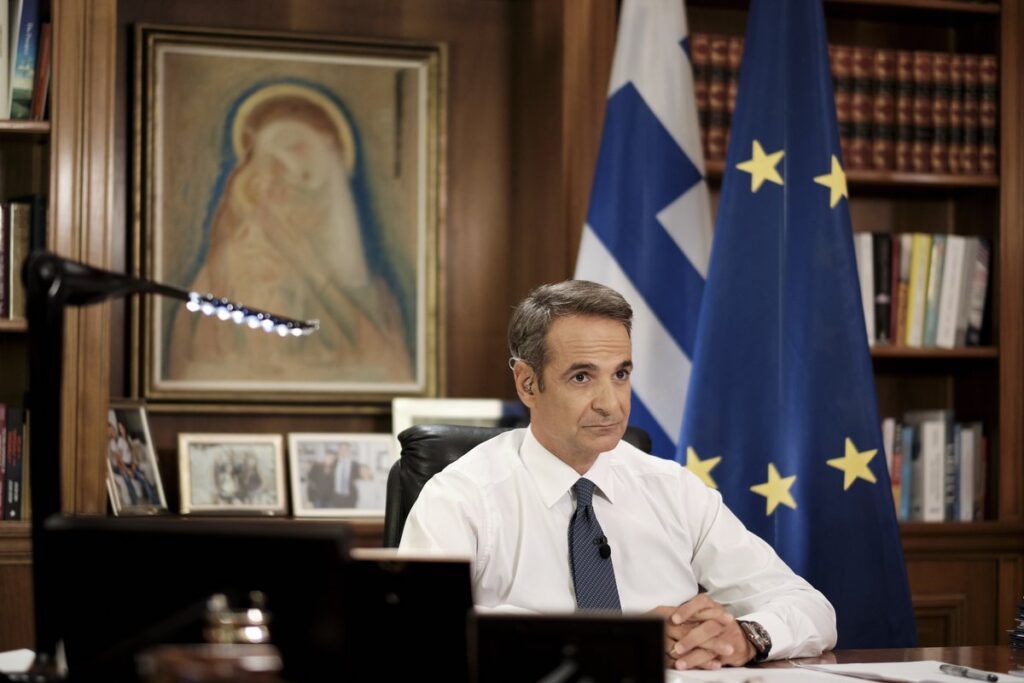
Greek Prime Minister Kyriakos Mitsotakis called on Turkey to “stop the provocations” in the Eastern Mediterranean, during an interview on CNN with Christiane Amanpour on Wednesday evening.

“My message to Turkey is very simple: stop the provocations and let’s start talking as civilised neighbours,” Mitsotakis stated, adding that the only disagreement with Turkey is the delimitation of maritime zones.

“What we’ve told Turkey very openly is that we should sit and discuss as civilised neighbours,” and if the issue cannot be resolved between the two, “then we can always take it to the international court,” he added.


The PM stressed that Greece “cannot tolerate is unilateral activity by Turkey,” which challenges Greece’s EEZ “by sending not just an exploration ship but also a significant number of military vessels to the area. Greece has never escalated tension first.”

Turkey is behaving in a manner that does not accord with international law, he said, especially towards a fellow NATO member. “If Turkey considers these areas to be disputed and we consider them to be part of the Greek EEZ, they should sit down with us and discuss about it. This is what we have always proposed. What we cannot accept is a fait accompli as a result of Turkish provocation,” he continued.

This issue, Mitsotakis further said was not a Greek-Turkish one. “I don’t think this is a disagreement between two neighbours. I think this is a challenge for Europe, it’s a challenge for the world,” he stressed.

Mitsotakis also said that the neighbouring country should know that if it continues its unilateral path, it will damage its relationship with the EU, and there will be consequences.

The Greek PM also referred to the recent agreement with Egypt for the demarcation of exclusive economic zones, saying it could “serve as a blueprint” for other agreements in the region. “But this cannot happen if we are engaged in sabre-rattling and if we have to face now and then half the Turkish fleet sailing in the Aegean or the eastern Mediterranean,” he continued.

When asked about the New York Times article claiming that the Greek Coast Guard had abandoned migrants at sea, he said that Greece had been a victim of a misinformation campaign. This is part of Turkey’s efforts to “weaponise the migration issue,” he pointed out, as Europe saw at the Evros borders between the two countries. It also insults the Greek Coast Guard, which has saved tens of thousands of lives in the sea and the Greek islands that took so many migrants in.

“Greece is a country that respects international rules. We have granted asylum to tens of thousands of people and helped them integrate in Greek society. We are working with Europe on a new pact on immigration and refugees. We want the Europeans to be our partners in this effort. We do not want to be left alone in managing this problem. We are the first country to organise returns of migrants whose asylum applications have been rejected, in tandem with the International Migration Organisation. We have a comprehensive migration/refugee strategy, which at its premise has the need to protect both our land and sea borders,” he concluded.

Friday, August 14, 2020

Ο Μέτα επιστρέφει νόμο που ορίζει ολόκληρη την ακτογραμμή ως κρατική ιδιοκτησία

SManalysi

την 8/14/2020 Link


Ο Πρόεδρος της Αλβανίας, Ίλιρ Μέτα, επέστρεψε τον πρόσφατο «νόμο περί ακινήτων», ο οποίος είχε ως στόχο να μετατρέψει τις ακτές σε κρατική περιουσία.

Ο Πρόεδρος υποστηρίζει ότι ο νόμος συζητήθηκε και ψηφίστηκε εντός επτά ημερών, σε μια στιγμή που η προσοχή του κοινού επικεντρώθηκε στις συνταγματικές τροποποιήσεις της εκλογικής μεταρρύθμισης.


Ένα άλλο ζήτημα με το οποίο ο Πρόεδρος δεν συμφωνεί είναι ο τρόπος εφαρμογής του νόμου.

Η πρωτοβουλία αναλαμβάνει να περάσει την ακτογραμμή από τη Βελιπόγια της Σκόδρας, μέχρι τα Εξαμίλια των Αγίων Σαράντα υπό κρατική περιουσία, αλλά ο νόμος δεν προσδιορίζει ποια περιοχή θεωρείται ως «ακτογραμμή», πόσα μέτρα από την ακτή προς την ενδοχώρα.

Ο Πρόεδρος ισχυρίζεται ότι ο νόμος θα πρέπει να έχει έναν χάρτη συνδεδεμένο με ολόκληρη την επικράτεια όπου θα τεθεί σε ισχύ ο νέος νόμος.


Να υπενθυμίσουμε πως ο νόμος αφορά άμεσα την Εθνική Ελληνική Μειονότητα, ενώ, κατά πολλούς θα αποτελέσει το όχημα της κυβέρνησης Ράμα για την υφαρπαγή της περιουσίας των μελών της.

Athens supported by France and Israel - tensions are growing every day

SManalysis
Foto: Tanjug/French Defense Ministry via AP
The Turkish research ship "Oruç Reis", located halfway between Crete and Cyprus, is being followed by a Greek flotilla.

SOURCE: RTS, TANJUG FRIDAY, AUGUST 14, 2020 | 23:02

The eyes of the whole world are focused there because of the new, dangerous tensions between Athens and Ankara, RTS writes, referring to the Greek media.

Athens is demanding the deployment of American forces.

The close meetings of Turkish and Greek frigates, which have aroused passions in the eastern Mediterranean in the last 24 hours, have been replaced by the inflammatory rhetoric of Ankara officials, so Finance Minister Berat Albayrak said it was time for the new generation to pay the price of independence.

"Our leader did not give up. It is our duty. If they attack us, we will fight back. We will fight to the end," Albayrak said, daily Hurriyet reports.

The Turkish minister's statement followed a series of similar words by President Recep Tayyip Erdogan, who warned Greece that the fleet accompanying the research ship "Oruç Reis" would retaliate against any provocation by Greek ships.

Although the media in Greece and Turkey report a significantly growing number of fighter jets in the zone where several hundred incidents have been registered over the past year, it seems that the two fleets, after a close encounter between frigates, are still enough far away to avoid any future problems.

According to the Marintrafik website, which monitors maritime traffic, the Turkish flotilla and "Oruç Reis" were about halfway between Crete and Cyprus on Friday afternoon, with occasional confusing maneuvers.
Foto: Tanjug/Greek National Defence via AP
Greece's "Ta nea" states that "Oruç Reis" changed course by 180 degrees, and that the next destination of the Turkish flotilla is not known now.

"Oruç Reis" changed course only 24 hours after the collision of the Greek and Turkish frigates during, apparently, clumsy maneuvering, which later led to serious accusations by the two sides and threats by Recep Tayyip Erdogan that Turkish ships would respond fiercely in the next such incident.

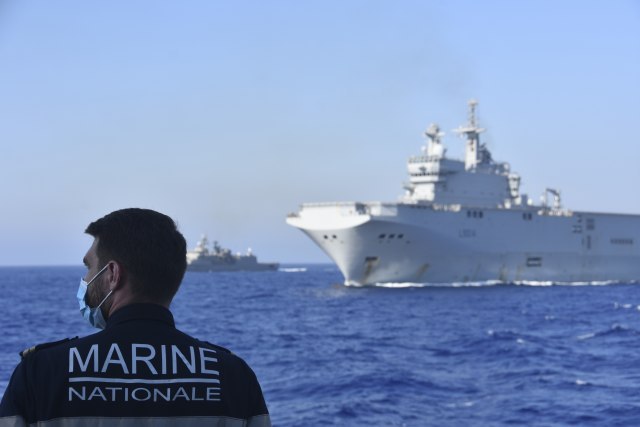
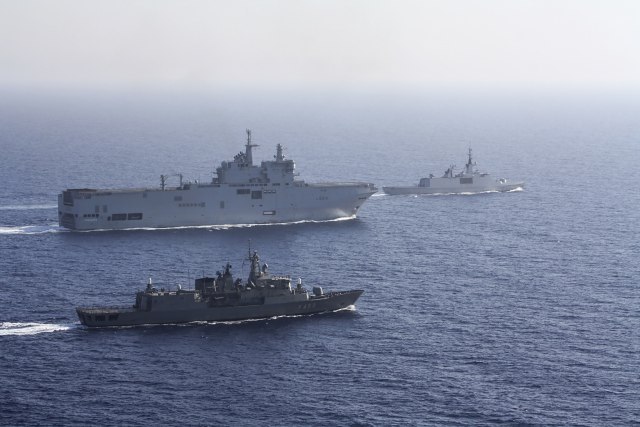
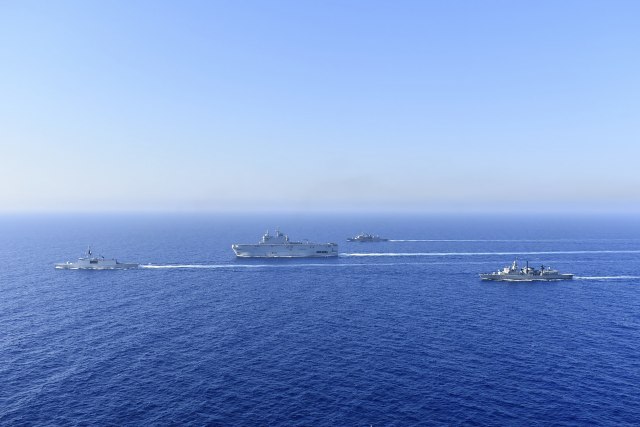
Tensions in the relations between Athens and Ankara provoked reactions, so France immediately sided with Greece and sent a helicopter carrier, a frigate and two "bursts" to the region. Athens was also supported by Israel, while Germany called on the conflicting parties to come to their senses.

Greece, meanwhile, has called on Americans to step up their presence in the Eastern Mediterranean. Greek Minister of Foreign Affairs Nikos Denidas requested a more significant engagement of American forces from US Secretary of State Mike Pompeo in Vienna, "Ta nea" reports.
Foto: Tanjug/Greek National Defence via AP
EU in solidarity with Greece

Tonight, the foreign ministers of the European Union member states expressed "full solidarity" with Greece and Cyprus and called on Turkey for "urgent deescalation", after the Turkish ship started exploring for oil and gas in the disputed waters of the eastern Mediterranean.

EU High Representative for Foreign Affairs and Security Policy Josep Borrell wrote after the emergency meeting on Twitter that the EU expresses full solidarity with Greece and Cyprus and called on Turkey to urgently deescalate and return to negotiations.

The European Union's foreign policy chief expressed "full solidarity" with Greece and Cyprus and urged a "immediate deescalation" by Turkey after EU foreign ministers held urgent talks Friday on high military tensions over offshore drilling rights in the eastern Mediterranean.

Foto: Tanjug/Greek National Defence via AP 
Foto: Tanjug/Greek National Defence via AP
Greek Foreign Minister Nikos Dendias, who met with US Secretary of State Mike Pompeo in Vienna earlier today, said he was "satisfied" with the solidarity of EU partners and their condemnation of "Turkey's illegal behavior".

"Turkey is the only (party) responsible for the escalation of tension in the eastern Mediterranean, and it must immediately leave the Greek continental shelf," Dendias said after Friday's talks. "That is a necessary precondition for deescalation."

The Turkish ship "Oruç Reis" began exploration two days ago in the disputed area in the eastern Mediterranean, rich in oil and gas, despite the opposition of Greece, which claims that the area overlaps with its continental shelf.

Turkish President Recep Tayyip Erdogan said earlier that Ankara would continue exploratory drilling until August 23, as planned, but after a telephone conversation with German Chancellor Angela Merkel, he hinted that Ankara and Berlin had agreed to "soften" the position when it comes to date.

However, he said on Friday that Turkey continues to work on oil and gas exploration in the eastern Mediterranean, because Greece has not kept its promises regarding those activities in the region.

Thursday, August 13, 2020

Από την κρίση Ελλάδας- Τουρκίας, κινδυνεύει το …Κοσσυφοπέδιο!

SManalysis

Αύγουστος  13, 2020. Echedoros
Πρίστινα.

Ο καθηγητής πανεπιστημίου του τμήματος φιλοσοφίας, Μπλερίμ Λατίφι, έχει προβεί σε προειδοποιήσεις για κινδύνους στο Κοσσυφοπέδιο, εξαιτίας του ξεσπάσματος μεγάλης κρίσης μεταξύ Τουρκία και Ελλάδας.


Σημειώνει ότι η σύγκρουση των δύο χωρών οφείλεται στα αποθέματα υδρογονανθράκων.


Σύμφωνα με ανάρτησή του στα μέσα κοινωνικής δικτύωσης έγραψε ότι τα ισχυρά κράτη, όπως οι ΗΠΑ, η Ρωσία, η Αίγυπτος, το Ισραήλ, αλλά και η ΕΕ εμπλέκονται σε αυτήν τη σύγκρουση.

Ο Λατίφι σημειώνει  ότι «κανείς πλέον δεν ασχολείται με το Κοσσυφοπέδιο, και ο χρόνος δεν λειτουργεί πια για εμάς».

«Η χημική έκρηξη στο Λίβανο και η πτώση της κυβέρνησης εκεί θα μπορούσαν εύκολα να ξαναρχίσουν έναν κύκλο εμφυλίων πολέμων στον αραβικό κόσμο. Σε αυτό το πλαίσιο, είναι απολύτως σαφές ότι κανείς δεν θα έχει χρόνο να πάρει σοβαρά το Κοσσυφοπέδιο. Ο χρόνος δεν λειτουργεί για εμάς. Αντιθέτως, όλες οι τάσεις μιλούν το αντίθετο. Όταν προσθέτουμε σε αυτό το γεγονός ότι  και εμείς οι ίδιοι δεν παίρνουμε στα σοβαρά την κατάστασή μας, δεν είναι καθόλου δύσκολο να μαντέψουμε ποιες θα είναι οι συνέπειες», γράφει χαρακτηριστικά.

Ρωσικό δημοσίευμα: «Ελληνική φρεγάτα ‘εμβόλισε’ τουρκικό πολεμικό πλοίο με πλήρη ταχύτητα»

SManalysis

Αύγουστος 13, 2020. Echedoros
Φρεγάτα του ελληνικού πολεμικού ναυτικού κατά τη διάρκεια της πρόκλησης του τουρκικού ναυτικού, χτύπησε με πλήρη ταχύτητα ένα τουρκικό πολεμικό πλοίο που εμφανίστηκε κοντά στα χωρικά ύδατα της Ελλάδας και προσπάθησε να παραβιάσει τα ελληνικά όρια.


 Έγινε γνωστό ότι τουλάχιστον δύο Τούρκοι ναύτες που ήταν στο κατάστρωμα εκείνη τη στιγμή τραυματίστηκαν, ωστόσο, τίποτα δεν απειλεί τη ζωή και την υγεία τους.


Σύμφωνα με τα στοιχεία που διατέθηκαν στη ρωσική ιστοσελίδα Avia.pro, το ελληνικό πολεμικό ναυτικό,  προσπάθησε να αποτρέψει ένα τουρκικό πολεμικό πλοίο να εισέλθει στα χωρικά ύδατα της χώρας, και έκανε έναν ελιγμό με πλήρη ταχύτητα, ως αποτέλεσμα του οποίου να χτυπήσει μια τουρκική φρεγάτα. 

Το τουρκικό πολεμικό πλοίο δεν υπέστη σοβαρή ζημιά, ωστόσο, κατά τη διάρκεια της σύγκρουσης, το τουρκικό πλοίο έστρεψε επικίνδυνα το πηδάλιο για να αποφύγει τη σύγκρουση, ως αποτέλεσμα του οποίου οι ναυτικοί στο κατάστρωμα γκρεμίστηκαν και δέχθηκαν μώλωπες και μικρούς τραυματισμούς. 


Η επιδείνωση της κατάστασης αποφεύχθηκε, ωστόσο, η Ελλάδα δήλωσε ότι είναι έτοιμη να λάβει πιο σοβαρά μέτρα εάν η Άγκυρα αποφασίσει να συνεχίσει την κλιμάκωση της κατάστασης στην περιοχή.

Πρόσφατα έγινε γνωστό ότι η Ελλάδα χρησιμοποίησε για πρώτη φορά τα συγκροτήματα S-300 που αποκτήθηκαν από τη Ρωσία εναντίον των τουρκικών F-16, τα οποία παραβίασαν δύο φορές τα εναέρια σύνορα της χώρας - η πυροδότηση δεν άνοιξε, ωστόσο, τα συγκροτήματα ήταν σε πλήρη επιφυλακή.

Νωρίτερα έγινε γνωστό ότι οι περισσότερες χώρες της ΕΕ και τα μέλη του ΝΑΤΟ υποστήριξαν την Ελλάδα, κατηγορώντας την Τουρκία για κλιμάκωση της κατάστασης, σημειώνει το ρωσικό δημοσίευμα.

Τι λένε οι Τούρκοι…


Οι Τούρκοι στα μέσα κοινωνικής δικτύωσης, ανατρέπουν τα γεγονότα του περιστατικού και τα παρουσιάζουν με τη δική τους εικόνα, της παραπληροφόρησης:

«Η ελληνική φρεγάτα Λήμνος F451, που πλησίασε την φρεγάτα TCG Kemalreis για να την εμποδίσει, υπέστη ζημιά. Αναφέρθηκε ότι η φρεγάτα Λήμνος F451 ρυμουλκήθηκε με τη βοήθεια ενός ρυμουλκού», γράφει ο Τούρκος με το όνομα Mavi Vatan.


MaviVatan.net
@mavivatannet
·
22 ώ
TCG Kemalreis fırkateynini engelleme ve tahrik amaçlı yaklaşan Yunan F451 Limnos fırkateyni hasar aldı. F451 Limnos fırkateyni römorkör yardımı ile çekildiği aktarıldı.

Friday, August 7, 2020

Greeks are more prepared to go to war than Turks are, poll finds

SManalysis
Greeks are more prepared to go to war than Turks are, poll finds
by PAUL ANTONOPOULOS


Greeks are more prepared to go to war than Turks are, poll finds

A poll has found that Greeks are more willing to go to war with Turkey, compared to Turks willing to go to war with Greece.

Kapa Research analyzed several issues relating to Greek-Turkish relations, including the conversion of Hagia Sophia into a mosque, gas resources in the Eastern Mediterranean, the predisposition for the use of the army in case of violations of sovereign rights, and views of world leaders.

On the subject of Hagia Sophia, the vast majority (86%) of Greeks said that Turkey should keep Hagia Sophia as a museum. Only 45% of Turks also believe that the historic church should not be turned into a mosque.

On the issue of the exploitation of natural resources in the Eastern Mediterranean, the positions are diametrically opposed. Greeks (91%) consider that research carried out by Turkish ships in the region violate international law and have become a factor of instability in the region. 81% of Turks say that their country has rights in the Aegean and the Eastern Mediterranean and properly conducts exploration for gas and oil fields.
Greeks are more prepared to go to war than Turks are, poll finds 3
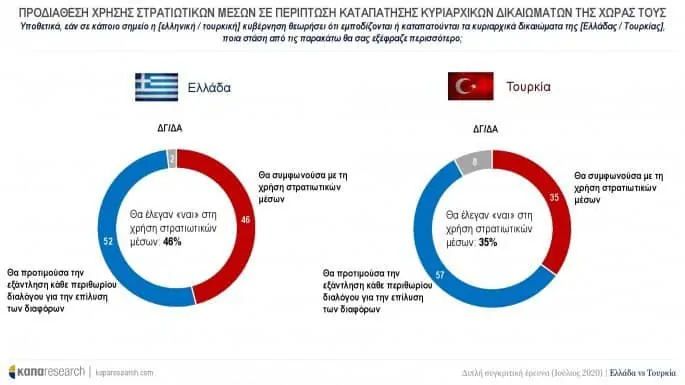
In the hypothetical scenario, where things get worse and if at some point the Greek and Turkish government considers that the sovereign rights of Greece/Turkey are being obstructed or violated, both nationalities want to exhaust the possibilities of dialogue instead of war. However, the inhabitants of Greece are more prepared for military use (46%) than Turks (35%).

Greeks are more prepared to go to war than Turks are, poll finds 3

The issue of coronavirus worries the residents in Turkey as according to the research, 77% state that they are worried that they or a member of their family will get sick. In Greece, only 54% are worried.

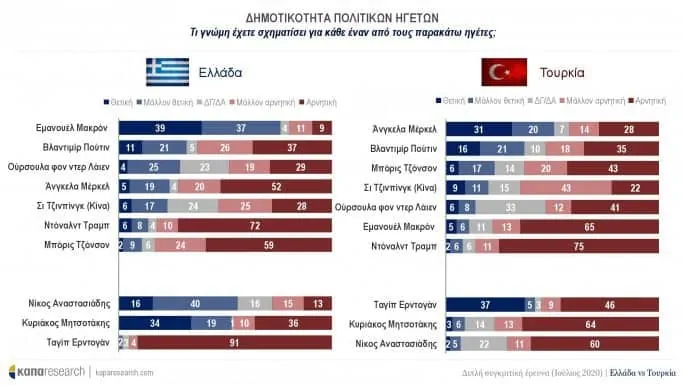
As for the leaders, 95% of the population in Greece has a negative or rather negative view of the Turkish President, Recep Tayyip Erdoğan, while 55% of Turks themselves have a negative view of their president. On the other hand, Greek Prime Minister Kyriakos Mitsotakis enjoys 53% acceptance in Greece and only 9% in Turkey.

Greeks are more prepared to go to war than Turks are, poll finds 4
As for the leaders of other countries, it seems that in Greece the most liked are Emmanuel Macron (76% positive opinion) and Vladimir Putin (31% positive opinion), while the most disliked are Donald Trump (14%) and Boris Johnson (11%). In Turkey, the most beloved are Angela Merkel (51%) and Vladimir Putin (37%) and the most disliked are Emmanuel Macron (11%) and Donald Trump (8%).

Ερντογάν για ΑΟΖ Ελλάδας – Αιγύπτου: «Δεν υπάρχει συμφωνία – Ξεκινάμε γεωτρήσεις»

SManalysis

Ερντογάν για ΑΟΖ Ελλάδας – Αιγύπτου: «Δεν υπάρχει συμφωνία – Ξεκινάμε γεωτρήσεις»
ΕΘΝΙΚΑ ΘΕΜΑΤΑ , ΕΘΝΙΚΗ ΑΜΥΝΑ , ΕΝΕΡΓΕΙΑΚΑ , ΤΟΥΡΚΙΑ 7 Αυγούστου 2020


Σε αναμμένα κάρβουνα είναι στην Τουρκία, ύστερα από την ιστορική συμφωνία της χώρας μας με την Αίγυπτο για την οριοθέτηση θαλασσίων ζωνών και μάλιστα, πριν προλάβει να στεγνώσει το μελάνι των υπογραφών των ΥΠΕΞ, εξέδωσε προκλητική NAVTEX για άσκηση με πραγματικά πυρά από τις 11 έως τις 20 Αυγούστου.

Την ίδια ώρα, ο Ρετζέπ Ταγίπ Ερντογάν παρευρέθηκε στην Αγιά Σοφιά για την προσευχή της Παρασκευής και με δηλώσεις του δεν έκρυψε την οργή του για τα τετελεσμένα ανάμεσα σε Ελλάδα και Τουρκία.


«Δεν υπάρχει τέτοια συμφωνία. Η Μέρκελ μου ζήτησε να σταματήσουμε τις γεωτρήσεις. Τώρα τις ξεκινούμε και πάλι. Ενημερώσαμε σχετικά την Μέρκελ», είπε χαρακτηριστικά ο Ερντογάν.


«Τι κάνουν εκεί η Ελλάδα και η Αίγυπτος; Αφού υπογράψαμε τη συμφωνία με τη Λιβύη, όλοι έπεσαν σε αυτό το γεγονός. Αυτή η συμφωνία μεταξύ Ελλάδας και Αιγύπτου δεν έχει αξιοπρέπεια. Η Μέρκελ μου ζήτησε να σταματήσω τις εργασίες γεώτρησης. Είπαμε, “Εάν εμπιστεύεστε την Ελλάδα, θα σταματήσουμε να δουλεύουμε για μερικές εβδομάδες, αλλά εμείς δεν τους εμπιστευόμαστε.”


Δεν τήρησαν τις υποσχέσεις τους και τώρα συνεχίζουμε αμέσως τις εργασίες γεώτρησης. Θα συνεχίσουμε τη συμφωνία μας με τη Λιβύη με αποφασιστικότητα. Ειδικά στις ναυτιλιακές δικαιοδοσίες, δεν χρειάζεται καν να διαπραγματευτούμε με εκείνους που δεν έχουν δικαιώματα ή νόμους», τόνισε.

ΠΗΓΗ: Newpost.gr

Thursday, August 6, 2020

Don’t Leave the Balkans to Europe

SManalysis
Kosovo - Wikipedia

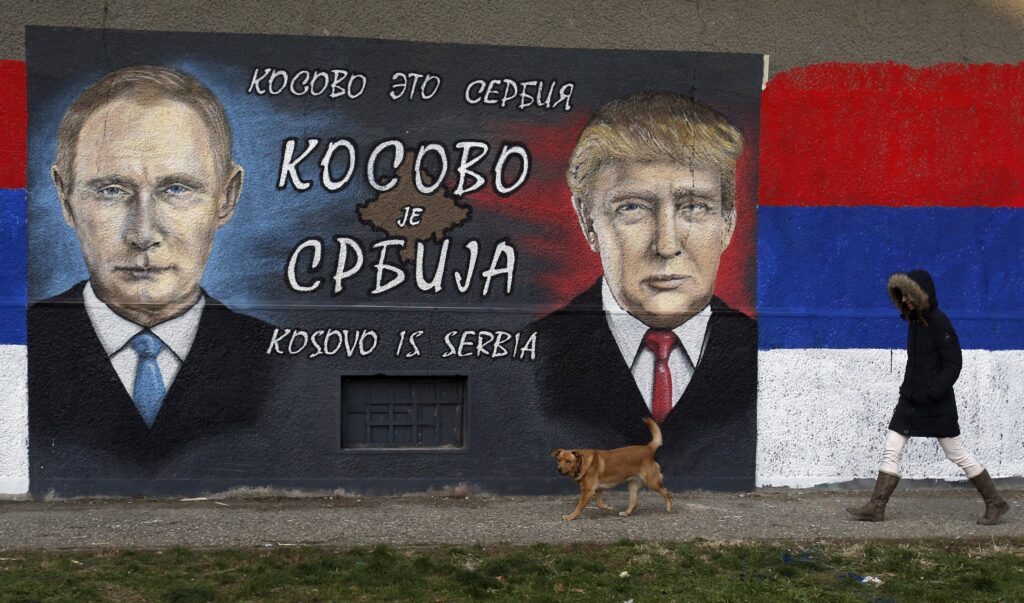
For all its bungling and missteps, the Trump Administration’s decision to pay attention to the Kosovo-Serbia dispute is a step in the right direction.

Transatlantic relations, on fragile footing for the better part of the last three and a half years, have been fracturing further across a region that has in the recent past been a rare area of policy consensus. The Western Balkans, always a difficult portfolio, had seen a rare breakthrough agreement in 2018, when Greece and North Macedonia signed the Prespa Agreement, putting an end to a contentious dispute that had lasted for decades. Behind the scenes, Washington and Brussels had been instrumental in brokering the deal, paving the way for North Macedonia to resume its journey to full euroatlantic integration.

There was hope that the Serbia-Kosovo dispute, an even thornier issue, might see a similar breakthrough. Serbia’s President Aleksandar Vucic and Kosovo’s President Hashim Thaçi had been promising one for years, dropping hints that an agreement was within reach. Such hopes were dashed late last month. First, the government of Kosovo collapsed during the coronavirus pandemic. Kosovo’s former Prime Minister Albin Kurti, a darling of Berlin and a critic of the ongoing discussions, subsequently alleged that Richard Grenell, Trump’s top official for Kosovo-Serbia talks, had engineered his ouster. In June, Thaçi was indicted for war crimes as he travelled to meet Vucic in Washington at a summit put together by Grenell. His backers allege that the charges—and their timing—were politically motivated to scuttle the talks.

In early July, the EU resumed the Belgrade-Pristina Dialogue for the first time since 2018. Unsurprisingly, however, the only outcome was more meetings—another round of which is taking place today. If the past is any indication, these talks are going nowhere. The stench of stale thinking permeates the corridors in Brussels. The European promise of speeding Serbia’s accession to the EU, its main “carrot” for inducing Serbia to compromise, is barely credible any longer. The EU, meanwhile, has not delivered on its promise of visa liberalization for Kosovo despite its meeting the relevant criteria two years ago. That “carrot” is so rotten that waving it in front of Kosovo’s face is borderline insulting.

This mental sclerosis is compounded by some truly bizarre personnel choices. At least from Kosovo’s perspective, Europe doesn’t just look incompetent; it looks malicious. Its two top officials for Kosovo are from Spain and Slovakia, two states that still do not recognize Kosovo as independent. EU foreign policy chief Josep Borell’s appointment of Miroslav Lajcak, the former Slovak Minister of Foreign Affairs, was met with skepticism in Kosovo, as well as in Bosnia where he served as High Representative over ten years ago. Lajcak lobbied hard within the EU to be in charge of the entire Western Balkans and “requested a much broader portfolio than just the Kosovo-Serbia negotiations, despite knowing very well that this in itself is a full-time job.” In practice, this means that he managed to connect the Serbia-Kosovo dispute to Bosnia. 

This may appear to be only of symbolic consequence, but symbolism matters in these parts. The much-criticized idea of land swaps, rumored to be the “secret sauce” that could get both Belgrade and Pristina to come to an agreement, originated within the office of Borrell’s predecessor Federica Mogherini. Critics correctly point out that this idea has the potential to negatively impact Bosnia, as well as North Macedonia with its large ethnic Albanian minority. By appointing Lajcak as a pan-Balkan hand, all these issues become linked. Allegations that the Trump Administration has taken up Mogherini’s idea of land swaps are indeed worrisome, as we believe that these ideas could be hard to contain. But the silver lining is that there is a clear division of responsibility within Washington: Grenell is exclusively in charge of Kosovo-Serbia talks while Deputy Assistant Secretary and State Department’s Special Envoy Matthew Palmer is in charge of the rest of the region. Tackling issues in the region one-by-one and on clear terms is the only way to make progress. And if Kosovo and Serbia want to make a bilateral agreement in accordance with the Helsinki Final Act, the issue needs to be carefully compartmentalized lest it wreak havoc more broadly. 

Beyond the fumbles in staffing, the EU has shown that it has no broader strategy for confronting Russia in the region. Russia’s goals are simple: Moscow wants to maintain its regional leverage by acting as both spoiler and final arbiter to any solution. The latest manifestation of Russian interference is happening in Serbia, where Russian far-right groups, along with Russian intelligence, are said to have instigated violent riots during anti-lockdown protests. As the riots died down, in the most recent meeting at the Russian National Security Council, Moscow labeled the Kosovo-Serbia dispute as a top priority. 

Russia was one of the most outspoken critics of the NATO intervention in 1999, which has made it popular among Serbs today. Russia routinely uses the 1999 bombing of Yugoslavia as legal precedent for its interventions in Ukraine and its annexation of Crimea. As a permanent UN Security Council member with veto power, Russia can protect Serbia by blocking votes to recognize Kosovo’s sovereignty. During Russian Foreign Minister Sergei Lavrov’s recent visit to Serbia, he and Russia’s closest Serb ally, then Minister of Foreign Affairs Ivica Dacic, wrote a joint letter emphasizing that compromise is only possible if the 1244 UN Security Council Resolution is respected. While the letter stated that “Moscow will agree only with a settlement that Belgrade will accept,” Minister Lavrov firmly stated that Russia’s approval would be required for any solution reached in peace talks. Following recent elections, the Serbian government is now in formation talks, and Moscow is likely lobbying for its closest allies to have prominent roles within it. 

For reasons that aren’t entirely clear, the Trump Administration has taken a keen interest in Kosovo. Some suspect the president simply hopes to make a deal; others that he wanted to beat Angel Merkel on her own turf. The good news for Kosovo is that it is again a foreign policy topic the American Presidential campaign. Former Vice President Biden has come out with a strongly worded statement all but guaranteeing that the United States will remain involved no matter who wins in November. 

Whatever one thinks of Trump’s foreign policy—and we have many, many reservations—his administration’s decision to pay attention to the Kosovo-Serbia dispute is exactly what the experts have been advocating for years. While the EU’s track record in the region is somewhere between abysmal and unproductive, the United States has maintained its credibility throughout the last thirty years, and has many cards to play. The main impediment to regional progress, ironically, is not the Balkans’ sticky politics but Washington’s tensions with Berlin. And those are likely to outlast Trump’s term. Trump’s abusive attitude towards allies has won him few admirers in Europe, but it’s issues such as the use of Chinese 5G technology and the Nordstream 2 gas pipeline that have cast a pall over U.S.-German relations. None of these magically disappear if Biden is elected in November. 

A Biden Administration may be tempted to try to rebuild bridges with Brussels and Berlin by simply backing the existing pointless dialogue, a process that relies on promises of eventual EU accession as its main motive force. This would be a grave mistake. Let’s not beat around the bush: No one believes that countries in the Western Balkans will enter the EU any time soon. But the issue of Kosovo’s recognition cannot wait. If Kosovo does not get a UN seat in the next few years, the pressure to unite with Albania might become unbearable for Kosovo’s political elites. That would also mean redrawing of the borders that would particularly hurt American standing in the region. Taking land swaps “off the table” in no way means that borders will not be redrawn anyway. Should that happen, the Europeans will likely wriggle their hands and claim that Kosovo is a massive failure of multiple American administrations.

Differences between the U.S. and key European states have been growing since the Cold war ended, but the most recent Kosovo dispute shows that the transatlantic partnership has reached a turning point. European inability to solve the crisis in the Balkans in the 90s resulted in the bloodiest conflict Europe had seen since the World War II, which ended only when America took the lead. No matter who wins in November, the U.S. should not leave the region to the Europeans. It’s too important for that.

Published on: July 23, 2020
Reuf Bajrovic co-chairs the US-Europe Alliance. Ivana Stradner is a Jeane Kirkpatrick Fellow at the American Enterprise Institute.

Ο Σερβικός Στρατός απέκτησε έξι drone με βόμβες λέιζερ

SManalysis


Αύγουστος 6, 2020. 19:18
Βελιγράδι.

Η σερβική πολεμική αεροπορία και η αντιαεροπορική άμυνα ενισχύθηκαν πρόσφατα με την αγορά έξι μη επανδρωμένων εναέριων οχημάτων, δηλαδή τηλεχειριζόμενα από απόσταση,  αεροσκάφη CH-92A  καθώς και βόμβες αεροσκαφών που καθοδηγούνται με λέιζερ,  από τη Λαϊκή Δημοκρατία της Κίνας.


Με την αγορά νέων αυτών UAV, ο Σερβικός Στρατός έγινε ο πρώτος χρήστης τέτοιων αεροσκαφών στην περιοχή και βελτίωσε σημαντικά τις δυνατότητες αναγνώρισης και ασφάλειας του σερβικού εναέριου χώρου.


Αίθουσα χειρισμού μη επανδρωμένων εναέριων οχημάτων
Οι αεροπορικές βόμβες με λέιζερ, μπορούν να χρησιμοποιηθούν σε ελαφρά θωρακισμένα οχήματα και οχυρωμένες θέσεις.
«Σε μια εποχή που είναι αδύνατο να φανταστούμε σύγχρονα πεδία μάχης χωρίς την ενεργή χρήση μη επανδρωμένων αεροσκαφών, τόσο στην ξηρά όσο και στον αέρα και το νερό, η προμήθεια μιας νέας κατηγορίας αεροσκαφών φέρνει νέες ευκαιρίες ανάπτυξης στον σερβικό στρατό», σημειώνει το δημοσίευμα της σερβικής «Βετσέρνιε Νόβοστι»/«Вечерње новости».


--

Wednesday, August 5, 2020

Grenell's successor: These people have never been our friends

SManalysis
Douglas McGregor nominated for the post of U.S. Ambassador to Germany
The candidate for the new US ambassador to Germany, Douglas McGregor, criticized the US intervention in Kosovo in 1999

SOURCE: TANJUG WEDNESDAY, AUGUST 5, 2020 | 12:59

He assessed that it was directed against Orthodox Christian Serbs and that a Muslim drug mafia was set up after it, which was called a success for democracy, CNN writes in a text in which it reminds of his other statements, which he calls xenophobic and racist.

"These people have never been our friends," said McGregor, who will replace Richard Grenell as US Ambassador to Germany.

CNN states that, in addition to statements in favor of Serbia, although at that time as a military staff member he participated in the preparation of the NATO campaign, McGregor published statements that contradict the official policy of Washington, such as when he sided with Russia in the conflict in Ukraine.

The text estimates that, if his appointment is approved by the US Senate, it will mark another low point of the American-German relations, which worsened during the mandate of President Donald Trump.

White House spokesman Judd Deer told CNN by email that McGregor was highly qualified for the job of ambassador, referring to the knowledge of German history and language that he learned while serving in West Germany.

Vučić met with the Russian Ambassador - topic of conversation - Putin's visit

SManalysis
FOTO TANJUG/ INSTAGRAM &BUDUCNOSTSRBIJEAV
Today, the President of Serbia, Aleksandar Vučić, received the Ambassador of the Russian Federation, Aleksandar Botsan Kharchenko.

SOURCE: TANJUG WEDNESDAY, AUGUST 5, 2020 | 12:09

He discussed with him the current issues of Serbian-Russian relations and bilateral cooperation, especially the realization of concrete agreements and joint projects.

The two interlocutors expressed hope that the circumstances will soon allow both countries to fully commit to the realization of joint plans for cooperation in various fields.

They also expressed the expectation that they would enable more frequent interstate contacts and exchange of high-level visits, so that the announced visit of President Putin would be prepared in the best way.

Vučić and Botsan Kharchenko discussed the course of the dialogue between Belgrade and Priština, especially the missing and internally displaced persons, as well as the economic issues

The two interlocutors agreed that it would be essential to implement previously reached agreements between Belgrade and Pristina, especially those concerning the Union of Serbian Municipalities.

Tuesday, August 4, 2020

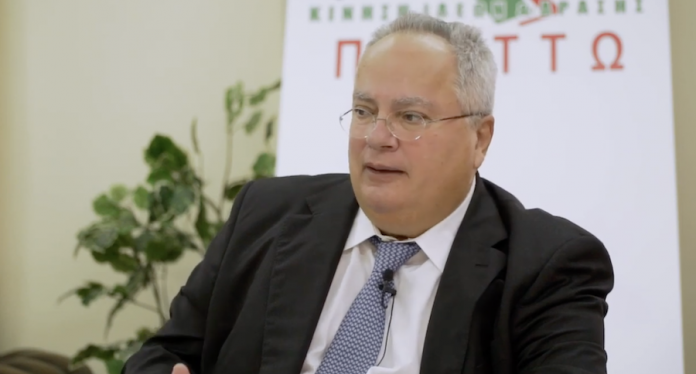
Κοτζιάς: “Η Αθήνα δεν ψάχνει πια συμμάχους για να αντισταθεί στην Τουρκία, αλλά μεσολαβητές”

SManalysis

Από Militaire News -03/08/2020 

Ο πρώην ΥΠΕΞ Νίκος Κοτζιάς γράφει για τα ελληνοτουρκικά.

Σε σειρά τριών άρθρων (που δημοσιεύονται και στο Ντοκουμέντο) θα προσπαθήσω να αναδείξω τρεις πτυχές των ελληνοτουρκικών σχέσεων: γεωπολιτικές, ιστορικές και πολιτικές. Ξεκινώ στο πρώτο άρθρο με δύο γεωπολιτικά στοιχεία. που σφραγίζουν την εξωτερική δράση της Τουρκίας.


Ανατροπή Συσχετισμού Ισχύος
Το πρώτο στοιχείο που θα μας χρειαστεί για να κατανοήσουμε τις εξελίξεις, είναι η ανατροπή του συσχετισμού ισχύος ανάμεσα στην Ελλάδα και την Τουρκία, ιδιαίτερα στον τομέα της οικονομίας, όπου η ισχύς της Τουρκίας είναι πολλαπλά πιο μεγάλη από εκείνη της Ελλάδας. Το αποτέλεσμα είναι να έχει η Τουρκία τη δυνατότητα μεγαλύτερης χρηματοδότησης της διπλωματίας και των εξοπλισμών της. Επιπλέον, σε αντίθεση με την Ελλάδα στην οποία ο δικομματισμός και τα μνημόνια διέλυσαν την αμυντική μας βιομηχανία, η Τουρκία έχει αναπτύξει ισχυρή αμυντική βιομηχανία, συμμετέχει στην παραγωγή αεροπλάνων και τανκς, ντρόουνς και μέσων κυβερνοπολέμου. Τέλος ο πληθυσμός της κοντεύει να είναι οκταπλάσιος από εκείνον της Ελλάδας. Η Τουρκία, ακόμα, διαθέτει πρόσφατη πολεμική εμπειρία, από τις παράνομες δράσεις της στο Ιράκ και στη Συρία, ενώ στη Λιβύη χρησιμοποιεί στρατό τζιχαντιστών. Συνολικά, οι αλλαγές συσχετισμού ισχύος, «επιτρέπουν» στην Τουρκία να προβάλλει τις νέες επιθετικές της δυνατότητες. Το γεγονός αυτό κάνει πιο επιτακτική για την Ελλάδα την πολιτική συμμαχιών.

Η Τουρκία, από την άλλη, έχει σειρά από αδυναμίες και αντιθέσεις στο εσωτερικό της που η ηγεσία της δυσκολεύεται να διαχειριστεί, Τέτοιες είναι οι κοινωνικές ανισότητες, οι θρησκευτικές και οι εθνικές αντιπαραθέσεις, η ασυμμετρία ανάπτυξης των διαφορετικών περιοχών της. Επίσης, η οικονομία της παρουσιάζει τάσεις κάμψης. Σημαντικό αδύναμο σημείο της Τουρκίας είναι οι θεσμικές δυσλειτουργίες της, η υποβάθμιση της δημοκρατίας. Δυστυχώς τα αρνητικά στοιχεία που συσσωρεύει το ελληνικό πολιτικό σύστημα, δεν επιτρέπει στην Ελλάδα να αξιοποιήσει επαρκώς τους δημοκρατικούς θεσμούς ως στοιχείο ισχύος. Κάτι που επείγει να γίνει με την διεύρυνση και στερέωση των δημοκρατικών θεσμών και κατακτήσεων.

Η Τουρκία νιώθοντας ισχυρότερη από ότι πριν ένα αιώνα, στη βάση και των πιο πάνω, δείχνει αναθεωρητικές τάσεις και μια μεγάλη νευρικότητα προς τα έξω. Επιδιώκει να εμποδίσει στις χώρες του περίγυρού της, με εξαίρεση ασφαλώς την Ρωσία, να εξασκούν τα δικαιώματά τους.


Τρεις παράγοντες προβολής ισχύος
Η επιθετικότητα της Τουρκίας, είναι προϊόν της ισχυροποίησής της. Της αίσθησης ότι μπορεί να αναθεωρήσει τα αποτελέσματα του παρελθόντος. Της φιλοδοξίας της ηγεσίας της. Αλλά, και της παρουσίας τριών, ακόμα, παραγόντων που θεωρεί ότι την διευκολύνουν στην υλοποίηση της πολιτικής της.

Ο πρώτος, είναι ότι νιώθει αρκούντως ισχυρή προκειμένου να επιβάλλει τη θέλησή της, είτε δια των πιέσεων, όπως κάνει μέχρι στιγμής στην Ελλάδα, είτε με τα όπλα, όπως πράττει στον αραβικό κόσμο, καθότι εκτιμά ότι τα πιθανά κέρδη θα είναι μεγαλύτερα κάθε ζημιάς.

Ο δεύτερος παράγοντας, είναι ότι αξιολογεί ως αδύναμες τις ηγεσίες που έχει απέναντί της, σε Συρία, Ιράκ και Λιβύη. Μια τέτοια αίσθηση αποκόμισε, δυστυχώς, και από την ελληνική κυβέρνηση, από την πρώτη στιγμή που «γνωρίστηκε» μαζί της, στην Νέα Υόρκη τον Σεπτέμβρη 2019. Ανάλογα εκτίμησε τα χαριεντίσματα στα οποία περιορίστηκε η Ελληνική Κυβέρνηση στις τουρκικές παραβιάσεις στην ΑΟΖ και στα χωρικά ύδατα της Κύπρου, αλλά και το «ανεμολόγιο» που κυριαρχούσε στους στρουθοκαμηλισμούς της ως προς σειρά γεγονότων στο Αιγαίο.

Ο τρίτος παράγοντας, είναι η αίσθηση της Τουρκίας, ότι αν προχωρήσει σε επιθετικές ενέργειες, επικαλούμενη, μάλιστα, με στρεβλό τρόπο το Διεθνές Δίκαιο, θα αντιμετωπιστεί με ανοχή. Καταγράφει δε, την ύπαρξη διεθνώς ενός κενού που θεωρεί ότι της επιτρέπει να το παίξει «περιφερειακός ηγεμόνας». Διαπιστώνει ότι η Ρωσία βρίσκεται, μέσα από αντιφάσεις, σε μια φάση ανάλογης με τη προσπάθεια του Λένιν, πριν ένα αιώνα, να αποσπάσει την Τουρκία από τη Δύση. Η Κίνα ενδιαφέρεται για την γεωοικονομία της περιοχής, αλλά όχι (ακόμα) εξίσου για την γεωπολιτική της. Το Ισραήλ είναι μπλεγμένο στα εσωτερικά του προβλήματα, με ένα νέο συγκυβερνών κόμμα που ο ηγέτης του είναι ιδιαίτερα φιλικός απέναντι στην Τουρκία. Η Μεγάλη Βρετανία έχει απορροφηθεί στο Μπρέξιτ και στην υγειονομική της κρίση. Η ΕΕ παριστάνει τον διαιτητή ανάμεσα σε ένα μέλος της και σε ένα μη μέλος. Κάτι για το οποίο ευθύνεται και η «διπλωματία» (ο θεός να την κάνει τέτοια) της κυβέρνησης, ενώ το ισχυρότερο κράτος-μέλος της ΕΕ, η Γερμανία, συμπεριφέρεται όπως και στα τέλη του 19ου αιώνα, ως οικονομικός σύμμαχος της Τουρκίας και τροφοδότης της με εξοπλιστικό υλικό. Τέλος, ο Τραμπ εκδηλώνει έναν «ατομικό» φιλοτουρκισμό. Μόνο μια χώρα προσπαθεί σε αυτή τη φάση να παρεμποδίσει την Τουρκία να αξιοποιήσει αυτό το κενό: η Γαλλία. Ασφαλώς για τους δικούς της λόγους, αλλά το προσπαθεί.

Η Γαλλία αυτή τη στιγμή είναι ο «φυσικός» σύμμαχος της Ελλάδας σε μια πολύ δύσκολη καμπή. Σύμμαχος διατεθειμένος να στηρίξει και την Κύπρο με ουσιαστικό τρόπο. Δυστυχώς, η Κυβέρνηση της ΝΔ, εγκατέλειψε την υπό διαμόρφωση συνεργασία με τη Γαλλία, κάτω από την πίεση των Γερμανών, και πιθανά με προτροπή των Αμερικάνων. Μια Γαλλία που έχει ισχυρή αμυντική συνεργασία με την Αίγυπτο και στη Λιβύη. Είμαστε, δηλαδή, σε μια φάση που τα συμφέροντα Κύπρου, Ελλάδας, Αιγύπτου και Γαλλίας συμπίπτουν ως προς την αντιμετώπιση της Τουρκικής επιθετικότητας.

Η Αθήνα, όμως, δεν ψάχνει πια συμμάχους για να αντισταθεί στις τουρκικές προκλήσεις, αλλά «μεσολαβητές» ώστε να «διευκολυνθεί» να οδεύσει στον δρόμο της ενδοτικότητας και της υποχώρησης. Φαίνεται ότι αποδιοργάνωσε τη συμμαχία με το Παρίσι προκειμένου να παραμείνει στο γερμανικό μαντρί. Με αυτό τον τρόπο οδηγεί τη χώρα σε μια νέα «ευρύτερη Μαδρίτη» (η οποία υπήρξε η κάκιστη υποχώρηση του Σημίτη) και σε ένα είδος «θαλάσσια Ίμια». Υποχωρήσεις που θα αναλύσω στο άρθρο μου της επόμενης εβδομάδας («τα ιστορικά»).

Monday, August 3, 2020

Στρατιωτική συνεργασία με την Αλβανία- ο Οθωμανισμός στα Βαλκάνια- ρωσικό δημοσίευμα

SManalysis


Αύγουστος 3, 2020. Echedoros

 Στις 23 Ιουλίου, το αλβανικό κοινοβούλιο ενέκρινε συμφωνία στρατιωτικής συνεργασίας με την Τουρκία , η οποία καθορίζει τους μηχανισμούς χρηματοδότησης της προμήθειας τουρκικών στρατιωτικών εξαρτημάτων και συναφών υπηρεσιών. Η τοπική βουλευτής Ελόνα Γκιεμπρέα Χότζα  μίλησε πριν από την ψηφοφορία.

«Ο στρατηγικός μας εταίρος συνεχίζει να μας υποστηρίζει σε διάφορους τομείς. Ευχαριστούμε την τουρκική πλευρά που δεν μας άφησε ποτέ μόνους σε μπελάδες. Ελπίζω ότι η υποστήριξή της όχι μόνο θα μας επιτρέψει να εκσυγχρονίσουμε τον στρατό, αλλά και να μας βοηθήσει να ανταποκριθούμε καλύτερα σε καταστάσεις έκτακτης ανάγκης».

Αυτή η συμφωνία υπεγράφη από τις αρχές της Αλβανίας και της Τουρκίας στο πλαίσιο του «Σχεδίου συνεργασίας στον τομέα της άμυνας για το 2020», που εγκρίθηκε τον Φεβρουάριο του τρέχοντος έτους στα Τίρανα. 

Το ακριβές περιεχόμενο του εγγράφου δεν έχει αποκαλυφθεί, αλλά είναι γνωστό ότι περιλαμβάνει μέτρα για την ενίσχυση των σχέσεων μεταξύ των δύο χωρών στον τομέα της ασφάλειας και της άμυνας. 

Ειδικότερα, προβλέπεται συνεργασία στον τομέα της εκπαίδευσης στρατιωτικού προσωπικού, το οποίο συζητήθηκε κατά την επίσημη επίσκεψη του Αλβανού Υπουργού Άμυνας τον Ιανουάριο στην Τουρκία.

Η Όλτα Τζάσκα επισκέφθηκε τους τότε Αλβανούς φοιτητές των τουρκικών στρατιωτικών ακαδημιών και τόνισε ότι έδωσαν ένα καλό παράδειγμα «πειθαρχίας και επαγγελματισμού» στους συμπατριώτες τους «που θέλουν να υπηρετήσουν στα στρατεύματα του ΝΑΤΟ».

Riafan.ru

Saturday, August 1, 2020

U.S. is pushing for a new provocation against Serbia over the Kosovo issue

SManalysis
U.S. is pushing for a new provocation against Serbia over the Kosovo issue 2
by PAUL ANTONOPOULOS

U.S. is pushing for a new provocation against Serbia over the Kosovo issue 2

Belgrade and Pristina have resumed dialogue in Brussels, but the recent delivery of American-made armored vehicles to Kosovo could make the talks difficult and signifies Washington is once again attempting to destabilise the Balkans. Serbia and Kosovo returned to the negotiating table on July 16 after a long hiatus; however the hopes of Josep Borrell, head of European diplomacy, to allow a constructive dialogue could now be in jeopardy. Washington’s delivery of Humvee armored vehicles to Pristina is a clear message to Belgrade that the U.S. will continue recognising Kosovo’s independence. Washington purposefully sent the armored vehicles knowing it will create tensions in negotiations between Belgrade and Pristina.

The U.S. is putting pressure on Serbian President Aleksandar Vučić to recognise Kosovo’s independence. However, this is in detriment to international law and UN Security Council resolution 1244, which is still valid and specifies that Kosovo is a Serbian province despite Washington’s recognition of its illegal independence. Although the delivery of Humvee armored vehicles makes little impact on the military capabilities of Kosovo, it is a symbolic gesture by the Americans to show they still have significant influence over Kosovo. Hashim Thaçi, the President of Kosovo and alleged war criminal, has always said that Washington should be an important player in negotiations between Serbia and Kosovo.

Kosovo is recognised as an independent state by the majority of Western countries, with the exception of five EU members who still refuse to recognise its independence: Spain, Romania, Greece, Cyprus and Slovakia. Russia and China, permanent members of the UN Security Council, have not recognised this either and are de facto preventing Kosovo from joining the United Nations.

There is clear proof that tensions are still high between Belgrade and Pristine, especially after Vučić attacked with virulence Kosovo’s Prime Minister, Avdullah Hoti, after the last round of negotiations:

“Is it nice to sit at the other end of the table facing Hoti and listen to his gibberish, saying that they are the only victims and that we are the only bad guys? No.”

The fact that Kosovo recently received a new shipment of armored vehicles from the U.S. will not help normalise relations between the two parties, but this is not surprising considering the Albanians are key to Washington’s policy in controlling the Balkans. Therefore, Belgrade likely recognises that it cannot trust Washington to bring a resolution to the Kosovo issue, especially since Serbia maintains strong relations with Moscow that it is not willing to sacrifice.

The special relationship between Belgrade and Moscow is viewed negatively by both Brussels and NATO. They would rather bring Serbia under its influence. This is further complicated by the fact that Beijing has an ever-increasing strong presence in Serbia and is investing a lot in the country. Beijing always supports the preservation of Serbia’s territorial integrity, especially regarding Kosovo, which could mean that the Balkan country might be a future flash point between the growing rivalry between China and the U.S.

In 2012, Belgrade highlighted that officials during the presidency of Bill Clinton, who were in charge at the time of the brutal NATO bombing campaign against Serbia in 1999, returned to Kosovo to invest – particularly General Wesley Clark and former U.S. Secretary of State, Madeleine Albright. Today Kosovo is a hub for drug trafficking, human trafficking and organ harvesting, something that Brussels and Washington are happy to turn a blind eye to.

Albanians are trying to unite in a Greater Albania that would serve the interests of U.S. foreign policy. The arming of Kosovo could be a consequence of this vision, especially since American arms deliveries to Kosovo contradict international law and could trigger a new armed conflict. This may be the hidden goal of the U.S. It is possible that Germany is also pushing in this direction, especially since Berlin was a key player in the dismemberment of the Federal Republic of Yugoslavia. The recognition of Kosovo’s independence opens the door to further destabilisation, violence and potentially even a new Balkan war. With the U.S. delivering Humvee’s to Kosovo, it has signified that it has no interest in finding a lasting resolution between the rebel province and Serbia.

*Source: InfoBrics

Tuesday, July 28, 2020

Πρόεδρος Σερβίας: «Αμερικανοί, Τούρκοι και Γερμανοί φροντίζουν το αγαπημένο τους παιδί»

SManalysis


Ιούλιος 28, 2020. 20:07

Βελιγράδι.

Ο Πρόεδρος της Σερβίας Αλεξάνταρ Βούτσιτς κατηγόρησε τις Ηνωμένες Πολιτείες και άλλες δυτικές χώρες ότι οπλίζουν τους γείτονες της Σερβίας, οι οποίοι είναι μέλη του ΝΑΤΟ και του Κοσσυφοπεδίου.


"Αμερικανοί, Τούρκοι και Γερμανοί φροντίζουν το αγαπημένο τους παιδί", δήλωσε ο Βούτσιτς, αναφερόμενος στο Κοσσυφοπέδιο.


Είπε ότι η Ουάσιγκτον πρόσφατα παρέδωσε θωρακισμένα οχήματα στη Δύναμη Ασφαλείας του Κοσσυφοπεδίου.


Πρόσθεσε  ότι έχουν ήδη ξεκινήσει αρκετές πρωτοβουλίες για την ενίσχυση της Σερβικής Πολεμικής Αεροπορίας, ειδικά στις μονάδες βομβαρδιστικών.


Είπε ότι η ικανότητα αεροπορικής άμυνας θα ενισχυθεί.


Η Σερβία έλαβε πρόσφατα ένα εξελιγμένο αντιπυραυλικό σύστημα από τη Ρωσία, η οποία παρέδωσε επίσης στρατιωτικά αεροσκάφη, ελικόπτερα και θωρακισμένα οχήματα.


Εν τω μεταξύ, η Κίνα προμήθευσε αεροσκάφη στη Σερβία, όπως σημειώνει η «kallxo.com».


Δημοσίευμα της αλβανικής «Koha» της 25ης Ιουλίου ανέφερε ότι στρατιωτικά οχήματα από τις ΗΠΑ έχουν παραληφθεί από τις Δυνάμεις Ασφαλείας του Κοσσυφοπεδίου. 

Μάλιστα, δημοσίευσε  και φωτογραφίες των οχημάτων (κάτωθεν) που έχουν πάει στο «Han të Elezit», κοντά στα σύνορα με τα Σκόπια.

Monday, July 27, 2020

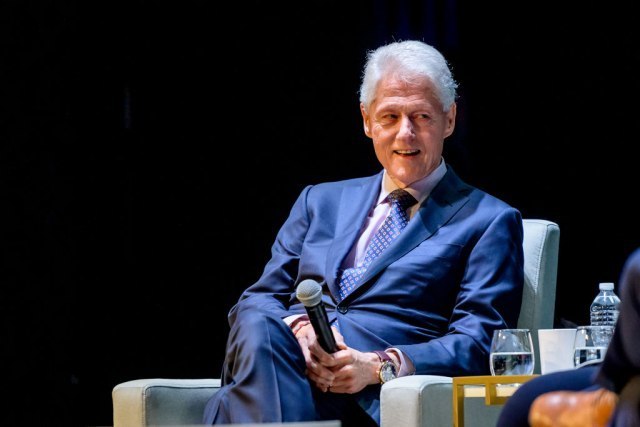
Secret documents revealed: Clinton's plan to resolve the Bosnian issue failed in 1995

SManalysis
Foto: Gettyimages/Roy Images
In the run-up to the 1995 US presidential election, Bill Clinton called on the Muslim-led Bosnian government to make territorial concessions to end the war.

SOURCE: B92, THE GUARDIAN MONDAY, JULY 27, 2020 | 10:15

This, according to the Guardian, is revealed by documents from 1995, published by the presidential archive, which speak about the events in Bosnia-Herzegovina during the war that lasted for three years.

"Declassified documents from the period and interviews with some of the protagonists reflect the determination of Bill Clinton and his foreign policy team to find a solution to the three-year conflict at all costs before his re-election campaign began in earnest in 1996 – even if that meant rewarding the Bosnian Serb leaders for their policy of ethnic cleansing by granting them their objective: secession", the Guardian specifies.

In phone conversations with other foreign leaders as the mass executions were under way, however, Clinton repeatedly expressed his disillusion with the Bosnian army for failing to defend Srebrenica. In the meantime, Clinton’s national security adviser, Anthony Lake, headed the secret plan for ending Bosnian war.

That strategy, begun by Lake’s team in the weeks before the Srebrenica attack, was to try to force a peace deal based on a roughly even division of the territory. The Federation of Muslims and Croats was to receive just under half of the state, while the Americans would consider putting pressure on the Muslim side to agree to Serbs in Bosnia holding a referendum on secession from Bosnia-Herzegovina within two to three years after the end of the war.

If that failed, the plan was to withdraw the UN peacekeeping force, lift the arms embargo on Bosnia and to give its Muslim-Croat Federation some initial support with airstrikes until it was strong enough to fight the Serbs on its own.

The Federation might have to accept less than half the country, and the US would consider “pressing the Bosnians to agree that the Serbs can conduct a referendum on secession after 2-3 years”. Clinton's plan called for talks between the US administration and representatives of Sarajevo first, in order to convince them of concessions after the fall of Srebrenica, which included the possibility of separating RS from Bosnia-Herzegovina.

“If the Bosnians cannot persuade the Serb population that their best future lies in reintegration, there is no point blocking the peaceful separation of the Union along the lines of the Czechoslovak model,” the proposal suggested, as presidential archive specifies.

David Scheffer, an adviser to the ambassador to the UN, later State Secretary, Madeleine Albright, who was attending White House meetings on Bosnia, reacted to this in the following words: “It’s a very slippery slope. The Serbs have seized enormous territory through ethnic cleansing, and then we hold a ‘democratic’ referendum to confirm such aggression? A very transparent act of appeasement”, Scheffer concluded.

In his communication with Chirac, Clinton complained about the Bosnian army, which had fled rather than trying to fight the Serbs.

“In Srebrenica there were about 3.000 Bosnian troops but they … left without putting up a fight,” Clinton said.

“I will talk to my military advisers, but they are very sceptical about bringing in forces with helicopters, especially if the Bosnians won’t fight. We cannot defend democratic values in the abstract”, Clinton added.

In the end, the US and its allies agreed to make a stand over the last Muslim enclave standing in eastern Bosnia, Gorazde, threatening massive air retaliation if it was attacked. A Croatian offensive against the Serbs in western Bosnia in August 1995 redrew the map, and forced the Serbs to the negotiating table without the promise of a referendum.

The Guardian concludeds that Clinton was re-elected US President in 1996, while Clinton papers serve as a reminder, however, of how close the US came to giving up on Bosnia.

«Δεύτερο μέτωπο» ανοίγει η Τουρκία βόρεια της Ελλάδας: Εγκρίθηκε από την αλβανική Βουλή μεγάλη στρατιωτική συμφωνία

SManalysis
«Δεύτερο μέτωπο» ανοίγει η Τουρκία βόρεια της Ελλάδας: Εγκρίθηκε από την αλβανική Βουλή μεγάλη στρατιωτική συμφωνία
27/07/2020 Pro News
Γράφει: Θεόφραστος Ανδρεόπουλος

 
Δεύτερο μέτωπο ανοίγει η Τουρκία στα βόρεια της Ελλάδας στα πλαίσια της γεωστρατηγικής περικύκλωσης της χώρας καθώς το Αλβανικό Κοινοβούλιο ενέκρινε τη μεγάλη στρατιωτική αμυντική συμφωνία Άγκυρας-Τιράνων με 105 ναι, τέσσερα όχι και τέσσερις αποχές.

Σύμφωνα με το Αλβανικό Συμβούλιο Υπουργών, η συμφωνία συνεργασίας αποσκοπεί στον καθορισμό των αρχών της οικονομικής βοήθειας προς την Αλβανία (2,3εκ. δολάρια) για την αγορά προϊόντων, 100% τουρκικής κατασκευής και προέλευσης και υπηρεσιών για στρατιωτικούς σκοπούς.

Σε ομιλία της πριν από την ψηφοφορία, η βουλευτής Elona Gjebrea, δήλωσε ότι το αλβανικό κοινοβούλιο έχει εγκρίνει 26 στρατιωτικές συμφωνίες και πρωτόκολλα με την Τουρκία από το 1998.

«Ο στρατηγικός εταίρος της χώρας μας, η Τουρκία, έχει υποστηρίξει σταθερά την Αλβανία σε διάφορους τομείς, συμπεριλαμβανομένου του στρατιωτικού εφοδιασμού, σύμφωνα με το πρόγραμμα άμυνας και εθνικής ασφάλειας», δήλωσε Gjebrea.

«Ευχαριστούμε την τουρκική πλευρά που δεν μας άφησε μόνους μας σε δύσκολες καταστάσεις, ακόμα και όταν ο σεισμός έπληξε τη χώρα μας. Ελπίζω ότι αυτή η υποστήριξη όχι μόνο θα βοηθήσει στον εκσυγχρονισμό των ενόπλων δυνάμεων, αλλά και στην ανταπόκρισή μας στις πολιτικές καταστάσεις έκτακτης ανάγκης», πρόσθεσε.

Η Αλβανία θα προμηθευτεί μεγάλες ποσότητες τουρκικού οπλισμού και θα καταστεί και επίσημα δορυφόρος της Άγκυρας καθώς θα εξαρτάται οικονομικά και στρατιωτικά.

Υπενθυμίζεται ότι ήδη έχει ολοκληρωθεί μια νέα βάση υποβρυχίων στο Δυρράχιο με τουρκική χρηματοδότηση, ακριβώς για να επιχειρούν τουρκικά υποβρύχια.

Τότε μάλιστα η βάση είχε εγκαινιαστεί με διμερή άσκηση όπου είχε συμμετάσχει το υποβρύχιο Dolunay (209/1200).

Επίσης έχει παραχωρηθεί προς χρήση στην Άγκυρα και η ναυτική βάση του Αυλώνα. Η Τουρκία θέλει να έχει μέσω ναυστάθμου στην Αυλώνα τη δυνατότητα ελλιμενισμού και διοικητικής υποστήριξης πολεμικών της πλοίων. Έτσι κυκλώνει την Ελλάδα και από δυτικά.

Η συμφωνία με την Αλβανία θα πρέπει να εξεταστεί στο πλαίσιο της συνολικής περικύκλωσης της Ελλάδας καθώς η Τουρκία απειλεί την χώρα και εκ του Νότου από την στιγμή που κατέχει την αεροπορική βάση Αλ Ουατίγια στην Λιβύη και δημιουργεί τουρκικό ναύσταθμο στην Μισράτα.

Βέβαια οι πρόσφατες εξελίξεις δείχνουν διχοτόμηση της Λιβύης σε ανατολικό και δυτικό κράτος με το ανατολικό να προκύπτει φιλικό για τα ελληνικά συμφέροντα και θα μειώσει κατά πολύ την αξία των τουρκικών προπυργίων.

Η Ελλάδα παρά την εχρθική στάση της Αλβανίας έχει υπάρξει ο μεγαλύτερος υποστηρικτής της (!) για την ένταξή της στην ΕΕ.

Το άγριο φαγοπότι στην Ελληνική Μειονότητα...

SManalysis
"Η ελληνική διπλωματία στρέφεται γρήγορα προς την κατεύθυνση της Βόρειας Ηπείρου, κατά 180 μοίρες, αφού δεν κατάφερε να δημιουργήσει οικονομικές ζώνες, στη Θράκη και τη Βόρεια Ήπειρο, δύο γεωπολιτικές θερμές περιοχές που έχουν ομοιότητες, όσον αφορά τις εξελίξεις στην Αθήνα, τα Τίρανα, Αγκυρα. Αυτό σημαίνει ότι ο ορισμός όχι μόνο των Αυτόνομων κριτηρίων, των υπερβάσεων, των εξελίξεων που μπορεί να έχουν φόντο, ταχείες αλλαγές στα κρατικά σύνορα". 
Τα θανατηφόρα εθνικά λάθη της ελληνικής διπλωματίας και ανεύθυνοι πολιτικοί, που εγκατέλειψαν τη Βόρεια Ήπειρο και επιστρέφουν γρήγορα μετά από 25 χρόνια…

SM

 7/24/2020 Millitare


Έχει… χιούμορ πάντως η κυβέρνηση. Ο ίδιος ο πρωθυπουργός προανήγγειλε τη δημιουργία Διακομματικής Επιτροπής για την ανάπτυξη της Θράκης ύστερα από αίτημα των τοπικών φορέων. Και με αυτήν την πρόταση σκαλίζει παλιές και ανοικτές πληγές…

Η Θράκη και τα επενδυτικά σχέδια, που για δεκαετίες απορρόφησαν εκατοντάδες εκατομμύρια επιδοτήσεων και άφησαν πίσω ρημαγμένα κτίρια και εγκαταστάσεις, κάνοντας πά­μπλουτους όσους βρέθηκαν στα πράγματα, τις τελευταίες δεκαετίες αποτελούν μια μεγάλη πληγή, για την οποία υπήρξε η απόλυτη σιωπή και ανοχή, που μάλλον είναι συνενοχή. Γιατί το μεγάλο σκάνδαλο της Θράκης, όπως νωρίτερα και το μικρότερων διαστάσεων αντίστοιχο σκάνδαλο της Βόρειας Ηπείρου, έμεινε στο περιθώριο ακριβώς για να μη διερευνηθούν οι ευθύνες.

Και να μην αποκαλυφθούν οι ένοχοι, που τώρα ζουν και γλεντούν με τα εκατομμύριά τους εις βάρος των κορόιδων, των ελλήνων φορολογουμένων, και προς τέρψιν της Άγκυρας και των Τιράνων. Και αυτό διότι το φαγοπότι που στήθηκε από παράγοντες του ελληνικού κράτους και υποτιθέμενους επιχειρηματίες τελικά ανέτρεψε τον σχεδιασμό για την οικονομική οχύρωση της Θράκης και ενίσχυση του επιπέδου ζωής για Έλληνες και μουσουλμάνους, αλλά και στην Αλβανία για την ενίσχυση και εξασφάλιση της οικονομικής βιωσιμότητας των ελλήνων μειονοτικών…

Όπως μας θύμισε η ιστοσελίδα anixneyseis.gr και το 1993 δημιουργήθηκε αντίστοιχη Επιτροπή στη Βουλή, ακολούθησε ο αναπτυξιακός νόμος, δαπανήθηκαν δισεκατομμύρια δραχμές έγιναν βιομηχανικές ζώνες και το αποτέλεσμα είναι ότι, π.χ., στην Αλεξανδρούπολη από 100 ε­γκαταστάσεις επιχειρήσεων που χρηματοδοτηθήκαν έχουν απομείνει δύο. Με τα χρήματα των ελλήνων φορολογούμενων οι ευνοημένοι επιχειρηματίες απλώς μπόρεσαν να επενδύσουν στην Κίνα και στη γειτονική Βουλγαρία και έτσι ανενόχλητοι υφάρπαξαν την περιουσία του ελληνικού λαού.

Όσον αφορά τη Βόρεια Ήπειρο, από το 1991, στις 40 εταιρείες, που είχαν πάρει 240 εκατ. δραχμές η καθεμιά για να επενδύσουν και να δημιουργήσουν θέσεις εργασίας για τους έλληνες μειονοτικούς, τελικά δραστηριοποιήθηκε μόνο μία, η οποία στο τέλος πουλήθηκε και αυτή…

Μήπως πριν από την Επιτροπή που θέλει να δημιουργήσει ο κ. Μητσοτάκης θα πρέπει πρώτα να υπάρξει μια αποτίμηση του ποιος πήρε και πόσα σε Θράκη και Βόρεια Ήπειρο, πόσα από αυτά διέθεσε για τον σκοπό για τον οποίο τον χρηματοδότησαν και πόσα κατέληξαν σε τραπεζικούς λογαριασμούς στο εξωτερικό;

Saturday, July 25, 2020

Turkey withdraws warships after strong response from Greece

SManalysis
Turkey withdraws warships after strong response from Greece 2
by PAUL ANTONOPOULOS
 

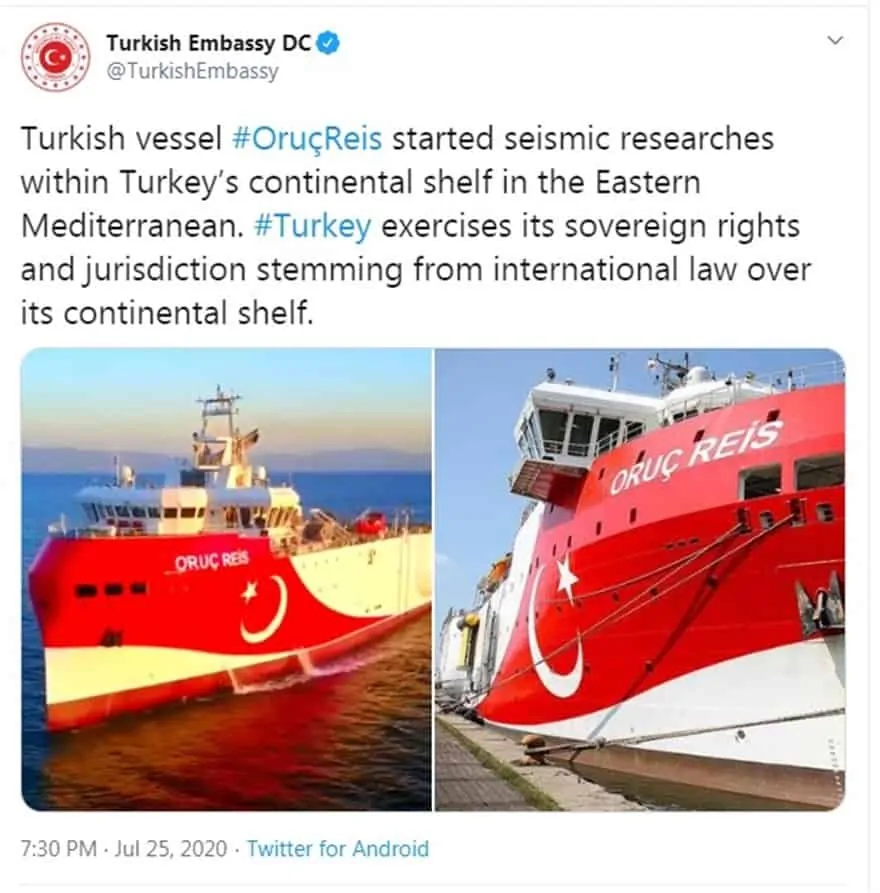
Turkey withdrew some warships and hurried to delete a propaganda tweet posted by the Turkish Embassy in the US, that claimed the Oruç Reis drilling ship started research in Greek maritime space.

The Turkish research ship remains moored outside Antalya despite Turkey boldly announcing that from the Tuesday that just passed until August 2, that it would violate Greece’s water.

Turkey withdraws warships after strong response from Greece 2

The Turkish embassy accused Greece of pretending that the search area is in Greek territorial waters, in an attempt to justify its maximalist aspirations.

Hours later, the tweet was deleted and the embassy wrote that Oruç Reis had stated on July 21 that it would begin investigations.


Greek President Katerina Sakellaropoulou met with the National Defense Minister Nikolaos Panagiotopoulos to discuss the latest developments in the Aegean and the movements of the Turkish fleet.

The following is their dialogue:

President: What are we learning?
Defense Minister: We are in our position and they are in theirs …
President: Is Oruç Reis still anchored?
Defense Minister: The situation will be normalized when the fleets return to the naval bases … We are a country that never suffers.

The Defense Minister who was accompanied by the head of the military, even stressed to Sakellaroupoulou that “We have strong backs of support” pointing to Konstantinos Floros.

Prime Minister Kyriakos Mitsotakis did not hide his intense annoyance with Turkish President Recep Tayyip Erdoğan’s provocations. When asked by a journalist how he felt seeing the image through Hagia Sophia, he replied: “I did not feel anything less than all Greeks.”

Although Erdoğan had a cheap “victory” by converting Hagia Sophia, Turkey’s inability to penetrate Greek maritime space since Tuesday and withdrawing its warships demonstrates that Turkey is unwilling to risk war with a country that is not already devastated by years of war like Libya or Syria as it has significant internal military issues.