The Panepirotic Federation of America vehemently condemns the brutal destruction by Albanian authorities on August 26 of a Greek Orthodox Church in the Chimara region of the former Communist nation that once prohibited all forms of religious worship.
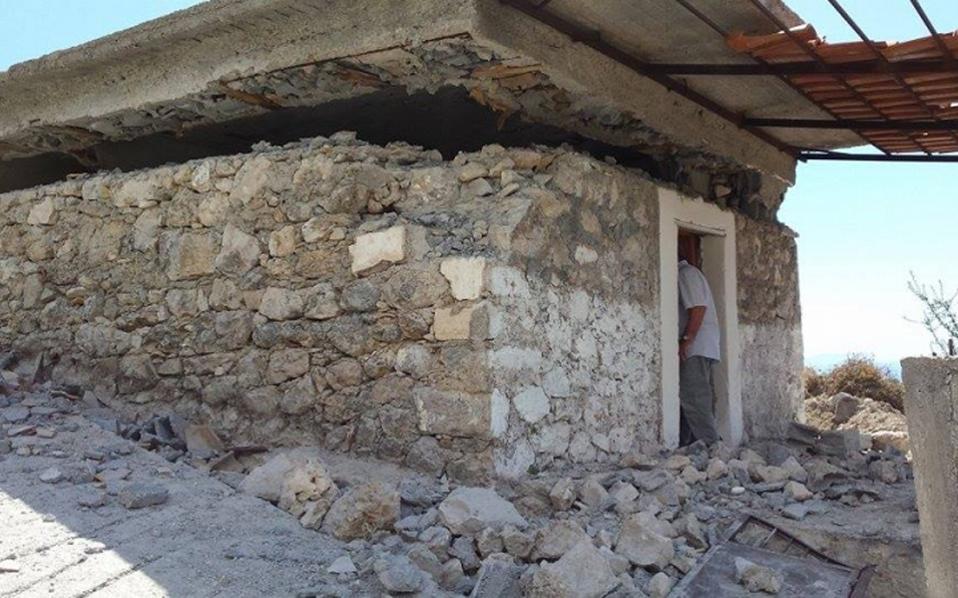
The Church of St. Athanasius in the town of Drymades, known in Albanian as Dhermi, was completely destroyed by government agents acting on the authority of Albania’s Interior Ministry.
The action has raised fears in Albania’s large community of ethnic Greeks of renewed persecution of the country’s Orthodox Christians, who constitute a third of the country’s 3.5 million people.
“The razing of St. Athanasius Church echoes the brutal actions of the Stalinist regime that ruled Albania for half of the last century when government forces executed priests, turned churches into stables and imprisoned anyone wearing a cross or reading the Bible,” said Nicholas Gage, president of the Federation.
“It is a shameful act for a country trying to shed its violent past and become a member of the European Union.”
Mr. Gage said the only way Tirana can make amends for its brutal actions is to offer an alternative site for the construction of a new church and to provide the funds to build it.
St. Athanasius was first destroyed in 1972 by agents of Stalinist dictator Enver Hohxa and its stones were used to build a water depot. When communism fell in the country in 1992, residents built a new church on the site of the old one. It served the Orthodox Christians in the town as a place of worship for 23 years.
Last week as worshipers were observing religious services, local government agents acting on an order from the Interior Ministry removed icons and other religious objects and began to destroy parts of the building.
The next day the agents returned in cars without license plates and continued the demolition despite the protests of the local priest who was almost crushed by falling debris. By August 26 the whole building was razed to the ground.
The Orthodox Church of Albania, leaders of the ethnic Greek minority, human rights activists and foreign diplomats have all condemned the destruction of the church by Albanian authorities as arbitrary, brutal and in violation of the country’s own laws. A spokesman for the Orthodox Church of Albania noted that Law 10057 passed in 2009 that ratified a previous agreement between the Albanian nation and the Orthodox Church guarantees the inviolability of places of worship and their protection by the state.
Reports from Tirana say that U.S. Ambassador Donald Lu met with Prime Minister Edi Rama to protest the destruction of the church as insensitive to the rights of the Orthodox faith in Albania and the ethnic Greek minority and to urge him to seek a solution to the problem acceptable to both.
Omonia, the largest advocacy group representing the Greek minority, and the Human Rights Party of Albania, the minority’s political organization, both issued statements condemning the brutal destruction of the church and warning that it will seriously harm relations between the government of Prime Minister Rama and all minorities in the country.
Those warnings were echoed by the leaders of the Panepirotic Federation of America both in the United States and in Albania, where the organization’s vice president, Menelaos Tzelios, is traveling to assess the treatment of minorities in the country. Mr Tzelios called on the Albanian government to move quickly and decisively to repair relations with its Orthodox Christians citizens if it wants to claim a rightful place in the community of civilized nations.
Albanian authorities say they have confiscated about half a million
cannabis plants this year, arresting 240 suspected growers and drug
traffickers.
Interior Ministry spokesman Ardi Bita said Friday that fighting drug production is a "top priority" for police.
Some 7 billion euros ($7.9 billion) worth of marijuana has been seized
and destroyed so far, Interior Minister Saimir Tahiri said.
On Wednesday, 100 police destroyed some 16,000 plants in Kurvelesh, south of Tirana.
Albania
was long a major marijuana producer in Europe. A crackdown started last
year, when police stormed the southern Lazarat village with armored
personnel carriers — despite coming under automatic weapon and rocket
fire by drug growers.
Prime Minister Edi Rama has set the fight against drugs as a main priority for his government, elected in 2013.
First entry: 28 August 2015 - 14:07 Athens, 11:07 GMT
Last update: 14:07 Athens, 11:07 GMTPolitics
Greece's
new prime minister, a top judge who is the country's first female
premier, named the members of her caretaker government Friday as the
country heads to early elections next month, the third time Greeks will
go to the polls this year.
The appointments come a day after
Supreme Court head Vassiliki Thanou was sworn into office. The
65-year-old was appointed after outgoing prime minister Alexis Tsipras
resigned last week, barely seven months into his four-year mandate,
following a rebellion by members of his radical-left Syriza party who
objected to his agreement with the conditions of Greece's third
international bailout.
The finance ministry post went to Giorgos
Houliarakis, an academic who had been on Greece's negotiating team
during talks with creditors. Popular Greek pop singer Alkistis
Protopsalti was named tourism minister. The new cabinet was to be sworn
in later Friday.
Elections are widely expected to be set for Sept.
20. Tsipras has said he needs a stronger mandate to implement the tough
austerity measures accompanying the three-year, 86 billion euro
bailout, but an opinion poll published in the left-leaning Efimerida ton
Syntakton newspaper Friday found small support for his move.
Sixty-four
percent said Tsipras' decision to call the snap poll was wrong,
compared to 24 percent who considered it correct. The remainder took no
position or did not reply.
Sixty-eight percent said they believe
the country should remain within the euro even if it means further
austerity measures and sacrifices. Asked whether the government got the
best deal it could for the third bailout, 48 percent said yes and 45
percent disagreed.
The poll showed Syriza supported by 23 percent,
compared to 26 percent in an early July survey by the same company. The
conservative New Democracy party stood at about 20 percent compared to
15 percent in July.
The small nationalist Independent Greeks,
Syriza's partner in the seven-month coalition government, were backed by
2 percent, below the 3 percent threshold for to enter Parliament.
Tsipras
has ruled out forming a coalition with any of the center-right or
center-left parties if he fails to win a majority to govern outright,
meaning he would be unable to form a government unless a party that
didn't make it into parliament last time manages to win above 3 percent.
The
poll was conducted by the ProRata company on Aug. 25-26 with a sample
of 1,000 people nationwide and had a margin of error of 3 percentage
points. Associated Press
A group of ethnic Albanians
in the town of Djakovica on Friday broke through a police cordon set up
to provide security for visiting Serb IDPs.
Source: B92, Beta, RTS, Tanjug
The Serbs in question, who had been driven out of their
homes in Djakovica and elsewhere in Metohija, today visited the town to
celebrate the Orthodox Christian holiday of the Dormition of the Mother
of God at the Serb Orthodox Church (SPC) monastery of Uspenje Presvete
Bogorodice (Holy Mother Assumption).
The Albanians who gathered to protest threw firecrackers and red paint at the police, RTS is reporting.
While three buses carrying the Serbs were leaving the monastery's yard,
a sizable group of people gathered at the end of the former Srpska
Street, shouting slogans against Serbs and throwing firecrackers. The
slogans included "Serbia cannot pass here," and, "No reconciliation
without justice."
The police used tear gas and prevented them
from approaching the IDPs as they were leaving the monastery. One person
was detained during the breaking through the police cordon.
After a short while, the Albanians dispersed while the IDPs left the
town safely with strong police escort, and headed toward the monastery
of Visoki Decani.
Beside the numerous Kosovo police members who
secured the monastery in Djakovica today, Italian soldiers from KFOR
had also been deployed. The entrance to the street was closed to
traffic.
Djakovica Mayor Mimoza Kusari Lila spoke with the
police before the buses arrived "to make sure everything is ready for
the visit."
"This municipality suffered a lot during the war
and that must be respected - but we of course know that is according to
the law, and we are ready for the believers to come in peace and we know
they come because of religion, and not for other reasons. When we take
into account there are many in our municipality still listed as missing
and all the sufferings and the situation here, it is not easy," said
she.
The liturgy held at the monastery today was also attended
by Kosovo Minister for Communities and Return Dalibor Jevtic who
stressed he "wished to send a message of peace and reconciliation from
this place."
"A message that nobody should ever be an obstacle
to anyone again, that life together is possible and that in line with
that only a small amount of tolerance and understanding is needed," said
he.
Vassiliki
Thanou, head of the Supreme Court in Greece, has been officially
sworn-in, as the first ever female prime minister to steer the Greek
government towards a new election amid the bailout crisis.
A
decree has been signed setting elections in Greece on September 20,
with parliament due reconvene in October. It's the first time the
country will be run by a female prime minister.
The country's economic future, in the short-term, relies on it
meeting all the demands set by the Troika in return for US$97 billion
dollars in a deal that left radical left wing Prime Minister Alexis
Tsipras with no choice but to resign following a rebellion in his Syriza
Party over his agreement with the Troika.
In January 2015, the Syriza party, with Alexis Tsipras at the helm,
won the election based on pledging to resist further austerity demands
from Brussels. Just seven months later and faced once again
with economic collapse and an exit from the Eurozone, Tsipras reneged
on his party promises and signed up to even stricter demands from the
creditors in return for another bailout. The deal was only approved
with the support of pro-European parties — and not his own.
Having been sworn-in to lead the interim government, Vassiliki
Thanou's task is to steer the ship until the country goes to the polls
during a time when Greece is facing an unprecedented immigration crisis,
which Thanou pointed out in her first public comment in office.
"<…> Given the circumstances… I believe that this government
will also have to handle crucial matters", Thanou said, suggesting that
the numbers of refugees arriving on Greek shores is a situation
as unstable and the country's economy. Greece has seen a 750 percent
rise in the number of refugees and migrants arriving on its shores this
year.
But the Syriza party is still topping election polls according to a
survey carried out by ProRata for Efimerida Ton Syntakton newspaper. The
same survey reveals that 68 percent of Greeks want to remain in the
eurozone — despite the increased austerity measures.
The same survey also suggests that despite everything, Tsipras still
remains in the wings as the most popular political leader with 41
percent of voters backing him — but his decision to call a snap poll
to seek a fresh mandate might just cost him the next election
on September 20.
Serbia's
ambassador to UNESCO told Sputnik Serbia that the country would win the
diplomatic battle against unrecognized Kosovo's membership in UNESCO,
as the opposite would mean putting Serbian cultural heritage in the
region in danger.
The
unrecognized state of Kosovo's admission to UNESCO, the United Nations'
cultural heritage body, is completely unacceptable, Serbia's ambassador
to the organization, Darko Tanaskovic, told Sputnik Serbia.
"If Kosovo joins UNESCO, from the
administrative point of view, Serbian heritage would belong to the
territory of the 'state of Kosovo' and it cannot be excluded that there
would be attempts to appropriate it," Tanaskovic told Sputnik Serbia.
According
to Tanaskovic, the ideology of "Greater Albania" advocates the
destruction of remnants of Serbian culture and attempts to create a
Kosovo culture which would appropriate everything on its territory. Over
100 Serbian Orthodox churches were destroyed in Kosovo between 1999 and
2004, when the breakaway territory was administered by the United
Nations.
"The law of Kosovo's cultural heritage, which still has not been
reviewed in the self-proclaimed republic's parliament, stipulated that
all heritage would be considered property of the 'state of Kosovo,'
which is absolutely unacceptable," Tanaskovic added.
Taskanovic also said that granting the unrecognized state of Kosovo
membership in UNESCO cannot happen, even despite partial international
recognition.
Athens has compared the demolition of the contested
church of St Athanas in a village in southern Albania to the actions of
Islamist jihadists in the Middle East.
Gjergj Erebara
BIRN
Tirana
Demolished church photographed on 26 August 2015. Photo: Facebook
Albanian police have demolished a contested church dedicated to St
Athanas in the southern village of Dhermi, angering the Orthodox Church
and neighbouring Greece, which supports the Church's mission.
The Orthodox Church called it a vandalistic act of desecration and a
violation of church property. Greece said the Albanians were behaving
like Islamist extremists.
Police used heavy machinery to reduce to rubble the roof built in
1994 to cover the foundations of a much older church destroyed during
the communist era.
The renovated church was declared an “illegal construction” by the
local authorities in Himara municipality two weeks ago, pitting Albanian
nationalists against the Greek-supported Orthodox Church.
Since news about the demolition order broke out last Friday,
government officials, including the Prime Minister Edi Rama, described
the church as an important part of the national heritage of Albania and
pledged to restore it properly.
Albanians believe that in the 17th century, a well-known Catholic cleric served there and opened Albanian-language schools.
Speaking about the church, Prime Minister Rama said on Monday that
“the old church in Dhermi will be regenerated in the name of national
heritage [over] the 'parking lot' that is illegal, which they call a
church.”
Albanian nationalist historians and politicians have dismissed the Orthodox Church complaints as Greek nationalistic propaganda.
The southern Himara area has experienced several conflicts between
Albanian and Greek nationalists during recent years. Home to a
significant Greek minority, some Greek nationalists still dream of
uniting the area to the Greek state.
The Greek government urged the Albanian authorities to stop the
demolition and reacted angrily after the demolition went ahead,
comparing it to the acts of Islamic extremists.
“The destruction of holy sites and objects of worship took place at
least until recently in the wider region of the Middle East and North
Africa at the hands of jihadists. Today we also saw such an act carried
out in our neighbouring country, Albania,” a Greek Foreign Ministry
spokesperson Konstantinos Koutras said on Wednesday.
“You will be informed directly of Greece’s moves in this instance towards Albania and the international community,” he added.
Greece has condemned the demolition on
Wednesday of an orthodox church in the village of Dhermi, on the
southwest coast of Albania.
“The destruction of holy sites and objects of worship took place, at
least until recently, in the wider region of the Middle East and North
Africa, at the hands of jihadists. Today we also saw such an act carried
out in our neighboring country, Albania,” Foreign Ministry spokesman
Constantinos Koutras told journalists in Athens Wednesday.
“No one is more ungrateful than a beneficiary,” he said.
Athens was expected to lodge an official complaint with Albanian authorities and the international community.
On Monday, Greece’s Foreign Ministry called on Tirana to respect
religious freedoms after local authorities had partially destroyed the
interior of the Holy Church of Aghios Athanasios.
Albanian officials have said they intend to carry out excavations at the
site in an attempt to discover the grave of Nilo Catalano, a Catholic
missionary from the 17th Century.
Commander-in-Chief, Hellenic Fleet; Chief of Staff of the Hellenic National Defence General Staff
Awards
Knight's Gold Cross of the Order of Honour, Knight's Gold Cross of the Order of the Phoenix , Medal of Military Merit,
Commendation Medal of Merit and Honour, Navy Force Formation Command
Medal, Navy Force Meritorious Command Medal, Staff Officer Service
Commendation Medal
Admiral Panagiotis Chinofotis (Greek: Παναγιώτης Χηνοφώτης, also transliterated Panayiotis Khinofotis, born 12 August 1949) is a Member of Parliament with the New Democracy party, a former Vice-Minister of the Interior and a former Chief of the Hellenic National Defense General Staff.
Born in Athens, Chinofotis graduated from the Hellenic Naval Academy and was commissioned an Ensign in 1971. He served aboard several patrol boats, destroyers and frigates of the Hellenic Navy before being sent to the Hellenic Naval War College, from which he graduated in 1986. He was then sent to study at the United States Naval War College and Salve Regina University, from which he graduated with a master's degree in international relations.
After graduation, Chinofotis was promoted to Commander, and was made
commandant of the Hellenic Naval War College. In 1991, he was made
commander of the HS Lemnos, flagship of the Commander-in-Chief, Hellenic Fleet.
In 1993, Chinofotis began a two-year assignment as Hellenic Military Representative to NATO in Brussels. He next spent a year as Commander of the Fleet Command, followed by a tour as Deputy Military Representative of Greece to the European Union, serving as chairman of the Military Working Group during Greece's EU Presidency.
Chinofotis next progressed through several staff assignments until,
in 2004, by now a vice admiral, he became Chief of the Fleet Command. A
year later, he was promoted to Admiral and became Chief of the Hellenic National Defense General Staff.
On 21 August 2007, he resigned in order to participate in the September legislative elections, where he was elected MP on the statewide ticket for New Democracy. On 19 September he was sworn in the new cabinet as Vice-Minister of the Interior, a position he held until 2009.
Athens criticised Tirana after a police attempt to
remove an alleged illegal construction at a village church rekindled
rivalry between the Catholic and Greek-backed Orthodox churches in
Albania.
Gjergj Erebara
BIRN
Tirana
Archbishop Janullatos of the Orthodox Church of Albania. Archive photo: LSA/Gent Shkullaku
The Greek Foreign Ministry on Sunday condemned what it called a
“violent incident” at the church of Saint Athanas in the Albanian
village of Dhermi, describing what happened as “unacceptable and
contemptible”.
Construction police from the local Himara Municipality went to Dhermi
on Friday to remove the concrete roof of the church, claiming it was an
illegal build.
But the Orthodox Church of Albania, which has strong Greek support,
called it an attempt to destroy the church and said that those involved
“used violence against the priest and believers”.
It claimed that there had been officially-sanctioned attempts to
carry out excavations at the church in a bid to find the grave of a
Catholic missionary from the 17th Century.
The Albanian Foreign Ministry meanwhile described Greece’s statement as “interference in Albania’s internal affairs”.
Artan Shkreli, an advisor to Albanian Prime Minister Edi Rama, said
that local police had simply intervened to stop illegal construction at
the site, which he said had “deformed” the church.
Shkreli claimed that the Church of Saint Athanas is a cultural
monument in Albania and that the reactions against the intervention by
the police were organised by the Greek minority group Omonia, which is known for its nationalistic stance.
“The illegal and illogical reaction from Omonia against the
intervention of the Construction Police is linked to the fact that they
deny the history of this country,” Shkreli said.
“The [17th Century] Basilian missionary Nilo Catalano, who opened the
earliest Albanian schools, was buried in this church, amongst others,”
Shkreli told local TV station A1 Report.
Albanian Orthodox Church spokesperson Thoma Dhima responded by saying
that the church in Dhermi does not have cultural monument status and
that it was built by the villagers in 1992 on the foundation of the old
church. He described the police intervention as unlawful and said that
he had filed charges at the prosecutor’s office.
Responding to Shkreli’s claims about Catalano, Dhima said that the
missionary attempted to convince people in the area to become loyal to
the Pope, but was rejected.
He said that Catalano “poured in plenty of money to buy” the locals’ faith, but was driven out.
The rivalry between the Catholic and Orthodox churches in Albania is
centuries old and is often mixed up with Albanian-Greek rivalry.
But as the dispute over the church illustrates, it still has the
potential to cause serious disagreements between Albania and Greece.
In its statement on the row on Sunday, the Greek Foreign Ministry
suggested that Albania’s EU integration process could suffer as a
result.
“Greece will be at our neighbouring country’s side on its course
towards Europe, on the condition, of course, that Albania fully meets
all of its obligations provided for by international law and the
European acquis [the body of law that needs to be met to secure EU
accession],” the Greek Foreign Ministry statement said.
Serbian FM Ivica Dacic said
in New York on Friday that his country finds Pristina's demands "to join
the work of UNESCO and Interpol" unacceptable.
Source: Beta, Tanjug, Sputnik
"I was born in Kosovo and Metohija 49 years ago in a town
called Prizren, which was in the 14th century the capital of Serbia,
and today 21 or 22 Serbs live there," Dacic said, adding this was "a
historical reality, the fact that today the majority in Kosovo are
(ethnic) Albanians."
According to him, Kosovo Foreign Minister Hashim Thaci,
while explaining Pristina's request to join UNESCO, "in effect
acknowledged the ethnic cleansing" when said that the idea was not
endorsed "only by the Orthodox (Christian Serb) community, which makes
up four percent of the population in Kosovo."
"Serbia has
extended a hand of reconciliation and that hand is hanging in the air -
but we have not raised both our hands in surrender," Dacic told a UN
Security Council session dedicated to Kosovo.
We will see how
each country will vote in UNESCO, he said, adding that Serbia cannot
allow Kosovo's membership in UN organizations through the back door.
"Either abolish resolution 1244 or don't apply double standards toward
Serbia," was Dacic's message at the UN Security Council.
"It
must be that this world is governed by principles. It cannot be that
Serbia, as the OSCE chairman, is expected to defend the territorial
integrity of Ukraine - and not defend its own territorial integrity with
the same force. Serbia is in favor of dialogue, but we believe our own
eyes, not the claims that are often, in the case of Serbia, an example
of double standards," he added.
Dacic said that "a territory
administered by the United Nations under valid and mandatory Security
Council resolution 1244, Kosovo is not and cannot be considered a state
as a subject of international law and cannot, ipso facto, qualify for
admission to organizations like the ones referred to."
"We will
fight for our interests, politically and diplomatically. We'll see how
each state will vote on Pristina's request for membership in UNESCO. We
need to stop playing under the table and begin to play openly. Serbia
will not participate in the attempts to allow Kosovo to enter
specialized UN agencies through the back door," Dacic said.
According to him, "in that sense, each and every different attitude to
the consideration of the question of Kosovo’s membership in these
organizations would be tantamount to ignoring, i.e. violating, the legal
rules created under the auspices of the United Nations for the purpose
of maintaining international peace and security "If and when the time
comes, questions of this kind should be the subject of dialogue between
Pristina and Belgrade."
Stressing that Serbia "condemns any
desecration of religious sites of any religion," Dacic pointed out that
the destruction of cultural and religious heritage in the Middle East by
Islamic State (IS) is being met with strong condemnation across the
world as an act of terrorism - and added, in reference to Kosovo's
authorities, that "those who desecrate and destroy the Serbian cultural
heritage in Kosovo demand membership in UNESCO, "and a pat on the
shoulder as an act of reward."
Dacic also warned about "the
drastic discrepancy between the declarative commitment and the actual
conduct of Pristina" on the issue of the protection of the Serbian
cultural heritage:
"You will agree that someone who aspires to
membership in UNESCO must, not only with words but also with deeds,
confirm their commitment to the objectives and principles of the
Constitution of UNESCO - with which the deliberate, systematic, vandal
destruction of cultural and historical monuments of their fellow
citizens, in order to eliminate the traces of centuries of existence of a
people in an area, as well as the impunity got perpetrators of such
barbaric acts unworthy of the 21st century - are undoubtedly
irreconcilable."
The Serbian minister then told the UN Security
Council that "from June 1999 until today 236 churches, monasteries and
other buildings owned by the Serbian Orthodox Church (SPC, in Kosovo) as
well as cultural and historical monuments, have been the target of
attacks."
Of these, as many as 61 have the status of cultural monuments, "and 18 are of great importance for the state of Serbia."
"In the area of Kosovo and Metohija 174 religious sites and 33
cultural and historical monuments have been destroyed, more than 10,000
icons, religious, liturgical, and artistic items stolen. 5,261
headstones have been either destroyed or damaged in 256 Serbian Orthodox
cemeteries - and not a single whole tombstone stands on more than 50 of
the graveyards," said Dacic.
He pointed out that the attacks
on the Serb heritage in Kosovo in this regard represent attacks on the
Serb identity, have a direct impact on their sense of acceptance in the
local community and are a part of the process of "changing historical
facts in order to marginalize and eliminate Serbs and Serbia from the
history of Kosovo and Metohija."
The foreign minister went on to say that Belgrade "received information
that EULEX (EU mission in Kosovo) is preparing to transfer the cases
and the accompanying documentation processed by EULEX prosecutors and
judges to the PISG, i.e. the local judiciary."
"About 500 cases
are involved, about 300 of them related to war crimes, out of which 270
have been taken over from UNMIK (UN mission in Kosovo). The government
of the Republic of Serbia expresses its concern at the intention to
transfer the cases related to war crimes in the territory of Kosovo to
the local judiciary since all of them belong to the exclusive competence
of EULEX even after the amendment of the PISG regulations on the
mandate of the EU Mission relating to the rule of law in the province.
In point of fact, it is provided that EULEX prosecutors continue to
process the cases in respect of which they decided to launch an
investigation prior to April 15, 2014, as well as the cases allocated to
EULEX prosecutors before this date which include the cases of war
crimes that EULEX took over from the UNMIK judiciary," Dacic said, and
added:
"If EULEX does proceed and transfer the cases to the
institutions in Pristina, in particular the sensitive cases of the
investigation of the war crimes committed in the territory of Kosovo,
the consequences for processing the war crimes committed by the KLA
against the Serbs, non-Albanians and Albanians, marked ‘Serbian
collaborators’ during the armed conflicts of 1998 and 1999 would be
unforeseeable."
"Since it is expected that a Specialist Court
will be established soon to try the war crimes committed by the KLA in
the territory of Kosovo and Metohija, and it is being established
precisely for the incapacity of the local Kosovo judiciary to
investigate and try the perpetrators of war crimes from the ranks of the
KLA, let me point out that the transfer of the war crimes cases to the
local judiciary by EULEX runs counter to the activities of the
international community aimed at establishing the Specialist Court," the
foreign minister told the UN Security Council, and added:
"If
the said cases were to be transferred to the local judiciary, there is
reason to believe that much of material evidence and many witnesses
would be removed or intimidated, which would make the work of the future
Specialist Court for war crimes much more difficult. Politically
motivated arrests and long trials, as well as the different yardsticks
of the local judiciary should not be disregarded, either. One example of
which I already spoke at the previous meetings of the Security Council
is the case of Oliver Ivanovic, the leader of the Civil Initiative
'Serbia, Democracy, Justice', who was detained at the end of January
2014 and continues in detention regardless of the guarantees and calls
of the Government of Serbia that he be granted bail. In an effort to win
this right, Oliver Ivanovic has been on hunger strike for days now."
Dacic also told the UNSC that the Serbian government "attaches
particular importance to finding solutions for internally displaced
persons while the creation of conditions for their sustainable return is
one of the key segments of the reconciliation process."
"Out
of over 220,000 people who fled Kosovo since 1999, in the last 16 years
sustainable return has been achieved only by 1.9 percent, while around
204,000 persons sill remain displaced in Serbia. Accordingly, the
percentage of sustainable return in this case is below all international
standards and averages," said the minister.
Dacic also pointed
to the tendency of privatization of public companies in areas with a
majority Serb population, "leading us to the conclusion that the basic
motivation of these privatizations, the ethnic connotation of which is
very transparent indeed, is the destruction of economic resources
exactly in the Serbian communities which is incompatible with democratic
achievements and European standards."
"We are deeply concerned
over the Draft Law on the Kosovo Property Comparison and Verification
Agency which is under consideration in the Parliament of Kosovo and is
in outright contravention of the 2011 Technical Agreement on Cadastre.
It creates conditions for the legalization of the property expropriated
unlawfully from the Serbs, whereby enormous and irreparable damage would
be created to the Serbian community in the Province. It is exactly with
this in mind that we requested that the procedure of the adoption of
the said Law be stopped and that the Technical Agreement on Cadastre,
providing for the establishment of a body consisting of representatives
of Belgrade, Pristina and the European Union to carry out the comparison
of cadastral documentation, begin to be implemented," Dacic said.
The UN Security Council session was held on Friday in New York to
consider the UN secretary-general's regular report on the work of the UN
mission in Kosovo, UNMIK.
(Tanjug/Serbian MFA)
Addressing the session of the UNSC, Kosovo Foreign
Minister Hashim Thaci said that "Serbia's attempt to block Kosovo's
membership in UNESCO and Interpol" was "contrary to the Brussels
agreement."
"I heard harsh words from Dacic. I understand that
he is in an election campaign, but dialogue between Belgrade and
Pristina continues. Next week we will meet in Brussels and I hope we can
agree on important deals - on telecommunications, energy, the Community
of Serb Municipalities (SZO)," said Thaci.
Commenting on
Dacic's address to the Council, Thaci asserted that "Albanians have
always been the majority in Kosovo" and that Dacic "must realize that
the Serbian administration, the army and the police will never return."
"Your dream is over once and for all. If you start a war, you will lose," he said.
After 20 years, times when Greece has put Veto for the aids from EU to Albania, this is the first time that happens seriously
Foreign Ministry spokesperson’s response to
yesterday’s announcement from the Albanian Foreign Ministry’s
spokesperson regarding the episodes that took place at the Holy Church
of Saint Athanasios in Dhërmi, Himarë
Sunday, 23 August 2015
“Yesterday’s announcement from the
Albanian Foreign Ministry spokesperson regarding Albania’s commitment to
respect for and full protection of the individual, religious and
property rights of the minorities in Albania was very encouraging.
As
has been the case until now, Greece will be at our neighbouring
country’s side on its course towards Europe, on the condition, of
course, that Albania fully meets all of its obligations provided for by
international law and the European acquis.
This, moreover, is why
the Foreign Ministry is awaiting the response of and the taking of
immediate measures by the Albanian government regarding what occurred at
the Holy Church of Saint Athanasios in Dhërmi, Himarë.”
First entry: 21 August 2015 - 20:54 Athens, 17:54 GMT
Last update: 11:00 Athens, 08:00 GMTElections 2015
The New York Times has published the following text explaining to its readers what Alexis Tsiapras' call for a new election means for Greece.
A
tumultuous summer in Greece could lead to an uncertain autumn as voters
may have to decide who would best navigate the next phase of the
country’s financial struggle. What Is Happening in Greece?
Prime
Minister Alexis Tsipras called for new elections. In a nationally
televised address on Thursday, Mr. Tsipras said that he would submit his
resignation to Greece’s president, a move he hoped would clear the way
for his radical left Syriza party to win a new mandate.
Officials
said he would seek to schedule the vote for Sept. 20, but it might be
later as politicians from other parties jockey for influence. The
country’s main conservative opposition said it would try to avert
elections by forming a government, as is their right, under the Greek
Constitution. Why Did Tsipras Do This?
It is a bid to consolidate his power and press ahead with the bailout plan he agreed to this summer with European creditors.
Mr.
Tsipras has been weighing new elections for weeks amid a deep split
within his Syriza party over his embrace of the bailout plan that was
approved just last week by the Greek Parliament.
The contentious
vote on the bailout after an all-night parliamentary debate exposed a
growing schism within Syriza, which splintered on Friday.
Twenty-five
Syriza lawmakers announced the formation of a party, Popular Unity,
declaring in a letter to Parliament that they intended to “remain true
to our pre-election promises.” It was a reference to the anti-austerity
movement that brought Mr. Tsipras and Syriza to power in January — a
cause that his critics say he abandoned in negotiating the bailout.
That
bailout package, worth 86 billion euros, or about $95 billion, puts in
place strict spending limits, new tax increases and changes in the way
Greece manages its economy in exchange for money to pay the country’s
crippling debts. What Does This Mean for the Bailout?
In
calling for the vote after Greece received some €13 billion, or about
$14 billion, of new funds from the bailout package, Mr. Tsipras is
hoping that voters will endorse his approach — and effectively ratify
the bailout.
The money arrived just in time to repay €3.2 billion
owed on government bonds held by the European Central Bank. Much of the
bailout money will go to repaying debts, not to rebuilding the country’s
economy. However, avoiding default could help restore consumer and
investor confidence, which could, eventually, improve the economy. How Did Greece Get to This Point?
Mr.
Tsipras was elected in January as an anti-austerity renegade, vowing to
challenge Greece’s creditors and win a better deal to pay back and,
perhaps, forgive some of the country’s crippling debt.
After
several tumultuous months that included heated negotiations with the
country’s creditors — the European Central Bank, the International
Monetary Fund and the other members of the eurozone — the prime minister
reversed course and agreed to the bailout plan.
The deal
infuriated Syriza’s far-left factions and was approved by Parliament
only with the help of opposition parties. Many of the breakaway Syriza
lawmakers oppose the bailout plan because it proposes raising the
retirement age and opening parts of the Greek economy to greater
competition. Will Tsipras Be Able to Stay in Power?
That
is the gamble he is making. Despite his reversal on the bailout plan,
Mr. Tsipras has remained popular, with the most recent opinion polls
from late July showing no other leader in a strong position to challenge
him.
Mr. Tsipras said Thursday that he would resign as prime
minister — a constitutional requirement for new elections. But he will
not resign as head of his party, now smaller without his former Syriza
allies.
Syriza was left on Friday with 124 lawmakers in the
300-seat Parliament, but local news reports speculated that four more
legislators were preparing to abandon the party.
Popular Unity
will be led by a former energy minister, Panagiotis Lafazanis, the
leader of Syriza’s radical Left Platform faction, with which about 40 of
Syriza’s lawmakers were loosely aligned.
Mr. Tsipras is counting
on his connection to ordinary Greeks, and hoping that his personal
popularity can help his party win enough votes to maintain power without
the support of the radical parties.
If he does not, he might have
to form a new coalition with other centrist parties in Parliament, some
of whom he has depicted as part of Greece’s corrupted establishment.
Greek-American Alek Skarlatos and
another two US citizens who overpowered a gunman on a train between
Amsterdam and Paris on Friday were invited to the Elysee Palace by
French President Francois Hollande on Saturday and praised by President
Barack Obama as heroes.
Skarlatos, a 22-year-old member of the Oregon National Guard who had
recently returned from service in Afghanistan, said he and two friends,
another army officer, Spencer Stone, and Anthony Sadler, a student, had
been on the train when they saw a man enter holding a Kalashnikov.
Stone tackled the gunman but was cut with a knife.
The friends then disarmed the suspect, beat him until he was unconscious and bound him.
France train attack: Americans overpower gunman on Paris express
Police investigate incident near Arras, France, in which three US
citizens – two of them soldiers – prevented attack by suspect reportedly
armed with AK-47
0:00
/
1:10
French
interior minister Bernard Cazeneuve praises the brave actions of two
train passengers who reportedly helped overpower the gunman - link to video
A heavily armed gunman has opened fire on a high-speed train
travelling from Amsterdam to Paris before being overpowered by three US
citizens, two of whom were soldiers.
Two people were injured in the attack, including one of the
Americans, who was admitted to hospital with serious injuries to his
hand that needed surgery.
Barack Obama described the men as heroic following the attack on Friday.
Anthony Sadler, Alek Skarlatos and Briton Chris Norman after the attack on the train. Photograph: AFP/Getty Images
A British passenger, Chris Norman, helped the Americans tie up the
suspect, and French anti-terrorist police are now questioning him. He
was arrested after the train made an emergency stop at Arras, near the
French-Belgian border.
The suspect’s motive was not immediately known, but French
prosecutors said counter-terrorism investigators were launching an
inquiry. According to early briefings, the gunman, 26, was known to
French intelligence services and was Moroccan or of Moroccan origin.
Belgian prosecutors said on Saturday they had formally opened an
anti-terrorism investigation. “We have opened an inquiry as the suspect
boarded the train in Brussels,” Eric van der Sypt, a spokesman for the
prosecutor’s office, said.
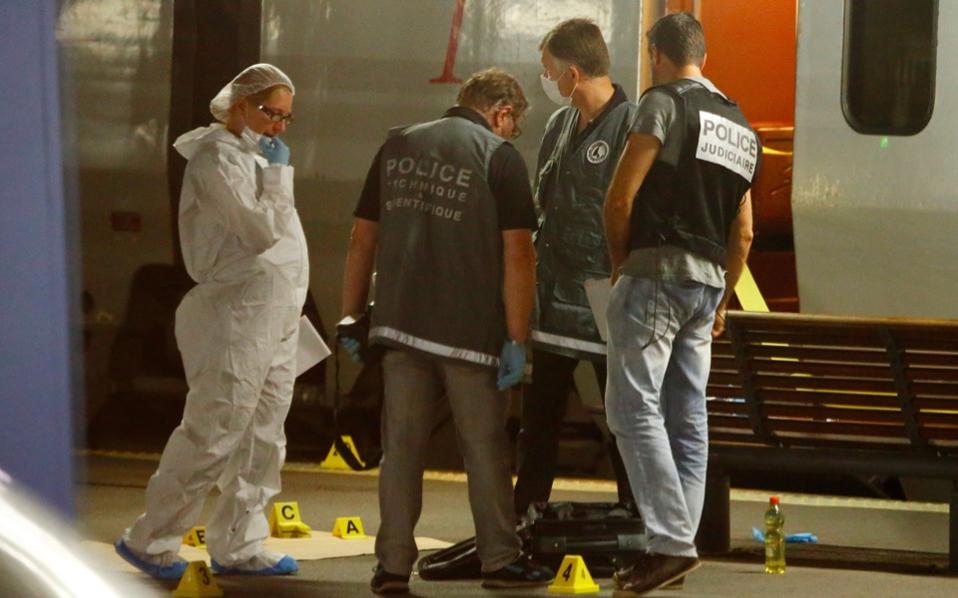
The shooting happened just before 6pm in the last carriage of the
train, which was carrying 554 passengers. The man had several weapons in
his luggage, including a Kalashnikov, an automatic pistol and razor
blades.
Two of the Americans were in the military, their travelling companion
and childhood friend Anthony Sadler, a senior at Sacramento State
University, said.
The one injured was named as air force serviceman Spencer Stone from
Sacramento, California. The other was Alek Skarlatos, of Roseburg,
Oregon.
Advertisement
“We
heard a gunshot and we heard glass breaking behind us and saw a train
employee sprint past us down the aisle,” Sadler said. The trio then saw a
gunman entering the carriage with an automatic rifle, he added.
“As he was cocking it to shoot it, Alek just yells: ‘Spencer, go!’
and Spencer runs down the aisle,” Sadler said. “Spencer makes first
contact, he tackles the guy, Alek wrestles the gun away from him, and
the gunman pulls out a box cutter and slices Spencer a few times. And
the three of us beat him until he was unconscious.”
Sadler later told AFP the gunman had demanded his weapon back. He
said: “He was just telling us to give back his gun. ‘Give me back my
gun! Give me back my gun!’ But we just carried on beating him up and
immobilised him and that was it.
“I’m just a college student. I came to see my friends for my first trip to Europe and we stop a terrorist. It’s kind of crazy.”
Skarlatos, who had recently returned from a tour of duty in
Afghanistan with the national guard, told Sky News the gunman’s AK-47
had jammed and that he had not known how to fix it.
“If that guy’s weapon had been functioning properly, I don’t even
want to think about how it would have went,” he said. “We just did what
we had to do. You either run away or fight. We chose to fight and got
lucky and didn’t die.”
Norman helped tie the gunman up while Stone helped another passenger who had been wounded in the throat and was losing blood.
US soldiers restrain Paris train attacker
“I just applaud my friends for being on point,” Sadler told Sky News.
“If Alek didn’t yell ‘Go!’ and Spencer didn’t get up straight away, who
knows how many people he would have shot.”
Advertisement
Norman, a 62-year-old consultant who lives in France, sad he had initially ducked down in his seat when he saw the man enter the carriage carrying a gun.
“I came in at the end and I guess just helped get the guy under
control at the end of it all,” he told French reporters. “We ended up by
tying him up, then during the process the guy actually pulled out a
cutter and starting cutting Spencer.
“He cut Spencer behind the neck, he nearly cut his thumb off too.
Spencer held him and we eventually got him under control. He went
unconscious, I think.”
The French actor Jean-Hugues Anglade, who appeared in the 1986 cult
film Betty Blue with Beatrice Dalle, was also lightly injured in the
incident. He was reportedly hurt while breaking the glass to activate
the train alarm.
The suspect is believed to have boarded the train in Belgium
and the shooting took place as the train was travelling through Belgian
territory. The Belgian prime minister, Charles Michel, tweeted his
condemnation of what he called a “terrorist attack”.
France’s interior minister, Bernard Cazeneuve, who rushed to Arras,
said the US passengers “were particularly courageous and showed great
bravery in very difficult circumstances”.
“Without their sangfroid, we could have been confronted with a
terrible drama,” he said. He described the incident as an act of
“barbaric violence”. The French prime minister, Manuel Valls, also
expressed his gratitude to the soldiers.
A White House official told reporters that Obama had been briefed on
the shooting and said: “While the investigation into the attack is in
its early stages, it is clear that their heroic actions may have
prevented a far worse tragedy.”
The French president, François Hollande, said: “All is being done to
shed light on this drama.” He had spoken to the Belgian prime minister
and the two countries were cooperating on the investigation, he added.
“The passengers are safe, the situation has been brought under
control,” the train operator, Thalys, said. The company is jointly owned
by the national rail companies of Belgium, France and Germany.
Passengers in other carriages described on French TV how the train
braked several times before pulling into Arras. Train alarms had sounded
on board and passengers in other carriages had heard staff
communicating with each other by loudspeaker about an ongoing incident
just before the train pulled in.
A police officer stands by as a passenger receives medical attention at
Arras train station. Photograph: Rafael Benamran/AFP/Getty Images
The passengers were taken to a gymnasium in Arras, where several were
treated for shock, French media reported. One, Patrick Arres, 51, told
AFP that when the train pulled into Arras station, he saw more than 30
armed police on the tracks. “They were looking for someone. People were
scared.”
Passengers arrived early on Saturday at Paris’s Gare du Nord station,
where they were greeted by a large group of staff from SNCF, the French
national rail company, with water, meals and help finding hotels and
taxis.
France remains on high alert after January’s terrorist attacks
on the satirical magazine Charlie Hebdo and a kosher supermarket in
Paris, in which gunmen killed 17 people. In May last year, four people,
including two Israeli tourists, were killed when a French gunman opened fire at the Jewish museum
MOSCOW (Sputnik) –
Over 3,000 refugees are currently at the Greece-Macedonia border,
with the staff from the Doctors Without Borders (MSF) aid organization
treating some for shrapnel wounds, the organization said Friday.
"More than 3000 refugees are gathered at the Greece/FYROM borders,
tensions are high, #MSF teams treating injured people with shrapnel
wounds," the organization said on Twitter.
Earlier in the day, Greek media reported that Macedonian police had
fired stun grenades and tear gas to disperse the crowds that formed due
to the border between the two countries being shut on Thursday.
The Macedonian government declared a state of emergency along the
country's southern and northern borders on Thursday and said it would
deploy the army to deal with the huge numbers of migrants on the border.
Europe is currently facing a major migrant crisis, as thousands
of undocumented asylum seekers from conflict-torn countries in North
Africa, the Middle East, Central and South Asia are arriving in Europe,
hoping to escape poverty and violence in their home countries.
Foreign Ministry spokesperson
Konstantinos Koutras stated the following in response to journalists’
questions regarding violent episodes that took place at the Holy Church
of Saint Athanasios in Drymmades, Himarë:
“The reports of violent
episodes that took place at the Holy Church of Saint Athanasios in
Drymmades, Himarë, give rise to deep concerns.
The violent
removal of faithful from, and prevention of faithful from approaching,
their place of religious worship, the removal of icons and sacred
objects from the Church, as well as the extensive destruction carried
out by employees of the Municipality of Himarë, are unacceptable and
condemnable acts, regardless of any legal claim, and they are very
clearly not components of a country that wants to become a member of the
European family.
Respect for religious freedom, protection of
places of worship, and the unimpeded performance of religious duties are
a sine qua non of rule of law and fundamental elements of the Community
acquis and European institutional culture.
We thus expect the Albanian government to provide explanations and take immediate measures on the issue.
The
Greek Embassy in Tirana and our Consular Authorities in the area have
been instructed to closely monitor and follow up on the issue.”
Pictures
of former Kosovo Liberation Army (KLA) members who might be accused
of war crimes by a special court, including Deputy Premier of Kosovo
and Foreign Minister Hashim Thaci, Speaker of Parliament Kadri Veseli,
Vice Speaker of the Parliament Dzavit Haliti, former Prime Minister Agim
Ceku and others, were published on by a Pristina daily called Bota
Sot.
The creation of a special court on war crimes was only recently
approved by the authorities of the self-proclaimed republic after a year
of intense international pressure.
According to the newspaper, investigators from Kosovo will be working
with the court that will be based in The Hague, though they are
concerned that Pristina establishment might target them for prosecuting
their friends and former comrades-in-arms.
The first cases to be reviewed by the new court are linked to a
report by Swiss politician Dick Marty regarding the alleged illicit
organ trafficking in the 2000s involving high-ranking KLA officers.
One
such case details the killing of 14 Serbian peasants on July 23, 1999
in which, according to an investigation by UNMIK, the subordinates
of Hashim Thaci were involved. The new court should probably consider
the bitter experience of the International Criminal Tribunal
for Yugoslavia, when dozens of witnesses in cases involving KLA officers
died in murky circumstances.
Fadil Lepaja, a political scientist from Pristina, told Sputnik that
today witnesses should feel themselves safer than before because Kosovo
politicians and the public opinion have a much lesser influence on the
new court. He pointed out that previously the crimes of former KLA
members were investigated by courts set up by EULEX and UNMIK, which
were subjected to constant pressure by the accused themselves and
suffered from corruption.
Former Kosovo MP Rada Trajkovic also noted that virtually all of the
KLA leadership was in bed with the Western intelligence services.
It remains unclear whether these agencies will attempt to protect
their ‘assets.’ But if the international community intends to expose
those who conducted systematic ethnic cleansing and targeted people
based on their ethnicity to murder them and harvest their organs, the
guilty must pay for their crimes.






![About 1,000 young Kosovar Albanians celebrate the UCK [Kosovo Liberation Army] victory over the Serbs with NATO's help in the centre of Pristina 02 July 1999](https://lh3.googleusercontent.com/blogger_img_proxy/AEn0k_vcCjBXDYi-UvVdbumleg2wPb6IaoqOiTV10n1YXPt19zUr5NRgm1o-CHd1BMBYxUAbWKufcexG0XNcXBGKaQ52H8lFdXz7wR6KMNY-w6ERgKP-uYOCNxoV-BdVa4JNKvBxGA=s0-d "About 1,000 young Kosovar Albanians celebrate the UCK [Kosovo Liberation Army] victory over the Serbs with NATO's help in the centre of Pristina 02 July 1999")
