Tuesday, October 21, 2014

Political risk slowing foreign investment in Greece: think tank

ATHENS Tue Oct 21, 2014 


(Reuters) - Political uncertainty is slowing foreign investment in Greece, the country's most influential think tank warned on Tuesday, endangering a fragile economic recovery.
Fears of a snap election and the government's plan to exit early from a bailout triggered a sell-off in Greek bonds last week, pushing the yield on 10-year government paper above 9 percent and pricing it out of international capital markets.

A presidential vote in February or March is seen as a likely trigger for early elections next year as Greece's coalition government does not have the backing of 180 lawmakers needed to push through its nominee for head of state.
Under Greek law, parliament must be dissolved if it fails to elect a president. Greece's main opposition, the anti-bailout Syriza party, which leads in opinion polls, has said it will not back any candidate put forward by the ruling coalition.

"Part of the electoral cycle uncertainty (after the European parliament elections in May) remains, continuing to dampen investment ventures from a portion of foreign investors," the think tank, IOBE, said in a report.
IOBE expects the economy to pull out of a six-year recession and expand by 0.7 percent this year, sticking to a previous forecast in July, and still sees unemployment averaging 26.7 percent.
The think tank's projections are broadly in line with estimates by the country's European Union and International Monetary Fund lenders, who expect the 183-billion euro ($233 billion) economy to grow by 0.6 percent this year.

IOBE also expects deflation to slow slightly to 0.8 percent from 0.9 percent last year.
Tourism, a major currency earner for Greece, will continue to be a main recovery driver, the think tank said, a forecast supported by balance of payments data released by the central bank on Tuesday.
The Bank of Greece said the country's current account surplus widened in August compared to the same month last year, boosted by higher tourism receipts. Tourism revenue grew 10 percent to 3.18 billion euros.
After meeting Prime Minister Antonis Samaras in Athens, the chief executive of British tour operator TUI Travel said on Tuesday that visitors to Greece rose 10 percent this year and the company aimed at a same-level increase in 2015.


Nationalism gaining strength in Serbia, Albania

Albanian Prime Minister Edi Rama has postponed a visit to Serbia, amid political tensions between the two countries following violence at a football match. Nationalism on both sides is on the rise.
Aleksandar Sekulic's workdays aren't always this busy. The young human rights activist has been traveling across Serbia, visiting Albanian-owned shops and snack bars targeted by nationalistic attacks.
At least a dozen bakeries and snack bars in the north of the country have been vandalized or torched by Serb nationalists in the last few days, with a bomb even being used in one case. Even a mosque was targeted.
According to Sekulic, who works for the Belgrade-based NGO Youth Initiative for Human Rights, "it's pure luck" that no one was killed. The Serb government and society in general have condemned the attacks. A few suspects have been arrested.
Pointing the finger
The Euro 2016 qualifier between Serbia and Albania - abandoned last Tuesday in Belgrade - is to blame for the renewed tensions.
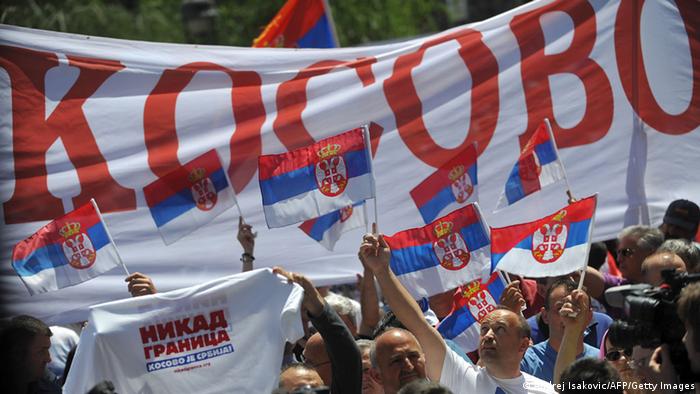
A protest against the accord on the normalisation of relations between Serbia and Kosovo 
AFP PHOTO / ANDREJ ISAKOVIC
Stefan Mitrovic of Serbia grabs a flag depicting so-called Greater Albania
Photo: REUTERS/Marko Djurica The Euro 2016 qualifier was disrupted by nationalist propaganda
Chaos erupted when a remote-controlled drone carrying a banner glorifying Albanian territorial aspirations appeared above the pitch. Albanian nationalists envision a land comprising Kosovo, parts of Serbia, Macedonia, Montenegro and Greece.
The banner was a signal for Serb hooligans to storm the pitch and attack Albanian players. After the game, Vienna saw massive rioting between members of the two ethnic groups.
Red-hot nationalism has flared on both sides since the incident, with "enemy" flags being burned and calls for genocide spreading online. DW has also received user comments along those lines. As has happened so often in the past, both sides are pointing an accusing finger at the other party.
"The Albanian public ignores the fact that one shouldn't defend nationalist Albanian symbols," Sekulic told DW. "On the other side, in Serbia, they are using the banner attack to justify racist campaigns in stadiums and violence against Albanians."
Politicians on both sides have fanned the flames in the media.
Serb President Tomislav Nikolic claimed that Albanians generally hate Serbs, and will do so for centuries to come, while Albania's Prime Minister Edi Rama said the Serbs have once again proven themselves to be notorious nationalists and racists.

DW

Monday, October 20, 2014

Greek public order minister to seek help from US on terrorism, illegal immigration

First entry: 19 October 2014 - 10:03 Athens
Greek public order minister to seek help from US on terrorism, illegal immigration
Greek Public Order Minister Vassilis Kikilias will seek closer cooperation with the US on fighting terrorism and dealing with irregular immigration when he travels to Washington next Friday for a week of meetings with American officials, a Greek daily reported.
Ministry sources have told Kathimerini that Kikilias hopes to secure Washington’s help in dealing with domestic terrorists and possible jihadists that may pass through Greece with the aim of joining the Islamic State, or ISIS, in Syria and Iraq.
"Our intention is to ask for assistance with regard to technical equipment that would improve our capability in terms of security and communication," said a Public Order Ministry official who wished to remain anonymous.
"The American government recognizes the progress that has been made on security matters over the past few months."
Kikilias is due to hold talks with all of the top security officials in Washington. He is to meet first with Lisa Monaco, President Barack Obama’s adviser on homeland security issues, including counterterrorism.
The Greek minister is also due to meet CIA chief John Brennan, as well as the head of the FBI, James Comey, and Director of National Intelligence James Clapper.
"We are working closely with the US, as well as Great Britain and Israel, with regard to the exchange of intelligence," said the ministry source. "Our aim is to strengthen the level of cooperation in this area."
Source: ekathimerini
45 Albanians barred from entering Greece 
 
Two days have already passed and 45 Albanian citizens are not allowed to enter the Greek territory, without any concrete justification, as they said to News 24.

They say that besides being barred from entering the country, the Greek border police has also offended them.

According to them the cause could only be what happened in Belgrade and after that in Dervican, an event which by the Greeks was called an incident.

In this village, after the match between Serbia and Albania where hooligans and security guards violated the players of the national team, a small group of youths have caused material damages to a vehicle.

ALBANIA CONDEMNS FLAG BURNING IN BELGRADE

  • AFP
Albania condemns flag burning in Belgrade
TIRANA — Albania on Sunday condemned the burning of its flag during a football match in Serbia, the latest in a series of incidents aggravating political tensions between Belgrade and Tirana.

The Albanian foreign ministry urged Serbian authorities to bring the perpetrators to justice and called on "Serbian politicians to distance themselves from those acts that are... harmful for the future and stability of the Balkans."

The incident took place during the match between Serbian first division sides Partizan Belgrade and Red Star Belgrade on Saturday, when Red Star fans were photographed setting fire to an Albanian flag.

The incident further threw into doubt the forthcoming historic visit of Prime Minister Edi Rama to Belgrade, the first by an Albanian prime minister in 68 years.

Rama was due in Belgrade on Wednesday, but there were already questions over whether the visit would go ahead after the violent end of a Serbia-Albania football match on October 14.

The Euro 2016 qualifying tie in the Serbian capital had to be abandoned after a drone carried a pro-Albanian flag over the stadium, sparking a brawl on the pitch.

European football's governing body UEFA has opened a formal probe into both Serbia and Albania over the violence.

Serbian leaders labeled the incident a planned "political provocation."

Rama said on Friday he had decided to travel to Belgrade, but his Serbian counterpart Aleksandar Vucic was still undecided whether to allow the visit.

Belgrade accused Rama's brother of controlling the drone from his seat in the stadium's executive box. But Olsi Rama, who later returned to Tirana with the Albanian team to a hero's welcome, denied the claims.

Following the incident, hooligans attacked several ethnic-Albanian owned shops in Serbia, notably in the northern town of Novi Sad. A Molotov cocktail was thrown into one bakery, while several others had their windows broken, local media reported.

Rama's visit was made possible by improved ties between Serbia and its former province of Kosovo, populated mostly by ethnic Albanians.

The 2013 deal between Belgrade and Pristina on normalization of ties was brokered by the European Union that the former foes, as well as Albania, hope to join.

Kosovo unilaterally declared independence in 2008 despite opposition from Belgrade.

Relations between Tirana and Belgrade have been sensitive over Kosovo and the ethnic Albanian minority in southern Serbia, which often demands more autonomy.

Turkey's Beşiktaş will play against Partizan in Belgrade on October 23, some Serbian newspapers and Partizan fans groups issued threats against Beşiktaş fans to not to come to Belgrade.
An Albanian from Italy placed drone on church roof 
Photo: Tanjug

BELGRADE – An Albanian from Italy, Ismail Morinaj (32), was a “specialist” who, on 14th of October, from the dome of the Church of the Holy Archangel Gabriel, launched a drone with the flag of so-called “Greater Albania”, which was then flown to the Partizan stadium, writes Belgrade media. 

 According to reports, Morinaj, mountaineering and rock climbing expert, entered Serbia on October 11, in a car with Italian license plates, and stayed in a hostel close to Partizan stadium, using an Italian identity card. Serbian Daily “Informer” reports that Morinaj, immediately after the match, ran from Serbia, but the police located him and have already asked Interpol to help in apprehending him. 

According to the paper, there is evidence that Morinaj and the brother of Albanian Prime Minister, Olsi Rama, know each other very well, and that they planned together details of inserting the drone to the stadium, in order to provoke riots. The paper writes that Rama, after Morinaj “drove” the drone to the stadium, took control of the aircraft, most likely through a program that was previously installed in his “iPhone”.

Sunday, October 19, 2014

Albanian PM’s visit to Belgrade postponed 
 Edi Rama - Photo: AP

 BELGRADE – The prime ministers of Serbia and Albania, Aleksandar Vucic and Edi Rama respectively, agreed on Sunday in a telephone conversation that the official visit by the Albanian prime minister to Serbia should be postponed for November 10. Edi Rama - Photo: AP Edi Rama – Photo: AP The two prime ministers said in a joint statement that the incidents at the stadium in Belgrade during the football match between Serbia and Albania were very unfortunate.

 “There are still obvious disagreements about how the incident occurred, but we must not and we will not miss the opportunity to meet and work on maintaining regional stability,” the two officials underlined. It is time we turned a new page in the political and economic relations between Serbia and Albania, the two prime ministers concluded. Vucic and Rama underlined that it is necessary to continue the dialogue and the process started at a conference on the Western Balkans in Berlin on August 28, because that will pave the way to improvement in relations between the two countries, the region and entire Europe. 

The European championship qualifier match between Serbia and Albania in Belgrade on October 14 was abandoned after a brawl that followed the appearance of a drone with a flag depicting the so called Greater Albania, a nationalist project that would include parts of Serbia, Montenegro, Macedonia and Greece. UEFA launched an investigation against both football associations.

Sweden steps up search for 'crippled Russian submarine' making Mayday distress call off its coast

  • Swedish ships, helicopters and troops are scouring waters off Stockholm
  • Follows reports a Russian submarine ran into difficulties on secret mission
  • Sources say a distress signal in Russian was intercepted 
  • Soviet submarine sightings caused security alerts in Sweden in the 1980s
  • The Russian defence ministry denied the reports today 
| Sweden has beefed up its military presence amid reports of 'a crippled Russian submarine' off its coast.
In a throw back to the Cold War, Swedish ships, helicopters and troops are scouring the waters off Stockholm following reports that a Russian submarine might have had mechanical problems while on a secret mission in the archipelago.
The operation began after Sweden's ministry said it was given a reliable tip-off about 'foreign underwater activity' off the country's coast in the Baltic Sea. 
Scroll down for video 
Swedish ships, helicopters and troops are scouring the waters off Stockholm for what was officially described as 'foreign underwater activity'
The Svenska Dagbladet newspaper said Sweden had begun a search after a distress signal in Russian was detected on an emergency frequency
The Svenska Dagbladet newspaper said Sweden had begun a search after a distress signal in Russian was detected on an emergency frequency on Thursday evening.
Encrypted radio traffic from a point in the Stockholm archipelago and Kaliningrad was picked up later as well.  
Another signal was intercepted on Friday night and Swedish intelligence was able to pinpoint the locations of the participants. One was in the waters off Stockholm, while the other could be traced to Kaliningrad, the port that is the home of Russia's Baltic Sea fleet.
Defence analysts cited in other reports speculated that a submarine might have been replacing old spy equipment or monitoring a Swedish naval exercise. 
Captain Jonas Wikström said: 'We consider the information we received as very trustworthy. I, as head of operations, have therefore decided to increase the number of units in the area.' 
Russia's military intervention in Ukraine this year has fuelled suspicion about its intentions towards other neighbouring states, notably in the Baltic.
It has several submarines based in Kaliningrad, a Russian enclave bordered by Poland and Lithuania and facing out to Sweden, as well as a much bigger force near Murmansk on the Kola Peninsula.
Last month, another Swedish newspaper, Expressen, reported an incursion by two Russian SU-24 fighter bombers into national airspace. Sweden scrambled jets to see them off, it said.
Swedish navy fast-attack vessels are engaged in a military operation in the Stockholm Archipelago 
Swedish corvette HMS Visby patrols the Stockholm Archipelago searching for what the military says is a foreign threat in the waters 
Swedish minesweeper HMS Koster searching for what the military says is a foreign threat in its waters
The submarine hunt is an early political test for Stefan Löfven, the new prime minister, whose centre-left minority government took office this month
In September two Russian Su-24 attack jets reportedly violated Swedish airspace over the Baltic, prompting Sweden's air force to scramble its own fighters. 
Soviet submarine sightings caused security alerts in Sweden, which is not a member of Nato, in the 1980s. 
The most famous incident took place in 1981 when a Soviet submarine hit rocks near Karlskrona, the main Swedish naval base, in the south of the country. 
The Russian captain claimed that the submarine had strayed off course and got lost.
The submarine hunt is an early political test for Stefan Löfven, the new prime minister, whose centre-left minority government took office this month. 
But Russia defence ministry denied reports that one of its submarines got into trouble off Sweden.
A spokesman said: 'Russia's submarines, like the surface ships, have been following their tasks in the world's oceans according to the plan.
'There have not been any emergencies or accidents with the Russian military vessels.  

Friday, October 17, 2014

Air Force’s top-secret X-37B spacecraft lands after nearly two years in orbit

Published time: October 17, 2014 20:18
X-37B Orbital Vehicle (Reuters / HO)

The Air Force’s top-secret space plane landed in California on Friday morning after nearly two years orbiting Earth on a classified mission. The robotic spacecraft’s purpose remains a mystery, though surveillance is a likely candidate.

The Boeing X-37B Orbital Test Vehicle ‒ an unpiloted aircraft that looks like a miniature space shuttle ‒ made its third landing at Vandenberg Air Force Base in Southern California after spending more than 670 days in low-Earth orbit.

“I'm extremely proud of our team for coming together to execute this third safe and successful landing," Col. Keith Balts, commander of the 30th Space Wing that is headquartered at Vandenberg, said in a statement. "Everyone from our on-console space operators to our airfield managers and civil engineers take pride in this unique mission and exemplify excellence during its execution.”
The spacecraft was launched on December 11, 2012 by an Atlas V rocket from Cape Canaveral Air Force Station. It has since been flying in low-Earth orbit, performing whatever mission the Pentagon had prepared for its third test run. In March, X-37B broke its own space longevity record for staying in orbit. Its two previous rounds in space in 2010 and 2011-2012 lasted 225 and 469 days, respectively. This mission lasted a total of 674 days.

A report by the IDG News Service earlier in 2014 suggested the trip’s mission was to test out the Air Force’s new space capabilities while also boosting the intelligence community’s surveillance capacity. However details about X-37B missions ‒ including the payloads carried to orbit ‒ are officially classified, Space.com reported.
Conventional theories from space and military enthusiasts believe the spacecraft will add additional reconnaissance capabilities to the US arsenal – either directly, or by deploying a small satellite from its cargo bay at a desired orbit.
More sinister theories suggest that the vehicle may be weaponized and serve as a space counterpart to the Predator unmanned aerial vehicles. Some postulate that it could be used to attack and destroy adversaries’ satellites orbiting the Earth. Others suspect that the X-37B might be used to transport troops to global hotspots within mere hours.
The Air Force owns two of the solar-powered space planes built by Boeing’s Phantom Works. The spacecraft will call Florida’s Kennedy Space Center home, thanks to an agreement between the Air Force and NASA announced last Wednesday. The X-37B will use the center’s Orbiter Processing Facility (OPF) Bays 1 and 2 to process the X-37B Orbital Test Vehicle for launch. The OPF bays have sat unused since the end of the Space Shuttle Program in August 2011.
“This agreement ensures the facilities will again be used for their originally-intended purpose ‒ processing spacecraft,” the space agency said in a statement. “In addition to vehicle preparation for launch, the X-37B Program conducted testing at Kennedy's Shuttle Landing Facility to demonstrate that landing the vehicle at the former shuttle runway is a technically feasible option.”
NASA expects to complete renovations on the two hangars by the end of the year, though painted blue doors on OPF-1 already tout it as "Home of the X-37B," marketing that is visible to passing tour buses, C4ISR & Networks reported.
The X-37B is about 29 feet long by 9.5 feet tall (8.8 by 2.9 meters), with a wingspan of 15 feet (4.6 m) and a payload bay the size of a pickup-truck bed. Two X-37Bs could fit inside the payload bay of the space shuttle, which was 184 feet (56 m) long from nose to tail.
Matoshi: Edi Rama should go to Serbia 
 
Albanian Prime Minister Edi Rama has confirmed that he will visit Belgrade on October 23rd. Publicist Halil Matoshi thinks it is nonsense to say that Rama should not visit Serbia. Matoshi explains that he is absolutely against mixing sports with politics.

"First, I am against any interfering in the internal affairs of the Republic of Albania. And, second, I am against mixing the sport with politics.

We are dealing with a football game and nothing more. There are two opposing teams, 22 players, respectively. I think the problems of Tuesday evening, which occurred in Belgrade, should not serve as an opportunity for the alienation between the two peoples" said Matoshi to "Telegrafi" newspaper.

According to him, this visit should bring these two countries closer and not create more problems.

Greece sends demarche to Albania

ATHENS -- The Greek government has announced that a demarche had been delivered to the Albanian foreign minister because of attacks against members of the Greek minority.
It was stated that the Greek ambassador in Tirana forwarded the protest note because of the attacks Albanians staged against Greeks in southern Albania after the stadium incident in Belgrade.
The Greek Ministry of Foreign Affairs said the Albanian authorities are asked to condemn the incidents that occurred near the border between the two countries.

The Greek ambassador also asked Albania to undertake all necessary measures in order to find, arrest and punish those responsible, as well as to protect the ethnic Greek minority ahead of the upcoming celebration of Greek Independence Day, October 28.

"The ambassador conveyed Greece's enormous concern because of such attacks on peaceful Greek minority, which represents an obstacle to the European perspective of Albania," the statement added.

The ministry in Athens also warns that "attacks of extremists and nationalists certainly weaken the European perspective of the country" and "awaken memories of the past of the Balkans that all countries in the region need to leave behind for the benefit of the common European future."

As the Greek media reported earlier this week around 100 people carrying Albanian flags and banners with nationalist messages arrived in the village of the Dervician in the district of Gjirokaster and demolished stores and cars before they were stopped by the police.

The violence broke out a few hours after the football match in Belgrade was abandoned on Tuesday night because of incidents sparked by a drone flown over the pitch, with a map of Greater Albania attached to it - showing Albania expanded to include parts of Serbia, Montenegro, Macedonia, and Greece.
The rise of the tension on Military Co-operations

Agreement on technical cooperation between armed forces of Serbia and Russia
InSerbia-PiB-0992

BELGRADE – The agreement on technical cooperation between the armed forces of Serbia and Russia is very significant for the Serbian military as an umbrella agreement used in further talks, Serbia’s Defence Minister Bratislav Gasic said on Friday. InSerbia-PiB-0992 The agreement was signed on Thursday by Gasic and head of the Russian federal agency for technical military cooperation Alexander Vasilyevich Fomin. 

The presidents of the both countries attended the signing. “Serbia has signed its first contract with the Russian Federation as an independent country,” Gasic told Radio and Television of Serbia, pointing out that the agreement was the bases for all future forms of cooperation and negotiations regarding the modernisation of the Serbian Armed Forces and equipment and spare parts purchases. 

He hopes that thanks to its reforms, Serbia will be able to take out the commodity loan it discussed with the Russian side in 2012 and will be able to buy new aircraft in 2016. Serbia and Russia have had close military relations so far, but they can now be expanded to military education, healthcare and technical cooperation based on this agreement, Gasic noted. It is extremely important that Serbia develop its defence industry and retake the place it belongs to it, because that branch can start the country’s reindustrialisation, he pointed out. 

The Serbian Armed Forces were reduced in size from 2000 to 2012, sold their equipment and property, and had that trend continued, this once respectable military force would have been reduced to a civil defence force, he stated. 

The military has been growing stronger for the past two years, and it has been successful in its work on all three of its missions, maintaining security, taking part in international peace operations and helping the population during natural disasters, Gasic said. 

The military parade held in Belgrade on Thursday in the presence of Russian President Vladimir Putin showed that, he remarked. The Serbian government is committed to EU integration, he said, adding that Serbia lied both in the east and west and wished to have good relations with everyone while keeping the interest of its people as its top priority.
Agreement on technical cooperation between armed forces of Serbia and Russia Today Politics Published: Oct 17, 2014 at 3:32 pm Modified: Oct 17, 2014 at 3:32 pm 0 Get Short URL Twitter1 Facebook2 Google Reddit BELGRADE – The agreement on technical cooperation between the armed forces of Serbia and Russia is very significant for the Serbian military as an umbrella agreement used in further talks, Serbia’s Defence Minister Bratislav Gasic said on Friday. InSerbia-PiB-0992 The agreement was signed on Thursday by Gasic and head of the Russian federal agency for technical military cooperation Alexander Vasilyevich Fomin. The presidents of the both countries attended the signing. “Serbia has signed its first contract with the Russian Federation as an independent country,” Gasic told Radio and Television of Serbia, pointing out that the agreement was the bases for all future forms of cooperation and negotiations regarding the modernisation of the Serbian Armed Forces and equipment and spare parts purchases. He hopes that thanks to its reforms, Serbia will be able to take out the commodity loan it discussed with the Russian side in 2012 and will be able to buy new aircraft in 2016. Serbia and Russia have had close military relations so far, but they can now be expanded to military education, healthcare and technical cooperation based on this agreement, Gasic noted. It is extremely important that Serbia develop its defence industry and retake the place it belongs to it, because that branch can start the country’s reindustrialisation, he pointed out. The Serbian Armed Forces were reduced in size from 2000 to 2012, sold their equipment and property, and had that trend continued, this once respectable military force would have been reduced to a civil defence force, he stated. The military has been growing stronger for the past two years, and it has been successful in its work on all three of its missions, maintaining security, taking part in international peace operations and helping the population during natural disasters, Gasic said. The military parade held in Belgrade on Thursday in the presence of Russian President Vladimir Putin showed that, he remarked. The Serbian government is committed to EU integration, he said, adding that Serbia lied both in the east and west and wished to have good relations with everyone while keeping the interest of its people as its top priority. Subscribe to Our Feed SOURCE Tanjug InSerbia Team InSerbia | E-Mail: desk@inserbia.info | http://inserbia.info TAGS army Bratislav Gasic Russia Serbia Twitter Facebook Google Reddit Previous article New Serbia-Albania match on neutral ground - report Next article Red Star Belgrade beats Galatasaray SIMILAR ARTICLES New Serbia-Albania match on neutral ground – report Oct 17, 2014 0 Biden: US not supporting ”Greater Albania” – report Oct 17, 2014 1 Albanian Ambassador: No “Greater Albania” In Gov’t Program Oct 17, 2014 0 Dick Advocaat pleased with his players’ conduct Oct 17, 2014 0 NO COMMENTS Leave a Reply Notify me of follow-up comments by email. Notify me of new posts by email. Today Agreement on technical cooperation between armed forces of Serbia and Russia Oct 17, 2014 0 BELGRADE - The agreement on technical cooperation between the armed forces of Serbia and Russia is very significant for the Serbian military as an... Maduro: “Colombian Paramilitary Behind Lawmaker’s Death” Oct 17, 2014 Biden: US not supporting ”Greater Albania” – report Oct 17, 2014 Albanian Ambassador: No “Greater Albania” In Gov’t Program Oct 17, 2014 Albania sends protest note Oct 17, 2014 Popular Military parade in Belgrade: ‘March of the Victorious’ Oct 16, 2014 1 BELGRADE – A military parade to celebrate seventy years since the liberation of Belgrade from Nazi occupation in World War II, attended by Serbian... Serbia-Albania match abandoned, brother of Albanian PM arrested Oct 14, 2014 “There is strong network of radical Islam in Kosovo” Oct 14, 2014 Kosovo: New “ISIS” Graffiti On Visoki Decani Monastery Oct 13, 2014 InSerbia News under DDoS attack from Serbia Oct 11, 2014 Current weather in Serbia: 21 Latest Agreement on technical cooperation between armed forces of Serbia and Russia Oct 17, 2014 Maduro: “Colombian Paramilitary Behind Lawmaker’s Death” Oct 17, 2014 Biden: US not supporting ”Greater Albania” – report Oct 17, 2014 Trending Military parade in Belgrade: ‘March of the Victorious’ Oct 16, 2014 Serbia-Albania match abandoned, brother of Albanian PM arrested Oct 14, 2014 “There is strong network of radical Islam in Kosovo” Oct 14, 2014 Popular InSerbia Latest News Serbia-Albania match abandoned, brother of Albanian PM arrested Brother of Albanian PM: "I am an American citizen and you cannot do anything to me" Vucic: "A gang of fake Albanian officials" Military parade in Belgrade: ‘March of the Victorious’ Jobs in Serbia Sales director Recent Comments Steve: I am agreeing with Mr OK. Serbian people lost ever ... Don: The fact remains that Albania's football team won' ... Grohom Martin: The Serbian police in conjunction with INTERPOL sh ... Steve: Albanian citizens were blocked for hours at the Be ... InSerbia Travel Belgrade Banging Serbian Dinar Exchange Rate [Australian Dollar] Australian Dollar 81.9 [Swiss Franc] Swiss Franc 99 [Euro] Euro 119 [British Pound] British Pound 149 [Hong Kong Dollar] Hong Kong Dollar 12 [Japanese Yen] Japanese Yen 0.878 [American Dollar] American Dollar 93.2 InSerbia Jobs InSerbia Banner InSerbia Banner

Read More at inserbia.info/today/2014/10/agreement-on-technical-cooperation-between-armed-forces-of-serbia-and-russia/ © InSerbia News

Putin meets with Merkel and Poroshenko

MILAN -- Russian President Vladimir Putin met in Milan with President of Ukraine Petro Poroshenko and German Chancellor Angela Merkel.
(Beta/AP, file)
(Beta/AP, file)
Putin and Merkel stated that there are still serious differences in their opinions regarding the Ukrainian crisis.
Shortly afterwards, the Russian president spoke with the Ukrainian counterpart during a meeting attended by Merkel, French President Francois Hollande, British Prime Minister David Cameron and Prime Minister of Italy Mateo Renzi.

"There are serious disagreements about the evaluation of the internal conflict in Ukraine, and about the deep causes of what is happening there now," said Kremlin spokesman Dmitry Peskov.

Putin late last night met with Merkel, after arriving to the Euro-Asian summit from Belgrade.

"During this long and detailed conversation (two and a half hours) Putin and Merkel carefully checked the implementation of the agreement signed in Minsk," said Peskov.

The agreement was signed on September 5 establishing a cease-fire in the east of Ukraine between separatists and forces loyal to Kiev, and is being broken on a regular basis.

Merkel last night also spoke with Poroshenko when, according to a source close to the Ukrainian government, they "expressed regret that a number points of the agreement has not been implemented, although they were accepted by both sides."

Hellenic Republic - Ministry of Foreign Affairs

Foreign Ministry announcement regarding the demarche made by the Greek Ambassador to Tirana

Friday, 17 October 2014
On the instructions of Deputy Prime Minister and Foreign Minister Evangelos Venizelos, Greece’s Ambassador to Tirana made a demarche to the Albanian Foreign Ministry, asking that the Albanian authorities condemn the incidents that occurred in the village of Dervican against members the Greek National Minority of Albania following the suspension of the Serbia-Albania football match.

Ambassador Rokanas also requested that all the necessary measures be taken to find, arrest and punish those who carried out the unprovoked attack, as well as to protect the Greek National Minority ahead of the upcoming events in celebration of the 28 October anniversary.

The Greek Ambassador conveyed Greece’s strong concern at similar attacks that target the peaceable Greek National Minority and pose an obstacle to the country’s European perspective, which is weakened and certainly not strengthened by extremist conduct and nationalistic flare-ups that awaken memories of a Balkan past that all the countries of the region must abandon, to the benefit of the region’s common European future.

Finally, Greece’s Consul General in Gjirokaster made corresponding representations to the local
authorities.

Thursday, October 16, 2014

NATO Naval Drills Begin in Mediterranean Sea, Atlantic Ocean

  • Last updated: 16 Oct. 2014


A large fleet of naval vessels is taking part in the multinational “Noble Justification” military exercise which is underway in the Mediterranean Sea and Atlantic Ocean. More than twenty warships, and several submarines and aircraft, are involved in the drills. "The exercise Noble Justification is a substantial opportunity for NATO to develop force integration, multinational inter-operability and enhance readiness, by using of an improved technology", said NATO's Maritime Commander, Vice Admiral Peter Hudson.
The aim of the event is to test the collective defence and crisis response capabilities of NATO’s Response Force. It will also test NATO naval forces to respond to crisis situations anywhere in the world, at short notice.  More than five thousand military  personnel are taking part from fourteen NATO nations: Belgium, Canada, France, Germany, Greece, Italy, the Netherlands, Norway, Poland, Portugal, Spain, Turkey, the United Kingdom and the United States. Two partner nations, Finland and Sweden, are also involved.
“It exercises a high-density, high-threat scenario in which NATO responds to a threat to its integrity, and the sovereignty, of its member states,“ said Vice Admiral, Peter Hudson. The event is being directed from NATO’s Maritime Command at Northwood in the United Kingdom. The exercise is running from 13-26 October.
A wide variety of aircraft are participating, including U.S. B-52 bombers. Anti-submarine and electronic warfare units are also taking part.

THE PRESS RELEASE OF NATO 

NATO’s Response Force (NRF) tests its crisis response capabilities at Mediterranean Sea and Atlantic 
 
A large fleet of warships from NATO’s Response Force (NRF) sailed from ports across Europe today to take part in the maritime component of Exercise NOBLE JUSTIFICATION in the Mediterranean Sea and Atlantic Ocean, which will encompass the anti submarine component and the electronic warfare component.

The Noble Justification prepares and tests the highest levels of readiness for rapid response to any NATO contingency. It also develops force integration, multinational interoperability and enhances readiness by building joint capability and deployability through a high density, high threat scenario in which NATO responds to a threat to its integrity and the sovereignty of its member states.
The warships will participate in demanding training evolutions that will enable them to respond to crisis situations anywhere in the world at short or no notice. The exercise, which runs through October 26,  will involve more than five thousand military and naval personnel from 14 NATO nations: Belgium, Canada, France, Germany , Greece, Italy, the Netherlands, Norway, Poland, Portugal, Spain, Turkey, the United Kingdom and the United States; and 2 partner nations: Finland and Sweden.

Afloat participants will include 23 warships: ten frigates, two amphibious ships, five auxiliary ships and six Mine Countermeasures vessels along with a number of submarines,  small units and embarked Marines.  Exercise Noble Justification will also include a wide variety of aircraft, including U.S. B-52 Stratofortress bombers. The participation of the bombers, which will assist in the exercise’s focus of validating the Spanish Maritime Forces as the 2015 NATO Maritime NRF, aims to strengthen interoperability with NATO allies and demonstrates the United States’ commitment to enhancing regional partnerships.  

NATO Allied Maritime Command, in Northwood, UK, is responsible for directing the exercise, ensuring that the NATO Response Force (NRF) is faced with a realistic and demanding scenario, presenting a number of challenges for the participants.
The first part of the exercise will focus on interoperability training in asymmetric multi-threat and maritime warfare operations. This will help units to be ready to work together for the second phase of the exercise, during which the force will undertake demanding responses within a complicated, crisis response scenario.

“The exercise Noble Justification is a substantial opportunity for NATO to develop force integration, multinational interoperability and enhance readiness, by using of an improved technology” said NATO’s Maritime Commander, Vice Admiral Peter Hudson of the UK Navy. “It exercises a high density, high threat scenario in which NATO responds to a threat to its integrity and the sovereignty of its member states. “ he said.


For more information on the exercise please contact NATO Maritime Command:
Email: publicaffairs@mc.nato.int
Telephone: (+44) 1923 956 763
http://www.mc.nato.int/Pages/home.aspx

Reuters

Albania's PM 'disappointed' but undaunted by drone incident

CAMBRIDGE Mass. Thu Oct 16, 2014
Prime Minister of Albania Edi Rama is interviewed by Reuters at the Kennedy School of Government at Harvard University in Cambridge, Massachusetts October 16, 2014.      REUTERS/Brian Snyder
Prime Minister of Albania Edi Rama is interviewed by Reuters at the Kennedy School of Government at Harvard University in Cambridge, Massachusetts October 16, 2014.
Credit: Reuters/Brian Snyder

Related Topics

(Reuters) - Albanian Prime Minister Edi Rama said he was "disappointed" at Serbian officials' comments following a drone stunt at a soccer match this week but vowed on Thursday to push ahead with plans to meet his counterpart in Belgrade next week.
Relations between the two countries have been tense since a Tuesday incident in which a drone bearing a flag representing "Greater Albania," an area covering all parts of the Balkans where ethnic Albanians live, flew over a major soccer match between the Albanian and Serbian teams, prompting a brawl on the field and the cancellation of the game.
Serbian Interior Minister Nebojsa Stefanovic earlier on Thursday claimed the incident showed that Albania was "not mature enough" to join the European community.
"We feel really sad and we feel really disappointed about what happened and about how Serbian authorities are reacting. It's unbelievable," Rama said in an interview with Reuters.
But he said he would not allow the remarks, or claims by Serbian officials that his brother had been responsible for the drone, to derail his plans to visit the Serbian capital on Oct. 22, in what would be the first visit to that city by an Albanian leader in almost 70 years.
"We should not be driven by this kind of politics of the past and hatred of the past. We should not be driven by what happened at a soccer game," Rama said ahead of a speech at Harvard University, just outside Boston. "I am very determined to go ahead."
The Albanian team fled the field at Tuesday's match, held in the run-up to the Euro 2016 championships. Riot police were called in to disperse the crowd.
Rama noted that, in an effort to avoid any violent outbursts, Albania had sent no fans to the game other than a contingent of 45 dignitaries including his brother. The group was searched carefully by Serbian authorities, he added.
"I don't see how someone could have brought in a drone or a flag when even scarves with Albanian symbols were not allowed to enter the stadium," Rama said. "It's clear that the flying object came from out of the stadium."
He also asked why media accounts to the game played down the crowd shouting threats to kill Albanians, using an ethnic slur.
Both Serbia and Albania aim one day to join the European Union. Relations between the two have long been marked by tensions over Serbia's former province of Kosovo, which has an ethnic-Albanian majority and declared independence in 2008.
"We are not going to respond in the same old way of a region that has suffered so much from this old way, from a region that has finally found peace," Rama said. "We are in peace not because we became angels but because we are all convinced that Europe is our destination and we want to be part of the European family of nations as members of the European Union."
 Fans ask Rama to cancel his visit to Serbia


After what happened in Belgrade, Albanians urge PM Edi Rama to cancel the official visit to Serbia this month, on October 22nd. On Twitter and Facebook you can read comments like this:

"Cancel the visit!", "Head of the Albanian Government, Vucic and Dacic are using your brother. Give them an answer that shows that we are a strong state". "Edi cancel your visit to Belgrade. 


Yugoslavia always worked against Albania. Act like Enver Hoxha did one, with the same language. Serbia wanted a piece of Albania, this is their big problem.
Albania sends a letter of protest to Serbia 
 

Albania has sent a letter of protest to Serbia, after what happened during the match. They ask Serbian authorities to apologize for what happened in Belgrade. The letter of protest was handed to the Serbian ambassador in Tirana Miroljub Zaric, who was summoned by the Foreign Ministry to give an explanation. In an official press release the Ministry says: "We firmly reject the political offense by leaders of Serbia against the Albanian people and state."
"Statements of Serbian officials contradict the most basic ethics of diplomatic relations and reciprocity of conduct, self-restraint and respect between sovereign states", the press release reads.

"We invite Serbia's leaders to show maturity condemning acts that occurred before, during the match Serbia-Albania, the blocking in the Belgrade airport of Albanian journalists and entrepreneurs accompanying the national team, burning the Albanian flag in the stadium, calls to kill Albanians and pathological violence exerted on the Albanian national team athletes. Albania is not responsible for the fact that the past can weigh on the conscience of government officials.

Albania as a NATO member and EU candidate, faithfully follows the policy of cooperation, good neighborliness and democratic stability in the region", it says.

PM: Serbia expects apology from Albania

Serbia will remain a true pillar of stability in the Western Balkans, and nothing can compromise this, Prime Minister Aleksandar Vučić has told CNN.
(Tanjug, file)
(Tanjug, file)
He was commenting on the football match between Serbia and Albania on Tuesday evening in Belgrade, when a small drone was flown above the pitch with a map of the so-called "Greater Albania," which caused disturbance and incidents, after which the game was abandoned.
"This was a severe provocation. I do not know who could benefit from this, but it is a fact that officials were the only supporters of the Albanian team at the match," Vučić said.

He said that this case is very clear, adding that in this incident he does not see any mistake by the Serbian side.

Vučić also posed a question how the world would react if something similar happened in Albania, namely if the Serbian side "waved the flag of Greater Serbia" in that country.

"I hope that we will manage to overcome this situation," the Serbian prime minister said, stressing that the Serbian side expects "a profound apology" from the Albanian side that caused the incident.

Tanjug noted in its report that "not a single official in Priština and Tirana condemned this provocation," and that, "on the contrary, Albanian footballers were welcomed as heroes, and Albanians in the region celebrated the incident as a national victory."

Vučić and Putin hold joint news conference

BELGRADE -- Russian President Vladimir Putin said on Thursday that Serbia and Russia have strong political ties.
(Tanjug)
(Tanjug)
He underscored that Moscow's position on the issue of Kosovo and Metohija will not change and that Russia insists on it being resolved in line with UNSC Resolution 1244.
"I thank President Nikolić and Prime Minister Vučić for the invitation. The talks passed in a constructive, working atmosphere. Our trade and economic relations are developing very well," Putin said during a joint press conference with Serbian Prime Minister Aleksandar Vučić, held in the Palace of Serbia after the talks of the two state delegations.

Putin extended an invitation to Nikolić for the celebration of 70 years since the victory over fascism that will be held in Moscow next year.

"We will be glad to see the president of Serbia at the celebration of 70 years since the victory over fascism in Moscow next year," he said.

Taking into consideration that Serbia will assume the chairmanship of the Organization for Security and Cooperation in Europe (OSCE) in 2015, the Russian president voiced the hope that "at that moment Russia will be able to continue constructive work and cooperation with that international organization, in this case with the support from Serbian friends."

Putin said that agriculture is the field with big cooperation prospects, adding that if the agreements signed today are realized, the exports of Serbian products to the Russian market will increase from USD 130 million to USD 500 million in a short time.

That is beneficial for the Serbian economy, means job creation, and it benefits Russia too, Putin said.

Pointing to the restrictions for imports of products from the countries that joined the sanctions against Russia, Putin said that this is a real chance for producers from those countries that want to develop cooperation with the Russian Federation.

Asked by a TASS reporter about the Russian investments and prospects for Russia-Serbia cooperation, Putin said that as long as the Western countries' sanctions against Russia are in place, there are big chances for Serbian companies to take the places they deserve in the Russian market.

"We are ready to invest," Putin said, adding that today's talks dealt with investments in the energy, machine building, railway, agriculture sectors, noting that these are not just state, but also private investments.

Putin noted that the South Stream gas pipeline cannot be realized unilaterally, but that he "truly believes that it is useful for European consumers."

"South Stream cannot be realized unilaterally, if our partners are still in two minds about it. This is like love, it can be happy only if there are two participants of this wonderful process, who both want to develop relations," he said.

The Russian leader added that similar debates about whether the pipeline is needed were held before the beginning of construction of Nord Stream, and now that it has been built everyone is happy, adding that he is confident that it will be similar with South Stream.

"I am deeply convinced that the project is beneficial for European consumers," said the Russian president, stressing that in this case policy harms economy and to some extent lowers the competitiveness of the European economy.

Putin also stated that Russia's investments in the Serbian economy could be doubled, and reach USD 6-10 billion in three years and specified that he and his hosts among other things considered prospects for cooperation in the agrarian sector.

In relation to that, he noted that European agricultural producers are sustaining losses worth billions of euros due to Russia's response to the sanctions.

"We would not like to continue that practice. But, for now, it is in place," Putin told reporters.

Besides the possibility of further developing cooperation in the agrarian sector and other investments to the benefit of both countries, in the energy, machine building, infrastructure sectors, he pointed to the fact that Russia granted an USD 800 million loan to Serbia for construction and upgrade of the railway system.

All in all, Russia's investments in Serbia so far total USD 3 billion, and in three years, including the private sector, they could be doubled, and reach USD 6 billion, or even USD 10 billion, Putin said.
(Tanjug)
(Tanjug)
Prime Minister Aleksandar Vučić also addressed reporters to say Serbia would not impose sanctions on Russia, and would continue with its EU integration.

Vučić thanked the Russian leader for his visit to Belgrade and decision to attend the 70th anniversary of Belgrade's liberation from German occupation, a victory won jointly by the Yugoslav Partisans and the Red Army.

"Serbia is on a path towards the EU and will not abandon it, but it is grateful to Russia for respecting that and not trying to make it give up on EU integration," Vučić stated.

"The Russian Federation has always protected Serbia, but Serbia has also shown that it is Russia's friend in tough times," the Serbian prime minister pointed out.

"I am embarrassed to have to reiterate that we have not and will not impose sanctions on Russia. This government will definitely not do that," Vučić emphasised.

Commenting on Serbia's upcoming chairmanship of the OSCE, he said that Serbia would play an important role and help solve problems in other parts of the world.

A number of cars manufactured in Fiat's plant in the Serbian city of Kragujevac will be exported to Russia, Vučić stated.

"The good news for the people of Serbia is that President Putin agreed to my request to export a certain quota of Fiat vehicles made in Kragujevac to Russia, and we also agreed on a moral liberal arrangement concerning cheese export, which is important for our agriculture," Vučić remarked.

"We also talked about increasing trade... we are on the verge of solving some energy issues, and the Russian president showed great understanding for our workers, for our efforts to save their jobs," he said.

"Putin showed a lot of understanding for employment. We discussed Petrohemija also and got significant support from our Russian partners, and we are grateful for all the humanitarian aid that has come from Russian," Vučić stated.

Serbia and Russia have a free trade agreement.

Serbian chemical company Petrohemija, which is scheduled to be sold, owes a large debt NIS, which is owned by Gazprom.