Wednesday, May 14, 2014

   
US Approves USD 170 Million MK48 Mod 6 Sale to Turkey

The U.S. State Department has made a determination approving a possible Foreign Military Sale to Turkey for MK 48 Mod 6 Advanced Technology All-Up-Round (AUR) Warshot torpedoes and associated equipment, parts, training and logistical support for an estimated cost of $170 million.


The U.S. Defense Security Cooperation Agency delivered the required certification notifying Congress of this possible sale on May 12, 2014.

The Government of Turkey has requested a possible sale of up to 48 MK 48 Mod 6 Advanced Technology All-Up-Round (AUR) Warshot Torpedoes, containers, fleet exercise sections, exercise fuel tanks, surface recovery cage and tools, exercise hardware, maintenance facility upgrades, support and test equipment, spare and repair parts, personnel training and training equipment, publications and technical documentation, U.S. Government and contractor engineering, technical, and logistics support services, and other related elements of logistics support. The total estimated cost is $170 million.

    “The Republic of Turkey is a partner of the United States in ensuring peace and stability in the region. It is vital to the U.S. national interest to assist our North Atlantic Treaty Organization (NATO) ally in developing and maintaining a strong and ready self-defense capability that will contribute to an acceptable military balance in the area. This proposed sale is consistent with those objectives,” the U.S. State Department said in its release.

The proposed sale will improve Turkey’s capability for self defense, modernization, regional security, and interoperability with U.S. and other NATO members. Turkey will use the enhanced capability of the MK 48 Mod 6 Advanced Technology torpedoes on the new CERBE Class submarines (214 Type 1200). Turkey has significant experience in maintaining and supporting advanced torpedoes, particularly MK 46 Mod 5A(S)W and MK 54 Lightweight Torpedoes (LWT), and has capable infrastructure that will require minimal updates. Turkey is capable of integrating, employing, and maintaining the MK 48 Mod 6AT Torpedo.

The proposed sale of this equipment and support will not alter the basic military balance in the region.

The principal contractor will be Raytheon Company Integrated Defense Systems in Keyport, Washington; and Lockheed Martin Sippican in Marion, Massachusetts. There are no known offset agreements associated in connection with this proposed sale.

Implementation of this proposed sale will not require the assignment of any additional U.S. Government or contract representatives to Turkey; however, contractor engineering and technical services may be required on an interim basis for installations.

US moving 200 marines to Sicily for Libya protection

Italy has announced the United States was transferring 200 marines and two planes to its base at Sigonella in Sicily to deploy in Libya in case US diplomats come under attack as they did last year.

US moving 200 marines to Sicily for Libya protection
Sigonella is both a US Navy installation and an Italian air force base Photo: AFP
Speaking in parliament after leftist MPs complained they had not been told about the deployment, Foreign Minister Emma Bonino said the transfer was "in accordance with bilateral agreements" between Italy and the United States.
"This is a reinforcement for the security of US personnel in Libya or for possible evacuations," she told parliament, adding that 75 marines would arrive first followed by 125 more as well as two additional military planes.
Sigonella is both a US Navy installation and an Italian air force base.
The Pentagon this week said the US was stationing extra military elements at Sigonella to protect or evacuate diplomats in Libya if necessary, saying they would come from an airbase in Spain where 500 marines were recently deployed.
Armed insurgents set fire to the main US consular facility in Benghazi on September 11, 2012 and then attacked a nearby CIA annex.
Ambassador Chris Stevens and three other Americans were killed.
The Pentagon has since faced criticism by those who said it should have been able to more quickly mobilise forces to thwart the attack.

Edi Rama: "If Europe Decides Not To Need Muslim Balkan States, Terrible Things Will Happen"

Published: Yesterday; 12:12 · (FriedlNews)

The Albanian Prime Minister Edi Rama visited the Bruno Kreisky Forum in Vienna.

Edi Rama: "The system is grabbing the people; therefore the system needs to be changed." / Picture: © FriedlNews Prime Minister Rama visited Vienna to meet with high-level authorities to assure them of future cooperation and support for Albania's accession to the EU.

At the Bruno Kreisky Forum for International Dialog Franz Vranitzky, Honorary President of the Forum and former Austrian Federal Chancellor welcomed him. Vranitzky is a deserved Albania expert. After leaving office, he served as Organization for Security and Co-operation in Europe representative for Albania from March to October 1997.

In addition, Ivan Krastev, Chairman of the Centre for Liberal Strategies/CLS in Sofia, and Permanent Fellow at the IWM Institute of Human Sciences has been present.

When arguing for Albania’s European Renaissance, Edi Rama stated, "The EU is the crucial objective".

"We cannot have a strong economy without a strong society, and we cannot have a strong society without a strong economy." Both sectors must be developed side by side.

Several indices show that Albania is Europe's most corrupt country. Edi Rama believes that the system must be changed, not the people. When asked about corruption, he said that under the same system "Austrians and Albanians would behave the same". "The system is grabbing the people; therefore the system needs to be changed."

"The number one reason why the year 2014 is the first year in the past 100 years that in Albania there is no violent conflict, is not that overnight the Albanian leaders turned into angels, but the Albanian perspective towards Europe."

Therefore, Europe's leaders must undertake everything to grant Albania candidate status without undue delay. "If Europe decides not to need Muslim Balkan states, terrible things will happen!"

About the Accession of Albania to the European Union

Officially recognised by the EU as a "potential candidate country" in 2000, Albania started negotiations on a Stabilisation and Association Agreement (SAA) in 2003. This was successfully agreed and signed on 12 June 2006, thus completing the first major step toward Albania's full membership in the EU. Albania applied for European Union membership on 28 April 2009.

Following the steps of the recently admitted Eastern European countries in 2004, Albania has been extensively engaged with EU institutions, and joined NATO as a full member in 2009. It has also maintained its position as a stability factor and a strong ally of Western Europe in the troubled and divided region of the Balkans.

Following its application for EU membership, the Council of the European Union asked the European Commission on 16 November 2009 to prepare an assessment on the readiness of Albania to start accession negotiations, a step in the accession process that usually takes about a year. On 16 December 2009, the European Commission submitted the Questionnaire on accession preparation to the Albanian government. Albania returned answers to them on 14 April 2010.

In 5 December 2013, an MEP meeting recommended to the Council to grant Albania candidate status without undue delay.
Photo of the Day

Ambassador Wolfgang Ischinger, Fletcher Alumni and former German Ambassador to the USA, will head European efforts to resolve the crisis in Ukraine.

Golden Dawn lures voters with welfare programme

golden dawn members in greece©Getty
Members of the rightwing Golden Dawn party join a rally in Thessalonika
In the 1980s, Christos Papadimitriou had a high-flying career setting up intensive care units at hospitals across Greece. Now retired, the doctor has found a new way to practise medicine: as an unpaid medical adviser to the neo-Nazi Golden Dawn party.
“Tens of thousands of Greeks lost access to the state healthcare system when they became unemployed and can’t afford private treatment. They [Golden Dawn] are trying to help, so I volunteered,” the French-trained physician said in his cramped consulting room at the party’s Athens headquarters.

Dr Papadimitriou takes medical histories from patients at twice-weekly sessions, he says, and recommends specialists from a list of 150 doctors who offer their services free of charge to impoverished Golden Dawn supporters.
“The state system is now desperately underfunded because of the crisis. Families don’t keep up with vaccinations, for example, and psychiatric help is hard to find,” he adds. “Golden Dawn’s network helps fill the gaps.”
Golden Dawn exploded on to Greece’s political scene from the wreckage of a devastating economic crisis that erased more than a quarter of the country’s economic output over five years and pushed unemployment above 26 per cent. Its members have become known for their menacing black shirts, strident anti-immigrant rhetoric and Nazi-style torchlit rallies.
While the welfare programme pursued by Dr Papadimitriou is a less appreciated part of its appeal, party leaders are relying on it as they try to establish deep roots in Greek society for years to come.
The softer approach is already finding a receptive audience among the wide swath of the Greek population that has felt abandoned as the country’s crisis-hit government has been forced to slash social spending to comply with the terms of its international bailout.
“The crisis has changed the way voters interact with political parties,” said Antonis Ellinas, a political-science professor at Cyprus University. “Golden Dawn seems to have found a way to offer something to voters through its social programme and thus consolidate its support.”
As well as medical advice, Golden Dawn activists regularly distribute food to needy families, provided they are Greek citizens not immigrants. The handouts have been curtailed since parliament voted to cut the party’s €800,000 annual allocation of state funding.

October 2013: Greece cracks down on the far-right Golden Dawn party after several members were arrested following the killing of an anti-fascist rapper.
Yet its 16 lawmakers still contribute almost 60 per cent of their salaries to “social welfare action to alleviate poverty and maintain the dignity of Greek patriots”, says Ilias Panayiotaras, a Golden Dawn deputy for Athens.
Angeliki Papadopoulou says her family began receiving food aid from the party after her husband, a carpenter, lost his job two years ago: “They used to deliver enough to fill the refrigerator twice a month . . . Now it’s less often but it still makes a big difference.”
The jobless rate in Ano Liosia, Mrs Papadopoulou’s neighbourhood in western Athens, is 70 per cent, more than double the national average.
“All our extended family will vote for Golden Dawn and so will a lot of other people around here,” she says. “They were there for us when the state wasn’t helping and neither were any of the other political parties.”
With EU elections looming later this month, Golden Dawn is polling at 7-8 per cent, putting it in third place along with a new centre-left party To Potami, or River, behind the governing centre-right New Democracy party and Syriza, the leftwing opposition.
Ilias Kasidiaris, a former army commando running for mayor of Athens at local government elections being held on May 18 and May 25, is doing better with 12 per cent, according to an opinion poll published last weekend.
“Support for the extreme right is definitely in double digits even though it doesn’t always show up in our figures,” said a Greek pollster who declined to be identified.
The bulk of Golden Dawn’s voters used to support New Democracy, but have shifted to the right amid discontent with a traditional political class they blame for the economic crisis, the pollster said.
Until now, Golden Dawn has been more associated with street violence than public health.
Its founder and leader, Nikos Mihaloliakos, was jailed last year in a crackdown prompted by the fatal stabbing of an anti-fascist rap artist by a self-admitted Golden Dawn supporter. Two young Golden Dawn members were killed last November in an apparent revenge attack for the rapper’s death.
“We heard shots and we rushed out on the office balcony,” a burly 24-year-old dressed in a black T-shirt and jeans as he pointed to the spot on the pavement outside the party offices where his comrades were shot. “It was just like a movie.”
Although it is hard to verify how many medical patients Golden Dawn has served, much of its appeal owes to the sorry state of Greece’s healthcare system.
A chaotic two-year overhaul of the state health system aimed at reducing costs and corruption has curtailed services and driven thousands of Greek doctors to seek work in other EU countries. Even before that, patients often languished for months waiting for non-emergency surgery or resorted to paying a cash bribe, known as a “fakelaki”, for hospital services.
With a recommendation from Dr Papadimitriou, Golden Dawn’s supporters can avoid such hazards and be seen by a specialist – almost always at no charge.
“We check back with the patient to make sure the doctor they saw has kept their word and not asked for a fee,” says Jenny Christou, a professional nurse who is married to a Golden Dawn lawmaker.
Greece’s social welfare ministry did not return calls seeking comment about Golden Dawn’s activities. In general, though, the government has welcomed pro bono activities to ease the strain on the state system.
As for Dr Papadimitriou, he shrugged when asked if he felt conflicted about providing medical work for a political party implicated in violence – and even murder.
“I’m aware of the allegations about violence involving party members, but I don’t have any personal knowledge,” he said. “My role here is about obtaining medical care for the people who contact us for help.”

Ukraine vs Russia: A mafia state's cover-up?

The false ethno-linguistic discourse distracts from the real essence of the Ukrainian conflict.

Last updated: 13 May 2014 10:02
Leonid Ragozin

Leonid Ragozin is a freelance journalist based in Moscow.


Educated, middle-class Russian-speaking Ukrainians tend to support united Ukraine, writes Ragozin [EPA]
It's not yet quite as bad as the battle of Vukovar, but the armed conflict in Ukraine is looking increasingly similar to the war in Croatia fought in 1991. One by one, Russia is trying to chip off the predominantly Russophone southeastern parts of Ukraine either through direct annexation, as in the case of Crimea, or by setting up puppet regimes akin to the one the Serbs established in eastern Croatia during the war.
The latter scenario appears to be implemented in the coal-rich region of Donbass, where on May 11 Russia-backed militants conducted a vote on either independence or autonomy from Ukraine (depending on how you interpret the vaguely worded question people had to answer). Although they called it a referendum, it was abundantly clear that the poll was neither fair nor representative.
The region is gripped by terror that is sown primarily by the insurgents. They have kidnapped dozens of Ukrainian activists and politicians. Three of them were found in a river near Sloviansk, the epicentre of the insurrection and the main rebel HQ, with signs of torture and their bellies cut open. Ruthless and armed to their teeth, the insurgents left the Ukrainian government with no other choice, but to use the army in an urban environment. The army's often hapless performance has contributed to the overall chaos.
The insurgents didn't have access to updated lists of voters, commissions at polling stations were comprised of people appointed by rebel commanders and there were just a handful of polling stations in large cities like Donetsk (population 1 million) and Mariupol (population 500,000). The latter fact combined with the genuine support for unification with Russia by a significant part of the locals (around 30 percent, according to various polls) led to massive crowds forming in front of them. Pictures of these crowds were delivered to the Russian TV audience as a proof of universal support. It seemed that obtaining these pictures was the main reason for holding the vote.

Kremlin propaganda is pushing the narrative of "oppressed" Russians rising against "the artificial state" of Ukraine on the lands that "accidentally" became a part of this country as a result of the Soviet collapse in 1991. This image appears to be very far from the truth when you actually travel in Donbass. Society appears extremely polarised over the issue of separation from Ukraine, but it looks much more as a class warfare than an ethnic conflict.
Educated, middle-class people tend to support a united Ukraine, even though practically 100 percent of them are Russian-speakers. Supporters of separatism are largely comprised of pensioners and state employees craving for paternalist social state, like the Soviet Union. They are mixed with members of local criminal gangs and employees of law-enforcement agencies, which in a highly criminalised region like Donbass is largely the same social group. 
Both the West and Russia appear to be describing the conflict in Ukraine in the same ethno-national terms as those in former Yugoslavia. Western politicians and media accuse Russia of imperialism and revanchism, reducing the extremely complex Russo-Ukrainian mutual history and densely intertwined cultures to the primitive and rather unhelpful empire-colony model.
At the same time, Russian propaganda is peddling a ridiculous grotesque image of Ukraine being taken over by extreme nationalists, who - it claims - want to ban the Russian language and eliminate every bit of Russianness in a country, where at least half of the population speaks Russian in daily life.
When I was talking to supporters of the separatists in Donbass, they were telling me horror stories about the Ukrainian government planning to introduce special passport stamps for people without ethnic Ukrainian heritage with the view to their further deportation, or about Kiev planning to stage an artificial famine in Russian-speaking regions. Despite the outlandish nature of these accusations, they seemed to sincerely believe that those were genuine threats.
Apart from being deeply flawed, the ethno-political discourse diverts people's attention from the root of the problem. The essence of the battle under way in Ukraine, as well as in Russia and other former Soviet countries, is best described by arguably the most popular (and definitely the shortest) slogan of the Ukrainian pro-democracy movement. It goes "Bandu get'!", which means "Down with the gang!". By the "gang" people mean the extremely corrupt regime, linked to organised crime and backed by a cruel repressive apparatus that benefits from looting businesses and robbing individuals - a mafia state. Different versions of such authoritarian kleptocracy are now in control of all of the ex-USSR countries, except Baltic states and arguably Georgia.

In Ukraine, the popularity of this slogan spans across the traditional ethno-linguistic divide between the Ukrainian-speaking West and the Russophone Southeast. Euromaidan protest that started last November and resulted in the ousting of President Viktor Yanukovich united both Ukranian - and Russian-speakers. Similarly at Moscow's Bolotnaya Square protests in 2012, the same anti-corruption and pro-democracy slogans united people across the political spectrum - from the extreme left to liberals to the extreme right.
Yet in Ukraine, the divisive ultra-nationalist component was constantly getting in the way, distracting people from the real agenda and alienating sceptics in Russophone regions. It was also fuelling the aggressive Russian state propaganda, which is itself characterised by extreme nationalism and toxic xenophobia, by far exceeding the Ukrainian rhetoric on this front. As a result even the pro-democracy movement in Russia is divided over Ukraine - many Russian liberals are either buying the propaganda argument about "Ukrainian fascism" or their own nationalism prevents them from understanding and supporting the Ukrainians.
The ethnicisation of the Ukrainian conflict suits the Kremlin. Its worst nightmare is a Ukraine growing into an alternative Russia - a better place for talented and entrepreneurial Russians to live and work than Russia proper. Or even worse - a united pro-democracy front rising against the mafia state in all of the former Soviet republics, with Ukraine in the lead.
The West misinterprets Putin by thinking that he wants to rebuild an empire - it is much more likely that the real goal is a compact, monoethnic and ultra-nationalist Ukraine, with the Russian element reduced to a minimum. Being intimately linked to Russia at many different levels, a successful, democratic and tolerant Ukraine threatens the existence of the mafia state and that's what is at stake for the Kremlin rulers.
Leonid Ragozin is a freelance journalist based in Moscow.
The views expressed in this article are the author's own and do not necessarily reflect Al Jazeera's editorial policy.

Soldiers killed in east Ukraine ambush

Defence Ministry says at least six government troops killed by separatists near city of Krematorsk.

Last updated: 13 May 2014 19:44


Listen to this page using ReadSpeaker
Email Article
Print Article
Share article
Send Feedback
The convoy was reportedly attacked by a group of about 30 [EPA]
An ambush by pro-Russian separatists has killed at least six Ukrainian soldiers, the heaviest loss of life for government forces in a single clash since Kiev sent soldiers to put down a rebellion in the country's east.
Ukraine's defence ministry and state security service on Tuesday said the troops were killed and seven others wounded when their armoured column was ambushed near the town of Kramatorsk, one of several hot spots in the largely Russian-speaking east where the army has had scant success against the rebels.
Al Jazeera's Paul Brennan, reporting from Donetsk, the incident occurred at 13:00 local time when a convoy of military units from the Ukrainian army was ambushed by a group of about 30 people the ministry called "terrorists".
 

The attackers had taken cover among bushes along a river and used automatic weapons and grenade launchers.
According to the ministry, the first shot was fired from a grenade launcher at the convoy and hit an engine of one of the vehicles.The initial attack killed two and injured three, the ministry said.
All the dead and injured have since been evacuated.
Our correspondent said a pro-Russian website had made the claim that 30 soldiers had died in the attack, but this information could not be independently verified.
Krematorsk is in the northern part of the Donetsk region, which on Sunday declared its independence from Ukraine and sought an alliance with Russia following a vote for self-rule in the area.
The attack comes less than two weeks ahead of Ukraine's presidential elections, slated by many as a means of restoring peace, but something that both Donetsk and Lushank, the second area to declare independence, have said will not be held in the regions.
"The timing of this attack is particularly bad," our correspondent said. "When you have incidents such as what happened this afternoon it really does overshadow the efforts of diplomats and politicians.
Another nine Ukrainian soldiers have been killed since Kiev launched a so-called "anti-terrorist" operation in the east in mid-April, a defence ministry official said.
The campaign has been directed mainly against rebels in the towns of Slovyansk and Mariupol.
The dead included 5 pilots, Defence Minister Mikhailo Koval said, who apparently died when their helicopters were downed by separatist fire.

Tuesday, May 13, 2014

PM Orban calls for autonomy for ethnic Hungarians beyond borders

Reuters
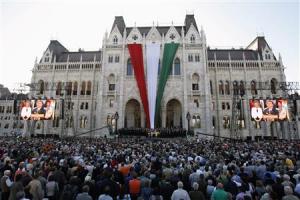
People look on as Hungarian Prime Minister Viktor Orban delivers his speech in front of the Hungarian Parliament, after taking his oath of office, in Budapest
.
View photo
People look on as Hungarian Prime Minister Viktor Orban delivers his speech in front of the Hungarian …
By Krisztina Than
BUDAPEST (Reuters) - Hungary will stand up for its rights within the European Union and wants autonomy for ethnic Hungarians living beyond its borders in central Europe, including Ukraine, Prime Minister Viktor Orban said on Saturday.
Orban, who was formally endorsed by parliament as prime minister for a second consecutive term after last month's landslide election win, said ethnic Hungarians supported his policies to unite the nation "above the borders".
His previous government granted ethnic Hungarians in neighboring countries citizenship shortly after it took office in 2010, as part of his efforts to restore a battered sense of national pride.
Orban, a 50-year-old former dissident against Communist rule, has also clashed repeatedly with the European Union over his go-it-alone policies in the past four years.
"We regard the Hungarian issue a European issue," Orban said in his first speech to parliament since his reelection.
"Hungarians living in the Carpathian basin are entitled to have dual citizenship, are entitled to community rights, and also autonomy."
Many Hungarians today view the 1920 Treaty of Trianon as a national tragedy because it took away two-thirds of the country's territory and left millions of ethnic Hungarians living in what are now Romania, Slovakia, Ukraine and Serbia.
Orban has won popularity at home by reaching out to Hungarians outside the country's borders who were allowed to vote in the national election for the first time in April.
He has never suggested reuniting the lost territories with Hungary, but his activities have irked governments in some neighboring countries.
He said on Saturday the issue of ethnic Hungarians was especially topical due to the situation in neighboring Ukraine, where around 200,000 ethnic Hungarians live, who are entitled to Hungarian citizenship and also the right to self-administration.
"This is our clear expectation from the new Ukraine which is taking shape now," Orban said, adding the new administration enjoyed Hungary's support in its efforts to build a democratic Ukraine.
BRAVE THINKING
Orban pledged to continue the policies of his previous government and said these would be based on "open dialogue and brave thinking" when it comes to European affairs.
He said Hungary was and remained, beyond doubt, part of NATO and also the EU and his government regarded any program that called for an exit from the EU a dangerous extremity.
"But we are members of these alliances and not hostages," he said. "We want a Europe that respects its own roots, respects Christianity and also gives due respect to individual nations."
His words echoed his ruling Fidesz party's campaign ahead of European parliament elections later this month, with billboards featuring Orban's photo and saying: "Our message to Brussels: More respect to Hungarians."
Orban called for a radical cut in energy prices in the EU to improve competitiveness and said his government rejected policies that support immigration.
"We do not want policies that support immigration and masses of immigrants who cause unmanageable tensions, but we want support for families to have more children," he added
Erdogan postpones visit to Tirana due tragedy miners
 

TIRANA - Turkish Prime Minister Recep Tayyip Erdogan has postponed an official visit that will evolve tomorrow in Tirana, because of a tragedy in a mine in Turkey where 17 people were killed and about 300 others were trapped underground. The tragedy happened after the explosion, which caused the fire, tonight 

The news comes via Facebook, the Prime Minister Rama, who recounts a phone conversation that he had with his Turkish counterpart. "The saddest conversation with Prime Minister Erdogan of Turkey miners tragedy and sympathy for the postponement of the visit in Tirana! With heart, near the pain!" - Writes Rama. 

The tragedy of the miners in Turkey occurred in the city of Soma's and under Mayor this city, the cause of the explosion was an electrical fault. incident occurred two kilometers below the surface of the earth, blocking miners about 4 miles from the exit. 

According to first reports, about 580 workers were inside the mine at the time of the explosion, but most of them managed to escape. Rescuers arrived at the scene and started rescue excavations for underground miners.

Monday, May 12, 2014

"Serb participation depends on election rules"

BELGRADE -- President Tomislav Nikolić has said that participation of Serbs in elections in Kosovo will depend on the rules based on which the voting will be held.
(Tanjug)
(Tanjug)
Nikolić made the comments as he met in Belgrade on Monday with Farid Zarif, who serves as head of the UN administration in Kosovo, UNMIK.
According to a statement from his cabinet, the Serbian president "stressed the importance and responsibility of the entire United Nations Mission in Kosovo and Metohija for the course of the electoral process, including its third pillar - the OSCE Mission in Kosovo and Metohija."

Nikolić told Zarif about Serbia's stance that participation of the OSCE was needed in the organization of elections in Kosovo.

He added that Serbia was left "a short time to consider the participation of the Serb people in these elections as a result of a bad decision of the Priština administration to call early elections, rather than wait for the regular vote."

Nikolić "pointed out that he was convinced that the Serbian government will bring the most correct possible decision on whether to call on the Serb people to participate in elections," adding that this will "primarily depend on the rules by which elections will be held."

If the Serb community in Kosovo considers that accepting Kosovo documents meant recognizing Kosovo's independence, "it is not logical for Priština to insist so much on that, and at the same time claim to be well-intentioned," the president was further quoted as saying.

Nikolić added that Serbia "in the past period in the talks with the administration of Priština achieved much of what initially seemed impossible, and invested a lot of effort in that."

"Serbia will never recognize independence of the southern provinces, but is willing to talk with Priština about anything that would help improve the lives of citizens in Kosovo, regardless of their ethnic, religious or any other affiliation. So far a significant result has been achieved, but it is not sufficient, thus both sides need to make further efforts so that the negotiations are not halted," said Nikolić.

Zarif stated that the international community "recognized Serbia as a factor that is actively participating in the shaping of relations in the region with its dynamic."

According to the statement, he said that Belgrade has made "a great contribution to the normalization of relations with the institutions in Priština."

At the same time, the position of the Serb people in Kosovo and Metohija is now "in many ways improved compared to the situation a few years ago," said Zarif, and added this was "in part thanks to the policy that Serbia conducted during the previous period."

Dačić meets with Zarif

Serbian First Deputy Prime Minister and Minister of Foreign Affairs Ivica Dačić conferred with Special Representative of the UN secretary general and UNMIK Head Farid Zarif in Belgrade on Monday.

Ahead pf the coming regular session of the UN Security Council on Kosovo, Dačić and Zarif exchanged experiences on the work done by UNMIK from January to April, "with an emphasis on the forthcoming EULEX reconfiguration."

Dačić pointed to "the key importance of the UNMIK presence and actions in Kosovo and Metohija based on UN Security Council Resolution 1244 as the only guarantee of status neutrality of international troops in the southern Serbian province," the Serbian Ministry of Foreign Affairs said.

Marie Le Pen is "calling" Golden Dawn

Marie Le Pen is "calling" Golden Dawn
In a coordinated manner, the parties of the extreme right in Europe are gradually paving the way to join forces after the Euro-elections, according to the votes which will take in any European Member - State, separately.
Head of this movement for the organized "European" presence of the extreme right in Brussels, the day after the elections, seems to be (informally) the leader of the National Front in France, Marie Le Pen.
Le Pen is expected to be the big winner of the Euro-elections, according to all the polls so far, something that has caused panic in the Élysée Palace and to decision-makers in Europe.
According to extensive reports in the French press, in the last 24hours, the head of France's far-right party is not only interested to record a high polling percentage in the forthcoming polls of Euro-elections, but also to see the extreme right forces to have a strong representation in the other Member States of EU. She gives strong emphasis on the countries of the South, which are affected by the crisis, including of course Greece.
Despite what is written or said by directed press reports, the reality is that Marie Le Pen desires the presence of the Golden Dawn in the European Parliament, so she follows very closely the political developments in our country.
Le Pen leaves the door open, for post-election cooperation at European level with all power of the extreme right who profess the same principles as the French National Front, and in this context has reportedly already addressed a call to members of the Golden Dawn, in order to act together in the European Parliament . According to well crossbred information, executives of the nationalist party in France have come into contact with members of the Golden Dawn in Greece, to examine all possibilities for such cooperation.
According to the same information, if Golden Dawn elicits a high polling rate, Mrs. Le Pen thinks to send (during the election night) a congratulatory message, which would result in the evolution of a courtship that has already begun between the French far right and the Greek Golden Dawn.
It is obvious that the bridges and the possible post-election cooperation of the National Front in France with the Golden Dawn in Greece, is translated as one practical political support against the accusations of the domestic judicial and political system, for the executives of the Golden Dawn for "setting up a criminal organization."
According newsbomb's information, Golden Dawn is positive in such a partnership effort. The sequel is expected with great interest...

Greece’s Golden Dawn given European election go-ahead

A protester with a Golden Dawn flag©AFP
A protester with a Golden Dawn flag
Greece’s highest court has ruled that the neo-Nazi Golden Dawn party can participate in elections to the European parliament on May 25, as allegations that the party operates as a criminal organisation have still to be proved in a court of law.
The decision by the Areos Pagos, the supreme court, is expected to benefit Golden Dawn at the polls by confirming its legitimacy, even if only temporarily, after months of speculation the party would be banned ahead of the European vote.

Two opinion polls published last week indicated Golden Dawn would capture between 8 per cent and 11 per cent of the vote and could win two out of the 21 European parliament seats allocated to Greece.
Golden Dawn’s 42-member list of candidates includes a retired army general who commanded the Greek special forces, lawyers and doctors, and the editor of a far-right weekly newspaper. Fourteen of its candidates are women.
The Areos Pagos did not publish a legal opinion explaining the ruling, but people close to the Greek judiciary said the party’s founding charter dating from 1987 did not conflict with the legal requirements for setting up a Greek political party.
Golden Dawn MPs claim they are nationalists not Nazis, even though recruits to the party until recently had to buy a copy of Adolf Hitler’s Mein Kampf and give Nazi salutes at party meetings, while the Horst Wessel song, the Nazi anthem, would be played at the party’s public gatherings.
Nikos Mihaloliakos, the party’s founder and leader, was jailed last October to await trial on charges of operating a criminal gang following the fatal stabbing of an anti-fascist rap performer in a brawl in an Athens suburb. A self-admitted Golden Dawn supporter confessed to the killing, according to the public order ministry.
Twelve of Golden Dawn’s 18 members in the Greek parliament have so far been stripped of their parliamentary immunity from prosecution to answer charges of participating in racist attacks and belonging to a criminal gang. None is expected to go on trial before October, according to lawyers handling the case.

In depth

European elections 2014
EU elections
May 22-25: Extremist and anti-European parties are expected to make gains across the continent when Europe votes for a new parliament
opular anger at austerity policies imposed by international lenders helped increase support for small, anti-systemic parties at general elections in 2012, making Golden Dawn a mainstream political party for the first time.
The party’s outspoken criticism of the Greek political establishment as ineffectual and corrupt, and its demands for the immediate expulsion of tens of thousands of immigrants working legally in Greece, struck a chord with disaffected voters, despite its members’ reputation for carrying out violent racist attacks.
Ilias Kasidiaris, the party spokesman and acting leader, is running for mayor of Athens in local government elections being held on May 18 and May 25. Support for Golden Dawn is high in depressed areas of the city centre with a large immigrant population, but Mr Kasidiaris is not likely to win enough votes to participate in a run-off vote, according to polls.
Prosecutor: Albanians hold heroin market in Switzerland 

Today World May 12, 2014 
20120117-heroin
 Geneva cantonal prosecutor Yves Bertosa urged Albanian authorities to take certain measures to rectify the image that Europe and the world have about their citizens. 20120117-heroin Bertosa, as reported by Albanian daily “Presheva jonë”, said that “Albania is European Colombia”. Speaking about the image of Albanians in Switzerland he said that Albanians have their “bad” sides, pointing out that “Albanian gangs hold the heroin market in Switzerland in their hands”. 

“The smuggling network consists mostly of people coming from Albania and Kosovo and their mafia is the most active,” said Bertosa stressing that Albanian authorities would have to take measures to improve the image that Europe and the world have about them. He said that Albania is a country that has “sunk in corruption” and in which “organized crime is at a high level”. 

“We consider Albanians in our country as a community that is important and well integrated in our society,” said the prosecutor, noting that they are freedom-loving, working, but despite that, he said, they are “not angels”. In addition to drug trafficking, they are involved in the “sex industry, trafficking, cigarette smuggling and car theft. 

This is why Albanian and Kosovo authorities, countries sunk in corruption and organized crime, have to do more to combat these phenomena in order to improve the image, not only of their countries, but also Albanians in Switzerland and the diaspora,” said Bertosa.

Read More at inserbia.info/today/2014/05/prosecutor-albanians-hold-heroin-market-in-switzerland/ © InSerbia News

Donetsk People's Republic asks Moscow to consider its accession into Russia

Published time: May 12, 2014 14:30
Edited time: May 12, 2014 15:33
Donbass residents vote in the referendum on the status of the self-proclaimed Donetsk People's Republic (RIA Novosti/Maksim Blinov)
Donetsk People's Republic has proclaimed itself a sovereign state and has asked Moscow to consider its accession into Russia, the Republic’s council said.
“We, the people of Donetsk, based on results of the May 11 referendum and the declaration of sovereignty of the Donetsk People’s Republic, declare that from now on DPR is now a sovereign state,” Republic Co-Chairman Denis Pushilin said. “Given the will of the people of the Donetsk People's Republic, and in order to restore historical justice, we ask Russia to consider the issue of our republic’s accession into the Russian Federation,” he added.
Earlier on Monday the results of referendums have been announced in Donetsk and Lugansk Regions, showing the majority of voters support self-rule, amid an intensified military operation by Kiev which resulted in several deaths.
Almost 90 percent of voters in Donetsk Region have endorsed political independence from Kiev, the head of the Central Election Commission of the self-proclaimed ‘Donetsk People’s Republic’, Roman Lyagin, announced.
Counting the ballots proved to be surprisingly easy – the number of people who said ‘no’ was relatively small and there appeared to be only a tiny proportion of spoiled ballots, so we managed to carry out counting quite fast. The figures are as follows: 89.07 percent voted ‘for’, 10.19 percent voted ‘against’ and 0.74 percent of ballots were rendered ineligible,” Lyagin told journalists.
In Lugansk Region 96.2 percent of voters supported the region’s self-rule, according to the final figures announced by the local election commission.
The Kremlin’s press service has issued a statement, saying: “Moscow respects the will of the people in Donetsk and Lugansk and hopes that the practical realization of the outcome of the referendums will be carried out in a civilized manner.”
It stressed the necessity of a “dialogue between representatives of Kiev, Donetsk and Lugansk.”
At the same time, both the EU and US dismissed the ballots in eastern Ukraine as illegal.
Cherie Blair, the oil tycoon and jobs for Blairites in poor Albania

“The Telegraph”: Shqipëria, burim i frytshëm pune për miqtë e familjen Blair
The Balkan country is proving a fruitful source of work for Blairites with a legal contract for Mrs Blair and a job for Alastair Campbell's nephew in the office of the Albanian PM

Robert Mendick By Robert Mendick, and Besar Likmeta in Albania8:30AM BST 11 May 2014
On the face of it, Albania, once the most hardline of Stalinist states and still one of the poorest countries in Europe, seems unlikely to hold much attraction for Tony Blair.
But The Telegraph can disclose that the Balkan country, recently discovered to be abundant in oil and gas, appears to be providing rich pickings for a dynasty of Blairites.
This newspaper has already disclosed how Mr Blair is a consultant to Albania’s Labour government. Now it has emerged that his wife Cherie picked up a lucrative legal contract with the previous government; while even the nephew of Alastair Campbell, Mr Blair’s former spin doctor, has landed himself a job advising the new Albanian prime minister.

Mrs Blair was awarded a contract worth £300,000 to advise the Albanian government after making friends with the wife of the Balkan country’s then prime minister while in Downing Street.
Mrs Blair, best known in the legal world as a human rights lawyer, acted for Albania in a billion dollar oil dispute with an American energy firm.

Related Articles
Tony Blair to advise next government of Albania 19 May 2013
Tony Blair strikes gold in Mongolia 09 Jun 2013
Cherie Blair’s empire and its secret HQ 30 Mar 2014

Mr Blair subsequently became an adviser to the current Albanian government. James Naish, Mr Campbell’s 25-year-old nephew, also works as an adviser in the office of Edi Rama, Albania’s prime minister.
The previous Albanian government appointed Omnia Strategy, Mrs Blair’s law firm, to act on its behalf in the oil dispute. Albania’s legal costs were a little over $500,000 – about £300,000. It is not clear how much of the total costs were owed to Omnia Strategy for its work.
In a press release issued after the case – which Albania won – Mrs Blair said: “Omnia Strategy is very pleased it was able to assist the government of Albania in successfully defending this arbitration.”
Mrs Blair is thought to have first visited Albania in 2010 as the guest of Liri Berisha, the wife of the prime minister at the time, Sali Berisha.
Mrs Blair flew to the impoverished country in a private jet owned by Rezart Taci, an oil tycoon, and one of Albania’s richest men.

Mr Taci had been accused of using his political connections – including his friendship with Mr Berisha – to acquire Albania’s sole oil refinery. Mr Taci has since sold the refinery.
The oil dispute revolved around a contract signed between the Albanian government and Sky Petroleum, a Texas-based oil company, which claimed to have exclusive rights to explore for oil in three swathes of land in southern and central Albania. Authorities in Albania terminated the contract in a row over bank guarantees and Sky Petroleum began legal action, seeking $1 billion (£600 million) damages.

Omnia Strategy began acting in the oil dispute on behalf of Albania at the end of 2012. The decision to appoint her came two years after her trip to Tirana, Albania’s capital, as a guest of Mr Taci and Mrs Berisha in July 2010. Albania terminated its contract with Sky Petroleum in June 2010.
At the time of Mrs Blair’s visit to Albania, a spokesman for her said she had accepted free flights from Mr Taci, a controversial figure in Albania now under investigation for alleged money laundering, to enable her to fit in more engagements in the Balkan state because of a tight timescale.

On the trip, she cut a ribbon inaugurating a television station which Mr Taci had acquired. On the same fleeting visit, she also toured a charity for autistic children set up by Mrs Berisha.
At the time, Mrs Blair’s spokesman said: “Mrs Blair was invited to Albania by Mrs Berisha, the wife of the prime minister, who wanted her to visit the charity for autistic children that she had set up in Tirana.
“The two women first met in 2006 when Mrs Berisha visited Downing Street with her husband and they discovered they shared an interest in children with special needs.”
Mrs Berisha’s husband was still prime minister when Omnia Strategy – which had at that stage been in operation for a year – won the tender for the lucrative job of representing Albania in the legal dispute.
The hearing took place over the course of a week at the London Court of International Arbitration in March 2013. Last May the panel of judges who heard the case ruled in Albania’s favour, awarding costs against Sky Petroleum in the process. Albania’s legal costs, according to a report filed by Sky Petroleum with the US Securities and Exchange Commission, came to more than $500,000.

Julia Yun Hulme, managing director of Omnia Strategy, said: “Omnia Strategy was appointed to the case through a bidding invitation process as per Albanian procedures. Omnia Strategy’s involvement in the case was not linked to the July 2010 trip. Omnia Strategy LLP was incorporated in October 2011.”
While Mrs Blair’s law firm has profited from the previous Albanian government, her husband enjoys a close friendship with Mr Rama, Mr Berisha’s successor as prime minister. Mr Blair, as previously disclosed by The Telegraph, has been hired as an adviser by Mr Rama to help with its governance and in its bid to join the European Union.

Mr Blair has denied being paid for his work by the Albanian government although it is not clear if a third party is paying him for his services. It is also unclear who employs Mr Naish, the son of Mr Campbell’s sister. Mr Naish, an Oxford University graduate, describes himself as an adviser in the “Prime Minister’s Office, Albania” on the professional networking site LinkedIn but last week the Albanian government insisted he was not an official adviser

Referendum results in Donetsk region show landslide support for self-rule

View image on Twitter
Published time: May 11, 2014 23:40
Edited time: May 12, 2014 09:04
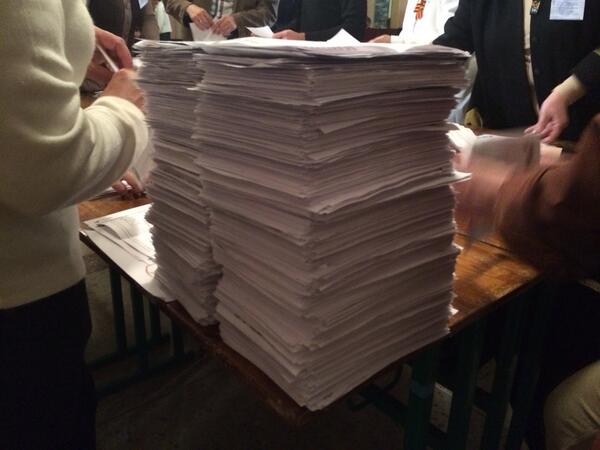
Members of a local election commission empty a ballot box as they start counting votes of today's referendum on the status of Lugansk region in Lugansk May 11, 2014 (Reuters / Valentyn Ogirenko)
Results of referendum have been announced in Donetsk and they show the majority of voters supported self-rule, despite intensified military operation by Kiev which resulted in several deaths. In Lugansk region ballots are still being counted.
Follow RT's LIVE UPDATES on Eastern Ukraine
Almost 90 percent of voters in Donetsk Region have endorsed political independence from Kiev, the head of the Central Election Commission of the self-proclaimed ‘Donetsk People’s Republic’, Roman Lyagin, announced.

Counting the ballots proved to be surprisingly easy – the number of people who said ‘no’ was relatively small and there appeared to be only a tiny proportion of spoiled ballots, so we managed to carry out counting quite fast. The figures are as follows: 89.07 percent voted ‘for’, 10.19 percent voted ‘against’ and 0.74 percent of ballots were rendered ineligible,” Lyagin told journalists.
In Lugansk region preliminary results have not yet been announced, but the leader of the local “people’s front” said only around 5% voted against the “Act of state self-rule of the Lugansk People's Republic.”
Despite fears that amid Kiev’s intensified military crackdown – which killed at least two civilians on referendum day – the turnout will be low, in both of the region it was unexpectedly high. In Donetsk it reached 74.87%, while in Lugansk the central election commission says 81% of eligible voters came to the polling stations.
With such a huge turnout, the referendums have been recognized as valid by both election commissions.
The acting president of Ukraine, Aleksandr Turchinov, has condemned as a “farce” referendums in the Donetsk and Lugansk regions.
This propaganda farce won’t have any legal consequences, except for criminal charges for its organizers,” Turchinov said, Interfax reported.
The referendums, according to Turchinov, were inspired by Russia to “totally destabilize the situation in Ukraine, disrupt the presidential election and overthrow the Ukrainian government.”
Calling the regional voting on self-determination illegal, Kiev sent its recently formed paramilitary forces to Donetsk and Lugansk regions on Sunday, in an apparent move to disrupt referendums.
As armored military vehicles blocked passage to polling stations, voting in four towns across Lugansk region was disrupted. In the Donetsk town of Krasnoarmeysk, the National Guard shot at a crowd and killed two civilians who were protesting their attempt to seize a polling station.

The people’s governor of the Donetsk Region, Pavel Gubarev, told journalists on Sunday that Donetsk and Lugansk will emerge as new legal entities as a result of the referendum.

The referendum for us is about creating a new state paradigm,” he said.

Vyacheslav Ponomaryov, the people’s mayor of Slavyansk, Donetsk Region, where some of the heaviest fighting between Ukrainian troops and self-defense activists took place, said the next step following the referendum would be developing closer ties with Russia.

"Russia is our brotherly nation, [we hope for] full interaction with Russia, including entering the Customs Union,” Ponomaryov said.

Sunday, May 11, 2014

Drug Suspect's Plane Crash-Lands in Albania

Drug Suspect's Plane Crash-Lands in Albania
A Piper plane on the Albanian beach of Divjake, 50 miles southwest of capital Tirana, Saturday on May 10, 2014
Tirana, Albania:  Albanian police have detained an Italian man as a suspected drug trafficker after his small plane crash-landed on a beach.

The Interior Ministry says authorities seized 460 kilograms (1,014 pounds) of cannabis in a vehicle a few hundred meters (yards) from the plane.

The Piper plane, with its damaged propeller and busted tire, was found at Divjaka beach, 80 kilometers (50 miles) southwest of the capital, Tirana, an hour after it had left Tirana international airport, Interior Minister Saimir Tahiri said on Saturday.

Police also arrested an Albanian trying to escape from the car with 27,000 euros ($37,000).

Albania is a cannabis-producing country that also serves as a transit point for drugs coming from Asia.

Ukraine Regions Hold Sovereignty Vote

Ukraine
Ukrainians line up to cast their votes at a polling station in the Budennovskiy district, on the outskirts of Donetsk, Ukraine, Sunday May 11, 2014. Manu Brabo—AP

Residents of two regions in eastern Ukraine engulfed by a pro-Russian insurgency defied the government in Kiev by voting Sunday in independence referendums

(DONETSK, Ukraine) — Residents of two restive regions in eastern Ukraine engulfed by a pro-Russian insurgency defied the central government in Kiev by voting Sunday in contentious and hastily organized independence referendums.
The ballots, which Ukraine and the West have rejected as illegal, seek approval for declaring so-called sovereign people’s republics in the Donetsk and Luhansk regions, where rebels have seized government buildings and clashed with police and Ukrainian troops over the past month.
Ukraine’s interim president has said that independence for eastern regions will destroy the country’s economy. “This is a step into the abyss for the regions,” Oleksandr Turchynov said in comments posted on the presidential website Saturday.
Polling stations opened at 8 a.m. (0500 GMT) and were due to close at 10 p.m. (1900 GMT). Referendum organizers said they expected a high turnout, even though the security situation remained unstable around much of the area where the vote was held.
There were reports of sporadic clashes, but the situation remained calm in most of the sprawling regions with a population of 6.5 million as voting got under way.
Insurgents in the city of Slovyansk, which has seen some of the most violent clashes between pro-Russian militants and government forces in recent weeks, exchanged fire with Ukrainian troops on the outskirts of the city overnight. The Ukrainian Defense Ministry said an army soldier was wounded in a mortar shelling near Slovyansk TV tower.
And the port city of Mariupol on the Sea of Azov has remained on edge after Friday’s clashes, in which at least seven died.
Ukraine and the West have accused Russia of fomenting or even directing the unrest in the east, with the goal of destabilizing Ukraine or finding a pretext for invasion. Russia has rejected the accusations.
Russia’s President Vladimir Putin had asked the referendums’ organizers to delay the vote as he bargained with Western powers on conditions for defusing the worst crisis in relations between Russia and the West since the Cold War. The insurgents, however, have refused to heed his call.
Moscow and many in Ukraine’s east denounce the new government as a nationalist junta and allege that it intends to trample on the rights of eastern Ukraine’s Russian-speakers.
Election officials said more than 30 percent of voters cast ballots in the first three hours of voting. With no international oversight mission in attendance, confirming such claims is likely to be all but impossible.
At one polling station in a school in Donetsk, turnout was brisk in the first hour of voting. All voting slips that could be seen in the clear ballot boxes showed that the option for autonomy had been selected.
Although election officials in Donetsk have said they are certain that turnout will be high, it seems likely that most of those opposed to autonomy will decline to participate.
Many of those who did vote said they hoped the vote would help stabilize the situation.
“I just don’t have the words to express what is happening in our country,” said the 65-year old Liliya Bragina. “I have come so that there will be stability, so that there will be peace.”
The polling station’s head, Andrei Mamontov, said he was certain the vote would be fair and not marred by falsification.
“In this polling station, everything will be fine, but I can’t speak for other polling stations,” he said. “We have prepared everything, we have signed everything, we have done all the checks — everything should be legitimate and clean.”
The haphazard nature of the referendums was in full display at Spartak, a leafy village on the northern fringes of Donetsk.
Villagers were unable to vote for about three hours after polls opened as election officials had failed to bring in the ballot box.
After some arguing between local people and the head of the village council, an election organizer arrived with a voting urn crudely fashioned from cardboard boxes and sealed with tape. Outside the polling station, set up in a village club, one local man complained volubly over the quality of the ballot box as cows basked in the bright sunshine.
Most present said they were voting in favor of autonomy and against the interim government. One said she would not take part in a nation-wide presidential election set for May 25.
“I don’t agree with what is happening in the country. And I want some changes for the better. What is happening on May 25 is not honest, truthful or for our best interests. And that is why I am voting today,” said Irina Zelyonova, 30, cradling her baby in her arms.
The hastily arranged ballots are similar to the March referendum in Crimea that approved secession fromUkraine. Crimea was formally annexed by Russia days later.
But organizers of Sunday’s vote have said that only later will a decision be made on whether they would use their nominal sovereignty to seek full independence, absorption by Russia or to stay part of Ukraine but with expanded power for the regions.
Surveys by polling companies have indicated that a significant majority of people in Ukraine reject movements to break away parts of the country.
Ukraine’s interim president said supporters of independence for the east “don’t understand that this would be a complete destruction of the economy, social programs and general life for the majority of the population.”
Turchynov and Ukraine’s caretaker government came to power in February following the ouster of Russia-friendly president Viktor Yanukovych after months of protests in Kiev.
More than 30 people have been reported killed since Ukrainian forces began mounting offensives to retake some eastern cities now under control of the insurgents.
Turchynov’s chief of staff Serhiy Pashynskyi pledged Sunday that the government would seek to avoid further civilian casualties. “We will not engage in street fights in Slovyansk or elsewhere because that will lead to dozens of unnecessary deaths,” he told reporters.